






Rudný důl Panny Marie Pomocné III Mine
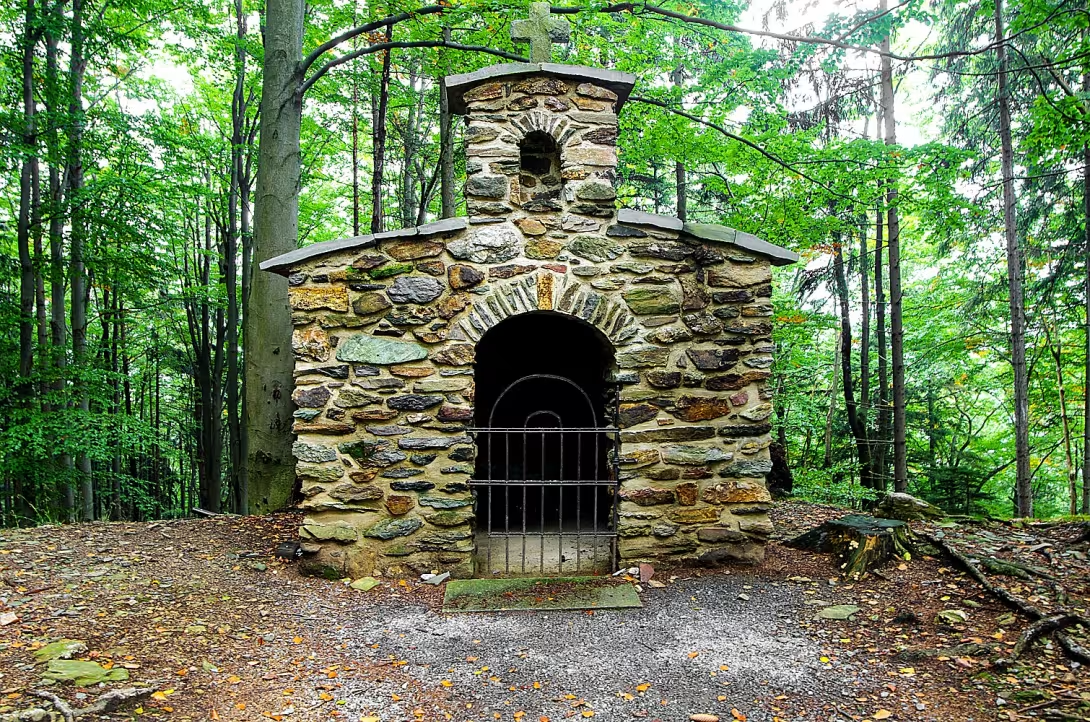
Rudný důl Panny Marie Pomocné III, located on the northeast slope of the Cross Hill in Zlaté Hora, is a monument-protected montanist area connected with a pilgrimage site in the image of the Virgin Mary the Auxiliary. This historically important location dates back to the 14th century when gold mining took place. The mine is known for its narrow underground quarry, the shaft drains after mining and falling ceiling, which attract historians and tourists. In 1994 it was declared a cultural monument of the Czech Republic and is part of the Zlatohorsky Mining Educational Path.
The mine was created during intensive gold mining in medieval Europe, namely in the 14th and 15th centuries. The locality is connected to the pilgrimage site in the picture of the Virgin Mary of the Auxiliary, which began to form since 1674. In 1729 the chapel was built in the painting and later the church. Gold mining in this area was likely to take place as part of Obirschar. The main mining operation was carried out by smashing and handcuffs, with narrow rigs ranging from 0.4 m to 1.6 m and high to 10 m. In the underground parts there are traverse roads and trapezoidal corridors from the 15th to 16th century.
Architecturally, the mine is characterized by its narrow rigs, which are extracted by the help of the smashing and handcuffs. In the walls there are holes for wooden fields, which suggests the technique used at the time. Total mine length is about 335 m and depth 42 m The mine also served as the winter grounds of bats, thus contributing to its ecological importance.
The history of the mine of the Virgin Mary's Auxiliary III is rich in events. In 1674, the eastern slope of the Cross Hill was connected to the pilgrimage point in the picture of the Virgin Mary the Auxiliary. The chapel was built in 1729 and later the church. In 1994 the mine was declared a cultural monument of the Czech Republic. The mining took place mainly in the 14th and 15th centuries, leaving these mines in the 16th century. The last mining was in the 1950s.
Today, the Rudný důl Panny Marie Pomocné III is accessible to visitors and is part of the Zlatohora Mining Educational Path. The location offers a unique opportunity to explore the history of gold mining in Bohemia and to understand the techniques used at that time. The mine is also a natural shelter for bats, which adds to its ecological importance.
Rudný důl Panny Marie Pomocné III is not only a historical monument, but also a natural shelter for bats. It is a place where visitors can enjoy the pilgrimage of the past and the present life of nature. The mine is an important part of the cultural and natural heritage of the Czech Republic and is worth visiting.
Historical milestones
- 1994
- Declaration of the mine for cultural monument of the Czech Republic.
Architectural development
The main mining took place in the 14th and 15th centuries by means of smudges and handcuffs, with narrow rigs ranging from 0.4 m to 1.6 m and high to 10 m. In the underground parts there are traverse roads and trapezoidal corridors from the 15th to 16th century.
Historical events
- 1674
- The eastern slope of the Cross Hill is connected to the pilgrimage point.
- 1729
- The position of the chapel in the image of the Virgin Mary the Auxiliary.
- 1994
- Declaration of the mine for cultural monument of the Czech Republic.
Points of interest
- Rudný důl Panny Marie Pomocné III is a monument-protected montanist area associated with a pilgrimage site in the image of Our Lady of Help. - The mine was created during intensive gold mining in medieval Europe, namely in the 14th and 15th centuries. - The mining was carried out using a smashing and handcuffs, with narrow rigs ranging from 0.4 m to 1.6 m and high to 10 m. - In 1994 it was declared a cultural monument of the Czech Republic and is part of the Zlatohorské mining teaching trail. - The mine also served as a winter site for bats, thus contributing to its ecological importance.
Guide
Show guide text
This text was created by artificial intelligence and has not been editorially reviewed. It may contain inaccuracies.
Welcome to the place where the country's history meets the silent whisper of nature. You are standing on the northeast slope of the Cross Hill, in the heart of the beautiful Golden Mountain, before one of the most important witnesses of human effort in this region. Before your eyes, the Red Mine of the Virgin Mary is spread out. Perhaps at first glance you can only see the ground and rock piles, but please stop for a moment and perceive the atmosphere of this place. It has the weight of centuries and the invisible presence of thousands of hours of hard work that was going on here. A montanistic area lies in front of you, which is not just an ordinary piece of land, but a rare conservation site. If you look around now, notice the unusual shapes in the landscape. What you're seeing is not just random hills, it's the shaft drains that were created during intense mining. These piles of material are traces of what people pulled from the depths of the earth. Feel the structure of the terrain that was directly shaped by the human hand and instruments. Let us now return together in time deep into the past to understand why this place was created and why it is so important. This area has its roots in the Middle Ages of Europe, namely the 14th and 15th centuries. That was the era where something extremely precious and precious was sought in these mountains - gold. Mining was not just a craft, it was a life-long journey for many people. It was the pursuit of this precious metal that formed the face of the entire Golden Mountain. It is fascinating to think how different the world at that time was from ours, and yet how strong the desire for wealth and stability was. This activity was also deeply linked to the spiritual life of the then inhabitants. The location is closely connected to the pilgrimage site in the image of the Virgin Mary the Auxiliary. For those miners who risked their lives every day in darkness and danger, faith was an important pillar. The Virgin Mary was a figure for them, to which they turned at difficult times, when the earth shook beneath them or when light was lost in narrow courses. This connection between the hard, physical world of mining and the soft world of faith creates a unique, even special energy in this place. Now pay attention to details that you can see right in front of you. Although this is not a built object with architectural designs that we know from cities, the very structure of the mine is the work of unknown mining masters. Notice the narrow spaces and paths that have been excavated here. These were the rigs that people had to move with extreme caution. Imagine the tightness, the tightness and how little space they had. Mining was not about large machines, but about the strength of human arms and simple but effective tools. Notice how history manifests itself in the field. You can see here the fallen parts of the cache ceiling, which is a clear indication of how much this country has been in motion and how much mining has been demanding. These informal but clearly visible traces of miners' activities are the best architecture you can find here. Every angle, every shaft, and every pile of rock tells the story of how people tried to penetrate the heart of the earth. If you look at the way they used to work here, you might start to imagine the sound that used to cut silence here. The miners didn't use modern technology, but they worked with a beating and a chain. Imagine the rhythmic, hard sound of a hit on a rock, the constant noise carried through the narrow corridors. It was the sound of work that was exhausting and constantly threatening their safety. Every blow had to be thought through, every move had to be accurate to prevent an accident. Although we don't know the names of the particular men who worked here hundreds of years ago, their presence here is felt in every stone. They are the unknown heroes of everyday life, who have laid the foundations for the region to flourish. Their stories are not written in names, but they are carved directly into these rocks and rolls. But now I want to invite you to think about something completely different, something that connects this history to today's present. Do you feel this place is abandoned? Maybe. But in fact, life never stopped here, just changed. This mine, which once served people, is now serving someone else entirely. This area has become an important winter for bats. Imagine the fascinating transformation: the place where he used to make the noise of the beatings and human voices is now home to these quiet, night creatures. When you look into the dark holes of the shafts, you realize that where they were looking for gold, they are now searching for the safety and tranquility of beings that are part of our nature. It's a beautiful example of how human work in time returns to the arms of nature. This mine is also an important part of the Zlatohora mining teaching trail. This means that the place you're standing on is part of a larger whole that will guide you through the history of this mining region. It is a place that was recognised as a cultural monument of the Czech Republic in the year 29-32, which underlines its immense value to all of us. It's an inheritance that we have to protect that gives us insight into our roots. In front of you, there are still other possibilities for exploring. I suggest you continue on the educational path and watch the landscape change and the other traces of old mining reveal their secrets. Feel the calm that prevails here, and at the same time realize the tremendous power that has been manifested here in the past. Thank you for choosing to pay attention to this place. We hope that this view of the ore mine of the Virgin Mary the Auxiliary Third brought you new ideas and a deeper understanding of the history and nature of our mountains. Read the surrounding landscape again, but this time already knowing everything you just learned. We wish you a beautiful and inspiring walk along the rest of your journey. Goodbye.
Tips for visitors
The best time to visit the Rust Mine of Our Lady of Auxiliary III is in the summer months when the weather is favorable and sunny day increases the attractiveness of this historic site. At that time, pilgrimage trips to the surroundings are even more active, creating a lively atmosphere associated with tradition and spirituality.
Parking can be found near the Golden Mountains. It is important to check the availability of the parking lots before visiting, as they may be limited. For those who prefer public transport, it is advisable to check the connections with the bus or tram that will bring you near the location.
When you visit, bring a suitable suit and shoes because the terrain can be impenetrable. We also recommend water, sunglasses and sunscreen. If you are planning a photo shoot, do not forget the high-quality zoom camera to capture the details of ruins.
Photography is suitable at noon when the light is brightest and you can get the best pictures. The best places for photos are mainly the northeast slope of the Cross Hill, where the mine is located, and the surrounding chapel built in 1729.
In the surroundings you can visit the restored pilgrimage church of the Virgin Mary of the Auxiliary. It is an ideal place for families with children, where they can not only see beautiful architecture, but also look at various pilgrimage equipment and possibly take part in some events or tours.
Businesses nearby
Do you run a restaurant, accommodation, shop, museum, rental, wellness or other visitor service near this monument? Show yourself directly to the people heading to it — this is how they will see you in the app and on the web:
Nearby
Obnovený poutní kostel Panny Marie Pomocné
Kaple postavená v roce 1729
Accommodation nearby
Themed route
Thematic cruise route from the village Zlaté Hory
1.Rudný důl Panny Marie Pomocné III (mine) - Type: Historical site - Why is it worth a visit: This mine is an important monument that resembles the period of industrial development of the area. It can be visited for understanding the history of mining and technology from past times.
2. Renewed pilgrimage church of the Virgin Mary's Auxiliary - Type: Religious monument - Why is it worth visiting: This church is the centre of spiritual life and historical importance to the local population. Its architecture and art equipment are attractive to visitors.
3. Chapel built in 1729 - Type: Historical Chapel - Why is it worth visiting: The chapel is proof of the historical and cultural wealth of the area. Its architecture from 1729 attracts people interested in history and art.
This route offers a view of the industrial and spiritual history of the village Zlaté Hory, connecting technical progress with the wealth of cultural heritage.
Seasonal recommendations
Spring: In the spring of the Red Mine of the Virgin Mary the third in the Golden Mountains offers visitors colorful flowers and new greenery. The sun lights up ruins with softer shadows, adding a calm tone to the atmosphere. Flowers in the surrounding fields and forests enrich visual impression. It is recommended to visit early morning or late afternoon to avoid full sun and possible crowds. It's a good idea to wear hooded clothes on any cool winds.
Summer: In summer the Red Mine offers a long day full of sunlight, which increases contrasts and colors of ruins. Nature is in full power, with dense trees providing a shadow sanctuary. More visitors are expected in the main summer season, so it is recommended to come earlier in the morning or later in the afternoon. Don't forget the sun purchase and sun protection.
Autumn: In the autumn period the Red Mine turns into spectacular colors. Tree leaves take on golden, yellow and red shades, adding a romantic atmosphere to the ruins. Solar light is less intense, which creates a lighter light. In this period, a smaller crowd load is expected than in summer, but it is worth remembering warmer clothes due to cooler evenings.
Winter: In the winter months the ore mine offers quiet and quiet visits, where the lighting is weaker and shadow contrasts contribute to the mystical atmosphere. Snow sheets can provide a romantic view of the ruins. Opening hours are shorter, so it is recommended to visit faster and in warm clothes. In the winter months it is advisable to come early in the morning, when the least chance of snowdrift is possible.
Visualizations and artistic views

The visualisations are generated by artificial intelligence and serve as inspiration.
Photos from the area
Real photos taken near the monument


Zdroj a licence jsou uvedeny u každého snímku.
Tips from visitors
No tips yet. Be the first!
Log in and add your tip.
Sources and literature
Faktickým podkladem tohoto textu byl článek na Wikipedii, jehož autory jsou přispěvatelé Wikipedie. Článek je dostupný pod licencí CC BY-SA 4.0.
Location on the map

Příběhy a pověsti
Legendy, pověsti a příběhy spjaté s touto památkou
Fotografie návštěvníků
Zatím žádné fotografie. Buďte první, kdo přidá fotografii z návštěvy!
Log in a přidejte svou fotografii nebo hodnoťte.
Za ověřenou návštěvu v aplikaci získáte víc bodů — poznáme podle GPS, že jste na místě.
Reviews and comments