



Skalní obydlí Skalní obydlí
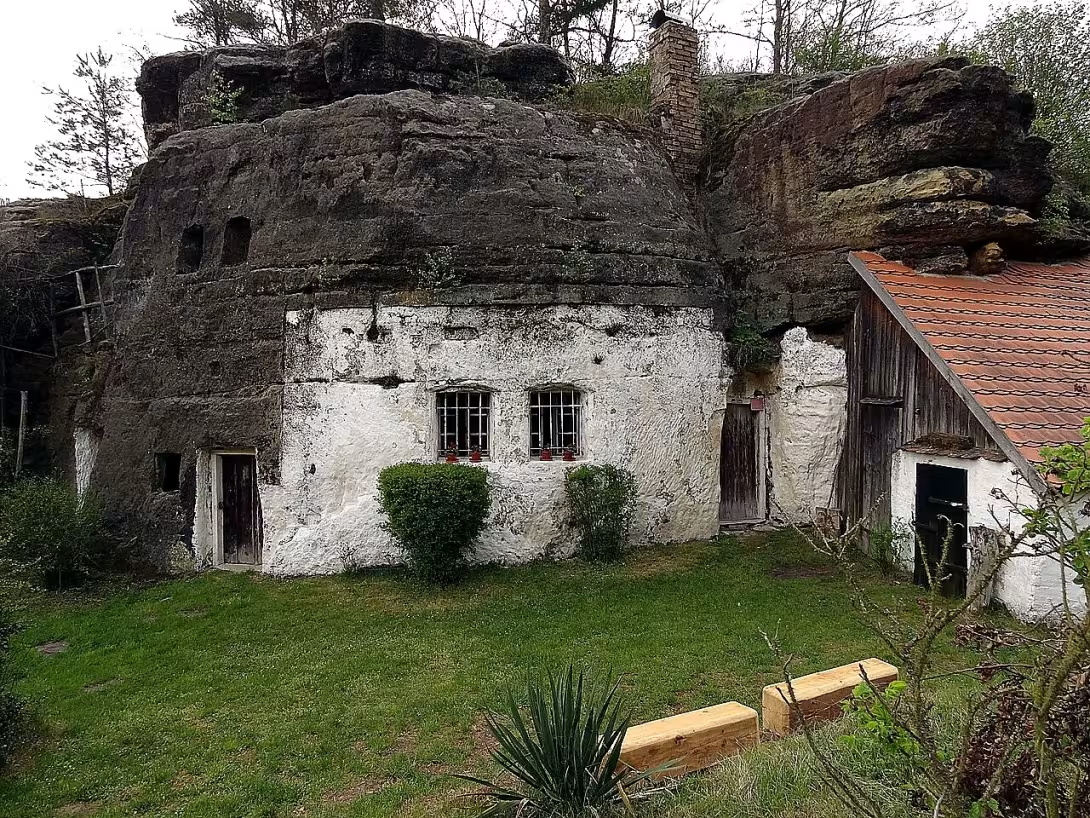
Skalní obydlí in Lhotce near Mělnik is an important example of folk architecture, typical of sandstone regions of northern Bohemia. This object was carved into rocks and served as permanent housing for several generations. In 2009 he became available to the public as an exhibition of the Regional Museum in Mělník.
Skalní obydlí, which appeared especially in the 18th and 19th centuries, is a characteristic phenomenon of folk architecture of northern Bohemia. They were created on the soil of Czech sandstone rocks, where the inhabitants used natural formations to build their homes. Archaeological findings show that these areas have already been inhabited in mesolite. In later times rock walls became a popular form of construction, but also for ordinary homes and cellars sandstone rocks were ideal material.
The architecture of the rock dwellings in Lhotce is a unique example of folk architecture carved into the rocks. The facade facing northwest contains an entrance corridor leading to a room with a bread oven and a larger skylight with two windows, which is marked from the outside as a rounded part of the rock wall. The second door leads to a ground-floor barn with the possibility of descending the stairs to the basement. At the top, above the living rooms, a granary is carved with two smaller windows. The complex complements the cutting plant and other economic objects.
Probably in 1859, the rock house was bought by Jan Beneš and his wife. After this, their son Josef Beneš lived here with his family, and finally Marie Holubová, the last resident of this apartment. Marie Holubová lived in the rock house from 1900 to 1982 when she had to leave the apartment due to her advanced age.
Among the key events are the accessibility of homes to the public in 2009 as an exhibition of the Regional Museum in Mělnik. This move allowed a wider audience to recognize the unique phenomenon of folk architecture and lifestyle, which has been preserved here for generations.
Today, the rock residence in Lhotce near Mělnik is not only a cultural monument, but also a valuable educational tool. Its current state and accessibility make it an attractive place to visit. Exploring this unique work of folk architecture is not only a way to the past, but also an opportunity to appreciate the innovative ways of life of our ancestors.
Skalní obydlí in Lhotce near Mělnik carries value not only as a historical monument but also as a testament to the resilience and creativity of the people who lived here. It's a place worth visiting if you like history or are curious about unique forms of living.
Historical milestones
- mesolite
- Archaeological findings are evidenced by the residence of the soil of Czech sandstone rocks.
- 1859
- Buy a rock house with Jan Benes and his wife.
- 1900
- Marie Holubová is starting to live in a rock house.
- 1982
- Marie Holubová is leaving the rock house for an advanced age.
- 2009
- Skalní obydlí becomes available to the public as an exhibition of the Regional Museum in Mělník.
Architectural development
Skalní obydlí was created during the 19th century and served as permanent housing for several generations. Architectural is a unique example of folk architecture carved into rocks.
Historical events
- 1859
- Jan Beneš with his wife probably bought a rock apartment.
- 2009
- Skalní obydlí was made available to the public as an exposure.
Owners
Probably in 1859 he bought Jan Beneš with his wife. Then they lived in the apartment their son Josef Beneš and his family, followed by Marie Holubová, the last resident.
Points of interest
The dwelling is carved into sandstone rocks and served as a permanent home for several generations. - The rooms include a room with bread oven, a larger skylight, a ground-floor barn and a cellar. - A granary with two small windows is carved at the top. - The last resident was Marie Holubová, who lived here from 1900 to 1982. - Since 2009, the building has been accessible to the public as an exhibition of the Regional Museum in Mělník.
Guide
Show guide text
This text was created by artificial intelligence and has not been editorially reviewed. It may contain inaccuracies.
Welcome to the rock residence in Lhotce near Mělnik, a unique testimony of folk architecture from sandstone rocks of northern Bohemia. Under your feet lies history that is carved into the stone itself. In front of you, the narrow steps leading inside this hidden pearl, which was home to several generations of people.
Let's dive into the history of this fascinating place. Archaeological findings show that these rock formations have already been inhabited in mesolite. In 1859 Jan Beneš and his wife Rosalie bought this rock house and became its new owners. Since then, he has served as a permanent residence until in 1982 he left the Marie Holubová residence due to an advanced age. In 2009 it became public space and today you can visit it as part of the exhibition of the Regional Museum in Mělník.
Look up and you'll see a granary carved into the top of the rocks, its two small windows are indicative of past times. Come in and notice the room with the bread oven - the center of everyday life. Take a look at the larger skyline where the family used to meet, and look at the ground-floor barn that was used for animals. The basement can now only be a memory of past times.
Among the key personalities associated with this place is Marie Holubová, the last permanent resident of the rock house. Her life and story have become an integral part of the history of this place.
The interesting thing is that the whole house was carved into sandstone rocks, which shows the extraordinary courage and skill of its creators. This architecture resembles past times when people lived in close contact with nature.
Now it is your chance to explore this unique house from within and perceive its atmosphere. We want you to have fun and enjoy your visit every moment. When you return home, bring with you a memory of this unique place where history and nature join forces.
Thank you for your visit to the rock house in Lhotce near Mělnik. We hope that you will return soon and explore the other beauty of our country.
Tips for visitors
The best time to visit the rock dwelling in Lhotce near Mělnik is during the summer months when the weather is favourable and the light is ideal for photography. This time of year offers the best conditions for exploring dwellings and surrounding rocks. Visit the place in the early afternoon when the light is softer and ideal for capturing the details of architecture.
To travel by public transport, check the online search engine to find out the current connection.
When visiting to take with you suitable shoes and clothes because the soil can be uneven and the rock terrain requires firm feet. Also remember the protective sunglasses, especially in the summer months when the light is intense.
For photography are the best places inside the rock house and its surroundings. If you are looking for dramatic effects, try to capture views of adjacent rocks and forested landscape in the light of dawn or dusk. During the day photography offers soft shading of rocks, which is ideal for detailed images.
In the vicinity of the monument there are several interesting sites that can be visited during the day trip. The Protected Landscape Region of Kokořín - Máchov Region offers beautiful walks and opportunities to observe wildlife. In addition, you can visit other rock dwellings in Vidimi, Šemanovice or Kokořín, which provides a comprehensive view of the popular architecture of the region.
Frequently asked questions
Can the monument be visited?
We have not verified whether this monument is accessible. Please ask the owner or operator, or the local municipal office.
Why is the monument protected?
It is listed in the Central List of Cultural Monuments of the Czech Republic as a cultural monument (register no. 1000129184).
Businesses nearby
Do you run a restaurant, accommodation, shop, museum, rental, wellness or other visitor service near this monument? Show yourself directly to the people heading to it — this is how they will see you in the app and on the web:
Nearby
Chráněná krajinná oblast Kokořínsko – Máchův kraj
Další skalní obydlí lze nalézt na území Vidimi, Šemanovic, Hlučova, Truskavny, Kokořína a Kokořínského Dolu.
Accommodation nearby
Seasonal recommendations
Spring brings gradual warming and the awakening of nature to the rocky environment. The light is already strong enough at this time to illuminate even deeper parts of rock formations, while the surrounding vegetation begins to grow green and blooming, creating a pleasant contrast to the grey stone. The atmosphere is calm and fresh, ideal for observing the details of the relief without summer heat. For a visit we recommend light layered clothes, as the morning cold quickly retreats before the afternoon sun. The footwear should be firm and with a good heel, as the roads to the rocks can be slippery or muddy after winter collisions. It is best to leave in the late morning when the air warms up and the shadows shorten, which makes field orientation easier.
Summer offers the longest days and the most intense sunlight, which penetrates into rock dwellings until late afternoon hours. Nature is in full bloom, with a rich variety of colors and sounds, but it also brings higher temperatures. The atmosphere is often hot and dry, so it is crucial to think about protection from direct sun. We recommend to wear light, breathable clothes made of natural fibers, hat and sunglasses. Due to the higher pressure of visitors in the high season, it is best to take a tour early in the morning or late in the afternoon, when the heat is more tolerable and the surrounding landscape gains a different, warmer tone. Always bring plenty of drinking water, as it may be wet and hot in the rock cavities.
Autumn brings golden and red notes of decaying leaves to the landscape, which contradict beautifully with a dark coloured base of rocks. The light is softer and warmer, often with longer shadows, which creates a dramatic and slightly melancholy atmosphere. Nature is going around for winter, and therefore is less noisy and more calm. For clothes it is necessary to count on significant temperature differences between day and night, therefore it is appropriate to use a laminated combination with a wind jacket. The roads can be covered with wet leaves, which are slippery, so solid footwear with good grip is indispensable. The best time to visit is usually late afternoon when the sun falls low and illuminates the rock walls with side light, highlighting their texture and depth.
Winter brings to the rocky environment cold and often a snow blanket that changes the overall appearance of the surroundings. The light is short and gray, which creates an intimate and quiet atmosphere, ideal for reflection. Nature is in resting mode, without leaves and insects, so the rock itself and its structure are fully extracted. Clothes shall be warm, waterproof and laminated to protect against frost and possible rain or snow. Visibility and safety are also crucial, because the roads can be cooled. We recommend visiting the monument in the late morning, when daylight is brightest and temperatures are highest. Observe how the shadows change with the course of the day, and use the calm of winter to deeper observe historical traces in stones without disturbing the effects of surrounding vegetation.
Visualizations and artistic views

The visualisations are generated by artificial intelligence and serve as inspiration.
Photos from the area
Real photos taken near the monument


Zdroj a licence jsou uvedeny u každého snímku.
Tips from visitors
No tips yet. Be the first!
Log in and add your tip.
Sources and literature
Photos: MartinVeselka / CC BY-SA 4.0 — Wikimedia Commons. The author and licence also appear when you hover over the image.
Faktickým podkladem tohoto textu byl článek na Wikipedii, jehož autory jsou přispěvatelé Wikipedie. Článek je dostupný pod licencí CC BY-SA 4.0.
Location on the map






Příběhy a pověsti
Legendy, pověsti a příběhy spjaté s touto památkou
Fotografie návštěvníků
Zatím žádné fotografie. Buďte první, kdo přidá fotografii z návštěvy!
Log in a přidejte svou fotografii nebo hodnoťte.
Za ověřenou návštěvu v aplikaci získáte víc bodů — poznáme podle GPS, že jste na místě.
Reviews and comments