



Sloup Nejsvětější Trojice (Kadaň) Plague column
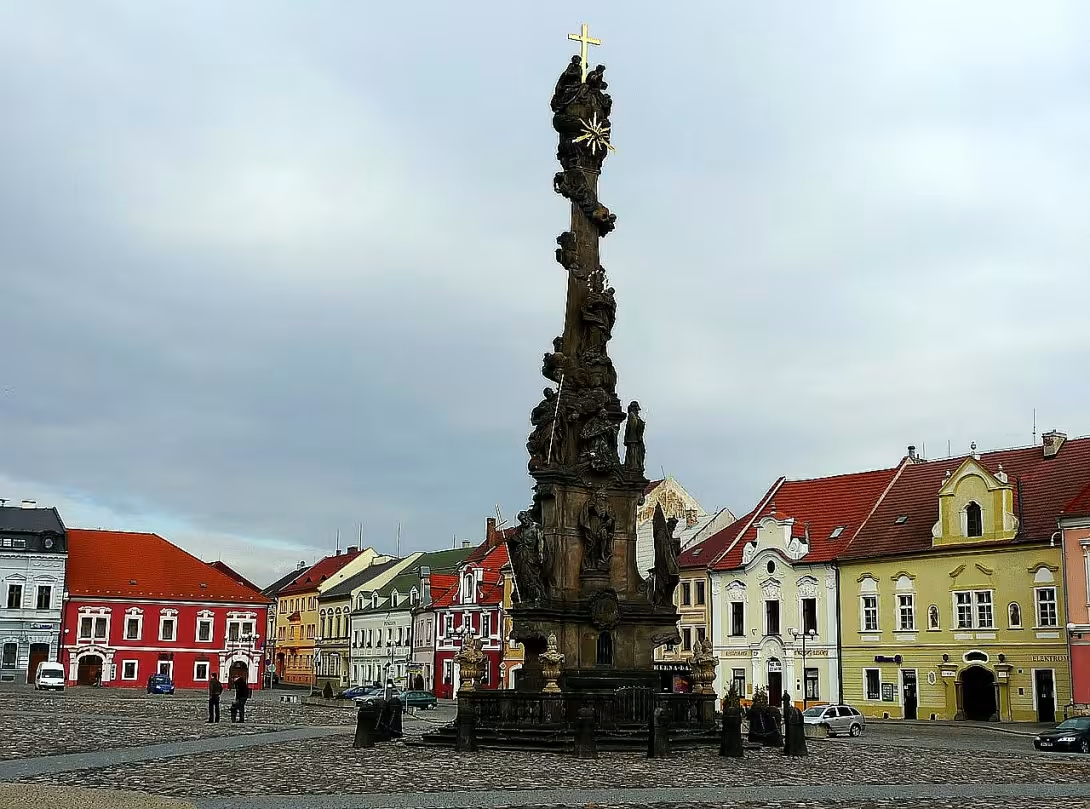
The Column of the Holy Trinity in Kadani is a Baroque sandstone monument from 1753 to 1755, which dominates the centre of the Peace Square within the Kadani Monument Reserve. This sacral monument was built to the glory of God and as a token of gratitude for ending the plague.
The memorial was created in the middle of the 18th century, when the Baroque peak and the Catholic Church emphasized its power and faith through spectacular sacral structures. In the Czech Republic it was common practice at the time to build pestilence columns as a thank you for the end of the epidemics. During the construction development of the city it was decided to build a building with a height of approximately 25 metres.
The whole monument is made of sandstone and its main sculpture work is attributed to Josef Weitzmann, who was also the author of the statue of St. John Nepomuk from 1741. The peak consists of the statue of the Holy Trinity, underneath which is the statue of the Virgin Mary Immaculata. On the ledge there is a figure of St. Rocha with a dog and a loaf of bread in his mouth. Underneath it is a chronogram inscription and a locked niche encapsulated with an arched arch.
The column adorns the statues of St. Isidor of Madrid, St. Florian, St. Catherine, St. Rosalie of Palermo with a skull and a wreath of roses, St. Elizabeth of Thuringian, St. Francis of Xaversky, St. Barbara and St. Francis of Serafinsky of Assisi. These characters complement angels in high relief. The lower part consists of a six-sided balustard with six decorative vases and fifteen sandstone paws, connected by metal iron chains.
The first restaurant work on the column was carried out in 1959 with the participation of Qid Adamce, Jana Adamca and Vladimir Bartunek. In the following year the survey took place as a preparation for the announcement of the historical reservation in Kadani. Another intervention in the appearance of the monument took place between 1998 and 2000 thanks to the restoration efforts of Ivan Hamáček.
The monument remains a dominant part of the Peace Square and is a key part of the historical core of the city. Thanks to its rich iconography and preserved balustrad, it represents an important example of baroque sacral art. Visiting this building allows you to perceive architecture and spiritual context in the middle of the 18th century.
Then and now
Drag the slider to compare how the landmark may have looked when it was built with the view today.
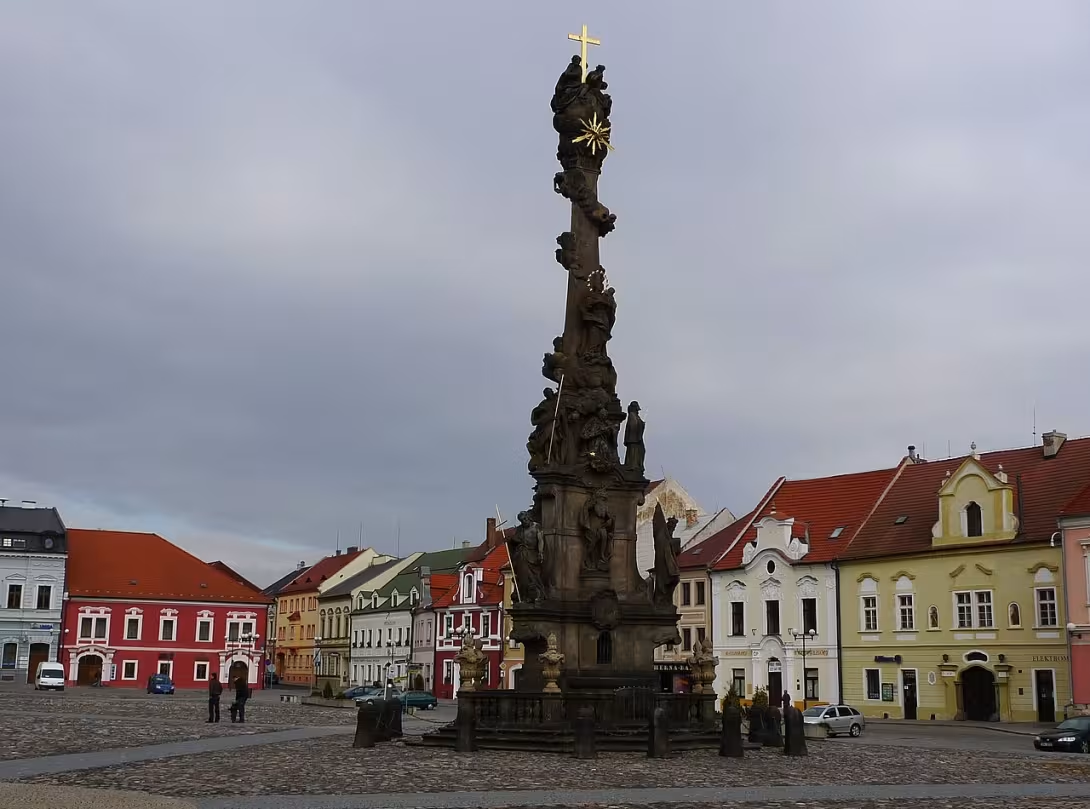
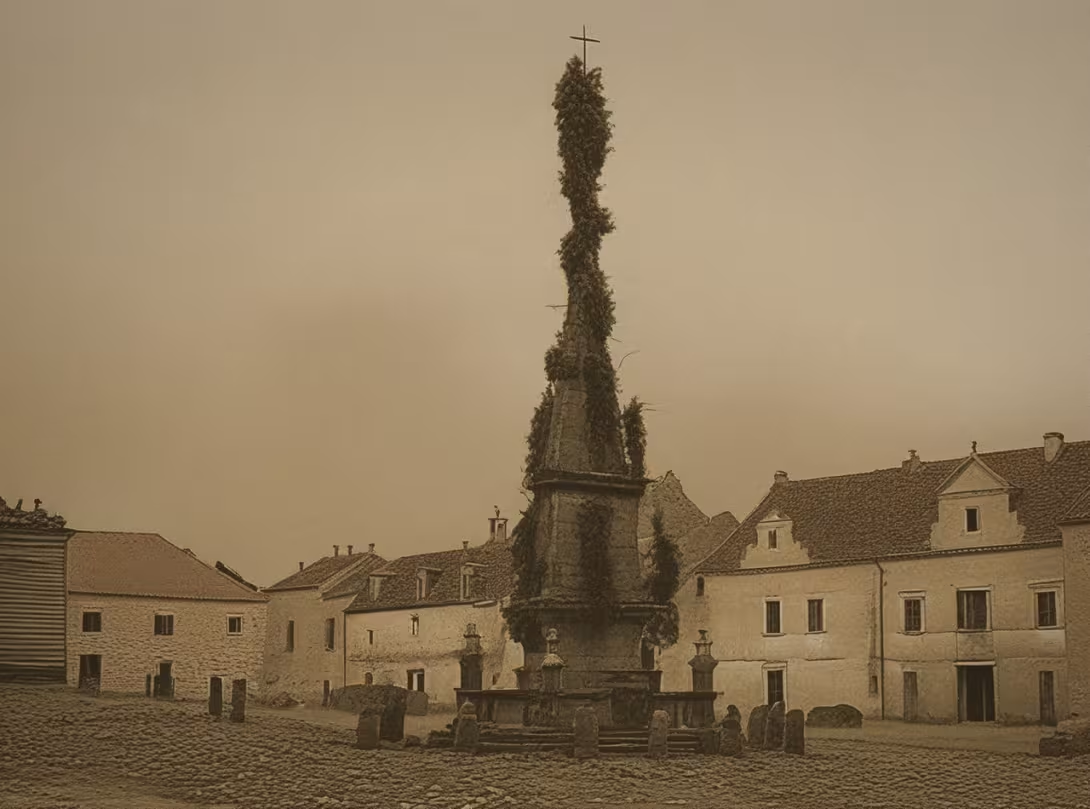
The historical appearance on the left is an AI-generated visualisation and serves as inspiration only.
Historical milestones
- 1753- 1755
- construction of the column of the Holy Trinity
- 1959
- execution of the first restoration work
- 1960
- the first survey in preparation for the declaration of a monument reservation
- 1998-2000
- great restoration intervention Ivan Hamáček
Architectural development
A sandstone column about 25 metres high with rich sculpture decoration. The construction includes a sculpture on the top, an eagle with statues of saints and a lower part with a six-sided balustrad. The balustrada is supplemented by decorative vases and sandstone paws connected by metal chains.
Historical events
1753-1755 construction of the column, 1959 first restoration work, 1998- 2000 extensive renovation of the look of the column.
Points of interest
- The monument was built between 1753 and 1755 to thank you for ending the plague and for the glory of God. - The main sculpture work on the column was created by Josef Weitzmann, who also participated in the statue of St. John Nepomuk from 1741. - There's a figure on the ledge of St. Roch holding a dog with a loaf of bread in his mouth. - The lower part of the monument consists of a six-sided balustard with six decorative vases and 15 sandstone paws connected by metal iron chains. - The first restaurant work on the pole took place in 1959, followed by another intervention between 1998 and 2000.
Guide
Show guide text
This text was created by artificial intelligence and has not been editorially reviewed. It may contain inaccuracies.
Welcome to Kadan, a place full of history and beauty! You are standing in front of one of the most famous monuments of this region - the column of the Holy Trinity. This Baroque sculpture monument, built between 1753 and 1755, dominates the centre of the Peace Square and is the main point of interest for anyone interested in history and architecture.
Look up at this impressive sculpture. The sandstone column reaches a height of approximately 25 metres and is richly decorated with various sculptures that tell their own story. His summit celebrates the Holy Trinity, which was the motive for his standing as a thank you for ending the plague and for the glory of God.
Let's go into history. This column was created according to the design of architect Josef Weitzmann, who is known for his work on the statue of St. John Nepomuk from 1741. The creation of this monument represents not only artistic success, but also a deep historical context - it was built as a symbol of hope and gratitude for ending the plague, which affected many people at that time.
Now pay attention to the details. On the ledge of the pillar is the figure of St. Roch, a well-known defender against diseases, who holds a dog with a loaf of bread - a symbol of care and auxiliary hands. This detail is a reminder of the role of the column as a place of prayer and thanks for saving.
An interesting feature of this local monument reservation is its architecture. The column, built from sandstone, lasted a century and testifies to the championships of the then sculptors and builders. Its appearance was preserved thanks to several restaurants, especially the large intervention of Ivan Hamáček between 1998 and 2000.
We invite you to explore this fascinating place again. Look around, enjoy the atmosphere of the Peace Square and let yourself be approached by the beauty and history of the column of the Holy Trinity. We hope that your stay in Kadan was as attractive to you as it was to many previous visitors. When you return, we will welcome you with open arms and other stories of this beautiful city. Goodbye!
Tips for visitors
The best time to visit the Column of the Holy Trinity in Kadani is the autumn season when the weather is pleasant and the sun illuminates Baroque architecture. In addition, this time is suitable for photography due to fine light effects.
You can find current information about routes and times on the official website of city transport services.
When visiting, it is recommended to take with you protective sunglasses so that you are not surprised by the sun, and suitable shoes for walking on asphalt. If you are planning a longer stay, it may be useful to take your luggage or purse with you.
For shooting the Most Holy Column The Trinity is an ideal place on Peace Square itself, especially at noon when the sun lights up the statue from the side. This angle of light highlights the details of the Baroque decoration.
In addition, it is possible to visit the historical centre of Kadani with its other architectural pearls, and various cultural events await visitors.
Frequently asked questions
Can the monument be visited?
This is a structure in a public space that can usually be seen from outside free of charge. We have not verified that this particular one is freely accessible.
Where is the monument?
Location: Kadaň, Ústecký kraj. The map on this page shows the exact spot.
Why is the monument protected?
It is listed in the Central List of Cultural Monuments of the Czech Republic as a cultural monument (register no. 1000146748).
Businesses nearby
Do you run a restaurant, accommodation, shop, museum, rental, wellness or other visitor service near this monument? Show yourself directly to the people heading to it — this is how they will see you in the app and on the web:
Nearby
Mírové náměstí, Kadaňská památková rezervace
Accommodation nearby
Themed route
Thematic cruise route: Column of the Holy Trinity and its surroundings
1. Column of the Holy Trinity (memorial) Type: historical monument Why is it worth visiting: This column is an important monument from 1714, which symbolizes the celebration of overcoming the plague. Its architecture and historical importance offer a view of the history of the city Kadaň.
2. Peace Square Type: public area, town centre Why is worth a visit: The Peace Square is the heart of Kadaňe and offers beautiful panoramic views of the city. It is a place where history and the present meet, ideal for relaxation and sightseeing.
3. Kadaň Monument Reservation Type: historical areas and architecture Why is worth a visit: This reservation includes an ancient part of the city with a rich heritage. You will visit a number of historical buildings and streets which represent a significant part of the cultural and architectural wealth of Kadaňe.
This route offers a view of the key historical sites of the city Kadaň, which are connected with the monument of the Column of the Holy Trinity.
Seasonal recommendations
Spring: In the spring period the Column of the Holy Trinity in Kadaňi appears in its most beautiful radiation when the soil is covered with flowering bushes and trees. Sun rays illuminate the monument in fine shades, adding a sense of recovery and hope to the atmosphere. Visitors can expect a slight increase in the crowd because people like to explore outdoor monuments on warm days. It is recommended to visit the monument in the morning or late afternoon to avoid the peak of the crowds and enjoy a quieter environment. Good day to visit are also days without forecast rain.
Summer: During the summer months, Pláp offers the Holy Trinity in Kadaňi unforgettable experience under bright blue sky. The atmosphere is full of life, when local and tourists meet for walks and picnics. This season the monument can be overcrowded in the main summer season, especially on the middle of the day. It is proposed to visit the memory early in the morning or late in the afternoon when the temperature is lighter and fewer people. It is advisable to wear light clothes and a umbrella, which ensures comfort during walks.
Autumn: In the autumn period the Column of the Holy Trinity takes place in Kadaňi melancholic beauty. November leaves, which are alternately golden and red, provide the original background for photos, while cool air adds to the atmosphere a sense of peace. Visiting is usually lower than spring time, which allows more personal space to explore the monument. It is recommended to wear warmer clothes and possibly an umbrella, because autumn can suddenly be wet or cold.
Winter: Winter visit to the Column of the Holy Trinity in Kadaňi offers unique views where the monument is covered with snow or a light freezing rose. The atmosphere is calm and quiet, which allows you to enjoy the view of the surrounding landscape without disturbing the crowd. It is important to wear warm clothes, including hat and gloves to avoid cold. It is also proposed to check the current information on the state of travel, as winter can lead to snow barriers.
Visualizations and artistic views


The visualisations are generated by artificial intelligence and serve as inspiration.
Photos from the area
Real photos taken near the monument


Zdroj a licence jsou uvedeny u každého snímku.
Tips from visitors
No tips yet. Be the first!
Log in and add your tip.
Sources and literature
Photos: H2k4 / CC BY-SA 3.0 — Wikimedia Commons. The author and licence also appear when you hover over the image.
Faktickým podkladem tohoto textu byl článek na Wikipedii, jehož autory jsou přispěvatelé Wikipedie. Článek je dostupný pod licencí CC BY-SA 4.0.
Location on the map
More monuments – Kadaň
Show all in the municipality
Příběhy a pověsti
Legendy, pověsti a příběhy spjaté s touto památkou

Fotografie návštěvníků
Zatím žádné fotografie. Buďte první, kdo přidá fotografii z návštěvy!
Log in a přidejte svou fotografii nebo hodnoťte.
Za ověřenou návštěvu v aplikaci získáte víc bodů — poznáme podle GPS, že jste na místě.
Reviews and comments