



Sloup se sochou svatého Linharta Statue column
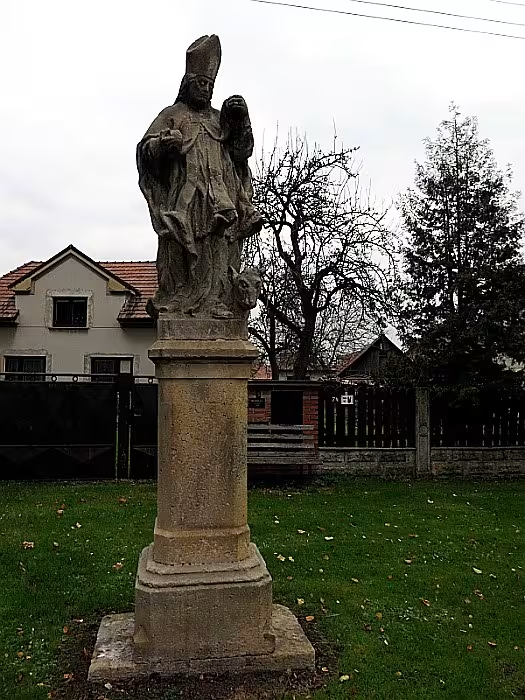
The Baroque sandstone statue of St. Linhart stands on the village of Lužec nad Cidlinou in the district of Hradec Králové. This work from the turn of the 17th and 18th centuries has been protected since 2006 as a cultural monument of the Czech Republic. It represents a proof of baroque sculpture which was closely linked to the Catholic restoration and the creation of pilgrimage sites during the period.
The artist of the sculpture remains unknown. Its creation falls into the period of the high baroque in Czech countries, when sacral art became an important element of the landscape. Originally, the statue was part of the monastery garden area of Hlumecký Loreta, a significant pilgrimage site.
The object is carved from sandstone and shows the saint in sublife size. Saint Linhart is wearing a bishop's robe and a master's head. At his feet lies a calf, which refers to his traditional role as the patron saint of cattle; He is also worshipped as a prisoner's protector. The whole sculpture is set on a four-sided pedestal with a profiled plinth and a ledge. In the past, there was damage to the monument, when the bishop's crutch was insulted, which the saint originally held in his right hand.
The original owner was the Chlumecký Loretta complex. A fundamental change in the fate of the work took place in 1845, when Countess Anežka Kinská donated them to the then Luzac priest Josef Parřek. Since then, the statue has been located in the village of Lužec nad Cidlinou, which has become its administrator. On 18 May 2006 it was declared a cultural monument of the Czech Republic and is kept in the catalogue of the National Heritage Institute under registration number 101855.
Today, the monument is freely accessible on the beach in front of house No. 74. Visitors can see it near the town of Hlumec nad Cidlinou, where the castle of Charles Koruna is located.
The statue represents a valuable proof of baroque piety and the history of the region, which was preserved by the transfer from the original pilgrimage point to the local parish. Visiting Lužka over Cidlinou offers an opportunity to see this historical work in its authentic rural environment.
Historical milestones
- around 1700
- The creation of the Baroque statue of St. Linhart for the garden of Chlumecke Loreta
- 1845
- Hábenka Anezka Kinska donated a statue to Luzecke Farari Josef Parizka
- 2006
- Declaration of a statue for the cultural mother of Ceske
Architectural development
The statue is carved from sandstone and represents a typical Baroque sculpture work. It's set on a four-sided pedestal with a ledge. In the past, there has been damage, namely an insult to the bishop's crutch, which the saint held in his right hand.
Historical events
1845: Transfer of the statue from Hlumec Loreta to Lužka nad Cidlinou. 2006: Declaration of the statue for the cultural monument of the Czech Republic.
Owners
Originally the premises of the monastery garden Chlumecký Loreta, since 1845 the village Lužec nad Cidlinou.
Points of interest
- The statue is carved from sandstone and depicts a saint of sublife size. He has a calf at his feet, which refers to his role as the patron saint of cattle. - In the past, it was damaged, and the bishop's crutch was insulted, which the saint originally held in his right hand. - Originally, the statue was part of the monastery garden area of the Chlumecký Loreta. - In 1845, Countess Anežka Kinská donated it to the Luzac priest Josef Parošek. - Since 2006 the work has been protected as a cultural monument of the Czech Republic and is listed under register number 101855.
Guide
Show guide text
This text was created by artificial intelligence and has not been editorially reviewed. It may contain inaccuracies.
Welcome to Lužec nad Cidlina. Please stop for a moment and focus fully on what you see right in front of you. You are standing in the village, in the heart of the village, where this remarkable sandstone column with the statue of St. Linhart is quietly protruding into space. The first impression of this work is a sense of peace and nobility. You see the figure of a man looking down on you from a stone pedestal. It's a character that combines spiritual authority with the freedom of rural life. Feel the texture of the sandstone, the fine, golden to grey shade of stone that has resisted the wind and rain for centuries. This statue is not only a religious symbol, but a real witness to the time that has brought here stories from completely different places and different eas.
Now let's take a look together at how this sculpture came into being and what its path to us is. Around 700 years ago, at the time when the Baroque peak was in Europe, this statue was carved. The Baroque was a period of grandeur, emotion and deep faith, which is also evident in the performance of this character. But what's interesting is that Saint Linhart wasn't originally here. His home was the monastery garden of Hlumec Loreta. Imagine this statue in a completely different environment, surrounded by carefully trimmed hedges, flowers and the silence of the monastery area, where it served as part of the spiritual reflection for visitors to this holy place. The fact that it is here today, in Lužec nad Cidlinou, is the result of a fateful gift and human generosity.
Now pay attention to specific details that you can see right in front of you. First look at the figure of the saint himself. Saint Linhart is depicted in a bishop's robe, which gives him dignity and authority. On his head he carries a master, a traditional bishop's hat, which clearly determines his high standing in the church. Note that the statue is of a sublife size, which means it's slightly smaller than a real human being, but because of the location on the high pedestal it still looks dominant. Look down now, at the feet of the saint. You see a little calf. This detail is not random. Tele is a symbol that tells us who Saint Linhart was trusted as a protector. In the folk tradition he is worshipped as a patron saint of cattle and also prisoners. By the time this statue was created, cattle were the foundation of survival for rural people, the most valuable property and livelihood. The presence of the calf at the feet of the bishop's garment so symbolically combines the high church hierarchy with the everyday work of a simple peasant.
The whole statue stands on a four-sided pedestal with a profiled plinth. This basis gives stability to the piece and raises it above the level of the surrounding space so that every bystander can realize the importance of the character standing here. The sandstone from which the work is made is a material warmly loved by baroque artists for its workability, but at the same time it is prone to erosion, which gives the statue a certain patina and a sense of antiquity.
When we look at the history of this place, we cannot ignore two key figures that have fundamentally influenced the fate of the statue. One of them was the Anežka Kinská. She was the one person who decided in the year one thousand eight hundred forty-five that the statue was not only within the closed Loreta area, but to bring comfort and protection to the wider community. The Count Anežka Kinská donated the statue to the Luke priest Josef Parošek. Imagine the moment when this noble Baroque statue leaves the walls of the monastery and comes here to the village village. It was an act of kindness and faith that brought together a noble family with local spiritual leadership and residents of the village. The vicar Josef Pařízek thus obtained a valuable jewel for his village, which became part of the landscape and everyday life of the local people.
Now I want to impress you with one interesting thing that is connected to this statue and that requires an attentive eye. If you look at St. Linhart's right hand, you'll notice something missing. Originally a saint in this hand held a bishop's crutch, which is a symbol of his power and rule in the diocese. Unfortunately, however, time and accidents have not been kind to the statue and the crutch has been offended in the past. This emptiness in the hand of the saint is not the intention of the author, but of history. It is a reminder that even the hardest materials are subject to time and that every monument carries certain wounds that tell its own story of extinction and survival. Paradoxically, this missing part of the statue creates some humanity and fragility that makes us think of the fleeting of all material.
For many years, the statue in Lužec above Cidlina stood, until its extraordinary value was acknowledged. In the year two thousand and six, the statue of Saint Linhart was officially declared a cultural monument of the Czech Republic. This act confirmed that this work is not just a local religious object, but an important part of the national heritage to be protected for future generations. It is fascinating to think of the path that the statue has traveled since its inception around seven hundred years ago, through the gift of the Kinské Vole, to today's recognition as a national monument.
Now that you know the story of this silent guardian of the village, I suggest you stay with him for a while. Try to look at the statue from different angles. Feel the light changing on the surface of the sandstone and the calf at the feet of the saint acting depending on where you're looking at it. Saint Linhart stands here as a symbol of protection, faith and connection between various social layers.
Thank you for your attention to this place. I hope this short trip to history has helped you see more than just a statue in this stone pillar. Now invited to further explore the beauty of Lužka over Cidlina and the surroundings. Let yourself be guided by curiosity and discover other hidden details of this picturesque village. I wish you a pleasant continuation of your journey and a beautiful day spent in the arms of history. Goodbye.
Tips for visitors
The best time to visit is during the sunny morning hours, when the natural light beautifully depicts the details of sandstone robes and the bishop's mistress of the saint. It is ideal for photographers to take advantage of the low sun, which will highlight the plastics of the baroque work on the baits. In the vicinity you can visit the nearby town of Hlumec nad Cidlinou, where the castle of Charles Koruna is located.
Frequently asked questions
Can the monument be visited?
This is a structure in a public space that can usually be seen from outside free of charge. We have not verified that this particular one is freely accessible.
Why is the monument protected?
It is listed in the Central List of Cultural Monuments of the Czech Republic as a cultural monument (register no. 1380739593).
Businesses nearby
Do you run a restaurant, accommodation, shop, museum, rental, wellness or other visitor service near this monument? Show yourself directly to the people heading to it — this is how they will see you in the app and on the web:
Nearby
Obec Lužec nad Cidlinou se nachází v blízkosti města Chlumec nad Cidlinou, kde se nachází zámek Karlova Koruna.
Accommodation nearby
Themed route
Thematic cruise route around the Column with the statue of St. Linhart
1.Sloup se sochou svatého Linharta (statue) This column is the main destination of our route and represents a monument that celebrates the history and culture of the village of Lužec nad Cidlinou. The statue of Saint Linhart is an important symbol of local faith and tradition.
2. Hlumec nad Cidlinou (city) After visiting the column we are headed to the neighbouring Hlum, where it is possible to explore the historical castle of Charles Crown. The castle is an important architectural monument and offers a view of the rich history of the region.
3. Hlumec Square (Square) In the heart of Hlum there is a beautiful square, where you can explore medieval architecture and relax on one of the picturesque parking lots. The square is an ideal place to relax after exploring the castle.
4. The Hlumec Church of St. Lawrence (Church) This church is another important historical and cultural place in Chlumci. Its architecture and interior are an example of the rich history of the village, which is reflected in the sanctuary.
5. Hlumec Gardens (Garden) The best way to end a trip is to walk through the Hlumec Gardens. These gardens offer beautiful flower orchards and quiet places to relax after a day of exploring.
This route offers a view of history, architecture and nature of the region around Lužka nad Cidlinou and Chlumce nad Cidlinou.
Seasonal recommendations
Spring: When spring comes, the surroundings of the pillar come alive thanks to the first flowers and young leaves. The light is fine in this period, which allows beautiful observation of the details of the statue without too strong shadows. I recommend you take several layers of clothing because the morning cold can quickly take turns with the heat of the sun. The best time for a tour is in the morning when the air is the cleanest.
Summer: During the summer months, the surrounding area is full of thick greenery and the sun shines brightest. The atmosphere is lively and the air warm, which makes walking around the monument a pleasant experience. It is advisable to carry a headgear and plenty of fluids, especially if you come in the morning. For the best look, choose a late afternoon when the shadows are longer and the colors are warmer.
Autumn: Autumn brings the colors of gold and brown to the landscape, which create a calm and slightly sad atmosphere around the stone pillar. Frequent fog may give the place a mystery, but it may also make it difficult to see fine cuts in stone. Prepare waterproof shoes and a warmer coat, because moisture and cold are spreading rapidly during this period. Morning hours with morning fog offer the most interesting views.
Winter: In winter there is a monument in silence and calm, often surrounded by snow or freezing air. The sun moves low above the horizon, creating long and interesting shadows on the surface of the statue. The best place to visit is around noon, when the lights are the most.
Visualizations and artistic views

The visualisations are generated by artificial intelligence and serve as inspiration.
Photos from the area
Real photos taken near the monument


Zdroj a licence jsou uvedeny u každého snímku.
Tips from visitors
No tips yet. Be the first!
Log in and add your tip.
Sources and literature
Photos: Sovicka169 / CC BY-SA 4.0 — Wikimedia Commons. The author and licence also appear when you hover over the image.
Faktickým podkladem tohoto textu byl článek na Wikipedii, jehož autory jsou přispěvatelé Wikipedie. Článek je dostupný pod licencí CC BY-SA 4.0.
Location on the map
Příběhy a pověsti
Legendy, pověsti a příběhy spjaté s touto památkou
Fotografie návštěvníků
Zatím žádné fotografie. Buďte první, kdo přidá fotografii z návštěvy!
Log in a přidejte svou fotografii nebo hodnoťte.
Za ověřenou návštěvu v aplikaci získáte víc bodů — poznáme podle GPS, že jste na místě.
Reviews and comments