



Sloup se sousoším Nejsvětější Trojice (Teplá) Holy trinity column
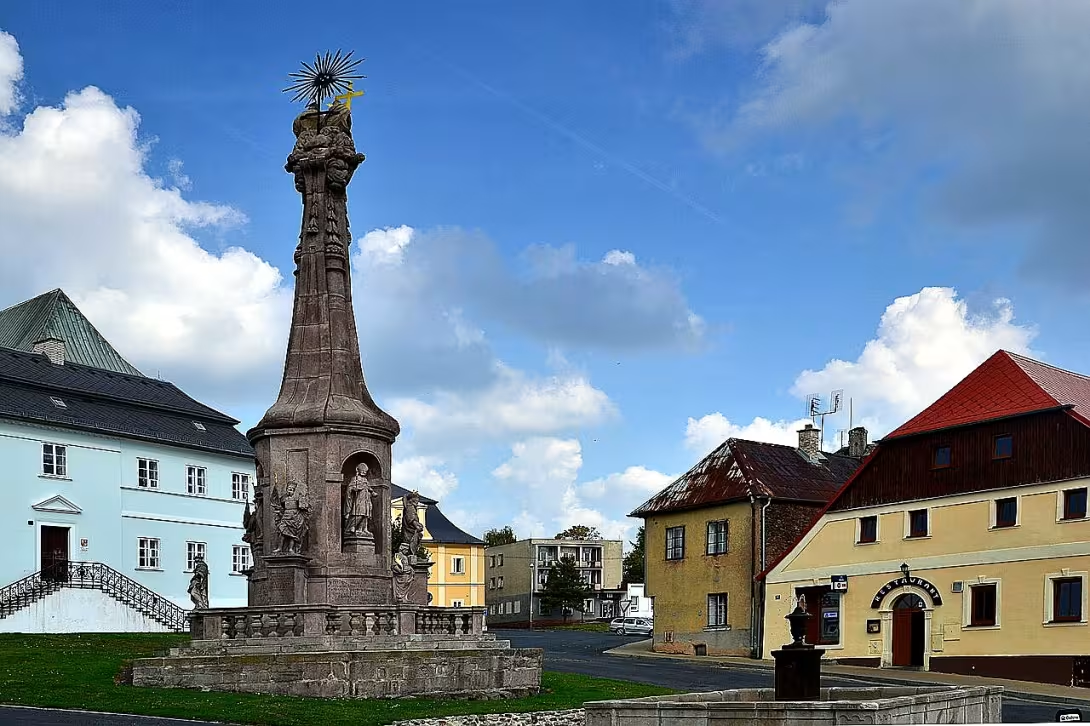
The column with the statue of the Holy Trinity, also known as the Plague Column, is a Baroque sculpture work located in the historical part of the Teplá district of Cheb. This monument was built in 1721 and since 1964 it has been protected as a cultural monument. It is an important work that reflects the baroque artistic tradition and historical context of the time.
The history of the column dates back to 1721, when it was erected at the expense of Zacharias Adalbert of Hittern. Although the authorship of the sculpture is not definitively determined, there are several theories. In 1932, historian Anton Gnirs proposed that he could have been the author of the yellow sculptor Oswald Josef Wenda. However, this claim is not confirmed and it is more likely that the Donor ordered a proposal from one of the then Viennese artists or local artists working for the Premonstrat monastery in Teplá. The thermal builder Wolfgang Braunbock, who had a strong connection with Prague's artistic environment, is also listed among the possible authors. A newer finding of archive sources suggests that Johann Karl Stilp was the author of the sculpture decoration.
Architecturally, the column is built on a three-stage suspect with a hexagon plan and composed on a circle through the triangle. It is surrounded by a stone bowling ball with statues of blessed Grapes, St. Rosalie and St. John Nepomuk. On separate bases are placed statues of St. Wenceslas, St. Florian and St. Leopold. The high cylindrical plinth is mounted on a ledge with semi-circular nobodies, in which are the sculptures of St. Norbert, St. Vojtěch and St. Quodvultde. The column is decorated with acanthus flowers and garlands, and on the ledge stands the statue of the Holy Trinity.
The column has undergone several repairs and reconstruction over the years. In 1765, 1808, 1855, 1881, 1928 and 1972 various modifications were made. After World War II, the column was badly damaged, resulting in extensive repairs in the years 1970-1972. The last major reconstruction was experienced in 2006-2008.
Today, the pillar stands in the centre of attention not only for its artistic and historical values, but also as part of the cultural heritage of the village Teplá. It is a place that attracts visitors from all over the world and offers a view of the rich history of the region. Visiting this monument is not only a way to the past, but also an opportunity to appreciate the artistic talent and historical importance of the Baroque period.
The column with the statue of the Holy Trinity is therefore not only a monument with a rich history, but also a lively reminder of artistic and cultural traditions. It is a place worth visiting anyone who is interested in the history of Czech art and history.
Historical milestones
- 1721
- Up at the expense of Zacharias Adalbert of Hittern.
- 1928
- Fixing the statue of the Greatest Trinity and the new gilding.
- 1970
- The beginning of extensive repairs and reconstruction.
- 2006
- The beginning of the last major repair.
Architectural development
Baroque sculpture work built on a three-stage pedestal. Many repairs have been made throughout history, especially in 1765, 1808, 1855, 1881, 1928 and 1972. After World War II, the work was badly damaged, but subsequently reconstructed.
Historical events
In 1721 the column was erected at the expense of Zacharias Adalbert. In 1970-1972 extensive repairs and reconstruction took place. The last extensive correction was made in 2006-2008.
Points of interest
- The column with the statue of the Holy Trinity is also known as the Plague Column and is located in the historical part of the Teplá. - The monument was built in 1721 and since 1964 it has been protected as a cultural monument. - The author of the sculpture is not definitively determined, but there are several theories about possible authors, including the yellow sculptor Oswald Josef Wend and thermal builder Wolfgang Braunbock. - The column has undergone several repairs and reconstruction over the years, most recently in 2006-2008. - Today the column is part of the cultural heritage of the village Teplá and attracts visitors from around the world.
Guide
Show guide text
This text was created by artificial intelligence and has not been editorially reviewed. It may contain inaccuracies.
Welcome to this historic place where the famous Column stands with the statue of the Holy Trinity. In front of you is a baroque art splendor that hits you with its beauty and historical depth. Take a look at the triple column standing on the hexagon stone suspect, surrounded by an elegant balustrade with statues of saints. Take a look at the high and cylindrical plaques placed in low containers. The whole complex is richly decorated with acanthus flowers and garlands, which adds its unique character.
This column was built in 1721 at the expense of Zacharias Adalbert of Hittern. His creation is closely linked to the desire to protect him from plague disease, which brought him his middle name - the Plague Column. At this time, Teplá was the place where people gathered to express their faith and trust in the miracle power of the Holy Trinity.
The architecture of the column is the fruit of the production of Johannas Karl Stilp and Wolfgang Braunbock. Look at the acantic flowers that decorate the whole complex - they are details that require attention. Note also the statues of the saints around the balustrad; each has its own story and symbolism.
Among the key personalities associated with this place is, of course, Zacharias Adalbert z Hittern, who became the protector of this work. Then Hroznata, a character whose story is closely related to the history of the Warm and its monuments.
The interesting thing is the fact that the authorship of the sculpture work is not definitively determined. There are several theories about possible authors, which adds another mystical layer to the site. This uncertainty attracts historians and artists from all over the world.
It is also remarkable that this monument was declared a cultural monument in 1964. Since then, several repairs and renovations have been made, most recently in 2006, to preserve its beauty for future generations.
I recommend to be careful of the details and biased history associated with this monument. If you have time, you can explore other historic places in the Warm, which have their unique story. I hope that your visit has been interesting and full of discoveries. Goodbye and hopefully we'll meet again in other historic places!
Tips for visitors
For the best experience we recommend a visit in spring or autumn months when the light is softer. It is ideal for photography to use the morning or late afternoon light, which will highlight beautiful Baroque details, statues of saints and sculptures in nobodies.
The location is available both by car and through public transport; Please check the current connection in the search engine. For the convenience of the visit we recommend taking water and shoes suitable for walking.
After a visit to the column, you can focus on other attractions in the immediate vicinity. In the area you will find the building of the town hall, the church of St. Jilje and the historical fountain from the beginning of the nineteenth century.
Frequently asked questions
Can the monument be visited?
This is a structure in a public space that can usually be seen from outside free of charge. We have not verified that this particular one is freely accessible.
Where is the monument?
Location: Teplá. The map on this page shows the exact spot.
Why is the monument protected?
It is listed in the Central List of Cultural Monuments of the Czech Republic as a cultural monument (register no. 1000126937).
Businesses nearby
Do you run a restaurant, accommodation, shop, museum, rental, wellness or other visitor service near this monument? Show yourself directly to the people heading to it — this is how they will see you in the app and on the web:
Events nearby

Zdroj akcí: otevřená data měst a obcí ČR (Národní katalog otevřených dat) a kalendář akcí Národního památkového ústavu.
Nearby
Budova radnice, Kostel svatého Jiljí a historická kašna z počátku 19. století.
Accommodation nearby
Trips and activities nearby
Guided tours, tickets and activities nearby from GetYourGuide
Affiliate link: if you buy from the partner, we may receive a commission. The price for you does not change.
Search tours and activities →Themed route
Thematic cruise route to Hot
1. A column with the sculpture of the Holy Trinity (monument) Type: Historical memorial Why is it worth a visit: This pillar is an important historical monument that reminds us of celebrating victory over Turkish forces. Its architecture and location in the courtyard of the castle offer a view of the rich historical background of the city.
2. Church of St. Gilji Type: Religious object Why is worth a visit: This church is an example of Baroque architecture and hosts artistic elements that reflect the spiritual and cultural history of Teplá. Its interior offers a view of rich decoration and artistic details.
3. Historical fountain Type: Architectural element Why is it worth a visit: The fountain, built in the early 19th century, represents an elegant architectural structure and is a symbol of local sources of drinking water. It's a place to relax and see the historical environment.
4. Town Hall Building Type: Historical building Why is it worth a visit: This building is a centre of local administration and offers a view of historical architecture with rich decorative features. It's a place where you can understand the administrative history of the Warm.
Visiting order: Start from Pláp with the statue of the Holy Trinity, which is a central monument in the complex. Then go to the Church of St. Gilya for a deeper understanding of the religious and cultural history of the city. Then visit the historical fountain, which is an ideal place to relax and see the 19th century architecture. Close your trip by visiting the Town Hall building and understand the administrative history of the Warm.
This route offers a comprehensive view of the historical and cultural wealth of the village Teplá.
Seasonal recommendations
In spring, the surroundings awaken and fresh green creates a pleasant background for statues. The light is fine during this period, which allows you to better observe small details. I recommend choosing layered clothes because the morning cold can quickly rotate with heat. The best time to visit is the morning hours when the air is the cleanest.
In summer the sun is strong and the days are very long. The atmosphere is warm and the monument is fully visible from every angle. It is advisable to carry water and headgear to protect the sun. For the best visual experience and avoiding the greatest heat I recommend a visit in late afternoon, when light is golden.
Autumn brings color changes in surrounding vegetation and often accompanies morning fog, which gives the place a melancholy touch. Light is low and creates deep shadows that highlight shapes. It is important to carry warmer clothing and high-quality footwear in case of wet surface. The ideal time is soon after sunrise, when fog most works.
Winter changes the appearance of a monument when frost and possible snow highlight the shapes of statues. The atmosphere is quiet and calm. It is necessary to prepare for the cold and wear strong winter clothes, including gloves and hat. Due to the short days it is best to visit the place around noon when the light is the most.
Visualizations and artistic views

The visualisations are generated by artificial intelligence and serve as inspiration.
Photos from the area
Real photos taken near the monument


Zdroj a licence jsou uvedeny u každého snímku.
Tips from visitors
No tips yet. Be the first!
Log in and add your tip.
Sources and literature
Photos: Petr Kinšt / CC BY-SA 4.0 — Wikimedia Commons. The author and licence also appear when you hover over the image.
Faktickým podkladem tohoto textu byl článek na Wikipedii, jehož autory jsou přispěvatelé Wikipedie. Článek je dostupný pod licencí CC BY-SA 4.0.
Location on the map


Příběhy a pověsti
Legendy, pověsti a příběhy spjaté s touto památkou
Fotografie návštěvníků
Zatím žádné fotografie. Buďte první, kdo přidá fotografii z návštěvy!
Log in a přidejte svou fotografii nebo hodnoťte.
Za ověřenou návštěvu v aplikaci získáte víc bodů — poznáme podle GPS, že jste na místě.
Reviews and comments