






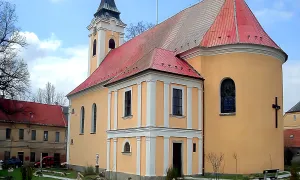
smírčí kříž v Mnichově nad kostelem Reconciliation cross
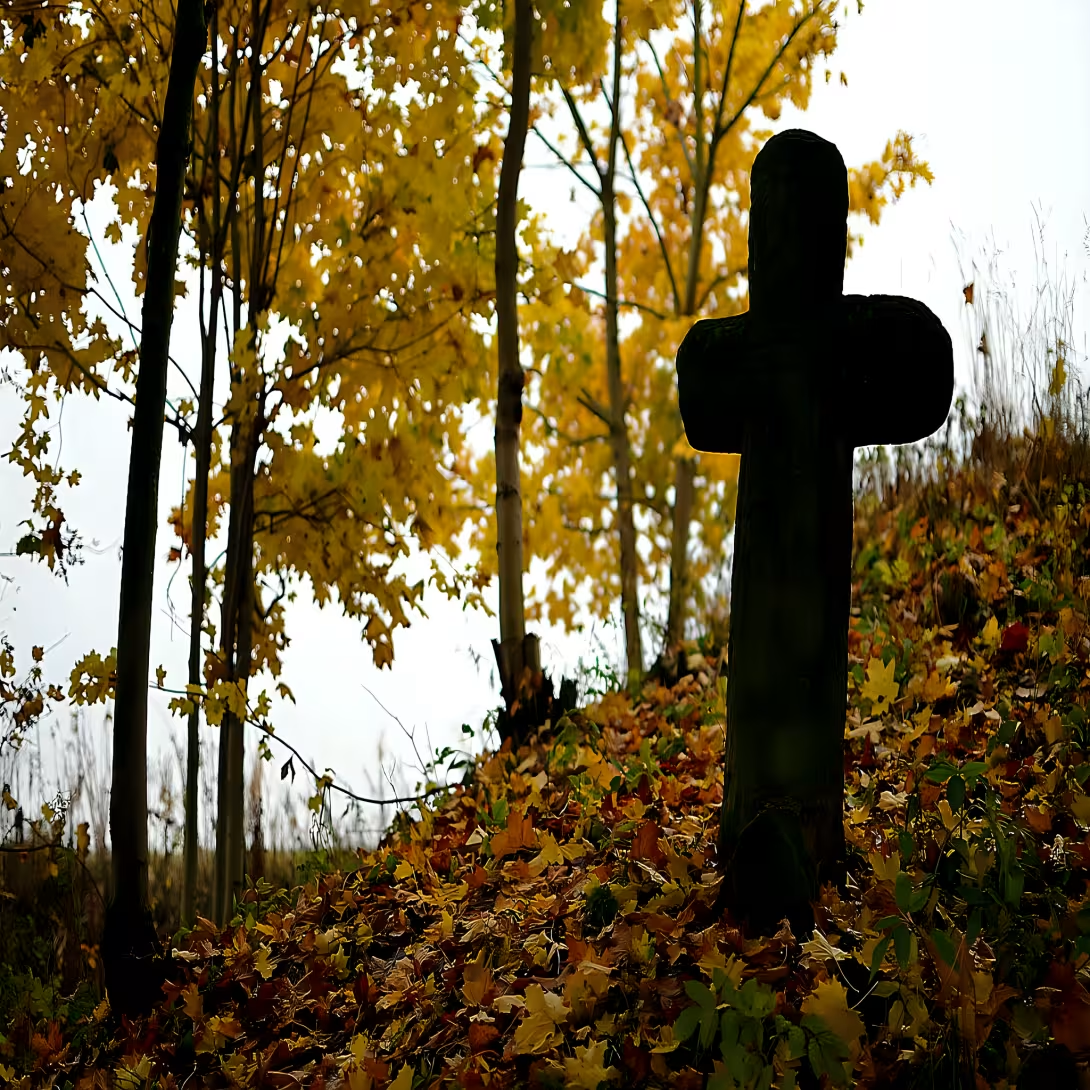
The Smírčí Kříž monument in Mnichov u Mariánských Lázní is a stone peace cross situated in the village. Originally located at a crossroads on the outskirts, it was moved to its current site after being rediscovered in 1980. The cross is crafted from sandstone and features a faint cross symbol on one side and a double inscription 'IHS' on the other.
The Smírčí Kříž has a rich history, with documentation dating back to 1845 when it was recorded on a military map. As a symbol of peace and reconciliation, its original purpose remains unknown. However, its presence suggests that this area was once an important meeting point for travelers.
The cross's architecture is characterized by simplicity and rustic charm. Made from sandstone, the rounded arms and shaft resemble wooden stakes. The circular profile of the arms and shaft evokes wooden stakes. Despite being poorly readable, the cross symbol on one side and the double inscription 'IHS' on the other demonstrate the craftsmanship of its creators.
Little is known about the Smírčí Kříž's earliest history, but it was rediscovered in 1980 by members of the CHKO Slavkovský les. Buried under layers of soil and vegetation, its exact location remained unknown until its rediscovery. Today, the Smírčí Kříž stands as a testament to the region's rich cultural heritage.
The Smírčí Kříž is an important cultural monument in the Cheb district, protected by the Czech Republic. Visitors can view the cross at its current location in Mnichov u Mariánských Lázní, where it serves as a symbol of peace and reconciliation.
Historical milestones
- 1845
- Recorded on a military map
- 1980
- Rediscovered by members of the CHKO Slavkovský les
Architectural development
The cross is made of sandstone with rounded arms and shaft, resembling wooden stakes. The circular profile of the arms and shaft is reminiscent of wooden stakes.
Historical events
Originally located at a crossroads
Rediscovered in 1980
Points of interest
– The Smírčí Kříž monument is a stone peace cross situated in the village of Mnichov u Mariánských Lázní.
– Originally located at a crossroads on the outskirts, it was moved to its current site after being rediscovered in 1980.
– The cross features a faint cross symbol on one side and a double inscription 'IHS' on the other, demonstrating the craftsmanship of its creators.
– Despite being poorly readable, the inscriptions suggest that this area was once an important meeting point for travelers.
Guide
Show guide text
This text was created by artificial intelligence and has not been editorially reviewed. It may contain inaccuracies.
Welcome to the quiet and reflective atmosphere of Mnichov u Mariánských Lázní. As you stand here, please take a moment to settle in and look closely at the object before you. You are standing in the presence of a peace cross that serves as a silent witness to a past that is only partially remembered. At first glance, it may seem like a simple, weathered block of stone, but this modest monument carries with it a weight of history and a story of rediscovery that spans over a century. Take a deep breath and let the stillness of the surroundings help you connect with the spirit of this place.
To understand what you are looking at, we must first talk about the nature of the monument itself. A peace cross is a tradition deeply rooted in the history of Central Europe. These crosses were not typically built as grand displays of faith or as markers for cemeteries. Instead, they were often erected as acts of atonement or reconciliation. In many cases, they were placed at the site of a sudden tragedy or a crime, serving as a physical manifestation of a legal or spiritual agreement between the victim's family and the perpetrator. While we do not have the specific names of the individuals involved in the event that led to the creation of this particular cross, the very existence of the monument tells us that someone, long ago, felt the need to mark this spot with a plea for peace and forgiveness.
If we look back at the chronology of this stone, we find its first official trace on a military map from 1845. Imagine the landscape of Mnichov u Mariánských Lázní nearly two hundred years ago. At that time, the cross did not stand where it does now. It was originally located at a crossroads on the outskirts of the village. Crossroads have always held a certain symbolic power in folklore and history, often seen as places of transition, decision, and sometimes, misfortune. For decades, travelers, farmers, and locals would have passed by this sandstone marker, perhaps forgetting its original purpose but acknowledging its presence as a permanent part of the horizon.
Now, I invite you to step a little closer and examine the physical details of the monument. Please notice the material it is crafted from. The cross is made of sandstone, a material that is common in this region but also susceptible to the passage of time. You can see how the elements—the rain, the wind, and the frost of many winters—have softened the edges of the stone, giving it a rounded, organic appearance. This weathering is not a flaw, but rather a visual record of the years the cross spent exposed to the open air.
As you move around the stone, pay close attention to the carvings. On one side, you will see a cross symbol. If you look carefully, you will notice that it is poorly readable now, faded by the erosion of the sandstone. It requires a bit of imagination and a keen eye to trace the lines that were once sharp and clear. This fading mirrors the way the specific story of the cross has faded from the local memory.
Now, please turn your attention to the other side of the monument. Here, you will find a different kind of marking: a double inscription of the letters IHS. For those who may not be familiar with this symbol, IHS is a Christogram, a monogram representing the name of Jesus. In Latin, it is often interpreted as Jesus, Savior of Mankind. The presence of this sacred monogram transforms the stone from a mere marker of a past event into a prayer for the soul of the departed and a symbol of hope for the living. The contrast between the simple cross on one side and the formal monogram on the other shows a blend of folk tradition and religious devotion.
While the architects and the specific personalities associated with the creation of this cross remain unknown to us, there is a different, more modern story of people who played a crucial role in its survival. For a long time, the cross was lost to the world, hidden by overgrowth or forgotten as the outskirts of the village changed. However, in 1980, a group of dedicated individuals from the CHKO Slavkovský les rediscovered the monument. These members of the protected landscape area were not just preserving nature, but also the cultural heritage embedded within that nature.
Imagine the moment of discovery in 1980—brushing away the dirt and leaves to reveal the weathered sandstone and the faint letters of the IHS inscription. It was through their efforts that the cross was saved from total oblivion. Because its original location at the crossroads was no longer suitable or safe, the decision was made to move it to its current site, where it stands today, protected and visible to visitors like yourself. This act of rediscovery is a reminder that history is not always found in grand archives or museums, but often lies hidden in plain sight, waiting for someone with a curious mind and a respectful heart to find it.
As you stand here in the silence, consider the mystery of this stone. We do not know whose name was whispered in prayer before it, or what specific act of reconciliation it was meant to seal. We do not know the hands that carved the sandstone or the emotions of the people who first placed it at that distant crossroads in the 19th century. Yet, there is something profoundly moving about this anonymity. The peace cross does not belong to one person or one family anymore; it belongs to the collective memory of Mnichov u Mariánských Lázní. It stands as a universal symbol of the human desire to make amends, to remember the fallen, and to seek peace after a period of conflict or grief.
Take a final look at the cross, noticing how it blends into the landscape. It is a small monument in scale, but its historical and emotional resonance is vast. It reminds us that even the most forgotten objects can be brought back to light and that the pursuit of peace is a timeless endeavor.
Thank you for taking the time to stop and reflect at this site. As you prepare to move on, I encourage you to carry this feeling of quiet contemplation with you. There is much more to discover in this beautiful region, and each stone and path has its own story to tell. Please feel free to explore the surrounding area at your own pace, breathing in the fresh air of the CHKO Slavkovský les. We wish you a wonderful continuation of your journey through the history and nature of Mnichov u Mariánských Lázní. Safe travels.
Tips for visitors
Best Time to Visit: The smírčí kříž is a year-round attraction, but the best time to visit is during spring or autumn when the weather is mild and sunny. This allows you to fully appreciate the cross's unique architecture and the surrounding landscape without the harsh conditions of winter or summer heatwaves.
Businesses nearby
Do you run a restaurant, accommodation, shop, museum, rental, wellness or other visitor service near this monument? Show yourself directly to the people heading to it — this is how they will see you in the app and on the web:
Events nearby
Zdroj akcí: otevřená data měst a obcí ČR (Národní katalog otevřených dat) a kalendář akcí Národního památkového ústavu.
Accommodation nearby
Trips and activities nearby
Guided tours, tickets and activities nearby from GetYourGuide
Affiliate link: if you buy from the partner, we may receive a commission. The price for you does not change.
Search tours and activities →Themed route
1. Peace Cross near the Church in Mníšek (Historical Monument) – Observe the stone cross to appreciate its unique shape and historical significance. 2. The base of the Peace Cross near the Church in Mníšek (Historical Detail) – Inspect the craftsmanship and any visible markings on the stone's surface. 3. The immediate area of the Peace Cross near the Church in Mníšek (Historical Site) – Walk around the monument to experience the quiet atmosphere of its immediate surroundings.
Seasonal recommendations
Spring
As you visit the historical monument, smírčí kříž v Mnichově nad kostelem, in the spring season, you'll be greeted by a vibrant atmosphere. The surrounding nature awakens from its winter slumber, with blooming flowers and lush greenery. A gentle breeze carries the sweet scent of blossoming trees, making it an ideal time to visit.
Practical tips: Arrive early to avoid crowds, and dress comfortably for the mild weather. Take advantage of the longer opening hours to fully appreciate the monument's beauty.
Summer
During the summer season, the historical monument takes on a lively atmosphere. The warm sunshine brings out the vibrant colors of the surrounding landscape, making it an excellent time to take photos. As you stroll around the area, you'll be treated to the sweet sounds of birds chirping and children playing.
Practical tips: Be prepared for larger crowds during peak summer hours, so consider arriving early or later in the day. Wear comfortable shoes and clothing suitable for the warm weather.
Autumn
As autumn arrives, the historical monument is bathed in a warm, golden light. The surrounding nature transforms into a kaleidoscope of colors, with leaves turning shades of orange, red, and yellow. A crisp breeze carries the scent of ripe fruits and woodsmoke, creating a cozy atmosphere.
Practical tips: Take advantage of the comfortable temperatures to explore the area at your leisure. Arrive early to avoid crowds, and dress in layers for the changing weather conditions.
Winter
During the winter season, the historical monument takes on a serene quality. The snow-covered landscape creates a peaceful ambiance, with the sound of snowflakes gently falling adding to the tranquil atmosphere. As you visit, you'll be treated to the beauty of the surrounding nature, blanketed in a layer of white.
Practical tips: Dress warmly and wear comfortable shoes for the potentially snowy or icy terrain. Take advantage of shorter opening hours to avoid crowds, but don't miss out on this magical winter wonderland experience.
Visualizations and artistic views

The visualisations are generated by artificial intelligence and serve as inspiration.
Photos from the area
Real photos taken near the monument


Zdroj a licence jsou uvedeny u každého snímku.
Tips from visitors
No tips yet. Be the first!
Log in and add your tip.
Sources and literature
Fotografie: Levap75 / CC BY-SA 3.0, rozlišení zvýšeno umělou inteligencí — Wikimedia Commons. The author and licence also appear when you hover over the image.
Faktickým podkladem tohoto textu byl článek na Wikipedii, jehož autory jsou přispěvatelé Wikipedie. Článek je dostupný pod licencí CC BY-SA 4.0.
Location on the map
More monuments – Mnichov u Mariánských Lázní
Show all in the municipality
Příběhy a pověsti
Legendy, pověsti a příběhy spjaté s touto památkou

Fotografie návštěvníků
Zatím žádné fotografie. Buďte první, kdo přidá fotografii z návštěvy!
Přihlaste se a přidejte svou fotografii nebo hodnoťte.
Za ověřenou návštěvu v aplikaci získáte víc bodů — poznáme podle GPS, že jste na místě.
Reviews and comments