



Šnajdrova vila Villa
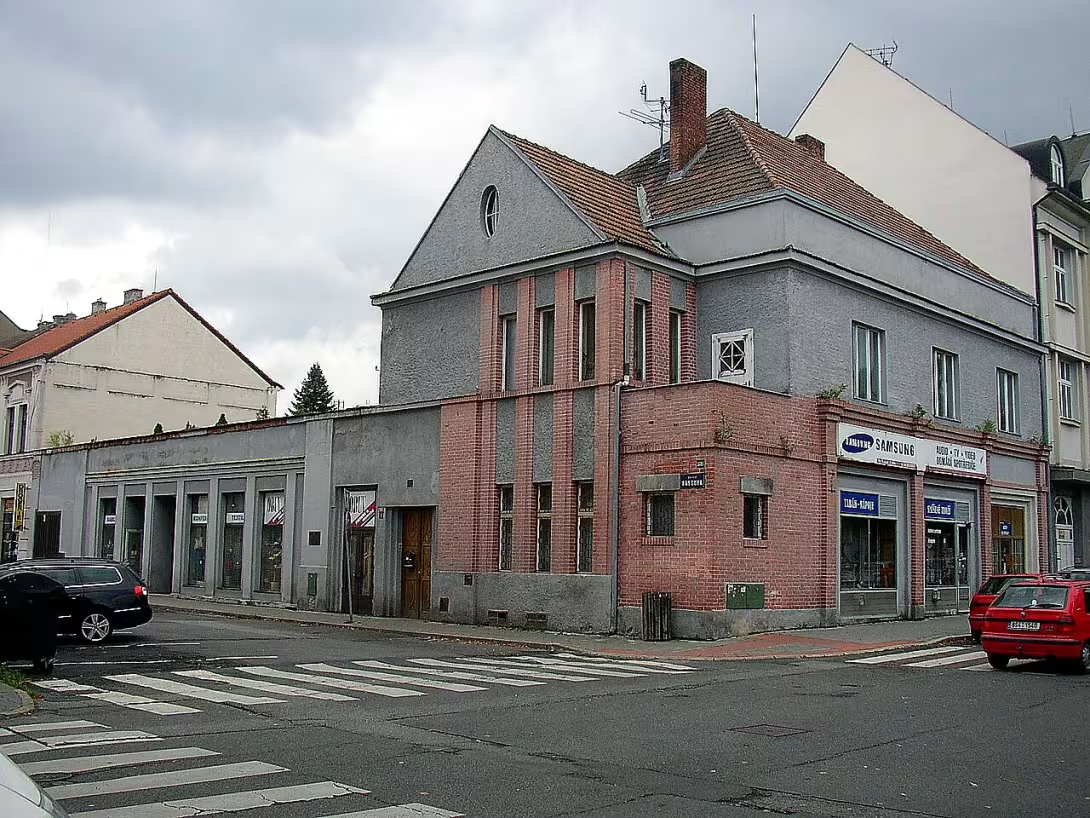
Šnajdrova vila in Kladno, situated in Saskova Street No. 1695, represents an important example of modern Czech architecture in the early 20th century. The building has been protected historically since 1958. In 1911, the publisher Jaroslav Šnajdr built it according to the design of architect Jaroslav Rössler as a combination of family housing and printer.
The foundation of the villas is closely linked to the rapid development of Kladno during the period of industrial conjuncture, when modern architecture was formed in Czech countries looking for new functional and aesthetic expression. Architect Jaroslav Rössler, graduate of the Vienna Academy of Fine Arts, designed a house for Jaroslav Šnajdra, who after obtaining a separate concession in 1906 successfully developed his publishing house. The construction was completed in 1911 and became part of the 2nd Jubilee Workers' Exhibition in Kladno in the same year.
The architectural rendition of the villa is based on the principles of modern life and shows similarity with Prague's publishing houses, such as the buildings of Jan Laichter, Jan Štence and Ismímír Urbanka. The storey building on the ground floor hid commercial premises while the living area was located on the floor. The architect connected the housing with the working building of the printer which had a separate entrance from Saxony Street. The facade combines a solid brick masonry with grey surfaces and is characterised by geometric layouts. The residential part included a garden terrace built on the roof of the operating tract, accessible directly from the apartment.
After Jaroslav Šnajdra's death in 1941 his wife led the business and since 1946 his son Pravoslav Šnajdr. The publishing house died in 1947. After 1948 the house ceased its original function and began to decay. In 1967, a market was set up at the premises of the former printer, which led to insensitive interventions in the appearance of the building. The inscriptions by J. ŠNAJDRA, the replacement of original windows and doors for aluminium and the overlay of the concrete wall with plaster, were removed. After 1989, the building was returned to the descendants of the builder as part of the restitution and subsequently underwent successive repairs to restore its original character. Between 1990 and 2023, the ground floor served as an electronics shop.
In the past, Šnajdra's editorship has been famous for producing the works of Rabíndranátha Thákur, which Stanislav Kuhlánek and Jaroslav Marík participated in the graphic design. The villa represents a valuable proof of the connection of housing and business in the urban development of the early 20th century. Visiting this place offers insight into the history of the Kladno publishing house and reminds us of the era when modern architecture became an integral part of the emerging Czech cities.
Historical milestones
- 1906
- Jaroslav Šnajdr obtained a separate concession for the printer.
- 1911
- The completion of the new building of the villa and its presentation at the 2nd jubilee workers' exhibition.
- 1958
- The building was declared to be protected.
- 1967
- There was a market in the premises of the printer, which led to a disturbance in the appearance of the building.
Architectural development
The villa was built in the spirit of modern architecture using a combination of brick masonry and plastered surfaces. The original appearance was negatively affected after 1948 by removing the inscriptions, replacing the windows with aluminium and covering the bricks with plaster. After restitution, successive repairs are made towards the restoration of the original character.
Historical events
1911: Completion of construction and participation in the 2nd Jubilee Workers' Exhibition in Kladno. 1958: Writing between protected objects. 1967: Establishment of a market in the premises of a former printer.
Owners
The family of Šnajdrov, after 1948 state, after 1989 restitution to the descendants of the builder.
Points of interest
The building has been protected historically since 1958. - The villa was built in 1911 as a combination of family housing and printer. - In 1911 the construction became part of the second jubilee workers' exhibition in Kladno. - The residential area included a garden terrace built on the roof of the operating tract, which was accessible directly from the apartment. - In 1967, a market was set up at the premises of a former printer, which led to insensitive interference in the appearance of the building.
Guide
Show guide text
This text was created by artificial intelligence and has not been editorially reviewed. It may contain inaccuracies.
Welcome. You're standing in front of one of the most important construction sites in this city. In front of your eyes is Šnajdrova vila, a building that carries the incredible power of its time. Stop for a moment and feel the atmosphere. In front of you, it is not just an ordinary house, but a real symbol of transformation that combines the world of work and the world of private home. Look at the construction as a whole and try to imagine what the world looked like in the early 20th century, when everything began to change, when people looked towards the future and when new ideas were born about what modern life should look like. This villa is exactly the witness.
Let us now go back deep into the past together to understand why this building is standing right here and why it is so important to us. The whole story begins in a thousand and nine hundred and six. This was the year when Jaroslav Šnajdr acquired its own separate concession to operate the printer. It wasn't just a business move, it was a journey to a dream of doing business. Then, many years of construction and planning followed, until in the year one thousand nine hundred eleven this construction became a reality. The villa was completed and its presentation was a great moment. It was part of the second jubilee workers' exhibition, which took place here. Imagine the pride of this new, modern construction being presented to the general public as proof of progress and success.
Now pay attention to the architecture itself that is around you. This villa was not built randomly. Its creator was an exceptional architect Jaroslav Rössler. If you look at the building now, notice its layout. It's a fascinating connection between two worlds. On the one hand, you have residential areas where everyday family life took place, and on the other hand you have the operating area where it was printed and where the history of the printer Jaroslav Šnajdra was created. This connection between housing and work is very specific at the time. Notice the facade as well. Its geometric layout is very distinctive and plays a key role in overall appearance. These shapes, these lines that you see are typical of modern Czech architecture of the time. If you look towards the part that used to operate, you can imagine how one very interesting thing was built. A garden terrace was built on the roof of this operating tract. It was a place that offered a rest and a view of the surroundings right above the busy world of work.
This house was not just an empty building made of stone and mortar. It was a home for specific people, for a family of Snails. Jaroslav Šnajdr built his life and business here, and Pravoslav Šnajdr plays an important role in his story. This whole building is firmly linked to their names and their pursuit of success. When you look at these walls, you look at the legacy of a man who wasn't afraid of his own path.
And now I want to tell you something that might surprise you. Although this villa now appears to be a stable and solid monument, its history has not always been about peace and protection. Since the year one thousand nine hundred fifty-eight, this building has been declared a monument protected. This means that its appearance and essence must be preserved for future generations. But over the years, things have happened that have threatened her appearance. In the year one thousand nine hundred and sixty-seven, a market was established in the premises where it was previously printed. Imagine the contrast - modern, geometric architecture, which was designed for noble purposes, suddenly became a place for ordinary trade and markets. This move has led to a breach of the original appearance of the building, as proposed by Rössler. It's a fascinating reminder of how human needs meet the need to protect art and history in times of change.
Look at her again. Feel the geometry, feel the connection between home and work. It's a building that survived the change of time, survived the market and various political periods to tell us its story today. It's a story about the courage to do business, the art of creation, and the importance of protecting what we've created.
Thank you for stopping by and paying attention to this important monument. We hope that this view of Snader's villa has helped you better understand her beauty and her difficult fate. Continue to walk now and look forward to the other attractions this city has to offer. Goodbye.
Tips for visitors
The best time to visit is in the morning or during the golden watch before sunset, when soft light beautifully depicts architectural details of the facade and decorative elements of the villa. Since the object is only viewed from the outside, it is ideal to choose a day with a clear sky that underlines the colour of the building.
Use the local transport network or your own car to get to the villa.
When photographing the villa, focus on the details of the facade and the overall composition of the building, which represents the modern architecture of the early twentieth century. The best pictures can be taken from the pavement in front of the building, from where the villa is well visible and undisturbed by the surrounding building.
In the vicinity of the villa you can take a walk towards the Square of Liberty and explore the historical centre of Kladna. The whole area offers an interesting view of the urban development of the city, including another building from the beginning of the twentieth century, which completes the period atmosphere of the place.
Children can admire interesting shapes and decorating villas, while the nearby historical center provides sufficient space for movement and relaxation in the urban environment.
Frequently asked questions
Can the monument be visited?
This is a residential or farm building, not a museum with opening hours. Please view it from public space and respect the owners' privacy. We have no information about access to the interior.
Where is the monument?
Location: Kladno. The map on this page shows the exact spot.
Why is the monument protected?
It is listed in the Central List of Cultural Monuments of the Czech Republic as a cultural monument (register no. 1000142075).
Businesses nearby
Do you run a restaurant, accommodation, shop, museum, rental, wellness or other visitor service near this monument? Show yourself directly to the people heading to it — this is how they will see you in the app and on the web:
Nearby
Náměstí Svobody, historické centrum Kladna, v blízkosti se nachází další zástavba z počátku 20. století.
Accommodation nearby
Trips and activities nearby
Guided tours, tickets and activities nearby from GetYourGuide
Affiliate link: if you buy from the partner, we may receive a commission. The price for you does not change.
Search tours and activities →Themed route
1. Freedom Square (central space) - The starting point of the road that represents the heart of the city. 2. The historical centre of Kladna (urban zone) - The walk through the old streets allows you to feel the atmosphere of past era. 3. Construction from the beginning of the 20th century (architectural monuments) - Possibility to admire elegant houses from the turn of the century. 4.Šnajdrova vila (villa) - The main destination of the trip is an example of the beautiful architecture of its time.
Seasonal recommendations
Spring: In the spring the surroundings of the villa awaken to life and the trees begin to green. The light is fine in this period and does not shine, which is ideal for observing the building. I recommend arriving early in the morning when the air is fresh and nature is clean. Put on several layers of clothing because the morning cold can still smell.
Summer: During the summer months, the building is surrounded by thick leaves, and the sun illuminates it from all sides. The day is long and the air can be very hot. The best time to walk around the house is in the evening when there is no such heat and shadows create interesting shapes on the wall. Don't forget the headgear and plenty of fluids.
Autumn: Autumn brings many different colours to the surroundings of the villa and morning fog gives the place a special mood. It is ideal to visit a place in the afternoon when the sun shines low and colors the leaves into gold. Prepare a waterproof jacket and firmer shoes because the roads can be slippery from falling leaves.
Winter: In winter, the villa is very quiet in the countryside, especially if everything is covered with snow. The tree crowns are bare and reveal all parts of the building that sometimes hides leaves. Since the days are short, plan to visit around noon to use the most light. The necessity is very warm clothing and shoes that protect you from freezing.
Visualizations and artistic views

The visualisations are generated by artificial intelligence and serve as inspiration.
Photos from the area
Real photos taken near the monument


Zdroj a licence jsou uvedeny u každého snímku.
Tips from visitors
No tips yet. Be the first!
Log in and add your tip.
Sources and literature
Photos: Miaow Miaow / Public domain — Wikimedia Commons. The author and licence also appear when you hover over the image.
Faktickým podkladem tohoto textu byl článek na Wikipedii, jehož autory jsou přispěvatelé Wikipedie. Článek je dostupný pod licencí CC BY-SA 4.0.
Location on the map
More monuments – Kladno
Show all in the municipality
Příběhy a pověsti
Legendy, pověsti a příběhy spjaté s touto památkou
Fotografie návštěvníků
Zatím žádné fotografie. Buďte první, kdo přidá fotografii z návštěvy!
Log in a přidejte svou fotografii nebo hodnoťte.
Za ověřenou návštěvu v aplikaci získáte víc bodů — poznáme podle GPS, že jste na místě.
Reviews and comments