



Socha Karla IV. (Karlovy Vary, 1858) Statue column
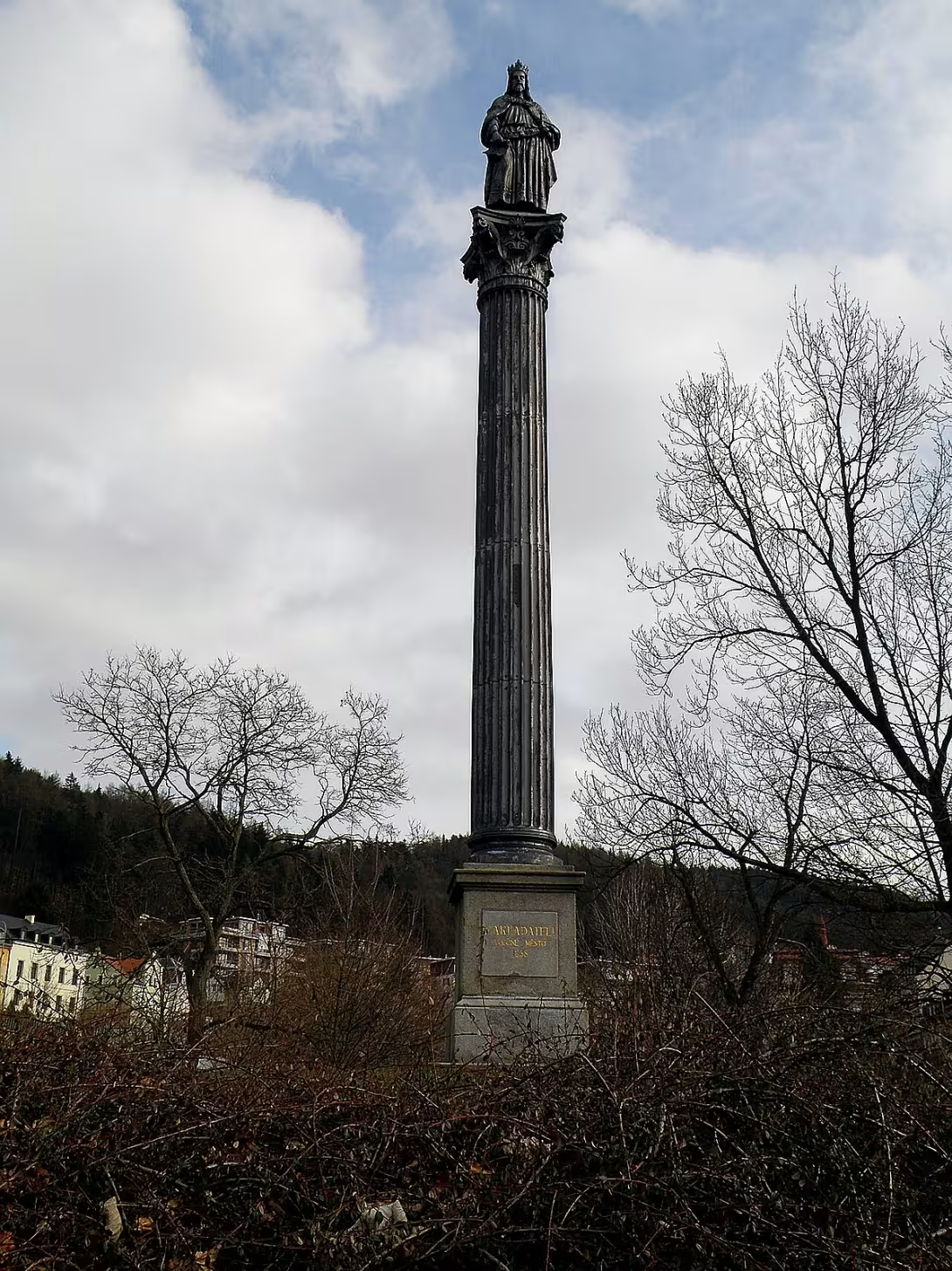
The statue of Charles IV, located in Jean de Carro orchards in Karlovy Vary, is a monument from 1858, which celebrates the origin of the city. This monument, the author of which was sculptor Josef Max, is a cultural monument and represents the emperor and Czech king Charles IV, founder of Karlovy Vary. The statue stands on a six-metre pole with a Corinthian head, making it a significant part of the city park.
The memorial was revealed in 1858 during the celebrations of the founding of Karlovy Vary. Its design and implementation was prepared by Prague sculptor Josef Max, who created a cast of zinc alloy, aluminium and lead, known as zinc or camped. This material was commonly used in the 19th century as a replacement for bronze. The statue represents Charles IV with a crown on his head in a dressed garment, holding a sword and a charter symbolizing the foundation of the city.
Originally, the monument was purchased by the patron of Karlovy Vary, Baron Lützow, who placed it in the garden of his villa. Subsequently, Carlsbad councilmen bought it and moved it to a high place in a newly established park. Although it was festively revealed, the statue faced criticism because of its height, which made it less visible.
Several repairs took place in the 20th century, during which the lower part of the column was due to mixtures of concrete and stone up to about 60 cm. This resulted in ventilation holes and pipes for condensation moisture extraction, which led to further structural problems. At the beginning of the 21st century the condition of the monument was very bad, with serious defects on the column and supporting structure.
In 2004, the city of Karlovy Vary did a complete reconstruction of the monument. In agreement with representatives of the National Monument Institute and investor, the building was dismantled, original coatings and corrosion removed and the entire monument restored. A new stainless steel support structure with circular belts was designed and the original ventilation was restored. After reconstruction, the building was coated with graphite paint, the total cost was CZK 400,000.
Today, the statue of Charles IV is the property of the city of Karlovy Vary and stands on a granite prism pedestal with profiled plates, paved with stone cubes. The front side of the plinth is now equipped with a modern inscription board with Czech translation of the original inscription in German.
The monument is located in the historical centre of Karlovy Vary, which makes it not only a monument to local importance, but also a part of the cultural heritage of the region. Its reconstruction and maintenance represent a significant effort to preserve the historical monument for future generations.
The statue of Charles IV is not only a monument, but also a testament to the history and culture of Karlovy Vary. Its existence recalls the importance of preserving cultural heritage and calls on visitors to look at this important monument during their visit to the city.
Historical milestones
- 1858
- The unveiling of the Charles IV statue.
- 1958
- Monument protection of the pillar with a statue since 3 May.
- 1964
- An eventual monument protection since February 5th.
Architectural development
The monument was originally built in 1858 and subsequently subjected to repairs in the 20th century, during which the column was shined with mixtures of concrete and stone. After reconstruction of 2004 the original supporting structure and ventilation was restored.
Historical events
- 1858
- The ceremonial discovery of the statue during the 500th anniversary of the founding of Karlovy Vary.
- 2004
- Total reconstruction of the monument by the city of Karlovy Vary.
Owners
The statue was originally bought by Baron Lützow, and subsequently bought by Karlovy Vary councilmen. It is currently owned by the city of Karlovy Vary.
Points of interest
The statue of Charles IV, located in Jean de Carro orchards in Karlovy Vary, is a monument from 1858. - The monument presents the emperor and Czech king Charles IV, founder of Karlovy Vary, and stands on a six-metre pole with a Corinthian head. - The statue was revealed in 1858 during the celebration of the founding of Karlovy Vary and its author is Prague sculptor Josef Max, who used the material known as Zinkal or Kamal. - At the beginning of the 21st century the condition of the monument was very bad, with serious defects on the column and supporting structure. - In 2004 the city of Karlovy Vary had a complete reconstruction of the monument, during which a new supporting structure was designed and the original ventilation was restored.
Guide
Show guide text
This text was created by artificial intelligence and has not been editorially reviewed. It may contain inaccuracies.
Welcome to Karlovy Vary. You have just stopped in the pleasant orchards of Jean de Carro, where you are surrounded by peace and history. You're standing right in front of one of the most important symbols of this city. Rarely raise your eyes and look at the statue that has been here for over a century and a half. This monument is not just a piece of art, it is a pillar that links the present of this place to its ancient, noble past. Feel the atmosphere of this place where nature and human work mingle, and let yourself be carried away by the story of this statue.
Let us return together to the time when this monument was created. Imagine 1858. The city of Karlovy Vary had an extraordinary moment. It was a 500-year anniversary since the foundations of this city were laid. At the time, people wanted to remember this crucial event in a way that would remain unforgettable. That is why this monument was revealed to celebrate the five centuries of this important place. It was a time when cities tried to consolidate their identities and pay tribute to those who gave them life and direction. This monument became not only an ornament of ornaments, but above all a reminder of proud history.
Now pay attention to the very form of this work. Look up and perceive the majesty that the statue radiates. The whole piece stands on a tall, six-metre pole. This tall pillar gives a figure on top of nobility and makes it visible from a distance. Notice the top of this column where the Corinthian warhead is located. It's one of the oldest and most decorated styles we know in architecture. This rich decoration of the column gives the whole whole elegance and depth that so important a person deserves. This entire work was performed by an important artist Josef Max. With his hand, the statue was breathed into life to capture the seriousness and strength of the character he represents.
And who is it, then, that stands so dignified here? Look at this man's face. It is Karel IV., a character who has no precedent in Czech history. He was not only a powerful emperor and a Czech king, but also the founder of this city. Without his will and his vision, the Karlovy Vary as we know it today would probably not exist. It is he who gave the beginning of a tradition that is still radiating in these orchards and throughout the city. When you look at this statue, you look not only at the statue of the king, but you look at the father himself of this place. His presence here is not only symbolic, it is a connection to the roots of the city.
You may now wonder how this monument survived for so long and how it cared for its preservation. It's fascinating how taking care of our history has changed over the years. Already in the middle of the last century, namely in 1958, the significance of this pillar and its statue was recognised, thereby ensuring its protection. Later, in 1964, this protection was further strengthened. But the biggest change that can be seen in recent years has taken place much recently. In 2004, the monument was subject to an overall and very thorough reconstruction. During this time, all damage caused by time and nature was eliminated. A very important step was also to restore the original way of ventilation to ensure that the statue is in good condition for future generations. This modern care allows us today to admire in peace a work that could otherwise lose its beauty long ago.
Something that might interest you is the invisible work that took place in this recovery. We often think that repairs are only about cleaning the surface, but with such an important monument, it is a deep care of each part to prevent decay. It is a constant struggle of time against human art in which we win thanks to these works. So this monument is living proof that as humans we value our heritage and try to preserve it.
Now that you have learned the story of this monument, its creator and its meaning, I suggest you continue your walk through these beautiful sets. Let the atmosphere of Karlovy Vary drift and continue to discover other hidden treasures that this city offers. Every step can lead you to another history worth exploring. Thank you for spending this moment with us. We wish you a beautiful and inspiring rest of your trip.
Tips for visitors
The best time to visit is early morning or late afternoon. In these hours, the light in the gardens is softer, which is ideal for viewing the statue, while avoiding the largest crowds of visitors.
Transportation to the place is possible by foot and by public transport; Check the internet search for the current connection.
Take with you comfortable shoes suitable for walking in gardens and drinking water. For the best photos we recommend to use places in Jeana de Carro gardens, where the monument is well seen, especially at sunset.
For families with children, walking in these gardens is pleasant and safe. Children can enjoy the free space in nature right in the historic city centre.
The Jeana de Carro gardens are located in the vicinity, which are ideal for a short rest during the sightseeing tour.
Frequently asked questions
Can the monument be visited?
This is a structure in a public space that can usually be seen from outside free of charge. We have not verified that this particular one is freely accessible.
Where is the monument?
Location: Karlovy Vary, Karlovarský kraj. The map on this page shows the exact spot.
Why is the monument protected?
It is listed in the Central List of Cultural Monuments of the Czech Republic as a cultural monument (register no. 1000124956).
Businesses nearby
Do you run a restaurant, accommodation, shop, museum, rental, wellness or other visitor service near this monument? Show yourself directly to the people heading to it — this is how they will see you in the app and on the web:
Nearby
Pomník se nachází v městském parku sadech Jeana de Carro, které jsou součástí historického centra Karlových Varů.
Accommodation nearby
Trips and activities nearby
Guided tours, tickets and activities nearby from GetYourGuide
Affiliate link: if you buy from the partner, we may receive a commission. The price for you does not change.
Search tours and activities →Themed route
Thematic cruise route in Karlovy Vary
1. Jeana de Carro City Park - Type: Park Jeana de Carro's urban park is ideal for relaxing and exploring the natural environment. He deserved his name thanks to his beautiful greenery, where there is also the memorial memorial of Charles IV. The park is part of the historical centre and offers a quiet atmosphere for relaxation.
2. Memorial of Charles IV. - Type: Memorial statue The main goal of our route is the memorial of Charles IV, built in 1858. This monument reminds of one of the most important Czech monarchs who had a significant impact on the history and development of the region. The statue is located in the middle of the park and is ideal for photos.
3. Historical Centre of Karlovy Vary - Type: City area After visiting the memorial, we will look at the historical centre, which is close to the park of Jean de Carro orchards. This place offers a view of architecturally interesting buildings and alleys that tell about the rich history of the city.
4. Fountains in the park - Type: Park element There are also several fountains in the park of Jean de Carro, which provide even more peace and beauty. Fountains are an ideal place to relax and listen to the sounds of water.
5. Karlovy Vary commercial street - Type: Business district After the tour of the park we will look at the commercial street, which is near the historical centre. Here you will find various shops and restaurants where you can buy a souvenir or relax after the tour.
This route offers a combination of relaxation in the park, historical elements and the possibility of shopping entertainment.
Seasonal recommendations
Spring: In spring, the statue of Charles IV stands out against the background of flowering bushes and trees that celebrate their return to life. The sun rays are promising to illuminate the memory, which increases its beauty. At this time the weather may be variable, so it is advisable to prepare various top garments. Visiting in the early morning or late afternoon will help avoid the biggest crowds who want to enjoy the first warmth of the sun.
Summer: Summer brings long days and warm sunlight, which joins the statue of Charles IV in the most attractive way. The atmosphere is full of vitality and local and tourist visitors are found here to enjoy the beauty of the Karlovy Vary region. Early arrival in memory is recommended to avoid long fronts. Due to the warm weather, it is advisable to take a protective head and sufficient drinking preparation.
Autumn: The autumn season offers the statue of Charles IV a stunning background of golden leaves and darker colours of trees, creating a romantic atmosphere. Sun rays get shorter, but hot noon is the perfect time to visit. The weather can be variable, so it is good to prepare your top clothes and perhaps an umbrella. Visiting on Sundays or weekends often becomes more popular because of the beautiful surroundings, so it is advisable to avoid these mountains of crowds today.
Winter: The winter visit to the statue of Charles IV offers a unique view of the monument under the snow blanket, creating a mysterious and peaceful environment. The sun's rays illuminate the snow, making the statue even more attractive. Due to cold temperatures, it is important to prepare warm clothes and in winter months the monument usually opens for a shorter time, so it is advisable to visit early in the morning. Despite the cold, this season can be used for a peaceful and thoughtful visit without large crowds.
Visualizations and artistic views


The visualisations are generated by artificial intelligence and serve as inspiration.
Photos from the area
Real photos taken near the monument


Zdroj a licence jsou uvedeny u každého snímku.
Tips from visitors
No tips yet. Be the first!
Log in and add your tip.
Sources and literature
Photos: U.username / CC BY-SA 4.0 — Wikimedia Commons. The author and licence also appear when you hover over the image.
Faktickým podkladem tohoto textu byl článek na Wikipedii, jehož autory jsou přispěvatelé Wikipedie. Článek je dostupný pod licencí CC BY-SA 4.0.
Location on the map
More monuments – Karlovy Vary
Show all in the municipality
Příběhy a pověsti
Legendy, pověsti a příběhy spjaté s touto památkou

Fotografie návštěvníků
Zatím žádné fotografie. Buďte první, kdo přidá fotografii z návštěvy!
Log in a přidejte svou fotografii nebo hodnoťte.
Za ověřenou návštěvu v aplikaci získáte víc bodů — poznáme podle GPS, že jste na místě.
Reviews and comments