



Socha svatého Jana Nepomuckého (Dolní Čermná) Statue
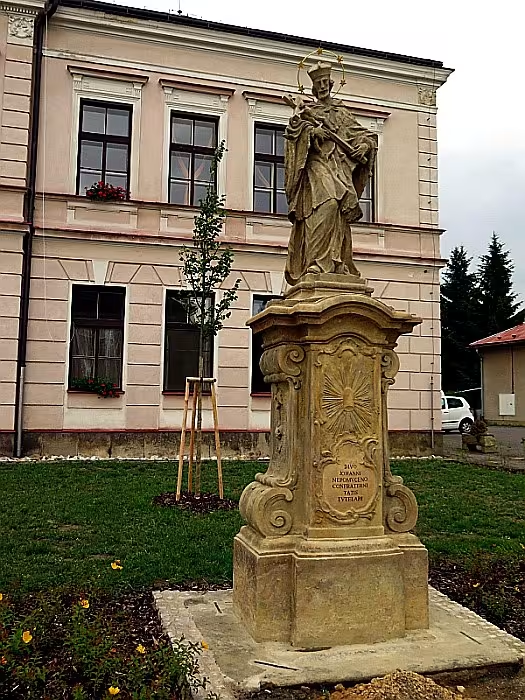
The late Baroque sandstone statue of St. John Nepomuk in the town of Dolní Čermá in the district of Ústí nad Orlicí is a valuable sculpture work from 1771. Its author is a Jamberly native Alexius Cyriak. This sculpture represents a demonstration of sacral creation in the seventies of the 18th century and since 1958 it has been protected as a real cultural monument of the Czech Republic.
The work was created in 1771 by the hands of Jamberek native Alexia Cyriak. In the seventies of the 18th century, the late Baroque in the art and sacralisation of the landscape was still strongly manifested in Czech countries. St. John Nepomuk's cult was already deeply rooted in the entire Habsburg monarchy. At that time, Europe was headed towards enlightened reforms, which later changed the face of church life significantly during the reign of Joseph II.
The statue is made of sandstone and is situated in the park design in front of the primary school building. It consists of a square base on which is a low prism on top of it by profiling a seared base with a rising front side. On it lies a pillar decorated on the sides with distinctive volumes. The back of the pillar and the side surfaces of the volute wings are decorated with rogaine motifs and hanging flower garlands. The convex front side of the pillar is flattened by rocajas and a rocajic medallion with Latin inscription is placed on the bottom of the front side. Above it is a specific attribute of St. John Nepomuk's language in halo. The Pillar is finished with a well-profiled ledge at the top, in the middle of the air into the arch. On the back wall there is decorative cartouche with monogram and roasting 1771 A.C. On the ledge of the pillar is a statue of a lifelike saint. The saint is dressed in canonical clothing and has a biret on his head. Around his head, he carries a halo made up of five stars and holds a crucifix on his forearm.
There is no mention of ownership changes or dramatic destinies of this monument. From the point of view of monument protection is the key year 1958 when the statue became a protected real estate cultural monument of the Czech Republic. In 2014, plastics underwent total renovation.
This monument is located in the town of Dolní Čermá in the district of Ústí nad Orlicí and is freely accessible in the park design in front of the local primary school building.
The visit to Dolní Čermá offers a meeting with the authentic Baroque sculpture of regional origin, which shows the craftsmanship of its creator and a permanent track of sacral art in the Czech landscape. The stop at this protected cultural monument allows you to look into the history of the 18th century and take a closer look at the detailed elements of the late Baroque.
Then and now
Drag the slider to compare how the landmark may have looked when it was built with the view today.
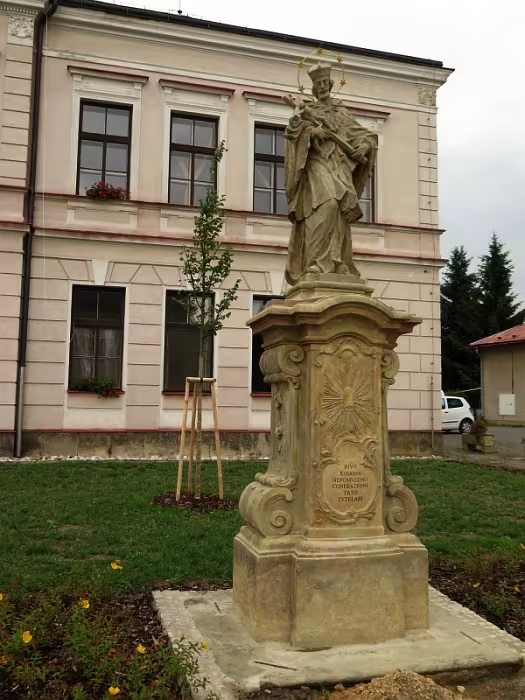

The historical appearance on the left is an AI-generated visualisation and serves as inspiration only.
Historical milestones
- 1771
- The creation of a late Baroque sandstone statue by the Jamberek native Alexi Cyriak.
- 1958
- The statue became a protected real estate cultural monument of the Czech Republic.
- 2014
- Total renovation of the statue has been carried out.
Architectural development
The statue was made of sandstone in a late Baroque style with rich decoration including rokaj medallions and volutes. On the back wall of the pillar there is cartouche with monogram and roasting 1771 A.C. It underwent a total renovation in 2014.
Points of interest
- The statue of 1771 is the work of the Jamberian native Alexia Cyriak. - It is made of sandstone and stands in park design in front of the elementary school building. - Life-size sculpture shows a saint in canovice robes with biret and crucifiks. - Pillar is decorated with rocadian motifs, floral garlands and medallion with Latin inscription. - Since 1958 it has been protected as a real-estate cultural monument and has undergone renovation in 2014.
Guide
Show guide text
This text was created by artificial intelligence and has not been editorially reviewed. It may contain inaccuracies.
Welcome to Lower Black. You have just stopped in a quiet part of this place, in a pleasant park treatment that serves as a green space in front of the building of the local elementary school. You're standing right in front of one of the most important cultural treasures of this town. Before your eyes is a statue of St. John Nepomuk, a monumental work that carries the soul of the past century. Before we go into a detailed viewing, let you just exhale and perceive the atmosphere of this place where history quietly cooperates with the daily life of school and park.
Look at this piece of art. The first one that's likely to charm you is the material. The whole statue is carved out of sandstone. This natural stone has a special warmth and texture that changes depending on how light hits it. Sandstone is a material that carries a trace of time; Its surface is slightly trimmed by quite nature, which gives the character a holy certain human, organic quality. This statue is not just a dead object, it is a living witness to history that has been standing here for over two centuries.
Now try to build the entire history of this work in your eyes. To understand why this statue is so special, we must return to 1771. That was the year this piece of art was finished. We live in a time when the art of Baroque has already begun to change, it has become finer, richer and more decorative. We call it the late baroque. In this period, artists were no longer only seeking monumental, but also constant movement, curves, and rich decoration, which is to keep the visitor's eye bound.
The author of this work is a man named Alexius Cyriak. It was not an unknown stranger, but a native from the nearby Jamberk. This is very important in this memory. It was these local masters who knew their country and their people who created works that became a solid part of the landscape. In 1771, Cyriak added not only his craftsmanship, but also his sense of aesthetics. Thanks to him, we have the opportunity today to admire the work that survived wars, changes in political regimes and centuries of storms.
Let's go together now, step by step, look at exactly what you see. Your eyes can start at the very foundation. The statue stands on solid, square ground. This geometric certainty provides the whole part stability. A low, prismatic base is then placed on this square base. This construction leads your view gradually up to the main part, which is the real peak of artistic expression.
Now look up to the pillar that forms the body of the whole statue. Here the baroque style manifests itself in all its beauty. Notice these crooked lines and decorative elements. Pillar is richly decorated with volutes, which are the elegant, spiral shapes that resemble rolled leaves or waves. Next to them, you'll see the rocajas. These are the typical, decorative shapes that look almost like mussels or organic plant patterns, very characteristic of the late Baroque. This whole pillar is further supplemented by floral garlands, which provide a whole lightness and elegance. And if you look very carefully, you can see the Latin inscription on the pillar, which at that time served as an important medium of information and eternal memory.
And then, in the midst of all this beautiful world, he stands. The statue is life-size, which means when you look at it, it stands before you like a real person. The Holy One is depicted in Canon's robe. Feel the weight and dignity of a substance that the artist could carve into a hard sandstone. He has a biret on his head, which is the typical, quadrilateral hat that was worn by the then spiritual leaders. In his hands he holds the crucifiks, the cross with the figure of Christ, which is a key symbol of his faith and sacrifice for this saint. His whole character radiates peace and a deep spiritual presence.
This man, Jan Nepomucký, is one of the most important figures associated with Czech countries. Even though we're looking at a beautiful statue today, it was a living symbol for people in the eighteenth century.
It is important to remember how much we appreciated this work in modern times. The statue wasn't just a forgotten piece of stone. In 1958 it was officially recognised as a protected cultural monument of the Czech Republic. This means that the state and society have realised its immense value. And in order for this sandstone not to fall in time, a total renovation was carried out in 2014. Thanks to this meticulous restoration, today you see the statue as well as it is. The work that the repairers had to do to preserve the details of volut and softness of the garment was crucial so that this gem could enjoy the next century.
An interesting thing for you is how this sandstone changes during the day. When you look at it in the noon sun, it seems clear and full of details. But when the evening starts to get dark, his shadows extend and the statue gets a more mysterious, even more serious character. It's fascinating how one material can tell such different stories depending on the light.
Now that you've gone all the way from the base to the saint himself, I suggest you stay in this park for a while. See how the statue fits into the surrounding green and how its presence affects the peace of this place. You may realize that even though the world around us is constantly changing, schools are being rebuilt and people are leaving, these stone witnesses to history remain here to remind us of our roots and the art of our ancestors.
Thank you for spending this moment with us and paying attention to this precious monument. We wish you a nice walk through the rest of the park and other interesting discoveries in our surroundings. Goodbye.
Tips for visitors
The best time to visit the statue of St. John Nepomuk in Lower Montenegro is the spring and autumn months.
When visiting the statue of St. John Nepomuk, bring suitable clothes according to the weather as well as a camera to capture a beautiful baroque work. In addition, it may be useful to carry a map or use GPS on mobile devices to orient around.
Photography: The best light for shooting the statue is usually early in the morning or late in the afternoon when the sun is not too high and the shadow effects are less conspicuous.
In the vicinity: Outside the memory itself is the opportunity to visit the primary school, where the statue is located.
Frequently asked questions
Can the monument be visited?
This is a structure in a public space that can usually be seen from outside free of charge. We have not verified that this particular one is freely accessible.
Why is the monument protected?
It is listed in the Central List of Cultural Monuments of the Czech Republic as a cultural monument (register no. 1000139836).
Businesses nearby
Do you run a restaurant, accommodation, shop, museum, rental, wellness or other visitor service near this monument? Show yourself directly to the people heading to it — this is how they will see you in the app and on the web:
Nearby
Městys Dolní Čermná v okrese Ústí nad Orlicí.
Accommodation nearby
Themed route
Thematic cruise route from Lower Black
1.Socha svatého Jana Nepomuckého (Dolní Čermná)
Type: Monuments
Why is it worth a visit: This statue is an important monument that reminds of the life and death of St. John Nepomuk. It is located in the place where the Holy One was executed, which makes it a key historical point for visitors.
2. Church of the Assumption of the Virgin Mary (Lower Montenegro)
Type: Cultural construction
Why is it worth visiting: This church is the center of local religious life and its history dates back to the 13th century. His architecture represents a noble example of the Gothic art that anyone can take.
3. City of Lower Black
Type: Historical Center
Why is it worth a visit: Walk on the streets of the city offers a view of ancient architecture and an opportunity to explore local shops and cafes. It is an ideal place for visitors to stop to relax and appreciate the atmosphere of the small Czech town.
4. Memorial of the fallen in both world wars (Dolní Čermá)
Type: Memorial
Why is it worth visiting: This monument is an important place to remember the victims of both world wars. It's a place where people can stop and remember the historical events that shaped the current society.
5. Natural walk around Lower Black
Type: Walking in nature
Why is it worth a visit: Short walks around the city offer a beautiful view of the surrounding countryside and an opportunity to relax in quiet nature. It's an ideal way to enjoy a place without the need for a long trip.
This route offers a comprehensive view of the cultural and historical wealth of Lower Montenegro.
Seasonal recommendations
Spring: In the spring period, the statue of St. John Nepomuk is decorated with flowers and trees in full bloom, adding a mild and lively atmosphere to the environment. The sun rays illuminate the statue in a strange way, making the room even more colorful. It is recommended to visit at noon when the sun is highest and shines in memory directly. A good idea is to wear light clothes with the possibility of adding a layer for colder moments, because temperature can be variable.
Summer: During summer, the statue appears in bright sunlight, which increases its beauty and attracts the attention of visitors. The natural green paradise around the monument offers an ideal environment for relaxation under sunlight. To visit the statue in the early afternoon or in the evening when the temperature is lighter and fewer people gather here. Don't forget to protect yourself from the sun - you must not miss with a hat and protective glasses.
Autumn: In autumn, the statue is surrounded by coloured leaves that sparkle in changing light. The atmosphere is quiet and friendly, which allows full appreciation of historical monuments. The best time to visit is an early afternoon, when the room is lit by sunlight and leaves are still on the trees. Good clothes should include layers because the temperature can be cold and wet.
Winter: During winter, the statue of St. John Nepomuk appears in a quiet atmosphere covered with snow or ice, adding magic to the place. The sun's rays illuminate the statue in a special way and the trees are without leaves, which further emphasizes the historical appearance of the monument. The best time to visit is in the evening or early afternoon when the sun illuminates the statue in a special way. It is recommended to wear warm clothes and protective shoes with adhesion soles for safe movement on a freezing surface.
Visualizations and artistic views


The visualisations are generated by artificial intelligence and serve as inspiration.
Tips from visitors
No tips yet. Be the first!
Log in and add your tip.
Sources and literature
Photos: Sovicka169 / CC BY-SA 4.0 — Wikimedia Commons. The author and licence also appear when you hover over the image.
Faktickým podkladem tohoto textu byl článek na Wikipedii, jehož autory jsou přispěvatelé Wikipedie. Článek je dostupný pod licencí CC BY-SA 4.0.
Location on the map
More monuments – Pardubický kraj
Show all in the region

Příběhy a pověsti
Legendy, pověsti a příběhy spjaté s touto památkou
Fotografie návštěvníků
Zatím žádné fotografie. Buďte první, kdo přidá fotografii z návštěvy!
Log in a přidejte svou fotografii nebo hodnoťte.
Za ověřenou návštěvu v aplikaci získáte víc bodů — poznáme podle GPS, že jste na místě.
Reviews and comments