



Socha svatého Jana Nepomuckého (Karlovy Vary, 1728) Statue
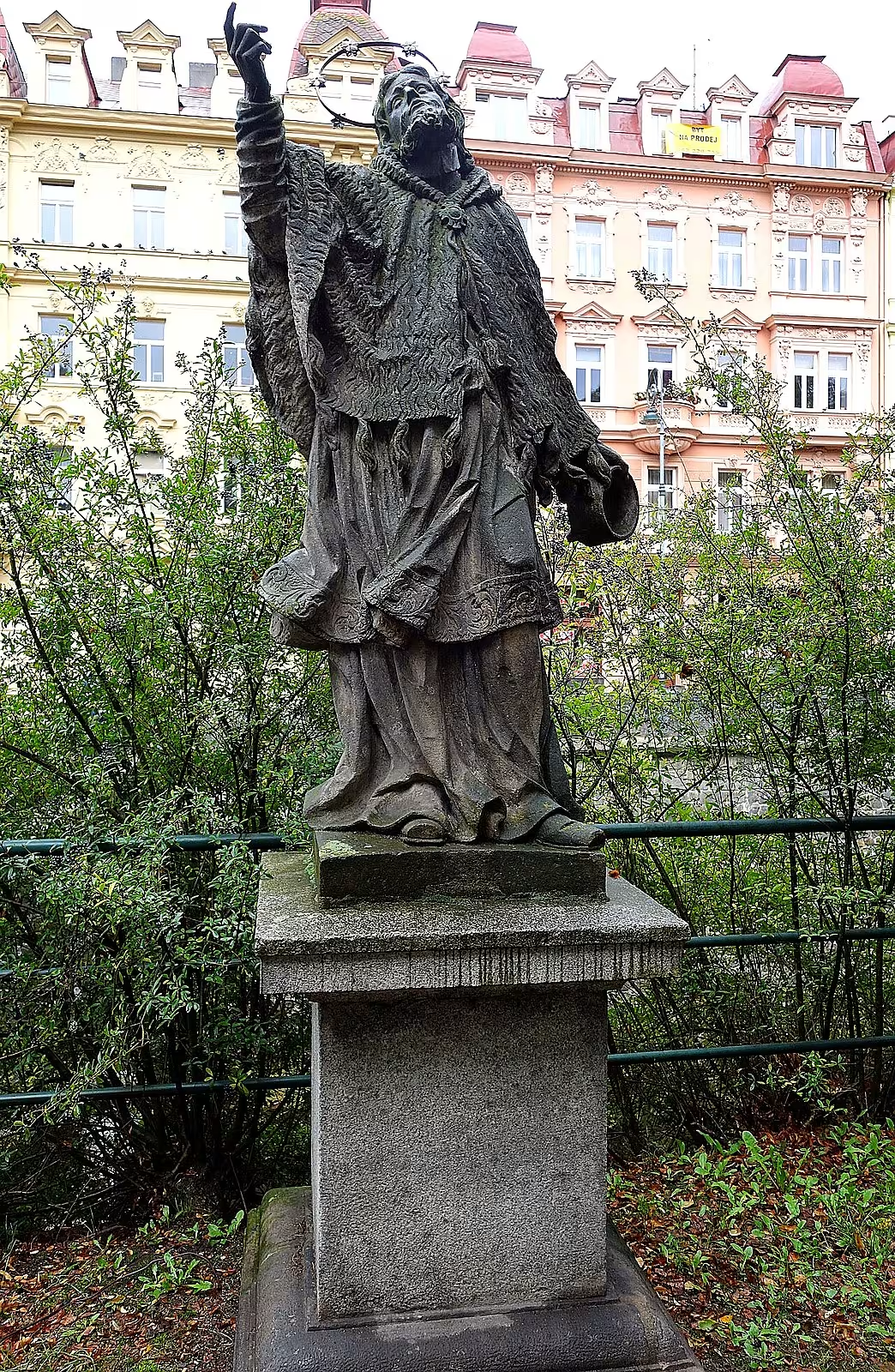
The Baroque statue of St. John Nepomuk from 1728 is a life-sized sandstone sculpture. It is located in Karlovy Vary on the left waterfront of the Teplá River near the school bridge. It is registered as a cultural monument of the Czech Republic and represents a typical example of the sacral sculpture of its time.
The work was created during the period when the Baroque peak in the Czech countries and the cult of St. John Nepomuk reached the highest popularity throughout Central Europe. The statue was donated to the spa city by Countess Maria Markéta Valdštejnova, born Černínová. The artist of the sculpture is not known in historical records.
From the point of view of visual rendering it is a sandstone painting with a height of 1.9 meters. The saint is depicted with plain hair, dressed in canon's clothing, clerics, rochets and alms. His right hand is raised up and his face is facing the sky, his left hand is held down by a biret. There are five stars on the iron frame around the head. Originally, the statue was polychrome. The whole object is on a younger, simple prism pedestal from a sandstone height of 1.05 meters. It has no inscription or relief and ends with a profiled cover plate and a base on a low plinth.
The fate of the statue has been marked by several movements throughout history. Originally, it stood in the centre of the city in the middle of the Janské Bridge near the Vladní colonnade. In 1844, in connection with the reconstruction of the bridge, it was transferred to the northern part of the city, specifically under the Janská Rock, near the František Bridge, to the place where the main post office is now located. In 1902, for the construction of new mail, it was moved for the third time and installed in the current location near the school bridge on the waterfront of the Liberation.
The monument has been protected as a cultural monument since May 1958 or February 1964. In 2019 she passed a complete restaurant. Its costs were estimated at CZK 123 000, and the Karlovy Vary Region contributed CZK 50 000.
Today, the statue is accessible to all visitors as part of a walk along the Tepla River. It represents a valuable historical artifact that reflects the urban development of Karlovy Vary along the way. Its visit offers an opportunity to meet authentic Baroque art in the city centre.
Then and now
Drag the slider to compare how the landmark may have looked when it was built with the view today.
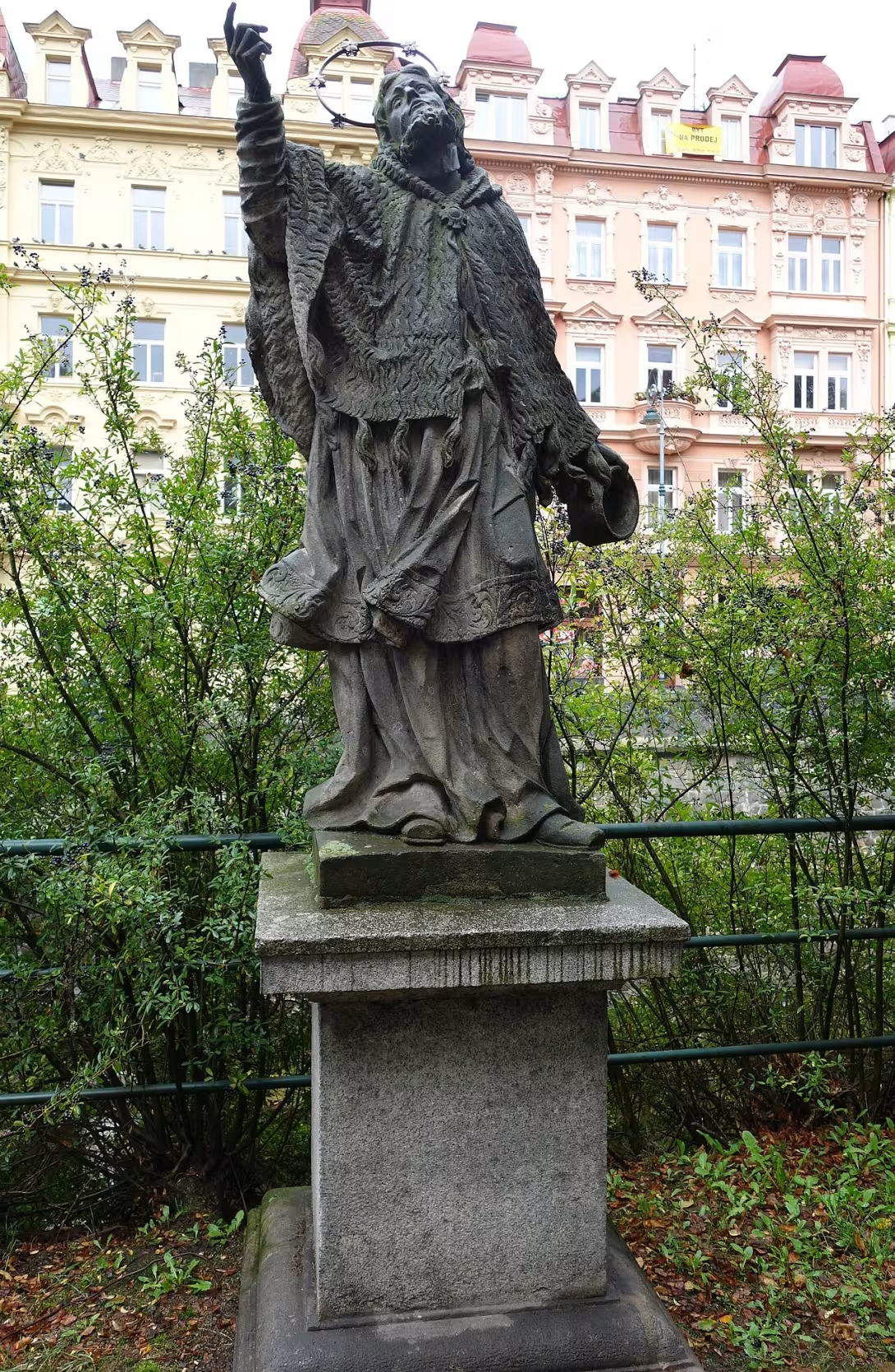
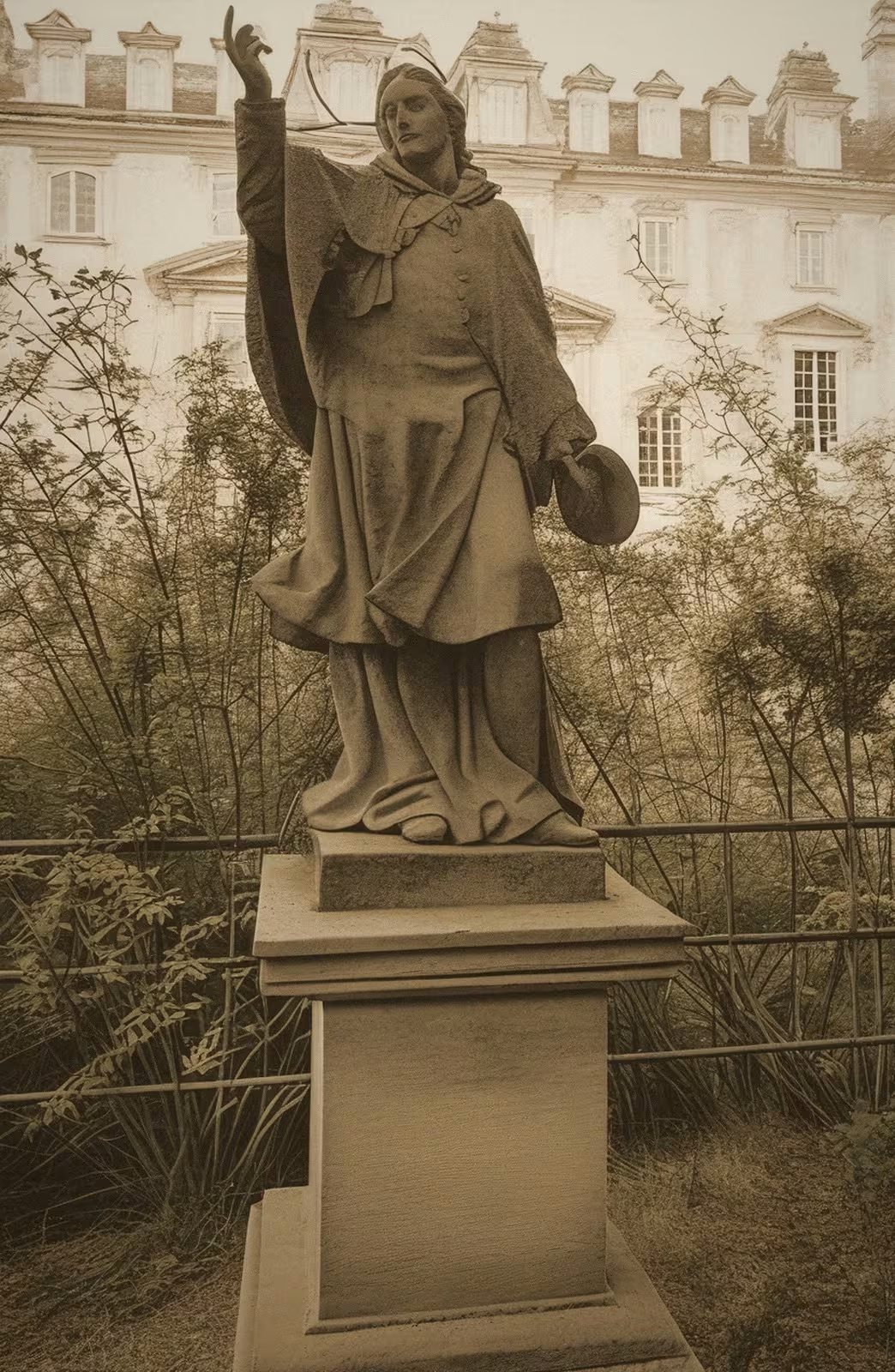
The historical appearance on the left is an AI-generated visualisation and serves as inspiration only.
Historical milestones
- 1728
- formation of the statue
- 1958
- declaration for cultural monument
- 2019
- restoration of the statue
Architectural development
The sandstone sculpture was originally polychrome. It stands on the younger simple prism pedestal of a sandstone height of 1.05 m In 2019 it passed a modern restaurant.
Historical events
1844 transfer of the statue near the František Bridge, 1902 transfer to the present place near the school bridge, 2019 complete restaurant statues.
Points of interest
- Life-size sandstone sculpture was donated to the city by Countess Maria Margaret Valdstein. - Five stars are placed on the iron frame around the holy head and the statue was originally performed in colour. The author of the work is not known in historical records. - The statue has been moved three times throughout history, originally in the middle of the Jansky Bridge. - In 2019 it passed through a complete restaurant to which the Karlovy Vary Region contributed.
Guide
Show guide text
This text was created by artificial intelligence and has not been editorially reviewed. It may contain inaccuracies.
Welcome to Karlovy Vary. Right now, you're standing on the left waterfront of the Tepla River, near the school catwalk, and in front of you is one of the silent but significant ornaments of this city. Look at this catchy figure who welcomes you with his calm expression. It's a statue of St. John Nepomuk carved from a life-sized sandstone. It is a work that brings to space a sense of stability and spiritual peace, and yet it carries the traces of many decades of history.
Now, let's stop a little bit by the way this statue actually moved here and who was behind it. The year is written seven hundred twenty-eight when this sandstone works. But it wasn't the work of chance or city plan, but it was a generous gift. The statue was donated to the city of Countess Marie Markéta Valdštejnová. At that time, it was customary that noble families supported the development of cities with the kind of gifts that were meant to serve to honor faith while also decorating public space. Imagine what this statue looked like at the time of its discovery nearly 300 years ago, when it was a new addition to the waterfront at that time.
Now pay attention to the specific details that you see right in front of you. Notice the careful processing of the figure. The saint is depicted in a traditional canovnik's garment, which gives him dignity and powaho knuklad. Look closer at his left hand, in which he holds a biret, a typical priesthood hat. It's a detail that highlights his social standing and his role in the church. But the most striking element that immediately attracts the sight is a five-star placed around his head. These stars are fixed on an iron frame and form a symbolic sanctuary just around the holy face. It is a very typical element to depict this particular saint, which symbolizes its purity and celestial glory.
When we think about the personalities associated with this place, we return to the already mentioned Maria Margaret Valdstein. Her name was tied to this statue as a symbol of city care. It is fascinating to think that even though the artist himself, who worked the sandstone with such precision, remained unknown in historical records, his work survived for centuries and still stands here. It's a reminder that some of the most beautiful things in our neighborhood were created by people whose names were erased by time, but their craft remained.
Now I want to impress you with one interesting thing, which may not be visible at first sight. If you look at today's surface of sandstone, you see the natural color of the stone. But know that this statue was originally made in color. Imagine what it would look like in rich colors, how the details of the robe would stand out and how the stars would shine around the head. It was a completely different visual experience that matched the period aesthetics. Another secret to this statue is its path in space. Even though he is now standing firmly at the school bridge, throughout history, this sculpture has been moved three times. Every transfer told a new story about how the city changed, how the roads regrouped and how the perception of this space changed.
This statue also passed modern time trials. In the year one thousand nine hundred fifty-eight it was officially declared a cultural monument of the Czech Republic, which provided it with legal protection. And since sandstone is a material susceptible to the effects of weather and moisture from a nearby river, it was necessary to take care of it. A few years ago, in the year two thousand nineteen, the statue went through a thorough restoration. That's why today you can admire the details of her robe and facial expression in such good condition.
If you look at St. John Nepomuk for the last time, see him not only as a stone statue, but as a witness to the history of Karlovy Vary. It is a link between the baroque times, noble gifts and today's modern city. He's a quiet waterfront guard who encourages us to stop and think in the middle of a daily rush.
Thank you for stopping by this beautiful monument. Now I invite you to continue to explore the banks of the Tepla River and discover other hidden corners of this beautiful city. Let yourself be guided by the atmosphere of Karlovy Vary and enjoy every moment you spend in this historic space. See you at the next stop.
Tips for visitors
The best time to visit is early morning or shortly before sunset, when the light is finer and baroque details of the sandstone sculpture better stand out. Thanks to the location in the city centre, the location is available by car and public transport; Check the current connection in the search engine.
You don't need any special equipment to search, you just need comfortable shoes to walk around the city. We recommend you take the camera with you because the life-sized statue offers beautiful details of canoeing clothing.
For the best pictures we recommend looking for an angle from the vicinity of the Teplá River or from the school catwalk. The reflection in the water and the surrounding architecture of the centre of Karlovy Vary is the ideal setting to capture this monument.
During a short walk in the surrounding area you can visit the Tepla River, cross the school bridge or walk through the centre of Karlovy Vary. All these places are located close to the statue.
For families with children, the visit is easy because it is an object in public space. Children can observe the details of sandstone processing and explore the surroundings of the river, making the visit a pleasant walk in the natural environment.
Frequently asked questions
Can the monument be visited?
This is a structure in a public space that can usually be seen from outside free of charge. We have not verified that this particular one is freely accessible.
Where is the monument?
Location: Karlovy Vary. The map on this page shows the exact spot.
Why is the monument protected?
It is listed in the Central List of Cultural Monuments of the Czech Republic as a cultural monument (register no. 1000157805).
Businesses nearby
Do you run a restaurant, accommodation, shop, museum, rental, wellness or other visitor service near this monument? Show yourself directly to the people heading to it — this is how they will see you in the app and on the web:
Nearby
řeka Teplá, Školní lávka, centrum Karlových Varů
Accommodation nearby
Trips and activities nearby
Guided tours, tickets and activities nearby from GetYourGuide
Affiliate link: if you buy from the partner, we may receive a commission. The price for you does not change.
Search tours and activities →Themed route
Here is the design of the thematic route:
1. Centre of Karlovy Vary (area) - The starting point of the journey where you can feel the atmosphere of the spa city. 2. Statue of St. John Nepomuk (statue) - The main destination of the trip from 1728, which represents an important work of art of its time. 3. School bridge (bridge) - A place for a short rest and a view of the surrounding countryside. 4. River Hot (Water flow) - Walk along the shore that offers peace and connects all the points of the route.
Seasonal recommendations
In the spring, the surroundings of the statue awaken to life and the fresh green creates a gentle contrast to the historical stone. We recommend a visit in the morning when the light is soft and pleasant. Due to the variable weather conditions, it is advisable to choose layered clothes and not be folded.
Summer brings a bright sun that highlights the details of the statue, but also the largest number of people on the streets. The best time for a tour is an early morning or a late evening when the air is colder and the surroundings are quieter. Don't forget light clothing and sun protection.
Autumn is the atmosphere of the city melancholic and the colours of the leaves in the surroundings complement the patina of the monument. The light is golden in this period, which is ideal for capturing the beauty of the object. We recommend shoes suitable for colder surfaces and a light coat against the wind.
In winter, the statue is very noble in silence and frost, especially if it is covered by a layer of snow. The tour is short at this time, therefore it is necessary to wear warm winter clothes, gloves and a hat. You'll feel the most atmosphere in advent time in the evening lighting the city.
Visualizations and artistic views


The visualisations are generated by artificial intelligence and serve as inspiration.
Photos from the area
Real photos taken near the monument

Zdroj a licence jsou uvedeny u každého snímku.
Tips from visitors
No tips yet. Be the first!
Log in and add your tip.
Sources and literature
Photos: Kürschner (talk) 21:18, 10 October 2016 (UTC) / Public domain — Wikimedia Commons. The author and licence also appear when you hover over the image.
Faktickým podkladem tohoto textu byl článek na Wikipedii, jehož autory jsou přispěvatelé Wikipedie. Článek je dostupný pod licencí CC BY-SA 4.0.
Location on the map
More monuments – Karlovy Vary
Show all in the municipality
Příběhy a pověsti
Legendy, pověsti a příběhy spjaté s touto památkou
Fotografie návštěvníků
Zatím žádné fotografie. Buďte první, kdo přidá fotografii z návštěvy!
Log in a přidejte svou fotografii nebo hodnoťte.
Za ověřenou návštěvu v aplikaci získáte víc bodů — poznáme podle GPS, že jste na místě.
Reviews and comments