






Šostýn Castle
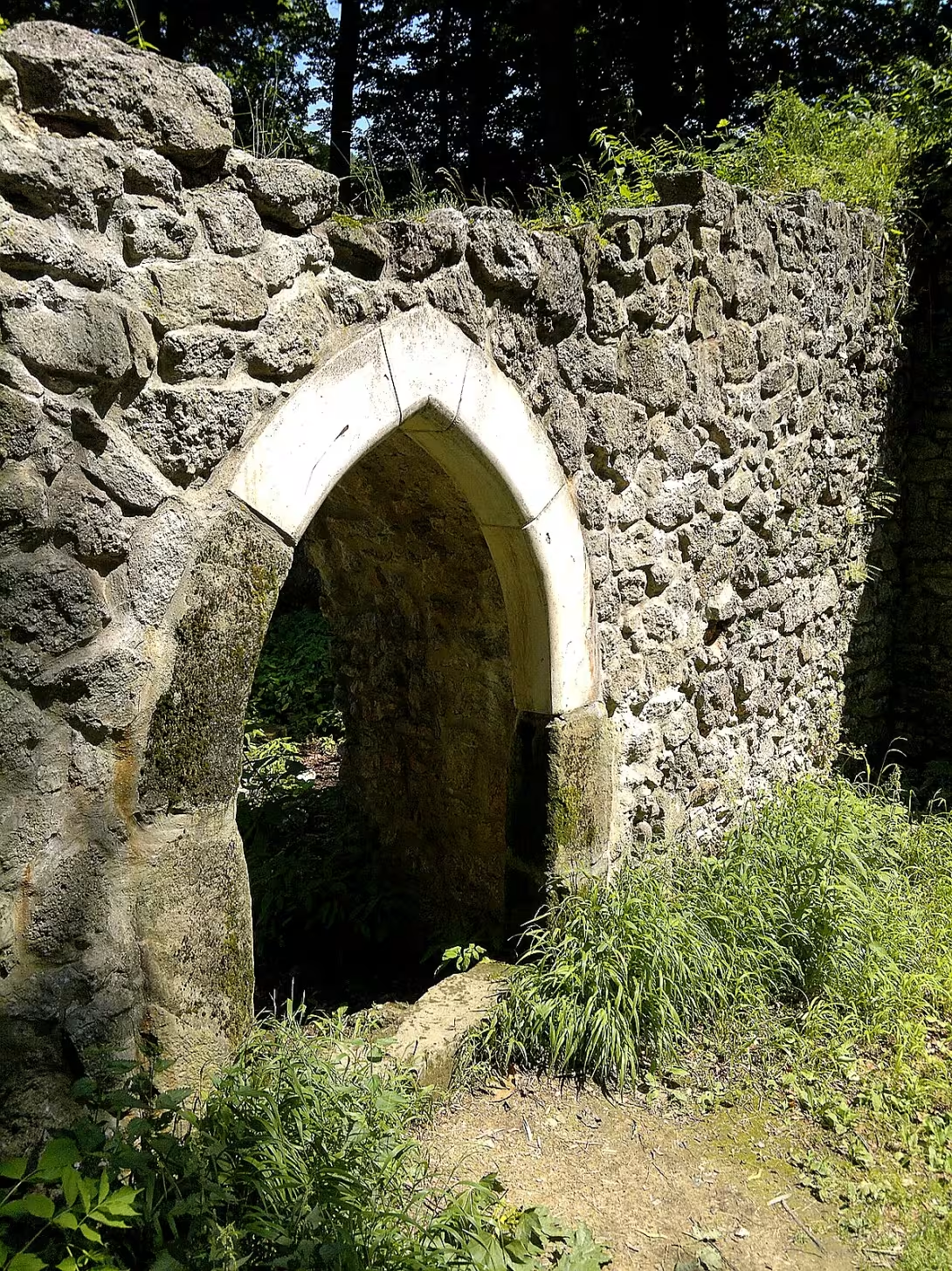
The ruin of Castle Šostýn (German Schauenstein) is located 1.5 km southeast of Kopřivnice in the Moravian-Silesian Region. The castle stands on the hill at a height of 442 meters above sea level, where the southwest and west slopes are very steep, while from the north and east side the terrain gradually passes to the platform with the pond. From an architectural point of view, it is possible to see the exposed foundation of the bergfrit and the remains of the cellar space of the palace, which have been partially renovated. You can also see the remains of entrance structures, scattered walls and landscaping in rocks and in the country. The castle is protected as a cultural monument and its premises are freely accessible to the public.
The exact date of creation of the castle remains uncertain; it is assumed to have occurred during the period 1280-1290. The location at that time belonged to the House of Hückeswagen and the castle was built at the request of Count Jindry of the House of Hückeswagen. From the end of the 13th century to the first half of the 15th century the castle served its purpose. The oldest written mention dates back to 1347, when the castle and Hukvalds were owned by Olomouc Bishop John VII. Volka, illegitimate son of Václav II.
During the 14th century, several owners gradually accepted the castle. Before 1354, the Bishop of Olomouc Jan Očko of Vlashimi donated it to Alšík from Fulštejn. Later he became property of the family of the Vikstejn; around 1382 it was driven by Vitek from Vikštejn along with his brothers Václav and Bernard. During this time the castle changed owners - bishops, earth lords and nobles took turns. In 1396, the Bishop of Olomouc stopped him from defending Jošt of Volfsberg during the conflict between Margrave Yošt of Moravia and Prokop of Luxembourg. In 1400, the estate was transferred to Zikmund to Luxembourg, which soon passed it on to the Moravian Castelan Jurka of Messenpek.
In the 15th century, various nobles gradually competed for Šostýn. Around 1402, a robbery group settled in the castle. In 1405, Záviš of Vikštejn renewed the legal process of returning the castle; was returned to him three years later by Bishop Conrad of Vecht. The following years were full of controversy and disunity - between 1408 and 1412 Zviš's brother Václav died, and the castle gradually came under the control of Nicholas Sokol of Lamberk. When he didn't get his property, he complained several times to the Bishop's court about holding the castle by force. Around 1420, a final clash broke out - the bishop's army under the leadership of John XII. The iron was finally attacked, the castle in the possession of Nicholas Sokol was conquered and destroyed. This ended the active phase of the castle; His remains are evidence of zealous noble disputes and political conflicts that tormented the Moravian nobility from the 14th to 15th century. / p >
Then and now
Drag the slider to compare how the landmark may have looked when it was built with the view today.
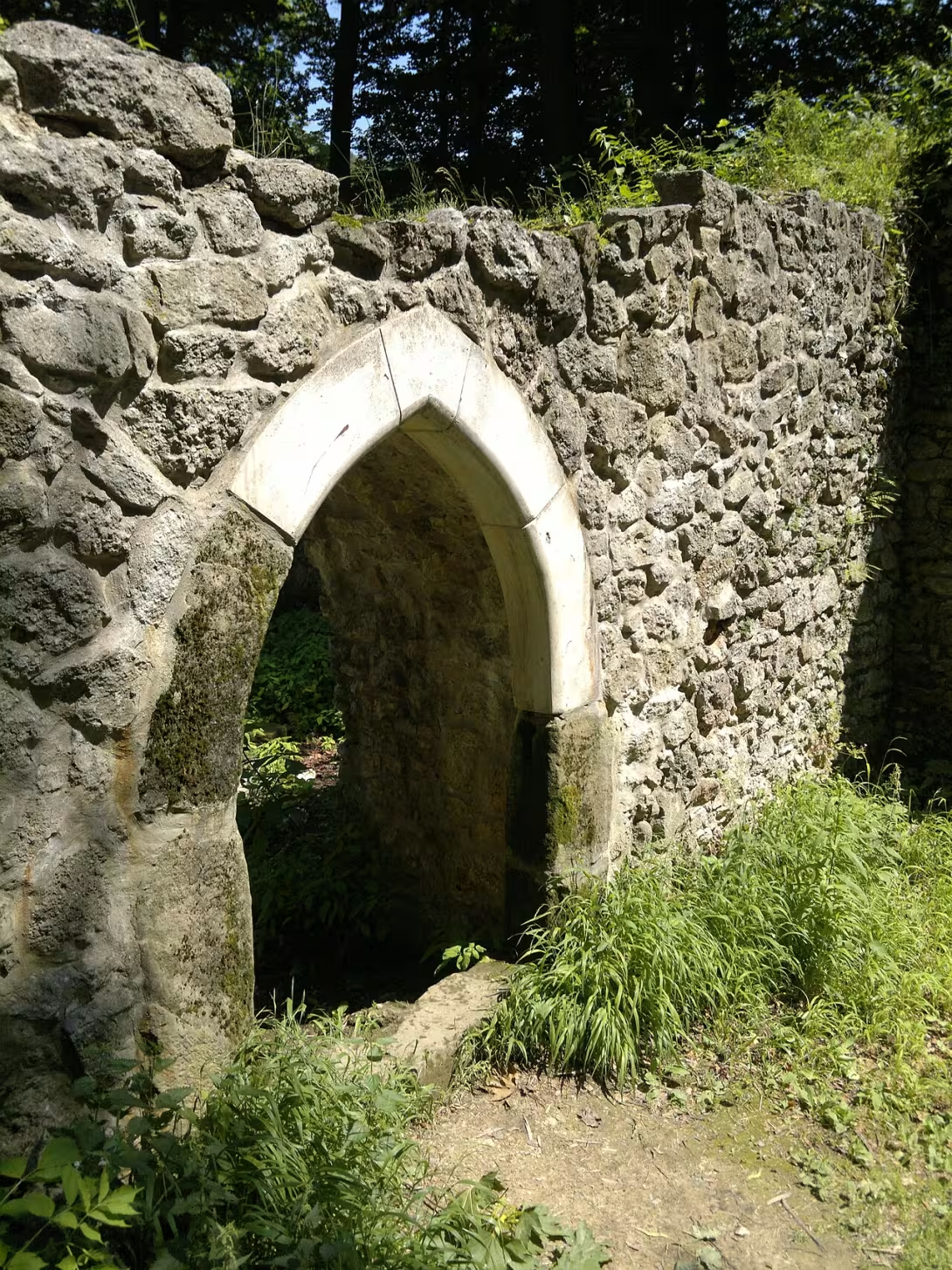

The historical appearance on the left is an AI-generated visualisation and serves as inspiration only.
Historical milestones
- 1280
- Estimated start of construction of the castle.
- 1347
- The oldest written mention of the castle.
- 1403
- Burning the castle with Polish soldiers.
- 1420
- Conquering the castle with the bishop's army John XII.
Architectural development
The castle was built as a construction of the bergfrit type on a shackle. The remnants of the castle walls were preserved, fortification of the castle and basement of the palace. The whole complex died in the first half of the 15th century.
Historical events
In 1403, the castle was burned down by soldiers of the Polish King Vladislav II. Jagellona after the Polish robbers settled here. Around 1420, the castle was conquered by the troops of Bishop John XII. Iron.
Owners
Rod from Hückeswagen (end of 13th century), Jan VII. Volka (1347), Alshik from Fulštejn (before 1354), Vítek from Vikštejn (from about 1369), Závish from Vikštejn, Mikuláš from Rýzmburk, Jošt from Volfsberk (zástavu 1396), Zikmund Lucemburský (zástavna 1400), Jurko from Messenpek (pav 1400), Vaněka from Lamberk and Bříník (about 1413), Mikuláš Sokol from Lamberk (after 1418).
Points of interest
- The castle stands on the hill at a height of 442 meters above sea level with very steep southwest and western slopes. - On site you can see the exposed base of the bergfrit and partially renovated remains of the cellar space of the palace. - The oldest written mention of the castle dates back to 1347. - Around 1402, a robbery group settled in the castle. - The castle was built around 1420 and was destroyed by an army under the leadership of John XII. Iron.
Guide
This guide is narrated by a synthetic voice generated by artificial intelligence.
Show guide text
This text was created by artificial intelligence and has not been editorially reviewed. It may contain inaccuracies.
Welcome to the ruins of Castle Šostýn. You are standing right where time has stopped and where nature is trying to slowly but relentlessly reclaim what once people with great effort and sweat have excelled high up the hill. Look around you. At first glance, you may find it just broken stones and unclear contours in the landscape, but try to look at them differently. Imagine this peak not as an empty place, but as a fortified fortress that once dominated the whole area and which everyone in the surrounding valleys avoided with respect and fear. Feel the atmosphere of peace, but it is contrary to the stormy past this place has experienced. You are standing on a hill that now surrounds you with its height and inhospitality, and it was here, in the heart of Moravian Silesia, that events were taking place that affected the fate of many generations and whole nations.
Let us now return together deep into the past to understand why this castle was built in the first place. It is estimated that the first stones of this castle were already laid around 1280. At that time, it was necessary to have fixed points of control, places that could serve as a strategic position in constant changes to the political map. Šostýn was not just an ordinary residence, it was a Bergfrit castle, which means that its main element was a massive, independent tower, which was intended to serve as the last refuge and symbol of resilience. Although we do not know the exact name of the builder, we know that the castle must have been the work of very competent architects who were able to use demanding terrain to create an almost impenetrable fortress. The first real clue in history, which confirms to us that the castle was already fully functioning and was part of the world at that time, is found in 1347. This is the oldest written mention we have of this place, and it serves us as a fixed point in a sea of vague legends. The castle remained here and performed its function until the first half of the 15th century, when the fate of this place began to change drastically.
Now pay attention to what is right in front of you and what you can see while walking. Although the castle is now a ruin, its basic skeleton is still visible. Look at the stone remains that stand out from the ground. What you see is the foundation of the bergfrit itself, the main tower that once set its height to heaven and was the heart of the castle. If you look closer to the places where the remnants of the walls extend, you can perceive the extent of the entire estate. Note also the exposed spaces that once were the basement of the palace. These basement spaces you see here are partially renovated, giving us a sense of what life looked like inside the castle. Even though there are no ceilings or walls to protect you from the rain, these stone shapes still tell us how the buildings were organized and how deep down the ground the builders had to dig to create solid foundations for their mansion. Feel the structure, the logic with which these stones were stored in the ground.
But Šostýn's history was not just a history of building and stability. It was a castle that was constantly perceived as a target, a symbol of the power that was fought for. And these fights were very bloody. Imagine 1403, when smoke and chaos spread over this hill. Polish soldiers burned down the castle, which meant a great destruction for the people of the time and for the very structure of the castle. But that wasn't all. Only a few years later, in 1420, the castle became the target of another conflict. He was conquered by the army of Bishop John XII. Iron. This period was characterised by a constant struggle of power in Moravia, where the interests of powerful generations, churches and aristocratic factions clashed. In these conflicts, figures such as Jan VII. Volka or Zikmund Lucemburský and later Vladislav II. Jagello often appeared. Each of these personalities has left a shadow in the history of this place, even if they don't have to write names in these stones. Šostýn was at that time part of a chessboard on which the borders and influences in the whole area were decided.
Now I want to invite you to think of one particular thing that makes this place so fascinating. Notice how the castle uses its location. It stands on a hill at a height of 442 meters above sea level and its slopes are incredibly steep, especially those towards the southwest and west. This natural protection was great for defense, but it also made the castle a place that was very difficult to supply and life. In addition, around 1402 a group settled here, which gave this place an even darker touch. It was a period when robbery broke down around the castles and forests. Šostýn was at that time a place where the border between the mighty nobility and the dangerous hiding place for people outside the law was wiped. This turbulent era, when power stopped following rules and replaced brute force, is felt in every stone of this ruin. It's the mystery that makes us wonder how many secrets these remains still hide under a layer of earth and moss.
Now that you know a little more about what this castle used to be and what went through its history, I suggest you continue your tour. Take a walk along the remaining walls, see the wind still blowing so hard on the hill, and try to imagine the times when there were rumbling hammers, shouting soldiers and the silence of night watch services. Let yourself be carried away by the atmosphere of this place, which, even in its present form as a ruin, can still be astonished. Thank you for choosing to visit Šostýn and for wanting to learn more about this piece of Moravian history. We wish you a pleasant walk and many other interesting experiences while exploring our sights. We'll say goodbye, but we believe the memory of this castle will remain within you.
Tips for visitors
The best time to visit the ruins Šostýn is in the spring or autumn season when vegetation is less dense and clarity is better. In addition, temperatures are comfortable for long walks. In summer it is recommended to visit morning or evening to avoid strong sunlight.
Parking is available near the ruins. You can also use public transport and take a bus or tram to take you to Kopřivnice. Check the current connections before travelling.
When visiting the ruins of Šostýn it is good to take with you shoes suitable for walking on irregular terrain, protective sunglasses and plenty of drinking water. Also remember the hat or umbrella according to current weather.
For photography is the best place ruin itself, especially in the early morning or evening when light is softer and shadow effects are stronger. The views of the surrounding landscape are also ideal for panoramic images.
In the vicinity of the ruins Šostýn there is a pond that is suitable for short walks or picnics. It's a place where you can enjoy a quiet moment in nature.
Frequently asked questions
Is Šostýn open to the public?
Šostýn is accessible to the public, but only after agreement with the heritage manager. We recommend contacting the administration in advance to ensure access to the premises.
How do I get to the place by car / public transport?
The nearest public transport stop is in the nearby town of Frýdek-Místek. Here you can change to the bus that will take you to Castle Šostýn.
How much is the entrance fee and is it paid on the spot?
Admission is paid on site, the current price list can be found on the official site of the sights.
Is the tour suitable for children and seniors?
Yes, the tour of castle Šostýn is also suitable for families with children. The area is relatively small and accessible by stairs, so there should be no problem for the elderly or small children.
How long does the tour take?
The tour of the castle Šostýn takes approximately 1-2 hours. It is recommended that we divide it into two parts so that it can be sufficiently oriented on the premises.
What are the opening times and booking is required?
Šostýn is only accessible to the public in agreement with the heritage manager. We recommend contacting the administration in advance to ensure access to the premises.
What's interesting in the immediate vicinity?
In the immediate vicinity of castle Šostýn there are forests and fields. If you like natural walks, we recommend visiting a nearby nature reservation.
For kids
Imagine going back to when the beautiful castle Šostýn was in this place! It was really amazing places where the earls and their families lived. The castle was built in the 14th century and served as an administrative center of the estate.
Who would have thought there were big economic buildings here? Or that there was a large garden full of fruit trees and medicinal herbs? Castle Šostýn was an amazing village with many houses and yards. But there were also strong walls to protect the people from their enemies.
Businesses nearby
Do you run a restaurant, accommodation, shop, museum, rental, wellness or other visitor service near this monument? Show yourself directly to the people heading to it — this is how they will see you in the app and on the web:
Nearby
The castle is located 1.5 km southeast of center Kopřivnice at a height of 442 m above sea level, near the pond on the platform.
Accommodation nearby
Themed route
Thematic cruise route around the ruins Šostýn
1. The ruin of castle Šostýn Type: Historical monument Why is it worth a visit: Interesting to explore the history and legends associated with this ruin, located in a picturesque environment 1.5 km southeast of center Kopřivnice. It's the perfect place for those who love history and nature.
2. Pond at Šostýna Type: Natural space Why is it worth a visit: After exploring the ruins you can disconnect for a quiet moment near the pond, which is near the castle. It's a perfect place to relax and observe the wild in the surrounding countryside.
3. Tank ruins Šostýn Type: Historical area Why is it worth a visit: Visiting splendor offers a view of the range and architectural elements of the ruins. It is an ideal place to understand the historical importance of the castle and its role in the past.
4. Tower of ruins Šostýn Type: Historical construction Why is it worth a visit: The appearance of the tower provides a view of the surrounding landscape and other parts of the castle. It is an unforgettable experience place for those who enjoy panoramic views.
5. Parking space for Šostýna Type: Infrastructure Why is worth a visit: Provides comfortable access to the ruins and other points of the route. It is an ideal place to park a car from which you can easily connect to other parts of the trip.
This route offers passengers a comprehensive impression of the historical and natural wealth of the area around the ruins of Šostýn.
Seasonal recommendations
Spring: In the spring season, the ruins of Šostýn are revived by flowers and new foliage, which add a living color to the ruins. Sunshine days provide ideal conditions for photographing and exploring historical remains in mild light. Visitors should be prepared for sudden weather, because the spring wind can quickly change the climate. It is recommended to visit early days of the week or Sunday morning to avoid a medieval crowd of tourists. A good choice of clothes is a warm dress and a bright hat to protect from sunlight.
Summer: In summer months, the Šostýn ruin is a popular destination for tourists, leading to a higher number of visitors. Sunny days and warm night atmosphere bring a romantic mood that is perfect for night walks. In addition, local green vegetation provides escape from summer heat. To ensure comfort it is recommended to visit early in the morning or late in the evening when there is a milder temperature and fewer people. It is advisable to wear light clothes, sunglasses and plenty of fresh fresh water.
Autumn: In autumn months, the Šostýn ruins offer a unique atmosphere with colour foliage and temperate temperatures. Sunshine days are ideal for exploring historic ruins, while wet autumn evenings add melancholy to the environment. Visitors should be prepared for a sudden rainy time and, if possible, bring protective clothing. The best time to visit is on Sunday or middle days of the week when there are fewer people. It is recommended to wear a warm dress and a clear hat.
Winter: During winter, the ruins of Šostýn offer peaceful walks in the snow environment, bringing a unique atmosphere and view. Sundays are ideal for shooting and exploring ruins without a crowd of tourists. However, it is important to note that open parts can be closed due to weather and visitors should prepare for cold temperatures. It is advisable to visit on the early days of the week when there is a more moderate crowd of visitors. It is recommended to wear warm clothes, including fur coat and protective shoes, and to carry drinking fresh water or hot drink to maintain thermal comfort.
Visualizations and artistic views


The visualisations are generated by artificial intelligence and serve as inspiration.
Photos from the area
Real photos taken near the monument


Zdroj a licence jsou uvedeny u každého snímku.
Tips from visitors
No tips yet. Be the first!
Log in and add your tip.
Sources and literature
Fotografie: Tedmek / CC BY-SA 3.0 — Wikimedia Commons. The author and licence also appear when you hover over the image.
Faktickým podkladem tohoto textu byl článek na Wikipedii, jehož autory jsou přispěvatelé Wikipedie. Článek je dostupný pod licencí CC BY-SA 4.0.
Location on the map


Příběhy a pověsti
Legendy, pověsti a příběhy spjaté s touto památkou
Fotografie návštěvníků
Zatím žádné fotografie. Buďte první, kdo přidá fotografii z návštěvy!
Přihlaste se a přidejte svou fotografii nebo hodnoťte.
Za ověřenou návštěvu v aplikaci získáte víc bodů — poznáme podle GPS, že jste na místě.
Reviews and comments