






Sousoší Nejsvětější Trojice (Loket) Holy trinity column
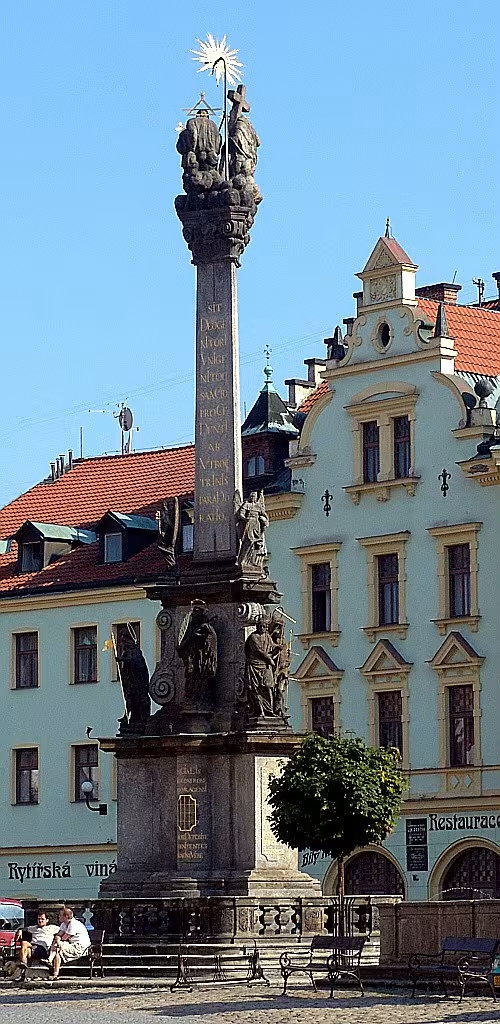
The statue of the Holy Trinity, also known as the pestilence column, is a Baroque sculpture work in the historical core of Lokte in Sokolov district. The monument was completed in 1719. It represents an important proof of Baroque piety and regional sculpture and since 1963 it has been protected as a cultural monument.
The creation of the column was accompanied by complicated disputes between the city council and a number of sculptors, which led to repeated changes in the job. The original contract was concluded in November 1716 with the Cheb sculptor Peter Anton Felsner, but the town decided to hold a competition. It involved Johann Karl Stilp from Waldsassen and the yellow sculptor Oswald Josef Wenda. Although the written contract is missing, the contract was eventually awarded by Johann Karl Stilp. The stone work was performed by local master Martin Lambacher with son Sebastian. Historical sources suggest that the main sculptor has been replaced after finding the defects based on an assessment by Osvald Josef Wendy. On 14 November 1718 a new contract was concluded with Jáchymov artist Johann George Grobisch, who created the top sculpture and city emblem. The reason for the exchange was probably economic disagreements, non-compliance with deadlines or doubts about quality of execution. The column was completed in the autumn of 1719 and ceremonially consecrated on November 12 by the Cheb commendator Pellet.
The architecture of the work is conceived into a triangular plan that symbolizes Christian tripartite. The building is surrounded by stone railing with balustrations. The three-sided base ends with a profiled ledge, on whose ribs stands the statues of St. Wenceslas, St. Florian, St. John the Baptist, Virgin Mary the Immaculata, St. John the Nepomuk and St. Shebestian. Above them is a plinth decorated with volute wings, on which are placed statues of archangels Michael, Gabriel and Rafael. The tall triangular column itself carries the Latin texts of prayer and culminates in the statues of the Holy Trinity with a cross and a star. The construction used a combination of grey granite on stages and non-commercial parts of the plinth, while sculptures and balustrations are made of fine grain sandstone.
Over the centuries, the monument has undergone several repairs. The first renovation took place in 1835, followed by work in 1873- 1875 and in 1908 when the restoration was carried out by the Cheb sculptor Karl Wilfert. Another comprehensive reconstruction took place in 1959 and the last major intervention took place in 2001. For his work he received Johann Karl Stilp 329 gold, while Johann George Grobisch was paid 140 gold for the top sculpture.
Today, the sculpture forms an invisible dominant feature of the historical center Lokte. Visitors can appreciate the technical complexity of baroque sculpture and the historical importance of the building, which reflects the period religious culture and the pursuit of visual expression of faith. The monument is freely accessible in the public area and represents an objective which should not miss any interested people in the history of the region.
Historical milestones
- 1716
- Making a deal with Cheb sculptor Peter Anton Felsner.
- 1718
- Making a deal with Jáchymov sculptor Johann George Grobisch.
- 1719
- The completion of the building and the ceremonial consecration of the column.
- 2001
- The last complex restoration of the monument.
Architectural development
The column was built from a combination of grey granite on degrees and fine grain sandstone on sculptures. During the 19th and 20th centuries he underwent several renovations, while the last complex restoration took place in 2001. The floor plan of architecture is divided into motif triangle with balustran railing.
Historical events
1716: Conclusion of the first contract for the construction of the column. 1719: Completion and festive consecration of the column. 1963: Declaration for cultural heritage.
Points of interest
- The sculpture is also known as a pestilence column and since 1963 it has been protected as a cultural monument. - The creation of the work was accompanied by complicated disputes between the city council and sculptors which led to repeated changes in the job. - The architecture of the work is conceived into a triangular plan that symbolizes Christian tripartite. - A combination of grey granite on stages and fine grain sandstone on sculptures and balustrations was used during construction. - For his work, Johann Karl Stilp received 329 gold pieces while Johann George Grobisch was paid 140 gold pieces for the top sculpture.
Guide
Show guide text
This text was created by artificial intelligence and has not been editorially reviewed. It may contain inaccuracies.
Welcome to one of the most remarkable monuments of Loket. You are standing in front of the baroque sculpture of the Holy Trinity, also known as the Pestilence, which is the true dominance of the historic core of this beautiful city. This architectural jewel will immediately appeal to you with its beauty and complexity of a form that boasts symmetry and harmony.
Let's dive into the history of this work. The sculpture was completed in 1719 and is the fruit of cooperation between several prominent personalities of that time. In 1716, the City Council concluded a contract with Cheb sculptor Peter Anton Felsner, which was later transferred to Jáchymov sculptor Johann George Grobish. This development was not without problems; complicated disputes between the city council and artists have led to repeated changes in the performance of the contract. In 1963, the sculpture was recognised as a cultural monument, which proves its historical and aesthetic value.
Look up at the triangle plan of the column. This form is not random; symbolizes the Christian trio that the column celebrates. At the top you will notice sculptures involving figures of saints and archangels, the highest part being the sculpture of the Holy Trinity itself. This detailed description is proof of the artistic fervor and the sculptor championship who participated in the creation of this column.
The key personalities associated with this monument are not only mentioned Felsner and Grobisch, but also architects Johann Karl Stilp, Martin Lambacher and Sebastián Lambacher. Each of them contributed his artistic view to this important work. It is interesting to note that even when the column was completed, disputes and debates about its appearance and function continued, suggesting its fundamental importance to the local community.
It is interesting that the sculpture has been a symbol of resistance and faith for centuries. Although it originally appeared as a pestilence, its importance to the local population grew and became a beautiful monument that attracts visitors from all over the world. The last comprehensive restoration took place in 2001, which ensured its preservation for future generations.
Now that you have learned about the origin and history of this column, I can invite you to further explore Loket. The city offers many other attractions and beautiful examples of architecture. I hope you enjoyed this place and its history. When we meet at the next stop of our journey!
Tips for visitors
For a visit, choose the morning hours during the working week when the square is quieter and avoid crowds of tourists headed for the castle. The statue is accessible freely, so you can see it at any time without limitation. You can reach the city by car or public transport, and parking is possible on reserved areas within walking distance of the historical centre. Remember to wear comfortable shoes because the streets are paved with cat heads. For photographers is the best light in the morning when the sun lights up the front of the column; The best pictures can be taken from a slight perspective from nearby historical houses. In the immediate vicinity of the sculptures there is Loket Castle and the Ohře River, which offer beautiful walks for the whole family, with children especially appreciating the space of the historical core of the city and the views of the castle fortification.
Businesses nearby
Do you run a restaurant, accommodation, shop, museum, rental, wellness or other visitor service near this monument? Show yourself directly to the people heading to it — this is how they will see you in the app and on the web:
Events nearby

Zdroj akcí: otevřená data měst a obcí ČR (Národní katalog otevřených dat) a kalendář akcí Národního památkového ústavu.
Nearby
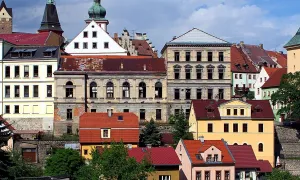
Historické jádro města Loket, hrad Loket, řeka Ohře.
Accommodation nearby
Trips and activities nearby
Guided tours, tickets and activities nearby from GetYourGuide
Affiliate link: if you buy from the partner, we may receive a commission. The price for you does not change.
Search tours and activities →Themed route
Thematic cruise route: Loket and its historical monuments
1. Historical core of the city Loket - Type: Urban area with historical architecture. - Why is it worth a visit: When walking the streets of the historic core you can appreciate an ancient construction that tells about the rich past of this place. It is the ideal start of your trip where you can enjoy a quiet moment and look at ancient houses.
Sousoší Nejsvětější Trojice (Loket) - Type: Statue - Why is it worth visiting: This statue is the main destination of your trip and symbolizes the spiritual values of the city. Its location in the square will give you the opportunity to relax and reflect.
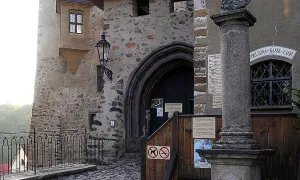
3. Castle Loket - Type: Historical castle - Why it is worth a visit: The castle is one of the most famous monuments in the area that offers a view of the whole city and the river Ohře. His history dates back to the Middle Ages and it's a great example of the architecture of that time.
4. River of the Bend - Type: Natural water flow - Why is it worth a visit: The river passes through the city and offers beautiful views, especially from the castle or during walking along its shore. It is an ideal place to relax and enjoy natural views.
This route allows you to explore the main historical and cultural monuments of the city of Loket, offering a combination of architectural and natural beauties.
Seasonal recommendations
Spring: In the spring season, the surroundings of the Souls of the Holy Trinity in Loket are particularly attractive due to the morning light and soft colours of shrubs that are beginning to bloom. This time of year offers a quiet atmosphere with mild temperatures, which is ideal for long walks around the sights and the use of nature. Visitors are advised to wear something to add because the morning may be colder, while the temperature may increase slightly on Wednesday. The best time to visit is early spring, when trips are usually less visited and nature offers its most attractive appearance.
Summer: Summer with the Most Holy Trinity Crescent becomes a center of attention for many visitors who enjoy warm sunshine and green nature. The atmosphere is full of vitality and we often meet with tourists and families looking for a place to relax in local park areas. For those who attend the main summer season, it is recommended to come early in the morning or later in the evening to avoid heat and crowds. Don't forget the sun protection, water-filled dishes, and perhaps an umbrella if you'd like to be ready for unexpected rain.
Autumn: In autumn, the monument offers beautiful experiences thanks to colour sheets and mild temperatures that are ideal for walking along the surrounding paths. The atmosphere is calmer than in the summer, which allows you to enjoy the solitude and beauty of nature in full. Visitors should be dressed according to temperature, because morning and evening can be colder, while the middle of the day is usually warmer. The best time to visit is early or late autumn, when the roads are less visited and all the colors of nature offer their peak.
Winter: The winter season brings a different atmosphere around the Statue of the Holy Trinity, where calm snow covers the landscape and the sunlight creates beautiful flashes. Visitors should be well dressed with warm leather, shoes suitable for snowman and perhaps even umbrella in case of rain. The opening time of the monument may be shorter due to winter conditions, so it is advisable to check the current opening time. The best time to visit is on quiet days away from the main holidays, where it is possible to enjoy the calm and beauty of the winter environment without too much crowd.
Visualizations and artistic views

The visualisations are generated by artificial intelligence and serve as inspiration.
Photos from the area
Real photos taken near the monument

Zdroj a licence jsou uvedeny u každého snímku.
Tips from visitors
No tips yet. Be the first!
Log in and add your tip.
Sources and literature
Photos: The original uploader was W.J.Pilsak at German Wikipedia. / CC BY-SA 3.0 — Wikimedia Commons. The author and licence also appear when you hover over the image.
Faktickým podkladem tohoto textu byl článek na Wikipedii, jehož autory jsou přispěvatelé Wikipedie. Článek je dostupný pod licencí CC BY-SA 4.0.
Location on the map
Příběhy a pověsti
Legendy, pověsti a příběhy spjaté s touto památkou
Fotografie návštěvníků
Zatím žádné fotografie. Buďte první, kdo přidá fotografii z návštěvy!
Log in a přidejte svou fotografii nebo hodnoťte.
Za ověřenou návštěvu v aplikaci získáte víc bodů — poznáme podle GPS, že jste na místě.
Reviews and comments