



Sousoší Nejsvětější Trojice (Třebechovice pod Orebem) Statue
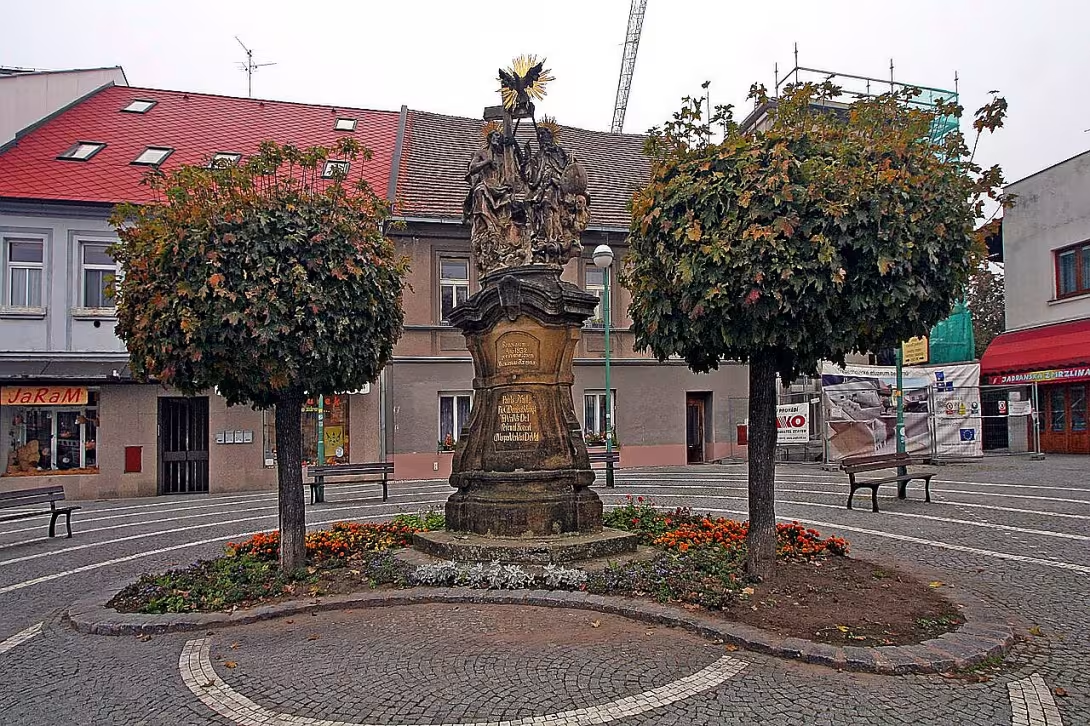
The statue of the Holy Trinity is a Baroque sandstone statue from 1749, located on the corner of Masaryk Square in Trebechovice under Oreb, the district of Hradec Králové. It was created in the workshop of the brothers Pacák and is protected as a cultural monument of the Czech Republic.
The statue was created during the peak period of Baroque, when religious artistic life developed. Třebechovice pod Orebem served at that time as an important centre for craft production, especially for Bethlehem, which affected local cultural and artistic life.
The monument is carved from sandstone and stands on a stone stage. It is built on a triangular plinth with convex strained sides and covered corners decorated with volutes. In the front wall of the plinth there are two bent frames with inscriptions. The statue depicts Jesus Christ and the God of the Father sitting next to each other on the clouds. Jesus is half naked with a cloak slid on his feet; With his left hand holds a great cross and his right hand lies on his breast, looking at the Father God. God the Father is clothed in a long bulkhead with a flying cloak; in his left hand, he holds the globe with a cross on the top, carried by winged angels' heads, and his right hand raised in a gesture of blessing. Above both figures is the Holy Spirit in the form of a dove surrounded by the rays of halo.
The statue was reconstructed in 1832, which was financially secured by Václav Rzehak. This event is documented by the inscription in the upper plinth: "Renovatum / Yes 1832 / per Fundatione / Wencezslaw Rzehak / '. The last documented restaurant was held in 2005.
The statue is located near the museum of Bethlehem, which creates a specific cultural context within the historical centre of the city. The work is registered in the catalogue of monuments of the National Monument Institute under the number ÚSCP 18601 / 6-717.
The sculpture is a valuable example of baroque sacral art from the pašáky brothers' workshop and it is recommended to visit during the tour of the centre of Trebechovice under Oreb.
Then and now
Drag the slider to compare how the landmark may have looked when it was built with the view today.
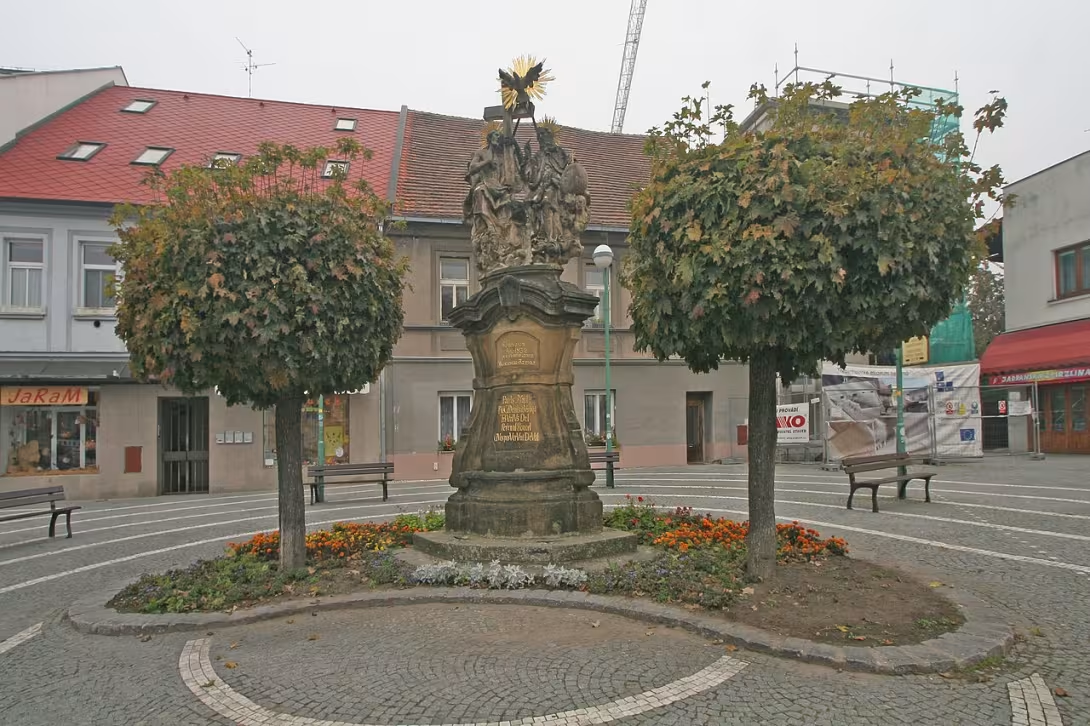

The historical appearance on the left is an AI-generated visualisation and serves as inspiration only.
Historical milestones
- 1749
- The creation of a baroque sandstone sculpture from the workshop of the brothers Pacák.
- 1832
- Reconstruction of sculptures financed by Wenceslaw Rzehak, recorded on the plinth.
- 2005
- The last documented restaurant of the sights.
Architectural development
The sculpture is carved from sandstone and stands on a triangular plinth with convex strained sides and covered corners with volutes. Sokl is placed on a stone stage and in its front wall there are inscription frames. The composition includes figures sitting on clouds and floating dove surrounded by halo rays.
Historical events
In 1749, the sculpture was created. In 1832 a reconstruction was carried out financed by Wencezslaw Rzehak. In 2005 the work was last restored.
Points of interest
The statue of the Holy Trinity is a Baroque sandstone statue from 1749. - It was created in the workshop of the brothers Pacák and is protected as a cultural monument of the Czech Republic. - Reconstruction was carried out in 1832, financed by Václav Rzehak. - The statue is located near the museum of Bethlehem in the historical center of Třebechovice pod Orebem. - It is registered in the catalogue of monuments of the National Monument Institute under the number SAR 18601 / 6-717.
Guide
Show guide text
This text was created by artificial intelligence and has not been editorially reviewed. It may contain inaccuracies.
Welcome to Trebechovice under Oreb, a picturesque town that boasts rich history and unique cultural monuments. You are standing right on the corner of Masaryk Square, where the Baroque sandstone sculpture of the Holy Trinity will attract your attention. Right in front of you is this work, which forms an important part of the urban space and is located in the immediate vicinity of the famous museum of Bethlehem. If you look at it, you'll see a monumental overall composition that emits calm and spiritual seriousness typical of the Baroque era. The material from which the sculpture is carved is sandstone, a stone surface that has been noble for centuries, while showing the durability of this work of art. It is protected as a cultural monument of the Czech Republic, which shows its extraordinary value for our national heritage.
Let's stop now and think about how and why this work was created. The sculpture dates back to 1749, the period when Baroque art reached its peak in our regions. It was created in the workshop of the brothers of the Pacas, who were at that time very well-respected sculptors and carvers. Their workshop was known for the quality of stone processing and the ability to create significant, emotional characters that come to life. The creation of such sculptures was not merely an order, but an expression of the faith and piety of the then society. The Baroque was an epoch that sought a connection between the celestial and earthly worlds, and it was such a sculpture that served as a visual bridge for believers who passed through the square. The location on the corner of the square ensured that it was visible from several directions and could thus fulfil its function as a spiritual point in the heart of the city.
Now pay attention to details that you can see directly in front of you. The statue represents three persons of the Holy Trinity. In the center of the composition you will find the figure of Jesus Christ, which is traditionally depicted as the centre of the time and representative of mankind. Next to him, or above him in the hierarchical structure of baroque sculpture, there is God the Father. The third element that completes the Trinity is the Holy Spirit, which is embodied here as a dove. This symbolism is very important because the dove is a symbol of peace and the breath of God in the Christian tradition. Take a look at the proportions and shapes of the statues, how they are carved with precision, which is typical of the Pac Brothers workshop. Although we cannot now see every small cut, the overall impression is that it is a harmonious whole where each character has its place and meaning. The sandstone from which the sculpture is made has a specific texture, which with age gains depth and character.
The history of this place is not only about its origin, but also about the care it has been given over the centuries. One of the key moments in the life of this monument was the reconstruction that took place in 1832. This repair was financed by Wencezslaw Rzehak, a historical figure whose name is still remembered today. On the plinth of the sculpture there is a inscription that documents this event and reminds us who was behind the renewal of the work. It is important to remember that monuments like this were never static; require constant care and maintenance to survive the destruction of time. Wencezslaw Rzehak thus became one of the protectors of this cultural treasure, which ensured that the sculpture could serve other generations. Its merit is proof of how private persons could have contributed to preserving the public heritage.
If you look at the surrounding environment, you will notice that the sculpture stands near the museum of Bethlehem. This museum is one of the most famous in the Czech Republic and collects dozens of Bethlehem from different parts of the world. The existence of such a museum in such proximity to the statue of the Holy Trinity is not random. Both of these objects share a common spiritual context and attract visitors to reflect on faith, traditions and art. Bethlehem is often considered to be a folk art, while the statue of the Holy Trinity represents the higher art school of the Baroque, and yet they both complement and create a rich cultural atmosphere of this place. A walk around the sculpture and a subsequent visit to the museum can be a very rewarding experience that combines various forms of Christian expression.
The interesting thing that can impress visitors is that the last documented intervention in the monument was the restaurant in 2005. This modern adaptation has ensured that the sculpture is in the best possible condition for today's viewers. Restorers had to proceed very carefully in order to preserve the original character of the work while removing the damage caused by weather and time. Sandstone is a material that is sensitive to moisture and frost, therefore such care is necessary. The fact that the monument has been preserved until today and has been restored several times shows its importance for the city of Třebechovice pod Orebem. He's a living witness to history that reminds us of what the city looked like two and a half centuries ago and how it changed over time.
When you look at the sculpture, try to imagine what the square looked like in 1749 when the work was revealed. The city was smaller, the houses were lower and life revolved around the square as the main center of social and spiritual life. The sculpture was not only a beautiful object for the inhabitants, but also an important landmark and place of prayer. Today, when you look at him, you can feel a connection with those who stood before you. It's where history touches the present.
I suggest you take your time and see the sculpture from different angles. Each perspective reveals different details and nuances. Notice how light hits the stone surfaces and how shadows highlight the shape of the figures. Try to find the place where the sculpture works most clearly and take a photo of it to remind you of this visit. If you are interested in deeper knowledge, you can stop at the Bethlehem Museum later to learn more about spiritual life in this area.
Třebechovice pod Orebem is a city that has something to offer not only its sights, but also its atmosphere and history. The statue of the Holy Trinity is just one of many proofs of how rich the cultural history of this region is. I hope this short guide helped you better understand the meaning and beauty of this work. Thank you for your attention and I wish you a pleasant continuation of your tour of the city. Don't forget to enjoy every step and every memory you meet on your journey. Třebechovice pod Orebem will certainly surprise you with many other interesting things that are worth discovering. When you walk through the streets of the city, he will remember this sculpture and the story
Tips for visitors
Best time to visit the sculpture The Holy Trinity is in the spring or autumn season when the weather is pleasant and the sunlight is especially beautiful. These years are ideal for photography of the work because the sun is not as high as in summer, which allows better lighting of the statue.
It is appropriate to use cars or public transport to access the sculpture. The place is also well accessible by foot from Masaryk Square.
When visiting the sights, take a camera or mobile phone with you for a photo as well as protective clothing and sunflowers in case of unpredictable weather. In addition, it may be useful to carry a map or GPS device for easier orientation in the historical centre.
Photography of sculptures is best performed in the afternoon when the sun illuminates the statue from the side and creates dramatic shadows. The best places for photography are on Masaryk Square or from the street next to the museum of Bethlehem, where it is possible to capture the statue in the context of surrounding architecture.
The historical centre of the city Třebechovice pod Orebem is located in the vicinity of the sculpture, which offers visitors a wide range of cultural and recreational activities. In addition, it is close to the museum of Bethlehem where families with children can see interesting exhibitions.
Frequently asked questions
Can the monument be visited?
This is a structure in a public space that can usually be seen from outside free of charge. We have not verified that this particular one is freely accessible.
Where is the monument?
Location: Třebechovice pod Orebem. The map on this page shows the exact spot.
Why is the monument protected?
It is listed in the Central List of Cultural Monuments of the Czech Republic as a cultural monument (register no. 1000129318).
Businesses nearby
Do you run a restaurant, accommodation, shop, museum, rental, wellness or other visitor service near this monument? Show yourself directly to the people heading to it — this is how they will see you in the app and on the web:
Events nearby

Zdroj akcí: otevřená data měst a obcí ČR (Národní katalog otevřených dat) a kalendář akcí Národního památkového ústavu.
Nearby
Masarykovo náměstí, muzeum betlémů, historické centrum města Třebechovice pod Orebem.
Accommodation nearby
Themed route
Thematic cruise route Třebechovice pod Orebem
1. * * The statue of the Holy Trinity (Statue) Why is it worth a visit: The main destination of the trip is this sculpture work, which represents the most famous monument to Trebechovic under Oreb. It is located in the square and stands as a symbol of local faith and history.
2. * * Masaryk Square (Square) Why is it worth a visit: This central square is the heart of a city where history and modernity meet. Here you can enjoy a quiet moment or see the architectural elements of the surrounding buildings.
3. * * Bethlehem Museum (Museum) Why is it worth visiting: The museum offers a unique collection of Bethlehem dioras that represent the biblical scenes. It's an ideal place for people interested in history and art.
4. * * Historical center of Třebechovice pod Orebem (City) Why is it worth a visit: Movements on the streets of the historic centre allow you to explore the ancient architecture and atmosphere of the city. Here you can find other attractions such as restaurants and shops.
Order: Start at the Holy Trinity, where you will notice its location and historical significance. Then move to the heart of the city, Masaryk Square, for a quiet break or a tour of the surrounding area. Then visit the Bethlehem Museum and enjoy its unique exhibition. Finish your trip by walking around the Historical Centre of the city, where you will learn more about local heritage and offer.
Seasonal recommendations
Spring: In the spring season, the Holy Trinity sets out beautiful lighting because of the long hours today, which increases the visual appeal of the statue. Green nature begins to bloom around and trees reveal themselves in their full glory, creating a vibrant and dazzling atmosphere. Visitors should be prepared for a sudden temperature reduction, therefore the appropriate outfit is a combination of light coat and thermal gloves. The best time to walk is in the afternoon when the sun lights up the statue from the most beautiful angles.
Summer: Many more people get to the memorial in the summer because of warm days and pleasant weather, which creates a lively atmosphere. The sun's rays illuminate the statue from different angles, allowing it to capture its details in light of the best quality. Visitors should be prepared for a warm and possibly dry atmosphere, therefore it is advisable to wear short clothes, sunglasses and plenty of drinking water. The best time to visit is in the morning or evening to avoid the hottest hours.
Autumn: In autumn, the monument offers a beautiful atmosphere with colorful tree leaves and mild sunlight. This time of year is ideal for taking photos because lighting brings deep colors on the statue. Visitors should be prepared for falling temperatures and possible rain toilets, so it is advisable to wear multi-ply clothes and a protective coat. The best time for a walk is in the afternoon when nature offers the most beautiful views.
Winter: In winter, the freezing weather and snow cover in the monument create a completely different atmosphere where a statue decorated with a light layer of snow takes on a mysterious appearance. Sun rays illuminating the statue from different angles can create wonderful light effects. Visitors should be well prepared for cold, wear thick clothes and protective shoes to enjoy a walk without discomfort. The best time to visit is at noon when the sun lights the statue best.
Visualizations and artistic views


The visualisations are generated by artificial intelligence and serve as inspiration.
Photos from the area
Real photos taken near the monument


Zdroj a licence jsou uvedeny u každého snímku.
Tips from visitors
No tips yet. Be the first!
Log in and add your tip.
Sources and literature
Photos: Petr1888 / CC BY-SA 3.0 — Wikimedia Commons. The author and licence also appear when you hover over the image.
Faktickým podkladem tohoto textu byl článek na Wikipedii, jehož autory jsou přispěvatelé Wikipedie. Článek je dostupný pod licencí CC BY-SA 4.0.
Location on the map


Příběhy a pověsti
Legendy, pověsti a příběhy spjaté s touto památkou
Fotografie návštěvníků
Zatím žádné fotografie. Buďte první, kdo přidá fotografii z návštěvy!
Log in a přidejte svou fotografii nebo hodnoťte.
Za ověřenou návštěvu v aplikaci získáte víc bodů — poznáme podle GPS, že jste na místě.
Reviews and comments