



Sousoší Nejsvětější Trojice (Ústí nad Orlicí) Statue
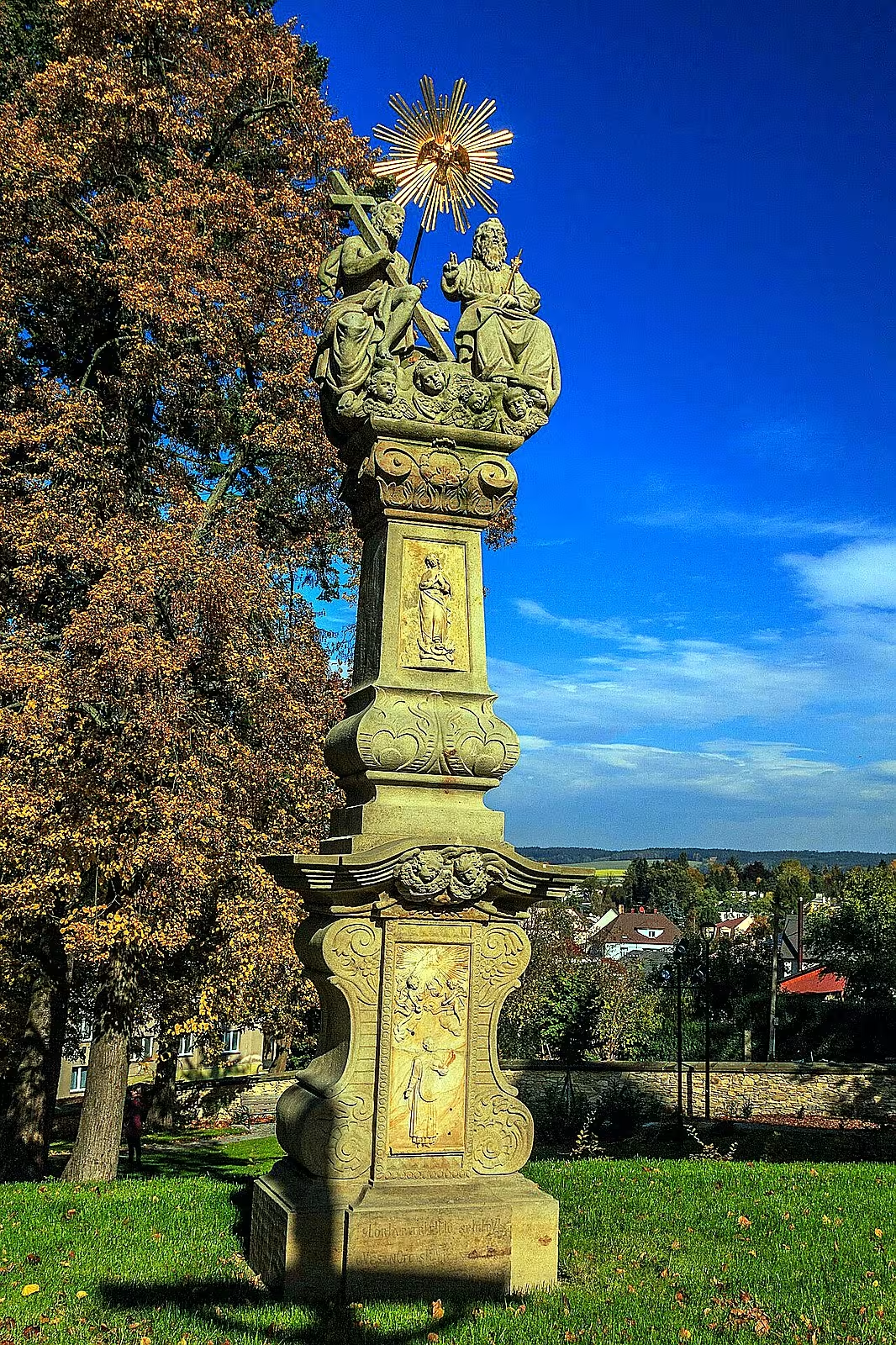
The late Classicist sandstone sculpture of the Holy Trinity from 1856 stands in Ústí nad Orlicí and represents an important example of the regional sacral sculpture, which is associated with the deep popular reverence of the mid-19th century. The monument originally stood in T. G. Masaryk Street near the house No. 116. From there it was moved to a former cemetery at the Church of the Assumption of the Virgin Mary in 1987. Since 1 November 1990 this work of art has been protected as a real-estate cultural monument of the Czech Republic.
The creation of this building dates back to 1856, when Ignatz and Barbora Reifs built it. This period in Czech countries characterized the continued development of late classical and empirical creation associated with the expression of deep popular piety. At the same time it was a period marked by a gradual industrial change of the region and an increase in the importance of cities, which included Ústí nad Orlicí. The sources do not mention the older or other history of the work itself.
It is a sculpture made of sandstone and carries a late-classicist shape. On the low prism and top-covered pedestal stands a higher pillar decorated with sides volutes. Among them is a presented frame with embossed figure of St. Ignatius in the priesthood. Above it are two angels and a halo with IHS written on it. The pillar ends up with a protruded ledge decorated with two angels' heads. On this ledge stands a graduated profiled prism, hollowed out and decorated with stylized flowers. On his front is the relief of the Virgin Mary Immaculata with his hands clenched on his chest. At the top, the panel carries a head with volutes, leaves and flowers. On the warhead sits on the left on the clouds decorated with four angels' heads Christ with a cross over his right shoulder. On the right lies God the Father in a long dress with his left hand on his lap, and the Holy Spirit stands over both sides in the halo.
There are inscriptions carved on the statue pedestal. In front is the Latin hymn GLORIA PATRI, FILIO, SPIRITVL-QVE SANCTO SIICVTA PRINCIPIO EXNVNC PER SAECVLA SECVLORVM. The German inscription Errichtet v. Ignatz u. Barbora Reifs in Jahre 1856 was preserved in the back, which resembles original builders.
Among the key events in the modern history of the monument are 1987, when the already mentioned relocation took place at the former cemetery at the Church of the Assumption of the Virgin Mary. Another important date is 1 November 1990, when the building became a real-estate cultural monument of the Czech Republic. The year 2014 also became an important milestone, when the total restoration of the sculpture took place, including the addition of missing parts.
Today this sandstone work is located in the immediate vicinity of the Church of the Assumption of the Virgin Mary. The visit to this place offers a view of the precisely restored late-classicist monument, which shows the craftsmanship of the former stone makers and keeps the legacy of builders from the mid-19th century.
Then and now
Drag the slider to compare how the landmark may have looked when it was built with the view today.
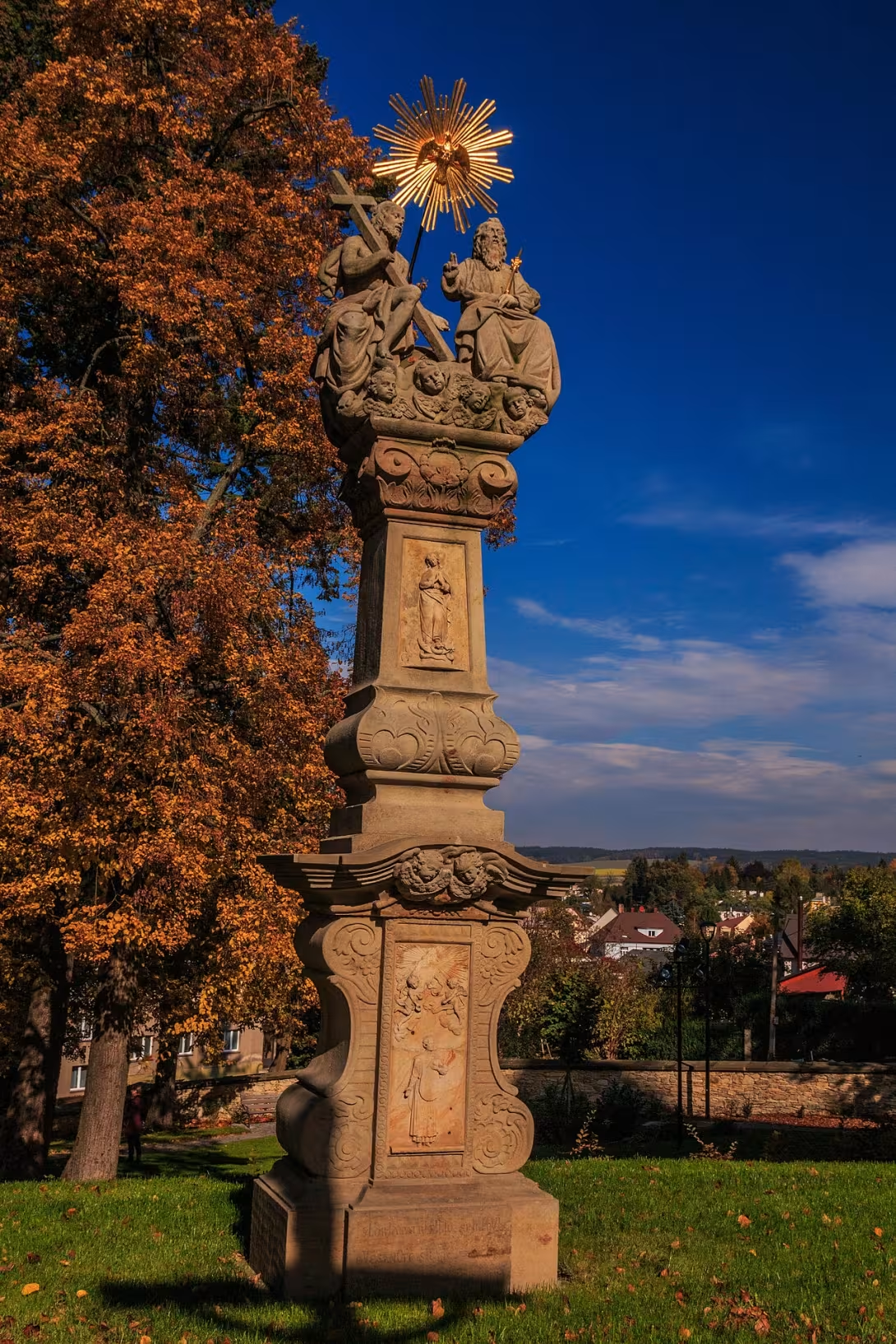

The historical appearance on the left is an AI-generated visualisation and serves as inspiration only.
Historical milestones
- 1856
- The position of the sculptures Ignatz and Barbra Reifs on T.G. Masaryk Street.
- 1987
- The transfer of sculptures to the former cemetery at the Church of the Assumption of the Virgin Mary.
- 1990
- The sculpture became a real cultural monument of the Czech Republic.
- 2014
- Total restoration of the sculpture including addition of missing parts.
Architectural development
The sculpture is made of sandstone and carries a late-classicist curd. It consists of a prism pedestal, a pillar with volutes and reliefs and upper figures of the Holy Trinity. The missing parts were added during the 2014 restoration.
Historical events
In 1856, the sculpture was built by Ignatz and Barbara Reifs. In 1987 it was moved to a former cemetery at the Church of the Assumption of the Virgin Mary. On 1 November 1990 it was declared a real estate cultural monument of the Czech Republic. Total restoration of the monument took place in 2014.
Points of interest
- A late classical sandstone sculpture was created in 1856 and built by Ignatz and Barbora Reifs. - Originally, the monument stood on T.G. Masaryk Street at a house with a descriptive number of one hundred and sixteen, from which it was moved to a former cemetery at the Church of the Assumption of the Virgin Mary in 1987. - Since the first November 1990 this work of art has been protected as a real-estate cultural monument of the Czech Republic. - There are inscriptions on the statue pedestal, there is a hymn in the front and a text in the back resembling the original builders. - In 2014 the total restoration of the sculpture took place including the addition of missing parts.
Guide
Show guide text
This text was created by artificial intelligence and has not been editorially reviewed. It may contain inaccuracies.
Welcome to this beautiful monument. Right now you're standing in Ústí nad Orlicí and you have the opportunity to observe one of the most important spiritual works in this city. Before we go into a deep investigation, let us just pause for a moment, soak up the atmosphere of this place and just watch. In front of your eyes is the statue of the Holy Trinity. It's a work that carries fragments of ancient times and a silent voice of history that tries to speak through sandstone. Feel the weight of time and peace that radiates this place. It's a moment when you can connect with the past that took place in this place decades ago. To understand why this sculpture is so exceptional, we must return together to the year one thousand eight hundred fifty-six. That was the year this work was first born into the world and began its journey. It was created by people whose names must be remembered today, so that their work will not be forgotten. It was Ignatz Reifs and his wife Barbora Reifs. Together, as partners in life and in this creative act, they donated this sculpture to the city. At that time, in the middle of the nineteenth century, art was promoted by a style we call late classicism. This style seeks harmony, balance and nobility, which is what you can feel in this sandstone work. Each cut into stone, every line you see here, bears a reflection of this effort for perfection and order. Now I want to ask you to start looking at the sculpture as a whole, but gradually, from earth to heaven. Your eyes are likely to hit the bottom first, the low base. It's a solid foundation that holds this whole demanding structure and gives it stability. There's a pillar above him. If you approach it, notice the subtle details. On this pillar is depicted a relief, a carved painting that depicts St. Ignatius. It's a detail that requires attention and patience when you look at it, because it captures the spiritual nature of this character. Let's look up now. There is another important part above the pillar. You will see the picture of the Virgin Mary Immaculata. Her character brings a sense of purity and nobility to the whole sculpture. And then when your eyes reach the very top, you will see the most important thing. There, at the highest point, sits the figures of Christ and God the Father. Above them lies the Holy Spirit, which is depicted in the halo, that is, in a shining circle of light that symbolizes the divine presence and light. This whole piece is carved out of sandstone. This material is fascinating with its texture and colour, which changes depending on how light hits it. Feel how light breaks on the edges of sandstone figures and how this stone holds both heat and shadow. You might think this place seems very quiet, almost lonely. And you're right. This sculpture does not have its original place. At the time of its inception, in the year one thousand eight hundred fifty-six, it stood in T. G. Masaryk Street. It was there, at a house with a description of a hundred and sixteen. It was part of the everyday life of the people who passed through here, part of urban activity and everyday affairs. But history turns and things change. In the year one thousand nine hundred eighty-seven there was a great change. The statue has been moved. It had a new journey and settled here, at the former cemetery at the Church of the Assumption of the Virgin Mary. This change took away his urban noise, but it gave him this quiet, meditation character that you're feeling right now. It's like a sculpture found its new home in peace and quiet. This piece of history is very valuable to us. Already in the year one thousand nine hundred ninety this sculpture officially became a real cultural monument of the Czech Republic. That means we have to treat him like a precious treasure that belongs to all of us. And that's what the experts took care of in two thousand and fourteen. There was a whole restaurant at the time. It wasn't just about cleaning up the stone from time and dust, it was about replenishing the parts that were missing over the years. Thanks to this meticulous work, you can now look at a work that looks like what its creators might have imagined more than 60 years ago. It is proof that even though time continues to flow, we can preserve beauty for future generations. Look at him for a while. Feel the connection between the people who built it and the people who admire it today. Feel the work of the hands that has turned into this permanent symbol of faith and art. I hope this short journey over time has brought you some peace and new prospects for this place. Please continue to search Ústí nad Orlicí and discover other hidden secrets of this city. Thank you for the moment.
Tips for visitors
The best time to visit this sandstone work is early morning or morning, when the sun rays pleasantly irradiate the front side with the relief of St. Ignatius and thus create ideal shading for the perception of details of late classical work from the year eighteen-six.
For transport, you can use a passenger car and local public transport, whose current connection you can easily verify in normal travel order search engines.
Take the comfortable shoes for walking on the city pavement, a small telescope for exploring fine ornaments on the pedestal and, in the case of sunlight, a headgear, as the monument stands in the open air without shielding trees.
For photography we recommend to stand slightly from the bird's-eye perspective or to use the morning light that best highlights the structure and color of the original sandstone. The camera lens best captures the entire composition, including a low base when viewed from a slight ceiling.
In the immediate vicinity within 30 minutes walk you can visit the nearby Church of the Assumption of the Virgin Mary in Ústí nad Orlicí and the adjacent former cemetery, which make up a historically valuable whole suitable for peaceful exploration of local architecture and past.
Frequently asked questions
Can the monument be visited?
This is a structure in a public space that can usually be seen from outside free of charge. We have not verified that this particular one is freely accessible.
Where is the monument?
Location: Ústí nad Orlicí. The map on this page shows the exact spot.
Why is the monument protected?
It is listed in the Central List of Cultural Monuments of the Czech Republic as a cultural monument (register no. 1894815805).
Businesses nearby
Do you run a restaurant, accommodation, shop, museum, rental, wellness or other visitor service near this monument? Show yourself directly to the people heading to it — this is how they will see you in the app and on the web:
Events nearby
Zdroj akcí: otevřená data měst a obcí ČR (Národní katalog otevřených dat) a kalendář akcí Národního památkového ústavu.
Nearby
Kostel Nanebevzetí Panny Marie v Ústí nad Orlicí a přilehlý bývalý hřbitov.
Accommodation nearby
Themed route
Thematic walk behind spiritual monuments:
1. The statue of the Holy Trinity Type: Sculpture A reason to visit: This impressive Baroque sculpture represents the ultimate example of the master stonework and offers the opportunity to see the detailed figures of the saints. It is the ideal starting point for a short experience of local sacral art.
2. Church of the Assumption of the Virgin Mary in Ústí nad Orlicí Type: Sacral construction Reason to visit: The impressive historical temple is the main spiritual dominant part of the city. You will be interested in its late Baroque architecture, its magnificent inner space and its valuable art decoration.
3. The adjacent former cemetery Type: Historical piety site The reason for visiting: The corner immediately adjacent to the temple offers a quiet atmosphere to contemplate and recognize the past. The site completes the peaceful character of the entire area and reminds us of previous generations of local residents.
Seasonal recommendations
Spring moons bring fresh energy to the city, where the waking trees and brighter skies create a welcoming background for a detailed tour of this stone work. Sharp, but not yet burning sun beautifully depicts elaborate character curves and their good condition. The weather is variable in this period, so it is worth choosing reliable laminated clothes with wind-proof jacket. The best time to stop at the monument is the morning hours, where you avoid the rush of the locals and the surrounding area offers a pleasant peace of mind for the uninterrupted admiration of sculpture work.
During the summer period, the public space comes to life with the daily ruckus and the sculpture becomes a natural part of the vibrating urban environment. Long days offer plenty of opportunities to search, while the midday sun can be very sharp and create deep shadows on carved clothes of saints. For the visit it is best to choose light summer clothing, head protection and come either early in the morning or late in the afternoon when temperature falls and soft golden light ideally highlights the plasticity of the sculpture. In the main summer season you will meet the most passers around, but in the evening the atmosphere is pleasantly calmed down.
Autumn time gives the surrounding area a melancholy mood, underscored by warm tones of decaying leaves and frequent fog. The low-pitched sun casts long shadows, which makes the expression of faces and embossed details disappear in full summer brightness. Due to the colder wind and humidity it is necessary to wear a warm coat and choose fixed shoes to walk on the urban surface. The ideal time for a visit is an early afternoon, when there is still natural daylight and the area is relatively quiet, without more people passing through.
In the winter months, the whole scene gains a quiet and secluded character, especially if sandstone elements cover a fine layer of snow or juniors, which underlines the contours of individual figures. At advent time and during winter evenings, the special charm of public lighting creates an impressive contrast between dark and lit stone. Hot winter clothes, including gloves and shoes with anti-slip soles are necessary for the tour due to possible icing. You will experience the best atmosphere in the evening, when the cold drives most people into the warmth of their homes and you can see the memory in complete peace.
Visualizations and artistic views


The visualisations are generated by artificial intelligence and serve as inspiration.
Photos from the area
Real photos taken near the monument


Zdroj a licence jsou uvedeny u každého snímku.
Tips from visitors
No tips yet. Be the first!
Log in and add your tip.
Sources and literature
Photos: Petr1888 / CC BY-SA 4.0 — Wikimedia Commons. The author and licence also appear when you hover over the image.
Faktickým podkladem tohoto textu byl článek na Wikipedii, jehož autory jsou přispěvatelé Wikipedie. Článek je dostupný pod licencí CC BY-SA 4.0.
Location on the map



Příběhy a pověsti
Legendy, pověsti a příběhy spjaté s touto památkou
Fotografie návštěvníků
Zatím žádné fotografie. Buďte první, kdo přidá fotografii z návštěvy!
Log in a přidejte svou fotografii nebo hodnoťte.
Za ověřenou návštěvu v aplikaci získáte víc bodů — poznáme podle GPS, že jste na místě.
Reviews and comments