



Sousoší svatého Jana Nepomuckého s andělem Statue
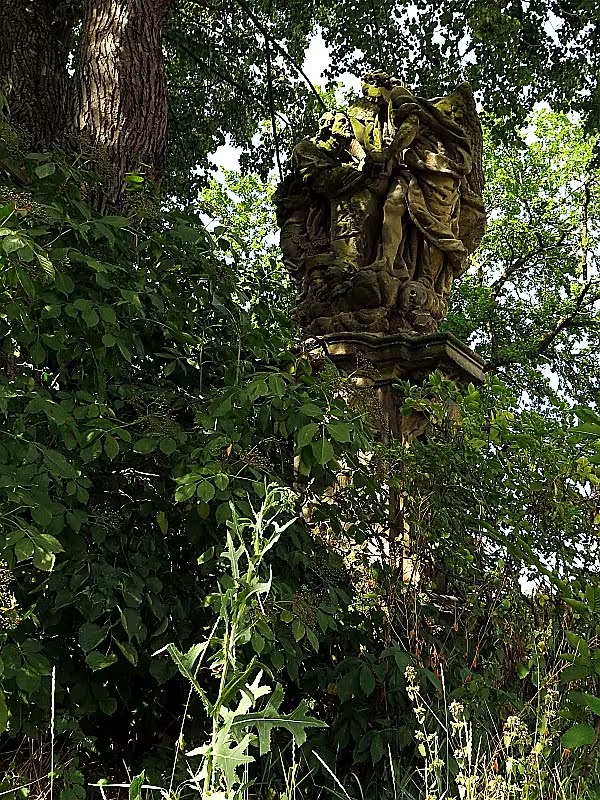
Sousoší svatého Jana Nepomuckého s andělem, located in the garden of the mill in the village of Platěnice, is an example of Baroque sculpture work from 1744. This monument is protected as a cultural monument and stands on a three-stage pedestal with volute sides. The statue represents the kneeling Saint John Nepomuk in Canovnik's garment, with his hands attached, to which an angel with his wings unfolded approaches from the right. On the side is a relief depicting the Queen's confession and underneath it are the heads of angels. On the front side of the pedestal is cartouche with the relief of P. Marie standing on the crescent, while the back has a inscription.
The creation of sculptures is linked to the period of Baroque art in the mid-18th century, when Europe was influenced by complex composites and dramatic expression. The Baroque was manifested not only in construction, but also in sculpture, which is evidenced by the statue of St. John Nepomuk.
Architecture and visual rendering of sculptures are characteristic of Baroque style. The statue is 3 meters high, which makes it visually dominant in the village environment. The composition of the statue with the angel and relief on the pedestal shows the complexity and detail typical of the Baroque.
The statue of St. John Nepomuk in Platenice is protected as a cultural monument, which highlights its historical and artistic importance. The current state of the statue ensures its accessibility to visitors who can be inspired by this unique work of baroque art.
Visiting the sculpture of St. John Nepomuk in Platenice is an opportunity to explore not only the beauty and complexity of baroque sculpture work, but also the deeper historical context of this time. This monument is worth visiting with its uniqueness and cultural significance.
Architectural development
The statue is the result of a Baroque artistic direction that manifests itself in complex composition and detail. It stands on a three-stage base with volute sides.
Points of interest
- Sousoší svatého Jana Nepomuckého s andělem is an example of Baroque sculpture work from 1744. - This monument is protected as a cultural monument and stands on a three-stage pedestal with volute sides. - The statue represents the kneeling Saint John Nepomuk in Canovnik's garment, with his hands fastened, to which an angel with his wings unfolded approaches from the right. - There's a relief on the side that shows the Queen's confession, and underneath, there are angels' heads in the clouds. On the front side of the pedestal is cartouche with the relief of P. Marie standing on the crescent, while the back has a inscription. - The statue of St. John Nepomuk in Platenice is protected as a cultural monument, which highlights its historical and artistic importance.
Guide
Show guide text
This text was created by artificial intelligence and has not been editorially reviewed. It may contain inaccuracies.
Welcome to Platenice, this quiet corner where time seems to be stopped for a while. Legally, you are now in the garden of the local mill, a place with a very strange and peaceful atmosphere. Stop, take a breath and look straight ahead. In front of you is a statue that defines this whole space by its presence. It's a statue of St. John Nepomuk with an angel. The first impression that radiates from it is a feeling of deep calm, humility and at the same time a certain drama that is so typical of the period in which it originated.
When we look at the history of this work, we are going to go deep into the eighteenth century. This statue dates back to the year seven hundred forty-four. Imagine what time it was. It was an era when faith and art went hand in hand, and there were similar monuments in the landscape as the declaration of loyalty and protection. This sculpture is a wonderful example of baroque sculpture work. The Baroque didn't just want to be simple or wild, it looked for movement, emotion and spiritual lift. That's why this statue doesn't seem static, but it tells us a story, even if it's quiet.
Now I want to ask you to pay attention to how the statue is built. Look down at the base first. The whole piece is on a three-stage pedestal. These three degrees are not just a practical basis, but symbolically they lead us from the Earth's plane to the sacred one. Notice the sides of this base. There are so-called volute shapes, namely elegant spiral decorating, which are so characteristic of Baroque style. These curves add ease and stability to the whole, so the statue does not appear cumbersome, but harmoniously fits into the surrounding garden.
If you look up now, you will see the very figure of St. John Nepomuk. The entire sculpture reaches a height of three meters, which means that the saint is slightly above us, reminding us of his spiritual authority. Notice its position. Saint John is not depicted here in a position but kneeling. This kneeling position is an expression of the highest humility and prayer. Look at his clothes. It is dressed in Canovnik's garment, which was the garment of a capitulation which clearly determines his social and religious standing at that time. His hands are clenched, which, combined with his kneeling position, creates an image of deep inner concentration and commitment to divine will.
You'll see an angel next to St. John. The angel here is not only an ornament, but it serves as a connecting block between heaven and earth. His presence complements the scene and gives him an otherworldly dimension. Together, these two characters form a harmonious whole that encourages us to reflect on the relationship of man and supernatural power.
Now, I would like to ask you to come a little closer, if space allows, and focus your attention on one very important detail. In the sculpture there is a relief, a plastic display in the surface, which represents the confession of the queen. This is the key moment in the whole story. Saint Jan Nepomucký is known primarily as holy secrecy in the Christian tradition. Legend has it that, as a confessor of the Queen, he refused to reveal the secret of her confession, even though the King himself pushed him. This loyalty to the promise and the protection of the secrets was so strong that he was eventually tortured and thrown into the river Vltava. It is this relief that you see before you that reminds us of this fundamental property of St. John, the yaith of his unwavering integrity and courage to stand by the truth even at the cost of his own life.
When you stand before this work like this, you realize that you're not just looking at an old statue but at a protected cultural monument. This means that the state and society have acknowledged that this work has irreplaceable value for our history and culture. It is a testament to the craftsmanship of sculptors from the mid-eighteenth century who have been able to conjure such fine details of the garment or the expression of humility in the face of the saint.
It is also interesting where this monument stands. The garden mill in Platenice creates natural frames for the statue. Imagine what this place looked like hundreds of years ago. The mill was the center of work and life, and this statue here served as a spiritual anchor, a place where one could stop for a while, pray and find inner peace in the midst of everyday hustle and bustle. It is fascinating to think how many generations of people have already stood before this statue, how many prayers have been said here and how many views have fallen on these same volute decorating pedestal.
Even though today we don't know the names of the particular architects or sculptors who created this work, their work speaks for them. The Baroque style we see here is not just about decorating, but about inducing strong feelings. If you look at the clenched hands of a saint and the presence of an angel, you will feel a certain peace that will separate you from the outside world. This statue teaches us patience and silence, which are things that are often lacking in today's rush world.
Now just slowly go around the sculpture from different sides. Notice how the impact of light changes on the holy garment and how the expression of his face changes from different angles. Try to perceive the atmosphere of this mill garden and let yourself be consumed for a while by the history that still breathes in this place.
Thank you for stopping by this beautiful sculpture of St. John Nepomuk. I hope this short trip to the year of seven hundred forty-four helped you better understand the beauty and importance of this Baroque monument. Now invited to further explore the surroundings of Platenice. Go through the rest of the garden, feel the silence, and look for the other traces of history this village has hidden inside of you. I wish you a pleasant continued journey and many new discoveries. Goodbye.
Tips for visitors
The best time to visit the sculpture of St. John Nepomuk is in the summer months when the garden environment in the village Platěnice is the most beautiful. The sunny days offer ideal conditions for exploring and enjoying the peace of nature.
For those travelling by public transport, there are various connections that will lead you to the surrounding area. We recommend checking the current options before departure.
When visiting, bring with you clothes suitable for outdoor conditions, including protective sun coat and shoes suitable for walking on the lawn. Also remember to drink, especially during warm days.
Photography of sculptures is offered from different angles, but the best light is usually in the early morning or evening. These times allow us to capture sunlight falling on the statue and its surroundings, highlighting baroque details.
In the vicinity of the village Platěnice there are several interesting places that can be visited within 30 minutes. These include historic buildings and natural spaces that offer beautiful views and a quiet atmosphere.
Frequently asked questions
Can the monument be visited?
This is a structure in a public space that can usually be seen from outside free of charge. We have not verified that this particular one is freely accessible.
Where is the monument?
Location: Platěnice, Pardubický kraj. The map on this page shows the exact spot.
Why is the monument protected?
It is listed in the Central List of Cultural Monuments of the Czech Republic as a cultural monument (register no. 1000132184).
Businesses nearby
Do you run a restaurant, accommodation, shop, museum, rental, wellness or other visitor service near this monument? Show yourself directly to the people heading to it — this is how they will see you in the app and on the web:
Nearby
🏰 Historic sites (266)
- Památník Jakuba Teplého 0.1 km
- Neulust 5.5 km
- Antonín Zápotocký navštívil 16.9.1956 tuto vesnici. 5.5 km
- sv. Jan Nepomucký 5.8 km
- Pomník obětem 1. světové války 6.3 km
- Pomník obětem 2. světové války 6.3 km
- DAVID FREI 6.6 km
- ETHEL FREIOVÁ 6.6 km
- KATEŘINA FREIOVÁ 6.6 km
- GABRIELA FREIOVÁ 6.6 km
- Jindřich Popper 6.7 km
- Pomník padlých 6.8 km
- Panna Maria 6.8 km
- Panna Maria 6.9 km
- Pomník generacím III. tisíciletí 6.9 km
- Max Goldbach 6.9 km
- Helena Goldbachová 6.9 km
- Františka Glaserová 6.9 km
- Jan Glaser 6.9 km
- Irena Neumannová 7.0 km
🍽️ Restaurants and dining (402)
- Hospoda Platěnice 0.2 km +420 731 300 250 web
- TM CATERING 1.1 km +420 725 153 553
- Dašické sklepy 3.3 km +420466261863 web
- Hospoda Na Ostrově 3.4 km +420603512780 web
- Roubenka u Mlýna 3.4 km +420778000033 web
- Hospoda Na Rozcestí 6.1 km
- Vejvanovice Hostinec 6.8 km +420 777 899 505
- Pizza bujoni 6.8 km
- Bêp Viêt bistro 6.8 km +420 722 757 494
- Grand 6.9 km náměstí Josefa Haška 6
- Restaurace Corona 6.9 km Jungmannova 5
- Restaurace u Skrblíka 6.9 km Dudychova 313 +420466681466 web
- Černý kůň 6.9 km Holubova 40
- Hospoda U Pařízků 7.2 km
- Asian Wok 7.2 km web
- Hostinec Veská 7.3 km
- Motorest Cha Cha 7.6 km
- Hostinec u Kosteleckých 8.7 km +420 604 713 585 web
- Na Hlubáku 8.8 km
- Rest Münster 8.9 km
🏨 Accommodation (41)
- Hana 6.7 km
- Autocamping Hluboký 8.7 km +420 605 276 028 web
- BezKempu 9.5 km
- Ubytování U Blažků 9.5 km
- Na Náměstí 9.6 km web
- Penzion Hůrka 11.0 km Hůrka 164 +420 774 884 834 web
- Penzion Zámeček 11.0 km web
- Penzion Jasopa 11.1 km Průmyslová 560 +420 725 565 534 web
- Ubytování v Pardubicích 11.8 km
- Hotel Kristl 12.0 km +420 739 287 636 web
- Zlatá štika 12.4 km web
- Hotel Euro 12.5 km Jiráskova 2781 +420 466 414 255 web
- Camping Na Venkově 12.6 km +420720302683 web
- Hotel MRÁZEK 12.7 km web
- Arnošt 12.8 km web
- Spolkový dům Království perníku 12.8 km web
- Hotel Zámecká 17 12.8 km
- U zlatého anděla 12.8 km
- Kostelní 102 12.8 km
- Hotel 100 12.8 km web
🚲 Rentals and sport (55)
- Vomit 7.0 km Nádražní 242
- Sportovní hala 7.2 km Holubova 1037
- TJ Spartak Sezemice z.s. 9.2 km
- Motokrosová trať Holice 9.5 km
- Okolokola.cz 9.9 km +420776666770 web
- Okresní Myslivecký Spolek Pardubice 10.3 km +420 466 263 411
- Hřiště pro veřejnost 10.6 km Erno Košťála 870 web
- Přístaviště Kunětice 10.9 km
- Laser game Pardubice 10.9 km Jana Zajíce 982 +420 601 369 568 web
- Hřiště pro veřejnost 10.9 km Pod Zahradami 317 web
- MI6 studio 11.5 km Na Okrouhlíku 1680 +420 602 870 855 web
- Sportovně střelecký klub TMS Pardubice 11.9 km web
- Kolda R+P 11.9 km +420 603372896 web
- Areál orientačního běhu 12.2 km web
- Plavání u Majáku s.r.o. 12.2 km Štrossova 172 +420 732 211 747 web
- Yetti 12.4 km
- Brouzdaliště 12.4 km
- Sokol 12.5 km +420 466 614 681 web
- Sportisimo 12.6 km
- BikeHouse 12.7 km U Mlýnů 1901 +420 725 971 515 web
🥾 Hiking and nature (111)
- Hlaváč 1.8 km
- Jandák 2.8 km
- Vršek 3.9 km
- Boršov u Litětin 5.3 km
- Hořánek 5.7 km
- Pravěká studna 6.1 km web
- Stropinský vrch 6.4 km
- Přesyp u Malolánského 6.5 km
- Borek 6.5 km
- Chmelnice 6.6 km
- Stráň u Trusnova 6.6 km
- Club Lázně Javůrka 6.7 km +420605543072 web
- Chvalák 6.8 km
- tvrz Holice 6.9 km web
- Sychrova 7.0 km
- Bývalá záložní nemocnice (před r.1989) 7.4 km
- Štětín 7.5 km
- Vesecký kopec 7.7 km
- Železitý pramen (10129) 8.0 km web
- Sand dump 8.0 km
Accommodation nearby
Themed route
Thematic cruise route from the village Platěnice
1.Sousoší svatého Jana Nepomuckého s andělem (statue) - Type: Historical statue - Why is it worth visiting: This sculpture is the most distinctive and main destination of our route. The statue of St. John Nepomuk, famous for its historical value and artistic quality, attracts visitors with its charm and an important place in the social life of the village.
2. Old ruins of the church - Type: Archaeological site - Why is it worth visiting: This ancient building, located near the sculpture, offers a view of the history and architecture of past times. Despite the ruins, it is possible to imagine an earlier important building and its role in village life.
3. Old municipal building - Type: Historical monuments - Why is it worth a visit: This building, located in the centre of the village, is an example of traditional local architecture. It is a place where the municipal economy and administration were once addressed, which provides insight into the past lives of the population.
4. Old brewery - Type: Cultural landmark - Why is it worth a visit: This ancient brewery is a witness to the history of beer production in the village. Despite the fact that it no longer works as a brewery, its building and accessories offer interesting information about technical processes and lifestyle of the past.
5. Forest sidewalk - Type: Natural walk - Why is it worth a visit: A short but comfortable forest pavement leading from the village Platěnice to the surrounding area offers an opportunity to explore local flora and fauna. It's an ideal place to relax for historical monuments.
This route allows you not only to discover the main goal - the statue of St. John Nepomuk, but also to immerse yourself in the history and culture of the village Platěnice through other interesting places.
Seasonal recommendations
Spring: In the spring period, the memory of St. John Nepomuk and the angel in Platenice is revived by flowering nature, which transforms the surrounding landscape into a green paradise. Sun rays illuminate the statue and its surroundings with a fine light, creating wonderful photographic moments. This time of year is ideal for natural observers who want to enjoy flowering shrubs and trees. Visitors are advised to wear light clothes with the possibility to add a layer depending on the temperature because spring weather can suddenly be variable. The best time to visit is in the morning or evening when we avoid the crowd and we can enjoy a quiet moment.
Summer: For years, the memory of St. John Nepomuk in Platenice is surrounded by living greenery, which is covered under sunlight. The atmosphere is full of heat and energy, making this time ideal for long walks around. The sun illuminates the statue in the afternoon most beautifully, offering perfect conditions for photography. Visitors are advised to wear light and light clothes, protective sunglasses and enough drinking water to avoid heat fatigue. The best time to visit is in the morning or in the evening when we avoid the hottest time of the day and also the crowds.
Autumn: In autumn, the memory of St. John Nepomuk in Platenice offers a view of the golden and red palette of leaves that transforms the surrounding landscape into a unique environment. The sun rays illuminate the statue and its surroundings in a mild light, creating a calm and soothing atmosphere. This time of year is ideal for nature lovers who want to enjoy the beauty of colored leaves. Visitors are advised to wear mild clothes with the possibility to add a layer depending on the temperature, because autumn weather can suddenly be variable. The best time to visit is in the morning or evening when we avoid the crowd and we can enjoy a quiet moment.
Winter: In memory of St. John Nepomuk in Platenice, winter brings a mild frozen atmosphere where the statue and its surroundings illuminated by the cold sunlight create breathtaking views. Due to the lower temperature, the opening time of the monument is usually shorter, which means that visitors are recommended to plan the visit well. This time of year is ideal for those who seek peace and tranquility. Visitors are advised to wear warm clothes, protective gloves and shoes suitable for freezing conditions. The best time to visit is during the day when we have enough light to walk and photograph.
Visualizations and artistic views


The visualisations are generated by artificial intelligence and serve as inspiration.
Tips from visitors
No tips yet. Be the first!
Log in and add your tip.
Sources and literature
Photos: Sovicka169 / CC BY-SA 4.0 — Wikimedia Commons. The author and licence also appear when you hover over the image.
Faktickým podkladem tohoto textu byl článek na Wikipedii, jehož autory jsou přispěvatelé Wikipedie. Článek je dostupný pod licencí CC BY-SA 4.0.
Location on the map
Příběhy a pověsti
Legendy, pověsti a příběhy spjaté s touto památkou
Fotografie návštěvníků
Zatím žádné fotografie. Buďte první, kdo přidá fotografii z návštěvy!
Log in a přidejte svou fotografii nebo hodnoťte.
Za ověřenou návštěvu v aplikaci získáte víc bodů — poznáme podle GPS, že jste na místě.
Reviews and comments