



Stadion Arnošta Košťála Other
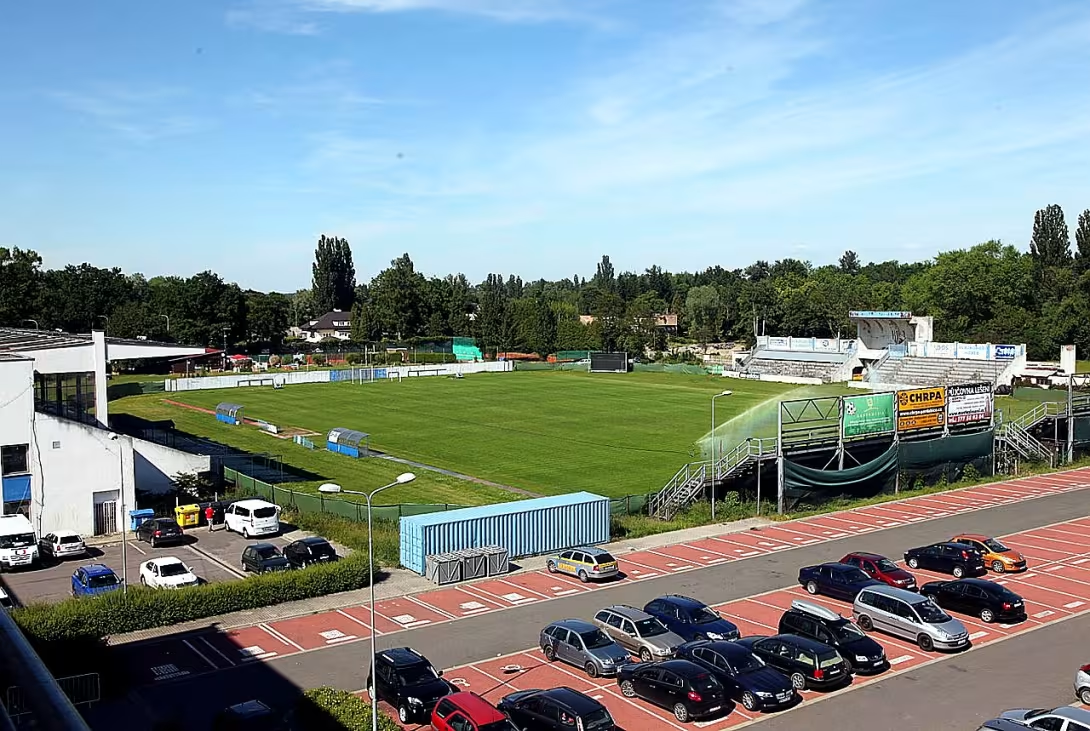
Stadion Arnošta Košťála, formerly known as Summer Stadium, is a major sports area in Pardubice. Its historical stands have been listed in the Central List of Cultural Monuments of the Czech Republic since 2016. The building underwent extensive reconstruction between 2021 and 2023. Today it serves as the home stand of the FK Pardubice Football Club and represents an example of modern sports architecture with roots in the first republic.
The need to build a dignified sports complex in Pardubice arose after the end of World War I. In 1924, the Cooperative was established to set up a sports stadium that strongly promoted this idea. The construction itself started on 14 October 1930 according to the design of architects Karel Řepa and Ferdinand Potouček. Cycling track with folded corners was designed by architect Schürmann from Münster. The stadium was completed in record time and ceremonially opened on 31 May 1931 on the occasion of the Exhibition of Physical Education and Sport with the personal participation of President T. G. Masaryk.
The architectural solution of the complex originally included a football field, a four-hundred meter sash track and a five-hundred meter cycling oval. During the modernization between 2021 and 2023, the commemorative main stand was completely renovated. The playing area approached the bleachers and added new covered sectors for spectators. The modifications also included the construction of artificial lighting and heating of the lawn, thus fulfilling the criteria for the highest football competition.
The property is owned by the city of Pardubice. Over the decades, the stadium changed its names and uses. After the construction of the winter stadium in 1947, the title Summer Stadium was used for football sports grounds, although it was officially called Gottwald Stadium during the communist regime. The Dukly Pardubice Cycling Division has been working here since 1956, but after the collapse of the railway in the 1970s, the construction was finally demolished in 2000.
The stadium was the scene of many important events. From 1936 to 1938, the flat-track races of J. K. Lobkowicz took place on the blacktop oval. Between 1937 and 1946 and then in the 1968 / 69 season this place hosted the highest football competition. Although representatives of the city agreed at the end of 2022 to name the stadium after the resistance of Arnost Koštál, shortly before the league premiere in February 2023, when the match against Slavia Prague took place, the stadium was renamed to the CFIG Arena.
Today the stadium is a modern sports booth with a capacity of 4620 spectators. It combines the historical value of the monument-protected bleachers with the requirements of contemporary professional football. Visiting this place offers insight into the history of the Czech sports infrastructure and allows you to watch first-round matches in an environment that links the tradition of the first republic to modern technologies.
Then and now
Drag the slider to compare how the landmark may have looked when it was built with the view today.
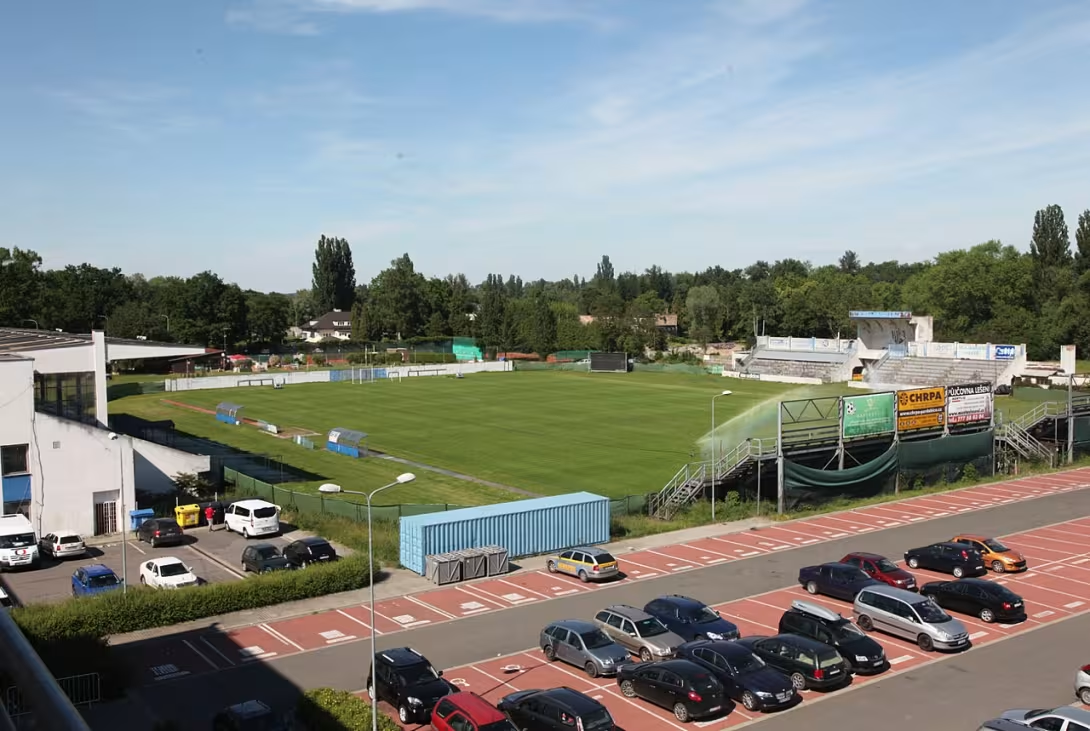

The historical appearance on the left is an AI-generated visualisation and serves as inspiration only.
Historical milestones
- 1930
- Opening of the stadium construction on 14 October.
- 1931
- Formal opening of the stadium on 31 May.
- 2016
- The entry of historical stands into the Central List of Cultural Monuments.
- 2023
- Completion of extensive reconstruction and launch of the modern arena.
Architectural development
The original construction from 1931 included a football field, a blackjack track and a cycling oval. In 2000, a surviving cycling track was demolished. In the years 2021 to 2023, a major reconstruction took place, during which the protected main stand was renovated and supplemented with new covered stands and modern background.
Historical events
Formal opening of the stadium with the participation of President T. G. Masaryk in 1931. The entry of historical stands into the list of cultural monuments in 2016. Completion of the complete reconstruction of the stadium in early 2023.
Owners
City of Pardubice
Points of interest
- The historical stands of the stadium have been registered in the Central List of Cultural Monuments of the Czech Republic since 2016. - The stadium was ceremonially opened on 31 May 1931 with the personal participation of President T. G. Masaryk on the occasion of the Exhibition of Physical Education and Sport. - The original complex contained a football field, a sintered track and a cycling oval whose construction was demolished in 2000. - From 1936 to 1938, the flat-track races of the J. K. Lobkowicz Memorial took place on the floor oval. - During the communist regime, the stadium was officially called Gottwald Stadium.
Guide
Show guide text
This text was created by artificial intelligence and has not been editorially reviewed. It may contain inaccuracies.
Welcome to Pardubice, Part Zelené Předměstí. Right now, you're standing in front of a place that is much more than just a sports establishment. In front of you is Stadion Arnošta Košťála, a place where movement, health and social life of the whole region have been intertwined for almost a century. Now, when you look around you, you perceive space that carries a layer of time. You can see the modern face of the current arena, but at the same time there is still history from the first republic. Stop for a moment, take a deep breath and imagine what this place looked like decades ago, when the new chapters of Pardubice sport began here. Let's go back in time together to understand how this journey began. It all started in the year of nine hundred and thirty. Imagine the autumn day, namely the fourteenth of October in the year one thousand nine hundred thirty, when the construction of this site was festively launched. At that time the stadium was designed as the Summer Stadium and was to serve as a centre for the development of physical education. It was an ambitious project that was supposed to bring the Pardubice top ground for the very popular sports at the time. The whole construction process was carefully planned and in the year one thousand nine hundred thirty-one, namely the last day of May, it was festively opened. It was a period of great optimism when it was believed in the strength of sport and healthy lifestyle as the basis of modern society. Now pay attention to the architecture that defines this space. If you look at the overall available, you will see the result of the collaboration of several talented creators. The main project of the stadium was developed by architects Karel Řepa and Ferdinand Potůček. Their aim was to create a functional and representative space that could handle the demands of thousands of spectators. Note, however, that the complex is not uniform in one style, because each part of it had a specific purpose. A very important part was the cycling track, whose design was entrusted to a German architect named Schürmann. It was this course that gave the stadium its specific character and made it a key hub for cycling in the region. If you look around now, focus your attention on the historical bleachers. These are the most valuable piece of the original substance that has been reading here for decades. These structures are not just a place for viewers, but they are the witnesses of history. It is fascinating to realize that these stands have been registered in the Central List of Cultural Monuments of the Czech Republic since two thousand sixteen. This means that the State has recognised their architectural and historical value as irreplaceable. Look at their line and see the atmosphere of a place where thousands of people once applauded their heroes in anticipation of victory. It's a combination of functionality and aesthetics from when it was built with respect to durability and dignity. This place is also associated with the names of the personalities who have left a deep mark in our history. The most important moment in the early history of the stadium was the ceremonial opening of the cérémony in May of the year a thousand nine hundred thirty-one. Imagine the crowd, the expectations and the festive atmosphere. The stadium was opened with the personal participation of President Tomáš Garrigue Masaryk. His presence here was not random because the opening took place on the occasion of the Exhibition of Physical Education and Sport. The fact that the founder of our state himself came to put this complex into operation underlines the weight of sport and health at that time. Masaryk here saw a way for a better and healthier nation. The stadium's name is in honor of Arnoš Koštěl, another prominent person who was closely associated with this place and sports in Pardubice. Today, when we say the name Stadion Arnošta Košťála, we pay tribute to people who have helped to build sports culture in our city. For decades there was a centre of football, athletic and cycling events. There were records, big teams were held here, and generations of Pardubicans spent their free afternoons here. You might be interested in one interesting thing that shows how this space evolved. The stadium has never been a static place, but it has constantly adapted to new times. While in the year one thousand nine hundred thirty-one we talked about the Summer Stadium and the visit to the President, in the year two thousand sixteen we celebrated the recognition of the tribune for a cultural monument. And then came the year two thousand twenty-three, which meant a big break. A major reconstruction was completed this year. What you see today is the result of modernization, which has turned the complex into a modern arena. It's a fascinating contrast when you see the top current technology and equipment, and at the same time the protected historical stands remain. It's like a conversation between the past and the future, where the old didn't get torn down, but it became the basis for the new. Now try to imagine how the dynamics were changing in this space. From the first start on the cycling track designed by Schürmann, through tense football matches, to today's modern operation. The stadium survived changes in regime, social upheavals, and time trials. The fact that we can stand before the modern arena today, which still remembers the visit of Masaryk, is proof of continuity and respect for tradition. Now you are invited to take a slow look around and perceive this space with your own senses. Go around, see the space around you, and think about how many emotions have happened in these walls and on this lawn in the last ninety-three years. From the joy of victory to the disappointment of loss, from the silence of morning training to the thunder of thousands of fans. It all forms the invisible fabric of this place. Thank you for accompanying me on this short journey through time. The stadium Arnošt Košťál is an excellent example of how the sports area can serve as a bridge between generations. I hope this story inspired you to further discover Pardubice and their hidden treasures. You are now being left to explore the premises. We wish you a pleasant rest of the day and enjoy the atmosphere of this unique place. Goodbye.
Tips for visitors
The best time to visit is during sunny days in spring or autumn months when the light is soft and the area is very photogenic thanks to its architecture from the 1930s.
The location is easily accessible by car and by public transport.
We recommend comfortable shoes for a walk around the premises and the camera. If you are planning a longer stay, bring a bottle of water and snacks.
The best pictures can be taken from the outside stands where the functionalist style of the building stands out. The ideal light for shooting details of architecture is in the morning or shortly before sunset.
The winter stadium, the historical centre of Pardubice and the local castle are nearby. For families with children, the surroundings are suitable for easy walking, while the historical centre offers plenty of space for relaxation and exploring.
Frequently asked questions
Can the monument be visited?
We have not verified whether this monument is accessible. Please ask the owner or operator, or the local municipal office.
Where is the monument?
Location: Zelené Předměstí, Pardubický kraj. The map on this page shows the exact spot.
Why is the monument protected?
It is listed in the Central List of Cultural Monuments of the Czech Republic as a cultural monument (register no. 1000026097).
Businesses nearby
Do you run a restaurant, accommodation, shop, museum, rental, wellness or other visitor service near this monument? Show yourself directly to the people heading to it — this is how they will see you in the app and on the web:
Events nearby

Zdroj akcí: otevřená data měst a obcí ČR (Národní katalog otevřených dat) a kalendář akcí Národního památkového ústavu.
Nearby
Zimní stadion v Pardubicích, historické centrum města Pardubice, zámek Pardubice.
Accommodation nearby
Themed route
Thematic cruise route to Green Suburb
1. Stadion Arnošta Košťála (Main objective) - Type: Sports complex - Why is it worth a visit: This is the home of the local football team FC Hradec Králové and hosted important international matches. Visit the stadium to see its modern facilities and historical exposition related to football.
2. Winter Stadium in Pardubice - Type: Sports complex - Why is it worth visiting: This stadium is the center of ice hockey and hosted many games and tournaments. It is an ideal place for athletes and fans who want to test the atmosphere of ice hockey.
3. Historical center of Pardubice - Type: Historical site - Why is it worth a visit: The centre is full of history and culture, with architecturally interesting buildings from different periods. Visit the streets with an ancient atmosphere and view the sights as a town hall or church of St. Bartholomew.
4. Castle Pardubice - Type: Historical castle - Why is it worth a visit: The castle is one of the most famous and beautiful Baroque locks in the Czech Republic. Its beautiful interiors, parks and historical significance make the visit unforgettable.
This route offers a combination of sport and culture, which is ideal for those who want to discover different aspects of the Pardubice region.
Seasonal recommendations
Spring In spring, the surroundings of the stadium awaken to life and the green suburb is filled with new vegetation. The light is soft in this period and very pleasant to observe the details of the construction. We recommend taking layered clothes because morning temperatures can still be low. It's the perfect time to visit, because crowds aren't as big as in the summer months.
Summer The summer season brings strong sun and dense green landscape. The atmosphere is very lively, but due to high temperatures it can be hot during the day. The best thing to do is to come first thing in the morning to avoid the greatest heat and the greatest number of people. Don't forget light clothes, headgear and enough water to drink.
Autumn Autumn offers an unmistakable atmosphere thanks to golden and brown leaf colours. The morning mist can provide special peace and mystery to the place. It is advisable to carry a waterproof jacket and fixed shoes because the road can be wet and slippery. The best time for a walk is in the morning, when the sun still illuminates the surroundings enough.
Winter In winter there is peace and quiet, especially if the landscape is covered with snow. The days are very short and the light disappears quickly, so plan to visit in the morning. It is absolutely necessary to have very warm clothes, including gloves and hats. In this period it is necessary to count on frost and wind.
Visualizations and artistic views


The visualisations are generated by artificial intelligence and serve as inspiration.
Photos from the area
Real photos taken near the monument


Zdroj a licence jsou uvedeny u každého snímku.
Tips from visitors
No tips yet. Be the first!
Log in and add your tip.
Sources and literature
Photos: Rvk3028 / CC BY-SA 4.0 — Wikimedia Commons. The author and licence also appear when you hover over the image.
Faktickým podkladem tohoto textu byl článek na Wikipedii, jehož autory jsou přispěvatelé Wikipedie. Článek je dostupný pod licencí CC BY-SA 4.0.
Location on the map
More monuments – Zelené Předměstí
Show all in the municipality

Příběhy a pověsti
Legendy, pověsti a příběhy spjaté s touto památkou
Fotografie návštěvníků
Zatím žádné fotografie. Buďte první, kdo přidá fotografii z návštěvy!
Log in a přidejte svou fotografii nebo hodnoťte.
Za ověřenou návštěvu v aplikaci získáte víc bodů — poznáme podle GPS, že jste na místě.
Reviews and comments