






Stará radnice v Ostravě Museum building
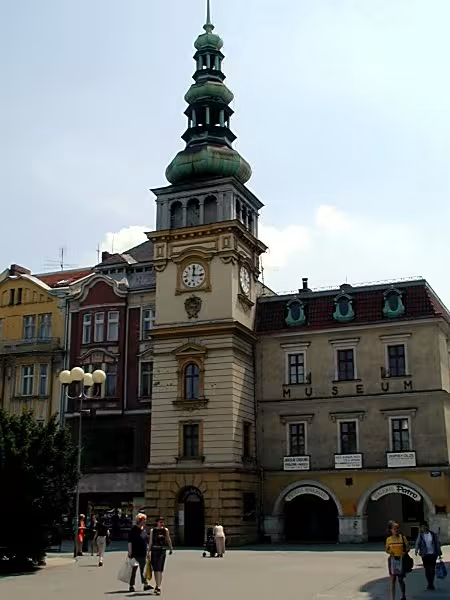
Stará radnice v Ostravě on Masaryk Square is a Renaissance building that has served for centuries as a seat of the city administration. It is an important historical element of Moravian Ostrava and since 1931 it has been operating as a seat of the Ostrava Museum.
The oldest history of City Hall is little documented, although the first mention of it dates back to 1539. The exact year of its construction cannot be determined. Archaeological polls indicate that there were originally two beanhouse houses at the site of today's town hall, and the town hall building at that time was without a tower. At the time of the first mention, Ostrava was part of the Czech Crown.
The appearance of the building gradually changed by a number of reconstructions that introduced various architectural styles. In 1689 a wooden gallery was built around the tower and the gilded dome was decorated with a city emblem. In 1737-1780 the town hall tower was rebuilt into a quadratic form with elements of Baroque, and clock was placed at the top of the tower. Between 1831- 1837 there was a reconstruction in the Empire style. In 1859, the second floor was beefed. The last significant change in external appearance occurred between 1874- 1875, when the facades received neo-Renaissance modifications. Another building was added to the building in 1885.
The fate of the town hall was influenced by several events. In 1556, a fire hit that burned down the city's papers. In 1829 the tower was struck by lightning and due to total decadence the building was on the verge of being torn down, but in the end it was thoroughly repaired. She served as a town hall until 1930 when New Town Hall took over. Since 1958, the Old Town Hall building and the rear corner building on the Brewery Street and the connecting track have been protected historically.
During the reconstruction in the years 2004-2006, rescue archaeological research took place, in which the remains of stone walls of houses from the 14th century were discovered. These walls can be viewed by visitors through the glass floor on the ground floor. Among the objects found were ceramics, glass cups and Prague grosh from the time of John Luxembourg. Another interesting feature is the flood mark on the pillar of the building at a height of approximately 1.7 metres, which resembles the flood of 1880, although there are doubts whether the water actually rose to that height.
Today the building serves as a seat of the Ostrava Museum, which has lasted since 1931. It's a place where you can watch fragments of the oldest history of the city. Visiting the Old Town Hall represents an opportunity for a detailed understanding of the history of Ostrava.
Then and now
Drag the slider to compare how the landmark may have looked when it was built with the view today.
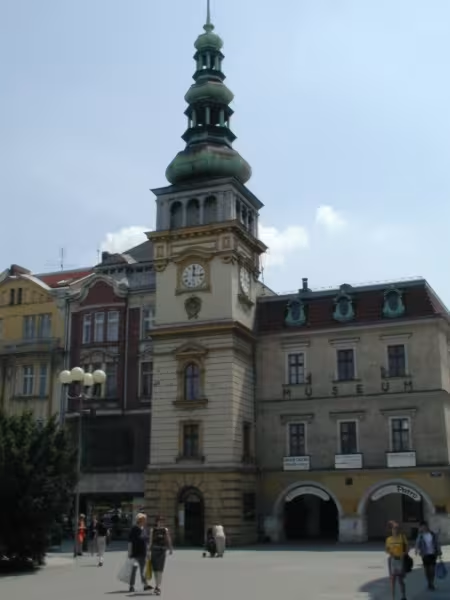
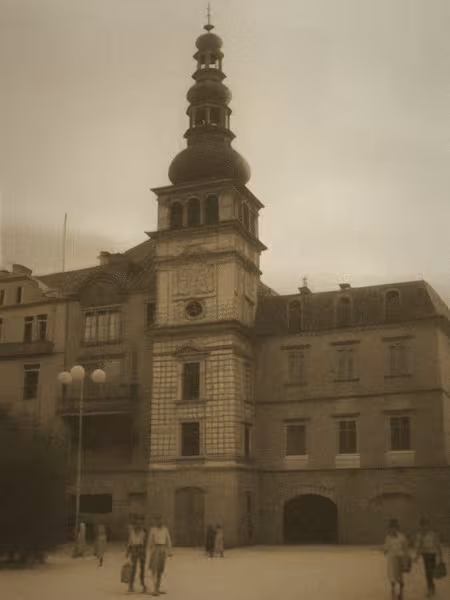
The historical appearance on the left is an AI-generated visualisation and serves as inspiration only.
Historical milestones
- 1539
- First mention of City Hall
- 1556
- City Hall fire and destruction of city documents
- 1931
- The building is starting to serve as a museum headquarters
Architectural development
The original condition without the tower was gradually changed by reconstructions, including baroque modifications of the tower and Empire reconstruction. The last significant change was brought about by the neo-Renaissance modification of the external facades in the 1970s.
Historical events
In 1556 City Hall was hit by a fire that burned down the city documents. In 1831- 1837 the reconstruction took place in the Empire style. Since 1931, the building serves as a museum seat.
Points of interest
- On the ground floor, visitors can see the remains of stone walls of houses from the 14th century. The findings include ceramics, glass cups and Prague grosh from the time of John of Luxembourg. - On the pillar of the building is a flood mark from 1880 at a height of approximately 1.7 metres. - Archaeological surveys suggest that two beanhouse houses originally stood at the town hall and the building was without a tower. - In 1689 a wooden gallery was built around the tower and the gilded dome was decorated with a city emblem. - In 1829, the tower was struck by lightning, and due to the decadence, the building was almost torn down, but in the end it was repaired.
Guide
Show guide text
This text was created by artificial intelligence and has not been editorially reviewed. It may contain inaccuracies.
Welcome to the heart of Moravian Ostrava. You are standing in front of a building that is not just an ordinary stone object, but a living witness of many centuries of urban life, political change and fateful events. While you're looking around, try to stop looking passively for a moment and start to perceive the atmosphere of this place. Can you feel the weight of history floating on these streets? This old town hall, which you have right in front of you, has been an artery to the Ostrava administration for centuries, a place where people's fate, urban development and the future of the entire region have been decided. Today, officials don't work here anymore, but in their place there is knowledge and memory of the city as a museum.
Let's go back deep into the past together to understand how this place came to be. The history of this town hall dates back to the 16th century. The first written mention of it appears already in the year of fifteen thirty Chinese. Imagine the period Ostrava, the restless and constantly evolving settlement. City Hall was a symbol of urban autonomy and power. However, the journey of this object has not always been a peaceful course of years. In the year 15-56, the city was in great trouble. A huge fire hit this city hall above all else. It was not just the loss of the building, but the tragic loss of city documents. All the important documents, chronicles and records that formed the city's identity were destroyed in flames. It was like the city lost its memory. Yet the town hall rose from the ashes and continued its service.
Now pay attention to the very appearance of the building that now surrounds you. Even though today's name was the architects who designed this building, we have only traces of their genius in the form of various architectural styles. The building is not the result of a single time, but rather a complex one composed of many epoch. If you look at its facade and its overall structure, you can see in it different faces of history. In a certain light or from a certain angle you will see elements of the Baroque that have brought their dynamism and richness into the object. Other reconstructions added elegance and rigour of Empire style. And finally, during the period of Neo-Renaissance, the building was supplied with its present, noble form. This mixture of styles creates a fascinating whole that constantly changes its character according to the way you look at it. It's like a book that has every chapter written in different letters.
Speaking of history, we can't forget the characters that are closely connected to this period. Even though the town hall became the center of administration later, its roots and atmosphere of the time when the city was formed go back to the era of John of Luxembourg. His era was a period when the foundations of later urban life were formed in these parts of the country. Even though the city hall did not have to build in these walls at the time, as we know it today, the spirit of the time and the coins from his government, which later archeologists found here, constantly remind us of how deep in time we are.
Now I want to invite you to something really special that awaits you inside. If you choose to enter the building, prepare yourself to change your view of the world under your feet. A unique glass floor is created on the ground floor of the building. It's not a simple decoration, it's a window into the depths of time. If you look through this glass, you will see not only the floor, but the real remains of the stone walls of the houses that stood here in the 14th century. It is a fascinating experience - a state in a modern building and at the same time to see the foundations of the older world which was here long before you. Among these findings you can see small objects that have survived centuries: ceramic fragments, pieces of old glass cups and even Prague grosh from the time of John Luxembourg. These little things are like whispering voices of the past telling us about the daily lives of people who lived here five or six centuries ago.
And if you're interested in one other thing that resembles human malaise before the forces of nature, focus on the pillars of the building. One of them still has a visible flood mark from a thousand eight hundred and eighty. It is located at a height of approximately five feet. This brand is a silent reminder of the time when water dominated the streets and when the city's inhabitants had to deal with unexpected disasters. It is a very tangible proof of how much the city has had to adapt to the surrounding environment in the past.
This building has undergone a huge transformation. In the year one thousand nine hundred thirty-one, the museum was established from where taxes and urban laws were decided. This change was crucial - the town hall stopped being just a tool of power and became a guardian of culture. Today, this object is strictly protected as a monument because its value for the city and for all of us is indispensable.
I won't keep you now. A gateway to the history of Moravian Ostrava opens before you. I suggest you enter, go through the museum space and let yourself be carried away by the stories that are stored here. Don't forget to look under your feet and look for clues of those who were before you. I wish you a nice tour and many experiences in discovering the secrets of the old town hall. Goodbye.
Tips for visitors
For the best experience we recommend a visit during the morning or late afternoon when the light for shooting architecture is the most suitable. Focus on capturing the details of baroque and neo-Renaissance elements offered by the building.
You can easily reach the monument by public transport or by car. Please check the current traffic connections and parking possibilities in the surrounding area in internet maps or search engines.
Bring comfortable shoes and possibly water. For families with children it is ideal to walk in the vicinity where children can try to move in the city area in peace.
After the tour you can take a short walk to Masaryk Square, which is located right in the vicinity and offers another urban atmosphere.
Businesses nearby
Do you run a restaurant, accommodation, shop, museum, rental, wellness or other visitor service near this monument? Show yourself directly to the people heading to it — this is how they will see you in the app and on the web:
Events nearby
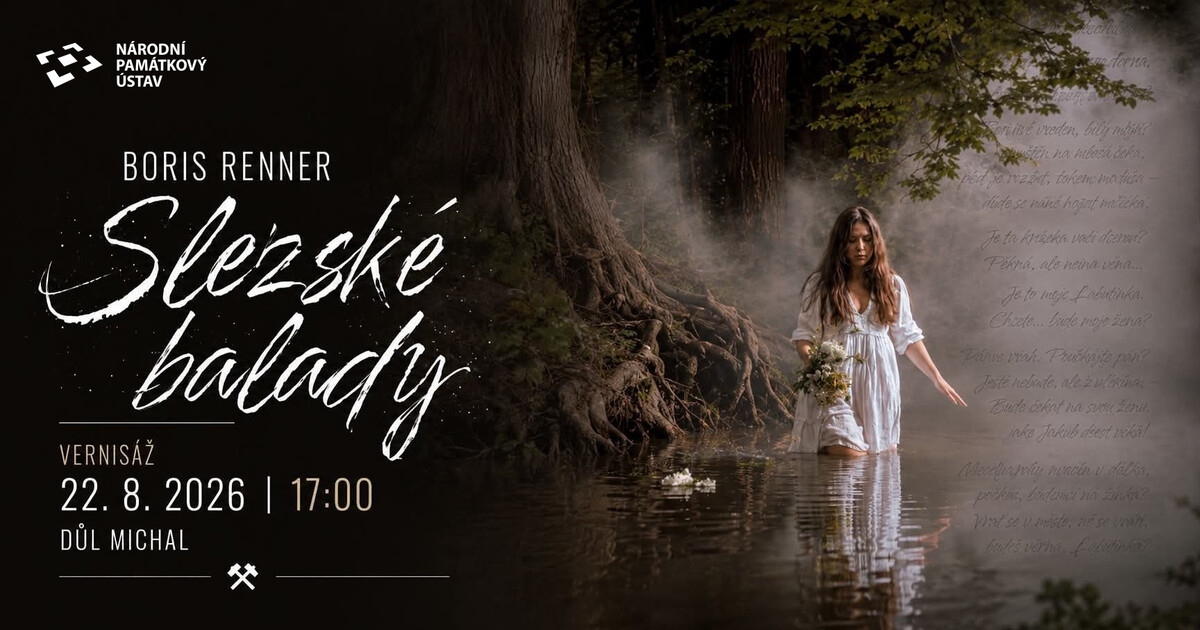
Zdroj akcí: otevřená data měst a obcí ČR (Národní katalog otevřených dat) a kalendář akcí Národního památkového ústavu.
Nearby
Masarykovo náměstí
Accommodation nearby
Themed route
Stará radnice v Ostravě Type: Historical building, cultural monument Why is it worth a visit: This impressive building dominates the centre of Moravian Ostrava and has served for centuries as a seat of the city administration. Visitors can enjoy a view of its Renaissance and Baroque elements, which tell the story of the development of the city.
Masaryk Square Type: Public area, historical centre Why is it worth a visit: The square is a natural and logical extension of the town hall, where history intersects with everyday life. It is an ideal place for a short break where you can admire the surrounding architecture and atmosphere of the old town.
Around Masaryk Square Type: Historical installation, pedestrian zone Why is it worth a visit: The immediate surroundings of the square offer a view of other historical houses, which together with the town hall form a continuous architectural complex. The walk in this area allows a better understanding of the urban structure of Moravian Ostrava without the need to leave the central part of the monument.
Inner spaces and courtyard Old radnice Type: Architectural detail, cultural heritage Why is it worth a visit: If you can enter the interior or the courtyard, you can see the historical halls or admire the facade details up close. This point of the route closes the circuit and allows for a deeper link with the history of the main destination of the trip.
This route is designed to be maximally compact and focused exclusively on the main target and its immediate surroundings, as specified. It starts at the town hall itself, moves to the adjacent Masaryk Square, continues with a short walk along the surrounding historical development and ends again with details of the main monument. The whole circuit can be managed during a short walk, making it an ideal destination for a short afternoon trip or as part of a longer stay in Ostrava. The focus is on the visual and historical context offered by these two closely connected locations.
Seasonal recommendations
In the spring the town hall shines with the waking city green and fine morning light. The atmosphere is fresh and full of optimism, which makes the visit a pleasant experience. We recommend to dress in layered clothes so that you don't get caught by the variable weather, and rather come in the morning before the city moves completely.
The summer season brings intense sun and noisy, energetic excitement around the building. The city hall's interiors offer a pleasant escape from the heat, while the exteriors seem very clear. Due to the largest number of visitors, it is best to plan the arrival immediately to be opened. Don't forget light, breathable clothes and plenty of fluids.
Autumn covers the memory of melancholy and golden colours of leaves in the surrounding alleys. Lighting is softer and shadows deeper, which gives the building a mysterious touch. The practical recommendation is to carry an umbrella or raincoat for frequent days. The ideal time for a tour is late afternoon hours.
In winter the town hall is cozy, especially when it is surrounded by an advent atmosphere and evening illusions. Freezing air contrasts with internal heat space. It is essential to choose warm clothes and fixed shoes. Due to the shorter day we recommend monitoring changes in opening hours and visiting the place before dark.
Visualizations and artistic views


The visualisations are generated by artificial intelligence and serve as inspiration.
Photos from the area
Real photos taken near the monument

Zdroj a licence jsou uvedeny u každého snímku.
Tips from visitors
No tips yet. Be the first!
Log in and add your tip.
Sources and literature
Photos: eo:Vikipediisto:Petr Tomasovsky / CC BY-SA 3.0 — Wikimedia Commons. The author and licence also appear when you hover over the image.
Faktickým podkladem tohoto textu byl článek na Wikipedii, jehož autory jsou přispěvatelé Wikipedie. Článek je dostupný pod licencí CC BY-SA 4.0.
Location on the map
More monuments – Moravská Ostrava
Show all in the municipality


Příběhy a pověsti
Legendy, pověsti a příběhy spjaté s touto památkou
Fotografie návštěvníků
Zatím žádné fotografie. Buďte první, kdo přidá fotografii z návštěvy!
Log in a přidejte svou fotografii nebo hodnoťte.
Za ověřenou návštěvu v aplikaci získáte víc bodů — poznáme podle GPS, že jste na místě.
Reviews and comments