



Šťastného vila Villa
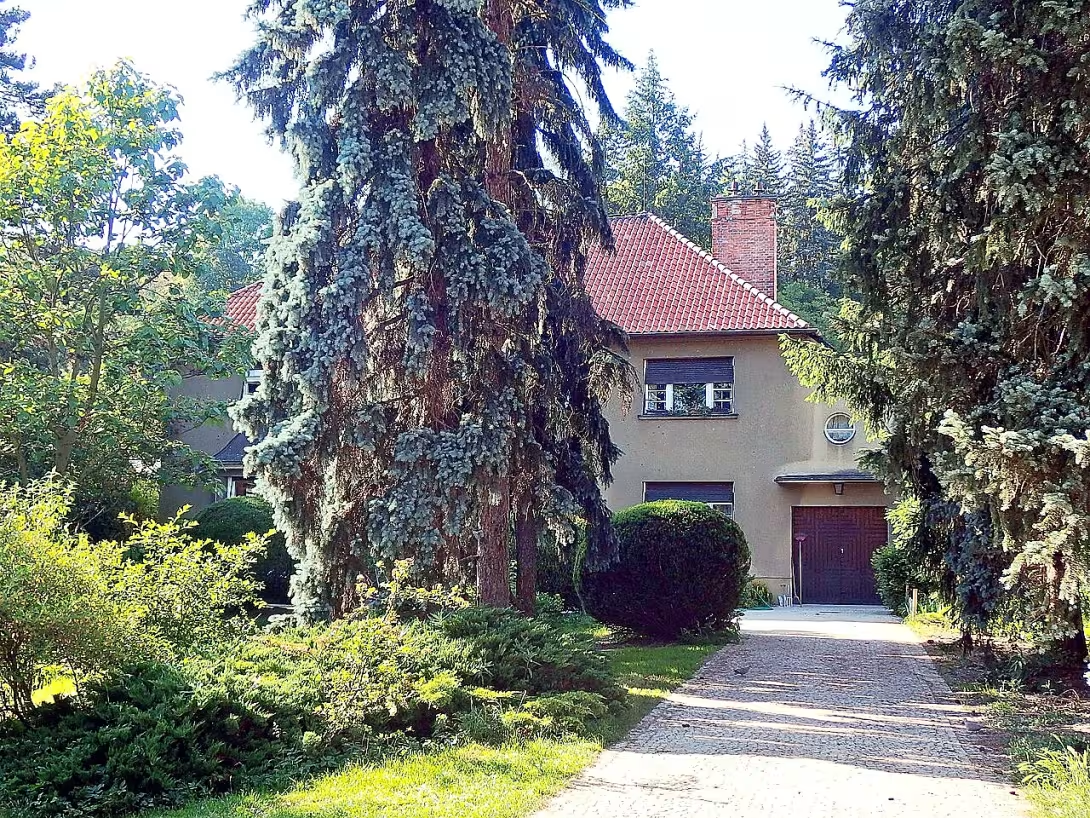
Šťastného vila in ZlínA is a family house from the years 1939-1940, built for the director of Bat Stools Antonín Happy. It is one of the few managing villas in the city, which survived in its original state including interior and furniture. The architecture of the villa combines elements of functionalism with individual modifications that distinguish it from purely functionalist solutions.
The development was linked to the development of Bat's enterprises in the 1930s, when the company was one of the leading industrial companies that influenced the urban development of Zlína. It was probably designed by architect Vladimir Karfik, who designed a number of other management villas in the area. Although it is not certain whether Karfik was the author of this project, his stylistic elements and details are so similar that his participation is considered likely.
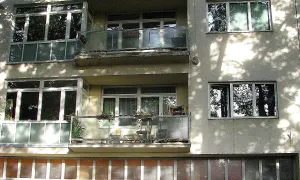
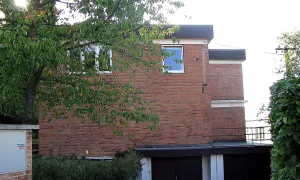
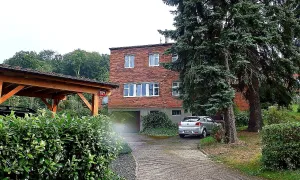
It is a one-storey villa with a rectangular plan, standing separately in the garden area on the slope in the part of Čepkov. The main facade is four-axis with a corner risalite, which forms a three-sided bay on the ground floor. The entrance part highlights the four-stage staircase leading to the entrance, which is overshadowed by a balcony on the first floor. The windows are divided into three-piece rooms and smaller for economic areas. The roof is a Valb with a segmental skylight and a massive chimney.
The interior layout is arranged around the central staircase hall, where the communication areas are paved with mosaic. The living rooms retain the original wooden friezes. The villa remains in the property of the Happy family and serves its original purpose today. Thanks to this it was preserved in very good condition including interior, where original door frames, fittings, built-in furniture and fittings were preserved.
In December 2000 the villa was declared a cultural monument along with the garden and surrounding trees. It is one of the exceptional examples of managing villas preserved in its original state. Although sometimes referred to as functionalist, its details and concepts are rather non-functionalist, suggesting a possible modification of the original project.
The villa is situated on a quiet slope overlooking the surrounding green spaces, which contributes to its unique character. Today it serves as a family house, but accessibility to the public is not publicly available. Yet it represents an important monument and a rare example of preserved architecture from the period of Bata's thriving businesses. It shows how industrial managers at the time wanted to present themselves. An interesting example for lovers of architecture and history is the combination of functionalist elements with individual adjustments for family comfort.
Then and now
Drag the slider to compare how the landmark may have looked when it was built with the view today.
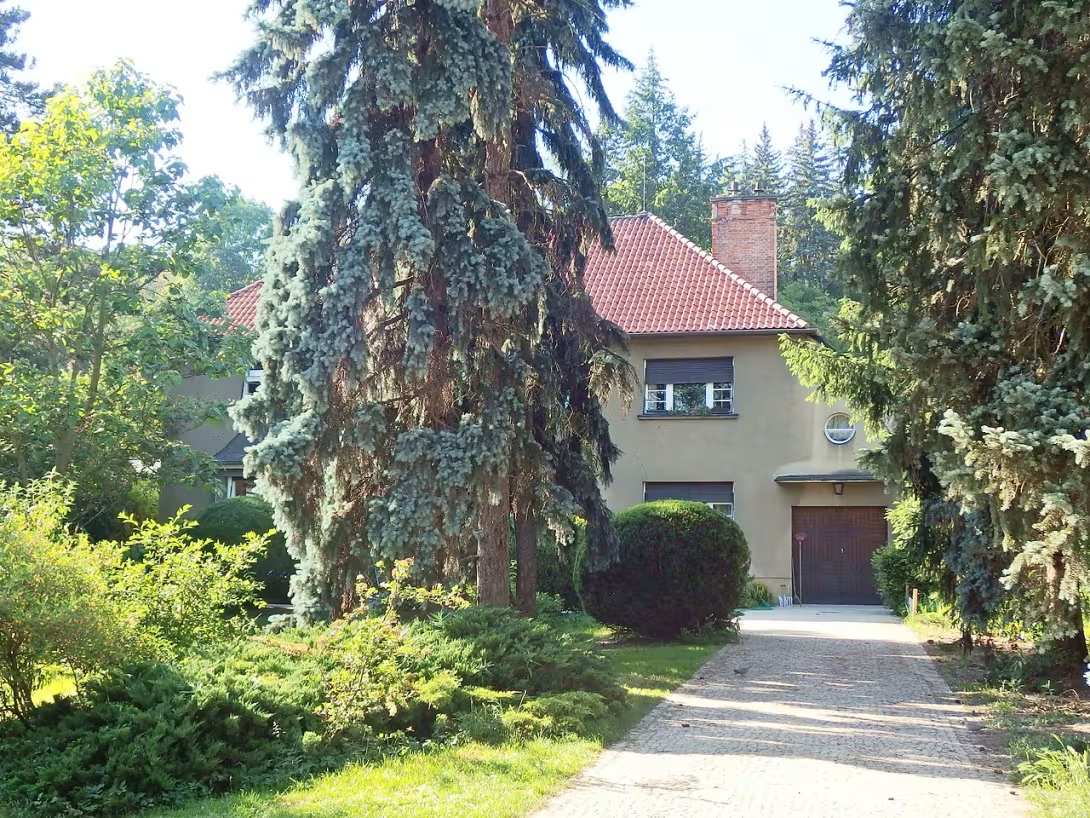
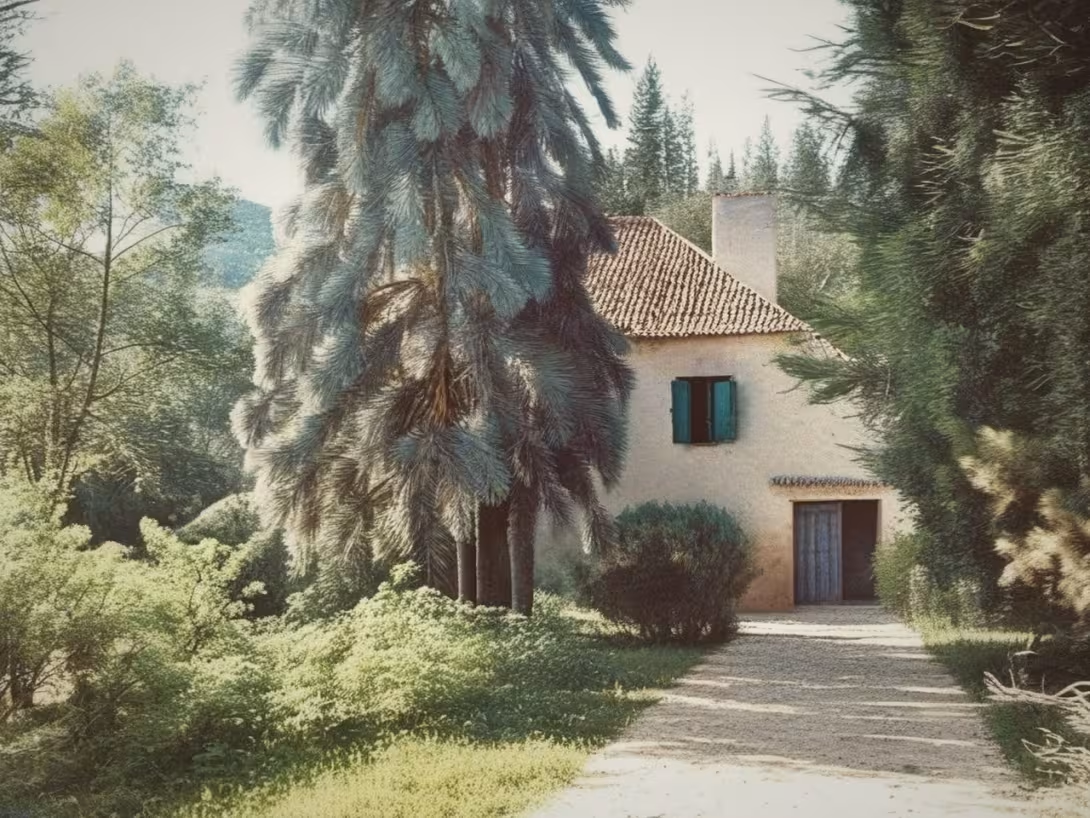
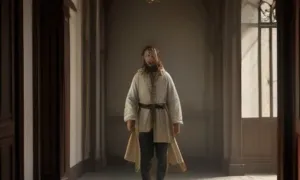
The historical appearance on the left is an AI-generated visualisation and serves as inspiration only.
Historical milestones
- 1939-1940
- Built a family house for director of Bat Stools Antonín Happy
- around 1930
- A number of management villas in Zlín are being established associated with the development of Bat Enterprises
- 1939-1940
- The villa serves as a residence of the Happy family, the original interior and furniture is preserved
- 2000
- Villa declared a cultural monument including garden and tree line
- around 1930
- Architect Vladimir Karfik is likely to design similar management villas in the area
Architectural development
The villa was built between 1939-1940 according to an unknown architect, with the likely participation of Vladimir Karfik. It is a one-storey building with a rectangular plan, with a risalite and a bay on the ground floor. The interior layout is arranged around the staircase hall, with economic areas in the right and social rooms in the left. The roof is a Valba with a skylight and a chimney. Materials and details correspond to functionalist style with adjustments for family comfort.
Owners
The family Antonín Happy (from creation to present)
Points of interest
- The villa was built in 1939-1940 for the director of the Bat Tannins Antonín Happy.
- It is one of the few managing villas in Zlín, which survived including the original interior and furniture.
- Architecture combines elements of functionalism with individual modifications that distinguish it from purely functionalist solutions.
- The villa is on a slope in the part of Čepkov and has a rectangular plan with a corner bay and a four-stage staircase.
- The interior is arranged around the central staircase hall with mosaic floor and preserved by original door frames.
Guide
Show guide text
This text was created by artificial intelligence and has not been editorially reviewed. It may contain inaccuracies.
Welcome to one of the most interesting parts of the city Zlín. You are standing right in front of a building that is not just an ordinary house, but a living witness of the ancient era when this city was transformed into a modern symbol of industrial progress. In front of your eyes is the Happy Villa. She may seem calm and discreet at first glance, but believe me, there is much more stored in her walls than the clean lines at first glance suggest. Feel the atmosphere, feel the calm that brings this garden and tree line to the surroundings. It's a place where the private life of an important person meets the great history of one of the most successful businesses in our history.
Let us now return together to the time this house was born. Imagine a period around the years of a thousand and nine hundred and thirty. Zlín had an incredible boom back then. It was not just ordinary growth, it was a celery variable process when a small village became a modern city with a clear structure. As part of this boom, a number of mansions were created for people who were very responsible in this city. It was in these years, namely between the years one thousand nine hundred thirty and one thousand nine hundred forty, that this villa was built. It wasn't a building for everyone. It was meant for a man who led one of the most important parts of the local industry. The happy villa was home to Antonín Happy, the man who was director of Bata's tights. This house was therefore not just a simple residence, but a symbol of position and stability within the then social and working structure.
Now pay attention to the construction itself that surrounds you. Look at her shape and the way she wedged into her surroundings. It is a single-storey house, which gives it a certain human measure, even though its architecture expresses great certainty. Notice how the building behaves in the corner of the property. It has a corner section, a so-called risalite that slides into the street and gives the whole house a dynamic look. If you raise your eyes a little higher, you can see the bay, that's the window coming out that brings light into the interior and gives the facade an interesting shadow. The overall architecture is very interesting as it tries to connect two worlds. On the one hand, you can clearly see the elements of functionalism - that is, the effort for simplicity, cleanliness and practicality, which was so important to modern thinking at the time. On the other hand, however, the architect, who is probably attributed to Vladimir Karfik, added individual modifications to the work. These details correct that the villa is not just a simple example of modern construction, but it has a certain elegance and personal touch that distinguishes it from many other similar buildings around it.
Speaking of this place, we can't forget the character of Antonín Happy himself. Imagine his everyday life. As director of industry, he had to be a man who ruled a great many people and complex machines. This house was his port, a place where he could find peace after a busy day at the factory. The villa was designed to reflect its role and character. It's a place that seems proper, organized and yet very dignified. The whole area, including the garden and the tree line, consists of one whole, which separates the private world of the Happy family from the busy world of work and industry.
And here comes what makes this memory truly special and what may surprise you. Most historical buildings have undergone many changes in time. People moved, interiors were painted, furniture was exchanged for more modern. But at Happy Villa, it's different. This building is like a vessel that kept time inside. It is one of the very few managing villas in all of Zlín, which we managed to preserve in the condition in which they were originally pre-STO flights. It means that even if you're standing outside now, the original interior and the original furniture are still inside. Imagine this incredible thing - a man can enter space and see things that touched the hands of people living at the time of construction. That's the rare thing that makes this monument a treasure. It's like you've found a little pocket in time that hasn't changed, while the world around it is spinning at a huge speed.
Imagine the strangeness of how this villa coped with the stormy times that followed its completion. It was built just before the Great World War began, at a time when history began to break. Yet, thanks to its strength and character, it survived decades and remained preserved. In two thousand years, this villa was officially declared a cultural monument, which was the guarantee that its beauty and its story would never be forgotten.
Now I suggest you move on slowly. Remember to pay attention to the surrounding environment, the garden and the trees surrounding the villa. Feel how this space connects to the surrounding landscape and how it forms a harmonious whole. Look at the facade from different angles, see if you can find any details in its shadows that you've missed before. Whether you decide to continue your journey along historic routes or just walk through the city, remember what you just saw. A happy villa isn't just a house of bricks and plaster, it's a story about people, about work and trying to create something permanent. Thank you for spending this moment with us. We wish you a beautiful and inspiring next part of your tour.
Tips for visitors
The best time to visit Happy Villa is early morning or late afternoon. In these times there are fewer visitors and you can see the villa in peace. Sunlight hits in these hours from different angles, creating interesting shadows and lighting of the interior, ideal for photography.
The living space is illuminated by a pleasant light at these times, which highlights the details of architecture and interior.
If you arrive by public transport, stops are within walking distance.
The villa is well accessible by car and on foot from nearby stops.
When visiting, wear comfortable shoes, as the villa and its surroundings should be seen on foot. If you want to take pictures, bring a lens with less focus to capture the overall view of the villa and its details. In winter, pack warm clothes because the villas have no heating.
Comfortable and suitable clothes are crucial for a comfortable visit.
The best places for photography are the corner risalit and bay villas, which are architecturally interesting. Ideal light can be found in the morning or afternoon sun, when it is reflected from the facade and creates contrast shadows. The interior is worth photographing rooms with original decoration.
Rizalite and bay are the most attractive points for images.
In the vicinity of the villa you can reach Bata's house in 30 minutes, which is an interesting historical monument. Another option is a tour of the Bata Canal complex, where natural elements and historical buildings are located. For green lovers it is advisable to visit parks and green areas in Čepkov which are quiet and pleasant.
Bata's house and channel are the closest places of interest.
For families with children it is advisable to visit Bata's house where children can become acquainted with history and technology. It is also possible to play in the park in Čepkov, which offers plenty of space for children's activities. A tour of the villa can be interesting for children as it is an example of architecture from the past.
Bata's house and park in Čepkov are ideal for children.
Frequently asked questions
Can the monument be visited?
This is a residential or farm building, not a museum with opening hours. Please view it from public space and respect the owners' privacy. We have no information about access to the interior.
Where is the monument?
Location: Zlín, Zlínský kraj. The map on this page shows the exact spot.
Why is the monument protected?
It is listed in the Central List of Cultural Monuments of the Czech Republic as a cultural monument (register no. 1000164264).
Businesses nearby
Do you run a restaurant, accommodation, shop, museum, rental, wellness or other visitor service near this monument? Show yourself directly to the people heading to it — this is how they will see you in the app and on the web:
Nearby
V okolí se nachází část města Čepkov, která je zelenější a klidnější než centrum Zlína. Do 5 km jsou významné památky jako Baťův dům (Muzeum Baťův dům) nebo areál Baťova kanálu. Přírodní prvky zahrnují parky a zelené plochy v okolí Zlína.
Accommodation nearby
Trips and activities nearby
Guided tours, tickets and activities nearby from GetYourGuide
Affiliate link: if you buy from the partner, we may receive a commission. The price for you does not change.
Search tours and activities →Themed route
Thematic cruise route in the vicinity of the Happy Villa in Zlín
1. Happy Villa - Happy Villa is a beautiful historical house from the 19th century, which was originally the seat of the Bat family. It is worth visiting for its architectural value and a romantic atmosphere that resembles a period lifestyle. The interior keeps the original equipment and the exposition shows the family history.
2. Happy Villa Park - Happy Villa Park is a quiet green oasis with large grassy areas and old trees. It is ideal for walking and relaxing, where you can enjoy a pleasant environment without a busy surroundings.
3. Bat House (Bat House Museum) - Bat House Museum (about 5 km) is an important monument which represents the life and business of Antonín Bata. Interesting are the exhibitions about industry and social influence of the Bat family, which had a great influence on the region.
4. The area of Bata Canal - Bata Channel (about 3 km) is a technical monument with historic bridges and canal channels. It is interesting for technical history and the possibility of walking around the water system, which was important for industrial activity.
Conclusion: The route combines cultural and natural experiences, focusing on historical monuments and quiet spaces around Zlína.
Seasonal recommendations
Spring At this time, the Šťastného vila is about to blossom in nature - first spring flowers, such as cherries and apple trees, bloom, and the forests become green. An important part of the atmosphere is also the warm sun, which brings long daily hours and mild temperatures, ideal for walking. The lighting of the monument can be less intense during this period, but thanks to the scattered light a pleasant, peaceful form arises.
It is advisable for visitors to pack light clothes with an accent on the warm layers, because even in spring days it can be cold. The best time to visit is in the morning when there are fewer crowds and nature is still full of life. It is also important to monitor the weather forecast, because spring storms can shorten walks.
Summer In the main summer season Šťastného vila is full of life thanks to warm weather and long daily hours. Nature is completely green, with the flowering grass and trees, and the lighting of the monument is intense, often supplemented by outdoor lighting elements. The atmosphere is warm and friendly, ideal for family trips.
It is advisable for a visit to come in a timely time to avoid crowds. It is recommended to wear light, airy clothes with sun protection. It is also convenient to have water and light refreshments with you, because in summer days the heat may be more intense. It is also important to monitor opening times that may vary depending on the weather.
Autumn In autumn days, the Šťastného vila is surrounded by a beautiful autumn atmosphere - leaves are getting yellow and become colorful, which creates a pleasant scenery. The lighting of the monument is usually less intense but supplemented by natural light sources such as sunlight and warm evenings. Nature is calm and therefore it is an ideal time for peaceful walks.
For the visit it is advisable to wear warmer clothes with an accent on the top layer, as temperatures may fall. The best time to visit is in late afternoon hours when nature is still full of colors and there are fewer crowds.
Winter In Advent Time Šťastného vila is full of darkness and frost, but at the same time it offers a unique atmosphere. Nature is covered with snow, and the lighting of the monument is often supplemented by light elements that create a magical atmosphere. The atmosphere is quiet and quiet, ideal for romantic walks or family trips.
For a visit it is advisable to wear warm, multi-ply clothes and suitable shoes. The best time to visit is in the morning when snow is still clean and the atmosphere is calm. It is also important to watch opening times that may be shorter in the winter months. It is also advisable to bring warm drinks and light snacks to avoid cold.
Visualizations and artistic views


The visualisations are generated by artificial intelligence and serve as inspiration.
Photos from the area
Real photos taken near the monument


Zdroj a licence jsou uvedeny u každého snímku.
Tips from visitors
No tips yet. Be the first!
Log in and add your tip.
Sources and literature
Photos: Palickap / CC BY-SA 4.0 — Wikimedia Commons. The author and licence also appear when you hover over the image.
Faktickým podkladem tohoto textu byl článek na Wikipedii, jehož autory jsou přispěvatelé Wikipedie. Článek je dostupný pod licencí CC BY-SA 4.0.
Location on the map

Příběhy a pověsti
Legendy, pověsti a příběhy spjaté s touto památkou
Fotografie návštěvníků
Zatím žádné fotografie. Buďte první, kdo přidá fotografii z návštěvy!
Log in a přidejte svou fotografii nebo hodnoťte.
Za ověřenou návštěvu v aplikaci získáte víc bodů — poznáme podle GPS, že jste na místě.
Reviews and comments