



Štědrá Motte
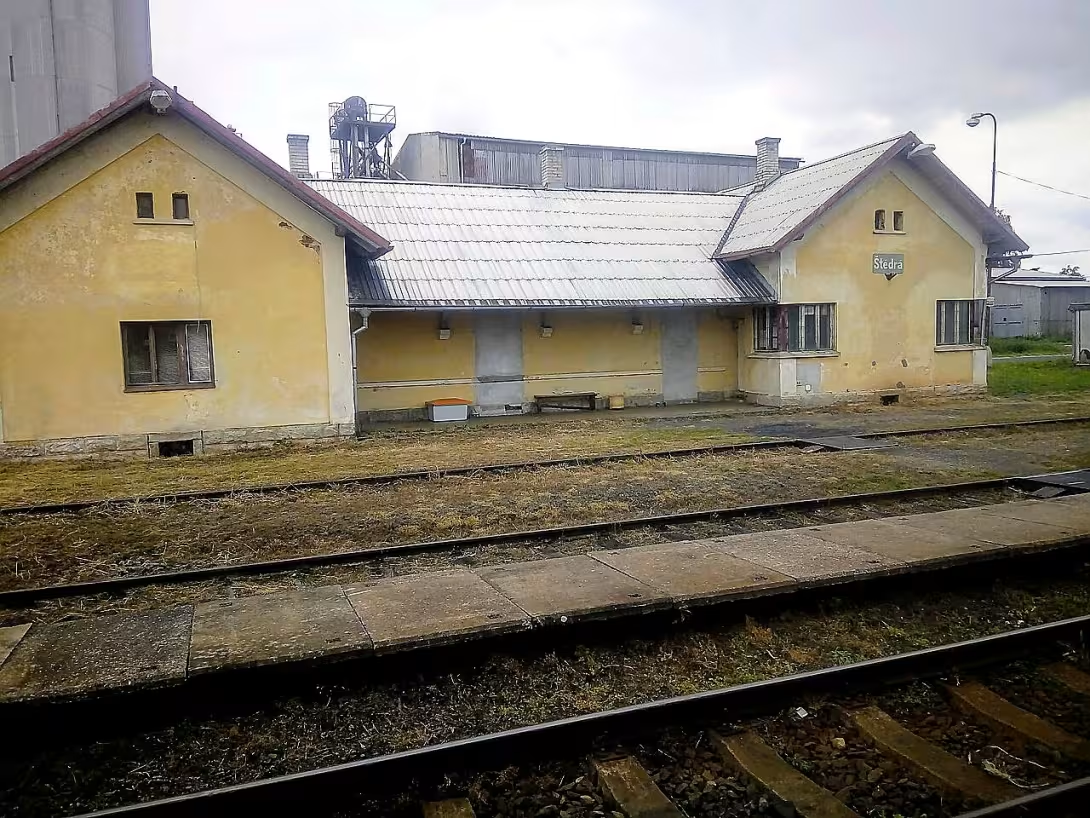
Štědrá is a extinct fortress in the village Štědrá, located in the district of Karlovy Vary. It preserved a fortress with a rectangular plan of 65 × 90 metres around the moat and a partially preserved wall. We are protecting these medieval mansions today as a cultural monument, even though the public cannot visit it.
It probably originated in the 13th century, as indicated by the first written mention of the village from 1239. At that time, Vít and Vice-Militia from Vídré were located here. The position of the fort on a less strategic slope suggests that its construction was more practical than defensive. At that time there was intensive settlement and development of the Czech countries, especially in the area of Karlovy Vary.
There is little information about the fortress that has been preserved architecturally. The preserved rectangular plan with dimensions 65 × 90 metres and the moats with partially preserved bevel indicate a simple structure, probably made of wood and clay. The exact date of construction and details of the original architecture were not preserved.
The ownership changed several times during the 13th and 14th centuries. After Vít and Vícemil, the fort was taken into the hands of Heřman of Výdré, who sold part of his property to the Convent of Chotešov in 1321. His relative Pribyslav, the servant of King John of Luxembourg, became another owner. The family contributed significantly to the development of the surrounding countryside. His descendant was probably Setech, who died in 1354. After it, Litold, Fridrich and Høman owned the fort around 1360.
The end of the original fort meant the purchase of the Generous Boršová of Rýzmburk after 1360. They also won the generous castle and Borek, making the generous castle the new center of the estate. The Štědrá Fortress has thus ceased.
The fortress is located on private property and is not accessible to the public. Yet it has been protected as a cultural monument since 1964. It represents an important historical element of the region, which reflects the dynamics of medieval residential development in the area of Karlovy Vary. Although it is not readily available, its existence brings valuable knowledge of the life and organization of the then estate.
Historical milestones
- 1239
- The first written mention of the village Štědrá and its owners.
- 1321
- Hřman from Výdré sold part of the estate to the monastery and began to separate from the village.
- 1354
- The death of Setou, the last known relative of the original owners of Generous.
- 1360
- The Borshes of Rýzmburk bought with Gretel and the original fortress was destroyed.
- 1964
- The remains of the fort were included in the state list of cultural monuments.
Architectural development
The fortress was built probably on a slope in the 13th century, but the exact date and details of architecture are unknown. The preserved fortress has a rectangular plan with moats and walls, which suggests a medieval defensive function. Materials and style have not been preserved, but according to preserved remains, simple construction of wood and clay can be expected. In the 14th century it disappeared and its remains were converted into a fortress.
Historical events
- 1239
- The first written mention of the village Štědrá and its owners Vít and Vicémili from Vídré.
- 1321
- Hřman of Výdré sold part of his property to the Chotešov monastery and later moved to Zhřice.
- 1354
- The death of Setou, probably a descendant of Pribyslav of Christmas, who belonged to the servants of King John of Luxembourg.
- after 1360
- The Borsches of Rýzmburk bought Christmas, Christmas Castle and Borek, which destroyed the original fortress in Výdré.
Owners
- 1239
- 1321
- about 1350
- about 1360
- after 1360
Points of interest
- The extinct fortress Štědrá is located in the village Štědrá and is protected as a cultural monument, although the public cannot visit it.
- The preserved fortress has a rectangular shape with dimensions of 65 × 90 metres and is surrounded by moats with partially preserved bevel.
- The first written mention of the village and the probable formation of the fort dates back to 1239, when Vít and Vice-Mile of Vídré were based here.
The fort is not open to the public because it is located on private property.
Guide
Show guide text
This text was created by artificial intelligence and has not been editorially reviewed. It may contain inaccuracies.
Audio guide for memory Štědrá
---
Welcome, dear visitors! You're still facing a stunning, extinct fortress that will show you the secrets of the past today. You are surrounded by a vast fortress, which reminds you of the forces that have ruled here in the past. Look up - in front of you is a rectangular space whose dimensions are 65 metres in length and 90 metres in width. Around it is a moat that is surrounded by a partially preserved boulder, as if there was ever a solid fortified structure. Notice how the ground rises and decreases here - the fortress was built on a mild slope, which may remind you that there was no ideal place for a fortress.
Let's move on to what happened here. The first written report on the village Štědrá and its owners dates back to 1239. At that time, there were people living here who set the foundation of their lives. However, there have been significant changes over time. In 1321 Heřman sold part of his estate to the monastery and began to separate from the village. But his heirs died in 1354 - Setty was the last known relative of the original owners. After his death, the situation changed, and in 1360, Gretel Borsha from Rýzmburk was bought. This means that the original fortress has disappeared and its place has been taken by the neighboring generous castle.
Now pay attention to the architecture that left a trail. The fort was built to be well surrounded by a moat and a boulder, which was typical of the fortified mansions of that time. Notice how the country gradually rises here - the wall was probably built to reflect the enemy's attacks. Although the fort no longer exists, its remains show us today what life was like at that time. The moat and the wall are leftovers that remind us of what life was like in this area.
The interesting thing is that the original fortress was destroyed in the 14th century, and a neighbouring castle complex was created instead. This means that there were several important construction stages that affected the history of this area. Notice also how important events have taken place here in the past that have affected the life of local people.
Today, this fortress is protected as a cultural monument, but the public cannot visit it directly. Yet it is a place that is worth looking at and understanding what forces have ruled in the past. If you are interested, you can look at the map or read more information to help you better understand the history of this place.
Notice how important events have taken place here in the past that have affected the life of local people. The fort was not only a fortified mansion, but also a place where the gentlemen here decided on the future of their family. Today is a place that reminds us of what the lives of people in the past were and what their ambitions were.
If you have time, explore further information about this monument. You can read chronicles or look at maps that help you better understand how things have evolved here in the past. Štědrá will show you today what secrets it hides underground and what history has been written here.
Let the visit to this monument bring you joy and at the same time help you better understand the past. Thank you for your attention and we wish you pleasant tours. If you like it here, don't hesitate to come back and explore the other secrets that these places hide for us. Thank you for your visit and wish you a pleasant day.
Tips for visitors
Best time to visit
The best time to visit the ruins of Štědrá is in spring or autumn when the weather is pleasant and the place is not crowded with tourists. The sunny morning or afternoon provides ideal light for photography. In summer there are often more visitors, while in winter access can be restricted due to snow or frozen moats. Always check if the site is accessible before visiting.
If you arrive by public transport, the stop is near the village. It is recommended to arrive by car and then take a walk along the surrounding roads.
What to take with you
To visit the ruins, take comfortable shoes, because the terrain is uneven and part of the road leads on reinforced roads, part of it along natural paths. It is also appropriate to take a map or mobile navigation because the ruins are located outside the main communication. In spring and summer bring plenty of water and sun protection, in autumn and in winter warm clothes. Remember the camera or mobile phone for documentation.
Photography - best places and light
The best places for shooting are the edges of the fort, where you can see the total schedule and moats. Sunlight is the ideal morning or afternoon when you avoid direct sun and shadows are shorter. The contrasts between green and stone remains are also interesting. If you want to capture the total view of the ruins, go to the edge of the moat where the best view is. In winter, some parts of the ruins can be covered with snow, creating interesting compositions.
What to visit in the area (within 30 minutes)
In the vicinity of the ruins Štědrá is worth visiting several interesting places. A little further, about 5 kilometers west, lies Chotosov, a town with a monastery and a historical core.
Tips for families with children
For families with children the visit to the ruins of Štědrá is interesting thanks to the possibility of discovering history and nature. Children can see the remains of an old fortress and imagine what life in the past looked like. It is possible to play and have fun in the surrounding area. For more comfort, bring some games or small workbooks to entertain the children while walking. In the nearby Beautiful Forest, children can observe animals and plants, which is also an educational experience. Always bring enough food and drink, because there are not many shopping options in the area.
Frequently asked questions
Can the monument be visited?
This is an archaeological site. Often there is little to see on the ground and the land may be private. We have not verified access.
Where is the monument?
Location: Štědrá, Karlovarský kraj. The map on this page shows the exact spot.
Why is the monument protected?
It is listed in the Central List of Cultural Monuments of the Czech Republic as a cultural monument (register no. 1000130613).
Businesses nearby
Do you run a restaurant, accommodation, shop, museum, rental, wellness or other visitor service near this monument? Show yourself directly to the people heading to it — this is how they will see you in the app and on the web:
Nearby
- Zachovalý hrad, který se stal novým centrem panství po roce 1360.
- Městys s klášterem a historickým jádrem, kde se nacházel klášter, kterému Heřman ze Štědré prodal majetek.
- Přírodní rezervace s bohatou flórou a faunou, typická pro karlovarskou krajinu.
Accommodation nearby
Trips and activities nearby
Guided tours, tickets and activities nearby from GetYourGuide
Affiliate link: if you buy from the partner, we may receive a commission. The price for you does not change.
Search tours and activities →Themed route
Daily trip route to the Štédré harbours and surroundings
1. Greed fortress - castle * * (main destination) Why? A preserved fortress from the 14th century, which became the new centre of the estate after 1360. Most interesting is the historical architecture and views of the surroundings. There is an exhibition on the history of the local area that helps to understand the importance of the fortress in the past.
2. Generous castle * * (300 m from the fort) Why? Small but interesting castle complex with well preserved tower and courtyard. Ideal for a short walk and recognition of the original castle area, which is part of the entire estate.
--- Alternative variant (if the surroundings are not too rich): 3. Tanks Stédré fort * * (internal inspection) Why? Suitable for visiting local history exposures that focus on the fortress and its importance for the region. The parking spaces around the courtyard offer a quiet atmosphere for a short relaxing time.
--- Total length of route: Approximately 1 km (including surroundings) or 500 m (internal tour). Recommended time: 2-3 hours.
Seasonal recommendations
Spring
At this time the monument manifests itself in a quiet atmosphere, when nature is blooming around the ruins - trees are beginning to foliage, first flowers are blooming and the first birds appear in the surroundings. The lighting is pleasantly soft, the sun shines weak, but sufficiently to illuminate traces of the past. The air is fresh and full of life, which gives the place special comfort. It is recommended to visit the memory early in the morning before the crowds begin to accumulate, and to dress in light but warm clothes that allow you to easily adapt to temperature changes.
Summer
In the main summer season the Štědrá ruins are full of human activities - visitors come here to look for rest but also to see the historical place. Nature is the richest here: meadows are green, grass blooms and meadows with a diverse plant world are spread around. The lighting is more intense, but thanks to the shadows and scattered sun, the space is pleasantly lit. It is recommended to come through the time limit to avoid the biggest crowds, and to dress in light but protective clothing that protects you from sunlight.
Autumn
At this time nature is in full beauty - leaves are beginning to turn into colours, forests become golden and red, and the first autumn flowers appear in the surroundings. The lighting is warmer and long, which creates a pleasant atmosphere but also slightly colder. The air is clean and full of leaves. It is recommended to visit a memorial in the late afternoon, when the crowds begin to disperse, and to dress in warmer clothes that allow you to adapt to cold weather and short night temperatures.
Winter
In Advent Time, the Štědrá ruins are surrounded by a quiet and magical feeling - the surrounding area is covered with snow, the trees are dressed in bright lights, and the atmosphere is full of darkness and calm. The lighting is more intense here, thanks to candles and lighting devices that create a special atmosphere. The air is cold, but places are often only open for short periods of time. It is recommended to visit the memory in the early afternoon, when it is still dark, and to dress up in warm, multi-ply clothes that will help you keep the heat and protect from the cold.
Visualizations and artistic views


The visualisations are generated by artificial intelligence and serve as inspiration.
Photos from the area
Real photos taken near the monument

Zdroj a licence jsou uvedeny u každého snímku.
Tips from visitors
No tips yet. Be the first!
Log in and add your tip.
Sources and literature
Faktickým podkladem tohoto textu byl článek na Wikipedii, jehož autory jsou přispěvatelé Wikipedie. Článek je dostupný pod licencí CC BY-SA 4.0.
Location on the map
More monuments – Štědrá
Show all in the municipality
Příběhy a pověsti
Legendy, pověsti a příběhy spjaté s touto památkou

Fotografie návštěvníků
Zatím žádné fotografie. Buďte první, kdo přidá fotografii z návštěvy!
Log in a přidejte svou fotografii nebo hodnoťte.
Za ověřenou návštěvu v aplikaci získáte víc bodů — poznáme podle GPS, že jste na místě.
Reviews and comments