



Střapole Hillfort
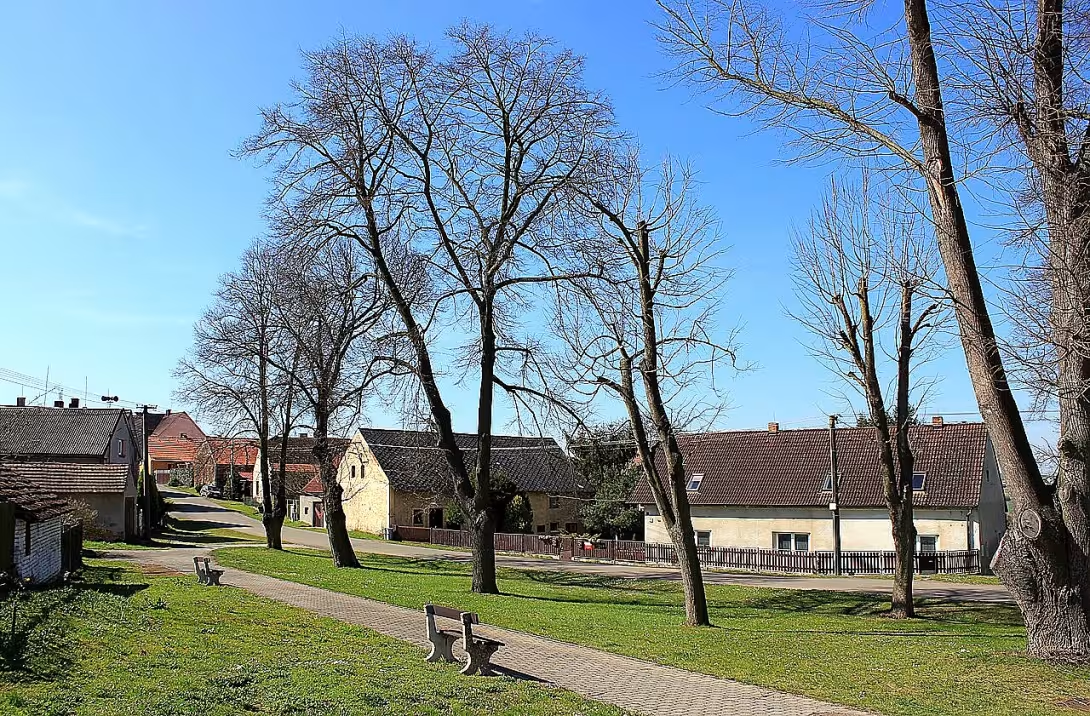
Střapole is an archaeological site located a mile northwest of the village Bušovice in Rokycany district. It is an island on the right bank of Berounka, surrounded by the Korean stream in the north and the Lužnice in the south. The locality is significant with its remains of the prehistoric settlement of the Chamese culture from the younger Bronze Age and the probable early medieval fort from the eighth to ninth century. It is protected as a cultural monument of the Czech Republic along with the hill burial site.
This site was inhabited in prehistoric and early Middle Ages, as evidenced by archaeological findings. The oldest settlement dates back to the younger Bronze Age, where there was a hill burial site and a settlement of the Champ culture. Archaeological research confirmed the presence of the people of the Champ culture on the basis of a single shard found at the sites of the riverbed wall. This culture, typical of Central Europe in the Bronze Age, has settled in strategically advantageous places, such as the islanders, which offered natural protection.
In the eighth and ninth centuries there was probably a fortified fort. The settlement from this time is documented by archaeological findings, but the exact details of its construction and function remain unclear. The fort was situated on a platform of about four hectares, with an accessible eastern side protected by a fortification formed by a moat and a valley. These elements have been destroyed in the past by agricultural activity, but still in the 1970s, traces were still visible in the form of earthly waves with dung clay and carbon.
The construction form of the castle is hardly visible today. The moat and the wall which protected the eastern side of the island hall were gradually destroyed by the pits of fields. However, archaeological findings and remains in the field show that this was a strategically important place. The fortification was probably designed to exploit the natural conditions of the island, which was common in the early Middle Ages.
The location Střapole is connected to the natural impact of the island, which was surrounded by two watercourses. This location made it an ideal place to settle, providing natural protection against enemies and easy access to water. The hill burial ground, which was nearby, is another proof of the importance of this place in prehistoric times.
Today Střapole is protected as a cultural monument of the Czech Republic. Access to the site is possible, but due to its archaeological importance, care must be taken to protect it. Visitors can admire the remains of the fortifications and think about the lives of people who lived here thousands of years ago. This site offers a unique opportunity to become familiar with the history of Central Europe and to understand how people used natural conditions in the past to protect their homes.
Střapole is a rare proof of prehistoric and early medieval settlement in our territory. Despite its original form being largely destroyed, it still represents a valuable source of information for historians and archaeologists. Visiting this place is not only educational, but also inspiring - it reminds us of how people have adapted their lives in the past to natural conditions and what strategies they used to protect their homes. For all who are interested in history and archaeology, Střapole is a unique location worth visiting.
Historical milestones
- about 1200- 800 bc.
- The emergence of a mound burial ground and a settlement of the Champ culture from the younger Bronze Age
- around the 8th - 9th century
- Likely foundation of early medieval fortified fort on the island
- to the 19th century
- Maintaining the remains of the fort (mound, moat) before intensive agricultural activity
- 1970s (1970s)
- The last visible traces of fortifications (walls with bulkhead clay) before their demise
- 1998
- Registration of Střapole as cultural monuments of the Czech Republic
Points of interest
- It is located a kilometer northwest of the village Bušovice in Rokycany district.
- It's an island on the right bank of the Berounka River, which is surrounded by the Korean stream in the north and the Lužka River in the south.
- It is significant with its remains the prehistoric settlement of the Champ culture from the younger Bronze Age.
- There was probably an early medieval fort from the eighth to ninth century.
- The fortification of the fort protected the eastern side of the island with a moat and a valley, which were seen in the past as earthly walls with drenched clay.
Guide
Show guide text
This text was created by artificial intelligence and has not been editorially reviewed. It may contain inaccuracies.
Welcome to a place that allows you to step into the past. You are standing before Střapolemi - a place where they meet with traces of people who lived here thousands of years ago, fought and left. In front of you lies the bay above Berounka, where you have been led by the time and desire to know the secrets of the old generations. Notice how nature and human activity intersect here - the remnants of the waves that once protected this place from danger are now quietly talking about the past.
Let's go together and see what this place tells us. Střapole is proof that this island has been an important place since the younger Bronze Age, about 1200 to 800 BC. Archaeologists here found a single shard of wool, which shows that there was a culture of Chamam - people who built the first settlements here and carefully protected their homes. Later, in the eighth to ninth centuries, a fortified fort appeared in this place, which probably served as a fortress or seat of important people. These moats and moats that once surrounded this place are now just footprints in the field, but their existence tells us that this location was important.
Now pay attention to what you see before you. The remnants of the waves that once formed the protection of this place are being dragged before you. These fouls are partially dislocated, suggesting that there may have been some fires, possibly associated with defense or demise. Although many have been lost, you still feel the atmosphere of the ancient estate. Look up - the island you stand on has been strategically selected for its convenient location. In the north, it is surrounded by the Korean creek, and in the south, it is protected by Lužežka, while Berounka underneath it gives the place strength and mystery.
The key stories of this place are linked to the people who lived here. The Chamese culture, which was based here in the Bronze Age, was known for its ceramic products and virtues in the processing of metals. Their settlements were often placed in elevated places to protect them from enemies and floods. Later, in the early Middle Ages, Střapole was likely to become a fortress that served as a centre of power or a defensive fortress. Even though we don't know the names of the people who lived here, we can walk through their tracks today and imagine what it was like to live in this time.
One of the biggest attractions of this place is its connection to the mound burial ground. Mohly, which was in the vicinity, served as a last resort for important persons or leaders. These burial sites are proof that people here respected their ancestors and cared for their memory. In addition, Střapole are unique by the fact that there were traces of both periods - both prehistoric settlements and early medieval castles. This makes them a place that is important for understanding the development of human society in our region.
Now let's look at what's left of this place. In the 1970s, there were still bulletproof walls that indicated that this place was active in the past. Unfortunately, intensive farming activity and time have done well and many of these tracks have been lost. However, in 1998 Střapole was registered as a cultural monument of the Czech Republic, which means that it looks after them and tries to preserve their importance for future generations.
Stay a while before leaving and inhale the atmosphere of this place. Střapole is like the guardians of the past telling us the stories of the people who once lived here. Imagine what it was like to stand in this place thousands of years ago - what sounds were coming in, what smells existed here. Even though today there are no walls or towers to tell us directly, the remnants of valleys and ditches are like pages of an old book waiting to be read.
If you like this place and want to learn more about our ancestors, I recommend you visit other places in the area that are just as rich in history. Bušovice and surrounding villages hide many secrets waiting to be discovered. Střapole is just one of the many stories our country tells us. Thank you for coming and getting carried away. Be careful, don't be afraid to ask and enjoy this trip to the past.
Tips for visitors
Best time to visit It's in spring or early autumn. At these times the weather is pleasant, nature is green and the local surroundings are less busy. In summer it can be hot and places can be crowded with visitors. If you want to see the most remains of the settlement, go to the place early in the morning when the light is softer and reveals more details.
It is recommended to arrive by car because public transport to this remote location is not very common. The place is available on a dirt road, which can be slippery in rainy weather. It is recommended to have a comfortable shoe and, where appropriate, a map or navigation.
Take a comfortable shoe, plenty of water and sun or rain protection when you visit Střapoli. The location is rural and may be unsought, so also bring basic equipment such as first aid, mobile phone and possibly map. If you plan a longer stay, you can take a picnic basket.
Photography is allowed on this archaeological site, but it is important to respect nature and the remains of the settlement. The best places for photos are the edges of the island, where it is well seen the overall view and remains of the ancient settlement. The best light is morning or evening, when the light is softer and creates fewer shadows. Avoid photography directly on archaeological excavations.
There are several interesting places within a 30-minute drive from Střapoli. You can visit the natural flow of the river Berounky or Lužezka, which surround this location. The village Bušovice is also nearby, where you can see the surrounding landscape and possibly local sights. Other historical sites in Rokycany district are also a suitable destination for the next trip.
For families with children, a visit to Třapoli is a great opportunity to explore history and nature. Children can look at the remains of the ancient settlement and learn about people's lives in the past. You can also play in the open and discover nature. It is also interesting for children to see birds and other animals living here. It is recommended to carry games or small activities that will impress children.
Frequently asked questions
Can the monument be visited?
This is an archaeological site. Often there is little to see on the ground and the land may be private. We have not verified access.
Where is the monument?
Location: Bušovice, Plzeňský kraj. The map on this page shows the exact spot.
Why is the monument protected?
It is listed in the Central List of Cultural Monuments of the Czech Republic as a cultural monument (register no. 1000143818).
Businesses nearby
Do you run a restaurant, accommodation, shop, museum, rental, wellness or other visitor service near this monument? Show yourself directly to the people heading to it — this is how they will see you in the app and on the web:
Nearby
V okruhu pěti kilometrů se nachází přírodní tok Berounky a Lužnice, které obklopují lokalitu. V blízkosti se nachází vesnice Bušovice a další historické lokality v okrese Rokycany.
Accommodation nearby
Trips and activities nearby
Guided tours, tickets and activities nearby from GetYourGuide
Affiliate link: if you buy from the partner, we may receive a commission. The price for you does not change.
Search tours and activities →Themed route
Daily archeological and natural cruise route from Bušovice * *
1. Střapole - archaeological site Střapole is one of the most important medieval residential complexes on Czech territory. The remains of the 13th to 15th century hide a rich history, including the castle and residential buildings, which give an idea of the life of the then inhabitants. For the visit it is worth exploring expositions with reconstructed findings and observing the remains of castle fortifications.
2. Natural flow Berounka (near Střapole) * * Above the edge of the archaeological area is a section of Berounka, which forms a natural pond with rich flora and fauna. A walk along the shore is ideal for watching water birds and a peaceful walk in nature.
3. Bušovice - historical village * * In the centre of the village there are ancient houses with typical Czech architecture from the 18th century. An interesting feature is also the local church with original interiors, which maintains an authentic medieval character.
4. Lukeks (within a radius of 5 km) * * There is a section of Lužík above the village, where there are small water tanks and forest trails. Walking along the shore is suitable for relaxing and observing nature, especially in the summer months.
5. Basic visit of the Střapole complex (inner part) * * It is worth visiting the exhibition with archaeological findings, including ceramics and tools from the Middle Ages. It is also interesting to observe the remains of the castle tower and surrounding area with historical remains.
Recommended route: From Bušovice, we will go to Stěpolí, where we will explore archaeological sites. Then we'll go to Berounka and take a walk on her shore. When we return, we will stop at Bushovice and look at historical houses. At the end, we visit Lužnice and walk around her neighborhood. All points are in a direct neighborhood or within a 5 km radius of Střapole.
Seasonal recommendations
In spring, the site awakens into life and the surrounding landscape of Bušovice green. The soft spring light highlights the details of the terrain and the landscape. I recommend moisture-resistant shoes, because the road can be muddy on a defrosted ground. The best thing is to come in the morning when the air is the cleanest.
The summer season brings a radiant sun and dense vegetation that partially covers the memory. The atmosphere is hot and full of life. Due to the largest number of visitors in the high season, it is advisable to leave very early in the morning. Don't forget light clothing and plenty of fluids.
In the autumn, the surroundings of the Třepolas are colored in gold and brown tones, creating a nostalgic mood. The morning mist gives the place mystery and peace. Layer clothes are suitable to protect you from the cold wind. The ideal time to visit is the late afternoon when the light is the hottest.
In winter, the archeological place is shady and quiet, especially if snow covers the landscape. The light is shielded and the days are short. It is essential to have warm shoes and gloves. I recommend you check the limited opening time and schedule the arrival around noon to use maximum daylight.
Visualizations and artistic views


The visualisations are generated by artificial intelligence and serve as inspiration.
Photos from the area
Real photos taken near the monument


Zdroj a licence jsou uvedeny u každého snímku.
Tips from visitors
No tips yet. Be the first!
Log in and add your tip.
Sources and literature
Faktickým podkladem tohoto textu byl článek na Wikipedii, jehož autory jsou přispěvatelé Wikipedie. Článek je dostupný pod licencí CC BY-SA 4.0.
Location on the map




Příběhy a pověsti
Legendy, pověsti a příběhy spjaté s touto památkou
Fotografie návštěvníků
Zatím žádné fotografie. Buďte první, kdo přidá fotografii z návštěvy!
Log in a přidejte svou fotografii nebo hodnoťte.
Za ověřenou návštěvu v aplikaci získáte víc bodů — poznáme podle GPS, že jste na místě.
Reviews and comments