



Svatomikulášská městská zvonice Church tower
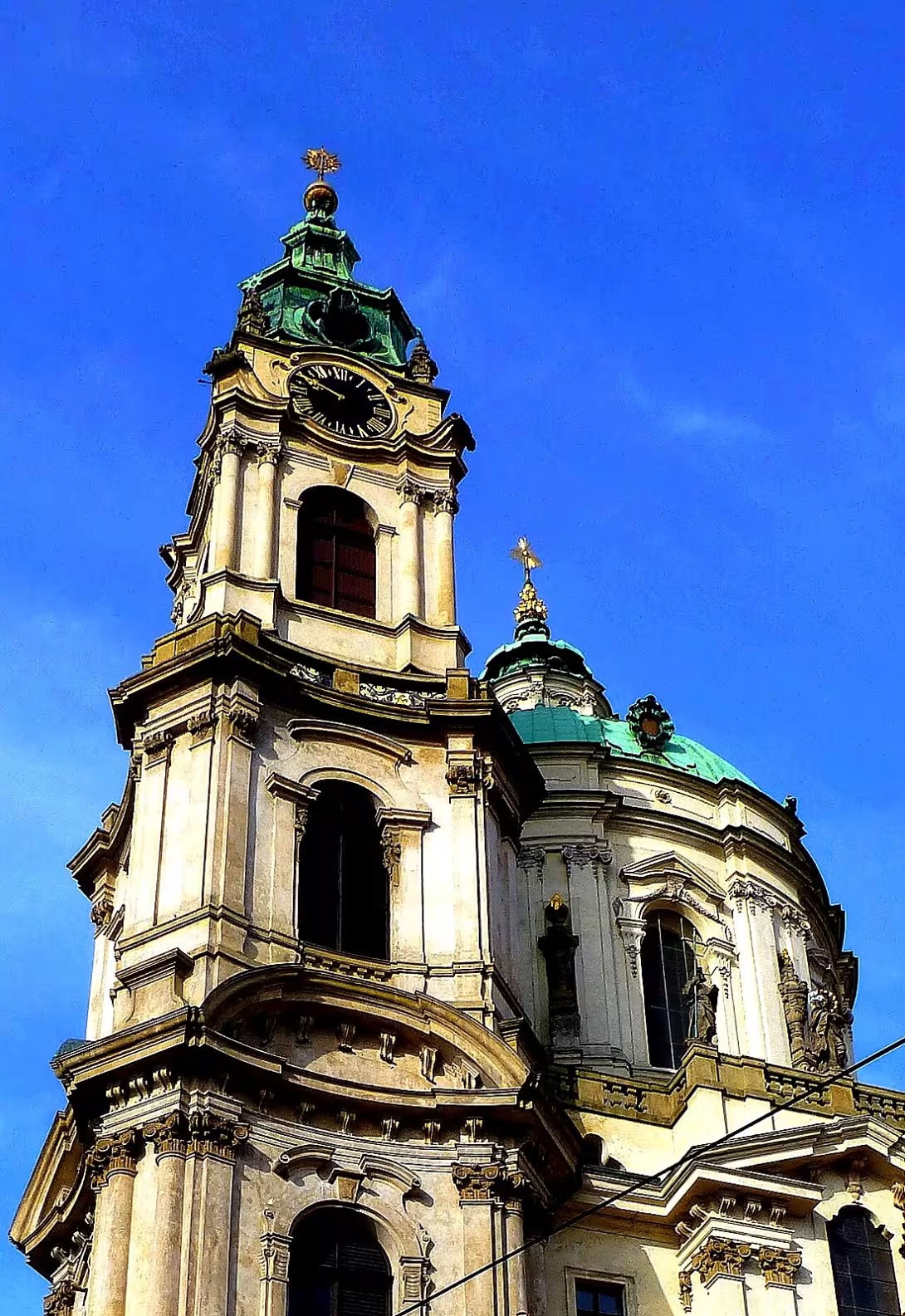
Svatomikulášská městská zvonice is a late Baroque building, which boasts a strong presence at the Malá Strana in Prague. This slender tower forms a dynamic contrast to the wide dome of St. Nicholas' church and is one of the most significant elements of the panorama of this historic place. The bell tower built by Kilián Ignác Dientzenhofer and A. Luragem was completed in 1752 and from the beginning it belonged to the city of Prague as a famous tower.
The history of the bell tower is closely linked to the history of St. Nicholas' church. The end of the 13th century stood in this place a smaller Gothic church, which was destroyed during the Hussite storms and later restored as a Protestant church. In 1623, the Jesuits took over the church of St. Nicholas and began building a new temple which was completed in 1752. The bell tower, originally intended as the proverbial tower for the destruction of the original municipal bell tower by Jesuit construction, became a key part of urban infrastructure. After a dispute with the Jesites about the original land, the tower was awarded to the Malostranski village and served as a famous tower since 1755.
Architecturally, the bell tower boasts a unique design, where individual floors retreat towards the top, which gives the impression that the adjacent dome exceeds. The chimes and dome reach the same height of 70 meters, making them one of the most prominent dominant of the Little Party. The construction was completed in 1752 and its Baroque style is an example of the Championship of architects Kilián Ignác Dientzenhofer and A. Luragem.
The ownership of the bell tower from the beginning belonged to the city of Prague, which was confirmed in 1752. The bell tower served as a proverbial tower until 1891 when the fire telegraph replaced its function. After centuries of changes in use, the bell tower remained a key element of urban infrastructure and history. In 1925, the attic part of the bell tower was damaged by a large fire, which led to replacement of baroque clock machine electric.
The oldest bell of Mikuláš, which was written in 1576 by the Prague bell tower Brikci of Cimperka, is interesting. This bell survived a great fire in 1925 and still hangs in the tower as a rare historical artifact. Another interesting thing is the fact that the bell tower was the subject of a dispute between the municipality and the Jesit because of the original land rights.
Today, the Svatomikuláš bell tower is in the administration of Prague City Tourism and offers visitors the opportunity to see the exposition inducing the atmosphere of the 18th and 19th century housing, including preserved black cuisine. The bell floor hides the valuable bell of Mikulas, while the observation gallery at a height of 65 meters offers a wonderful view of Prague. Since 2021, the bell tower has been open to the public and is worth visiting, not only because of its historical ties, but also because of the unique panorama of the city.
Svatomiculáš bell tower is therefore not only an architectural landmark, but also a witness to rich historical events. Its presence in Malá Strana still enriches the cultural and historical image of this Czech city. Visiting the bell tower is a journey to the past, where every detail tells its story about the spirit of Prague.
Then and now
Drag the slider to compare how the landmark may have looked when it was built with the view today.
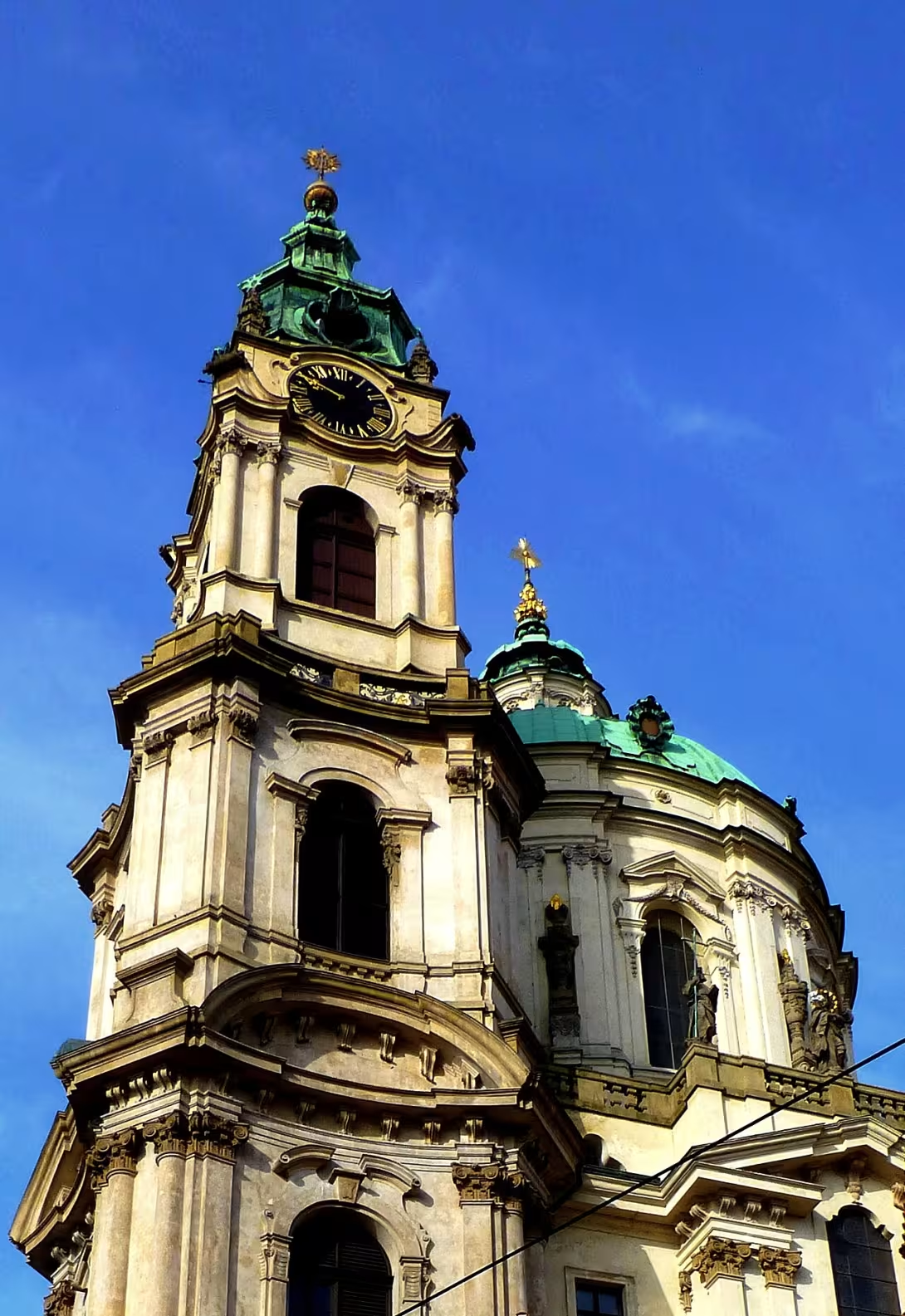
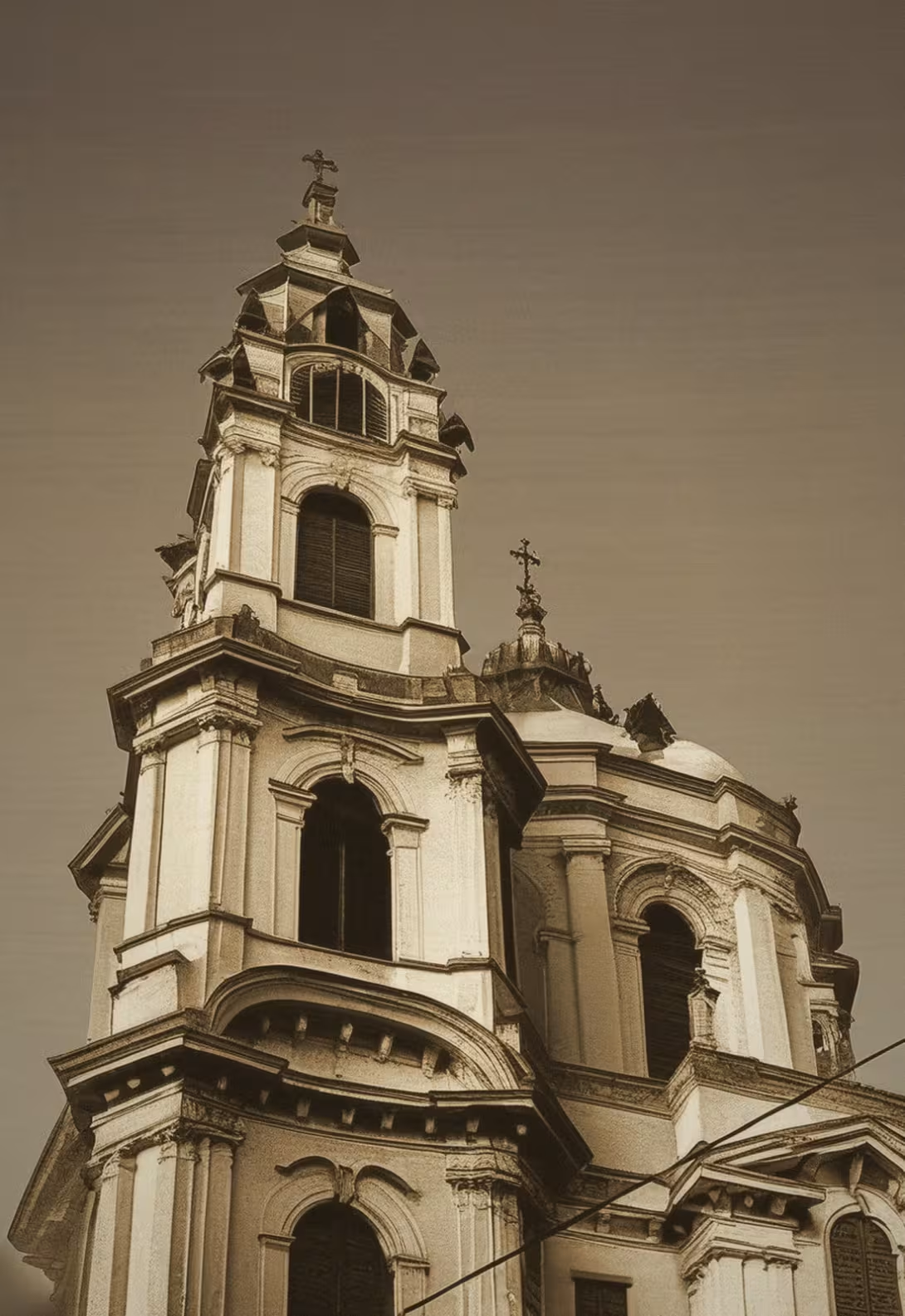
The historical appearance on the left is an AI-generated visualisation and serves as inspiration only.
Historical milestones
- 1752
- The bell tower has been completed.
- 1755
- The bell tower began to be used as a proverbial tower.
Architectural development
The building of the bell tower was completed in 1752. Its individual floors are receding towards the top, giving the impression that the adjacent dome exceeds. Bells and dome reach the same height of 70 meters.
Historical events
- 1623
- The church of St. Nicholas was entrusted to the Jesuits.
- 1673
- Emperor Leopold I. participated in the laying of the foundation stone of the new temple.
- 1755
- The bell tower began to be used as a proverbial tower.
Owners
- 1752
Points of interest
- Svatomikulášská městská zvonice is a late Baroque building built by Kilian Ignác Dientzenhofer and A. Luragem, completed in 1752. - The bell tower has served as a known tower since 1755 for a period of 56 years, when its function was replaced by a fire telegraph. - The oldest bell by Mikuláš, which was written in 1576 by the Prague bell tower Brikci of Cimperk, still hangs in the tower as a rare historical artifact. - The bell tower was the subject of a dispute between the municipality and the Jesit because of the original land rights. - Since 2021, the bell tower has been open to the public, offering an exposure that induces the atmosphere of the accommodation of the famous and sightseeing gallery with a view of Prague.
Guide
Show guide text
This text was created by artificial intelligence and has not been editorially reviewed. It may contain inaccuracies.
Welcome to the heart of old Prague, a place where every stone cube and every shadow on the wall seem to tell stories of centuries old. You are standing in one of the most picturesque parts of our city, on the Lesser Side, and right now you have one of the most important points in this neighborhood. Stop for a moment, relax and let yourself pass through the atmosphere of this place. Look straight ahead, where your eyes meet the heavens. See that tower? That's Svatomikulášská městská zvonice. Notice how her character is standing up and how she creates a fascinating and dynamic contrast to that huge, wide dome of St. Nicholas' church, located just next to her. It's a fascinating view of how these two different shapes, the wide and heavy dome, and this erected tower towards the sky, complement each other and create a unique picture that defines this whole neighborhood.
Now that you have realized this visual contrast, let's look together deeper below the surface of this building and understand why it stands here in this very form. This tower is not just part of the church complex, as it might seem at first glance. It's a city bell tower. That's a very important difference. While most of the towers in this area belong to the church, this tower has been the property of the city itself since its beginning. It was a symbol of urban power, independence and the need to have its own, its own control over the safety of its people. This whole building you are now observing is the work of a late baroque. If you look at its shapes, you may not only see it as a simple line, but you feel a certain movement in them, a certain life that is so typical of this style.
Let's go back in time to understand when and why this tower was built. The whole construction process culminated in the mid-eighteenth century. Thanks to the work of the two great masters of the time, Kilian Ignác Dientzenhofer and A. Lurage, this bell tower was completed in seventy-two years of Pa ^ {\} (I will write numbers like 1752 to make it clear). It was in 1752 that work was completed, which now allows us to watch this wonderful Baroque element. The architects put all their knowledge of form and space into it to create something that was not only useful, but also aesthetically impressive. And they really did, because this tower became one of the most significant elements of the Mala Party panorama. If people had looked at it 200 years ago, they would have seen it as important and beautiful as we see it today.
Now pay attention to what was the real role of this tower in people's everyday lives. Since 1755, just after its completion, the bell tower began to perform its main and very serious function. Because she was a proverbial tower. Imagine those times when there were no modern systems to report danger. There were no phones, no electronic signals that would alert you immediately to danger. At that time, the tower was a window through which the city watched its surroundings. On the tower, people had to watch the horizon and be ready to react at any moment. If smoke started spreading in the distance or if there was any other threat, someone on this tower must have intervened. This function of the proverbial tower was absolutely crucial to the city for its survival and safety. This role lasted an incredible 56 years. It was a time when the human eye and hearing were the main tools to protect the whole neighborhood.
And this is where we come to one of the greatest attractions this tower has to offer. Although the whole building is baroque and dates back to the mid-eighteenth century, there is something much older in its interior. The tower hosts a bell called Nicholas. This bell is not a modern addition, but a real historical piece, which was stashed in the year 15 hundred and seventy-six. Imagine the incredible length of time that this noise sounded over Prague. This bell has witnessed many generations, many events and many changes that the city has undergone. When later technology began to evolve and people began to use fire telegraph, the role of the tower as the proverbial tower began to end slowly. Modern devices could transmit messages faster and more reliably than a human voice or the sound of a bell. Yet the bell of Nicholas and the tower itself remained a fixed point in time.
Now if you look at this whole structure again, try to realize the continuity of history. You see the Baroque architecture, which was completed in 1752, but in its foundations there was already the sound of a bell that was almost a hundred years old. It's a fascinating combination of different periods that meet here in one place. This tower is not just stone and mortar, it is a living record of the history of the city, its fear for safety, its technological progress and its constant growth.
Now that you have taken a look at this town bell tower and understood its meaning, I suggest you continue your walk along these narrow and mysterious streets of the Little Party. Every step can lead you to another surprise, another historical monument, or an unexpected view of the city. Let yourself drift through this place, observe the details and enjoy every moment in this historic space. Thank you for spending this moment with us and for being interested in the history of this special place. We wish you a beautiful and inspiring next trip to Prague. Goodbye.
Tips for visitors
For the best experience we recommend a visit in the morning or shortly before sunset. In these times the sun best illuminates the Baroque details of the tower and creates interesting shadows that highlight its contrast to a nearby dome.
It is recommended to get to this part of the city on foot or use public transport.
When visiting, wear comfortable shoes suitable for walking on historic tiles. We also recommend that you bring water and possibly small coins if you need to pay on-site fees.
For photography are the best places in the surrounding streets, from where you can see the whole tower in connection with the surrounding architecture. Within a short walk you can visit the church of St. Nicholas or Clementinum. It is advisable for families with children to plan a visit in less busy times so that they can easily see the surroundings.
Frequently asked questions
Can the monument be visited?
Religious buildings are usually open mainly during services; at other times a visit is normally arranged with the parish or the operator. We have not verified specific times.
Where is the monument?
Location: Malá Strana, Hlavní město Praha. The map on this page shows the exact spot.
Why is the monument protected?
It is listed in the Central List of Cultural Monuments of the Czech Republic as a cultural monument (register no. 1000001505_0002). It is protected as part of a larger listed ensemble.
Businesses nearby
Do you run a restaurant, accommodation, shop, museum, rental, wellness or other visitor service near this monument? Show yourself directly to the people heading to it — this is how they will see you in the app and on the web:
Events nearby

Zdroj akcí: otevřená data měst a obcí ČR (Národní katalog otevřených dat) a kalendář akcí Národního památkového ústavu.
Nearby
V okolí zvonice se nachází kostel svatého Mikuláše, Klementinum a další historické památky Malé Strany.
Accommodation nearby
Trips and activities nearby
Guided tours, tickets and activities nearby from GetYourGuide
Affiliate link: if you buy from the partner, we may receive a commission. The price for you does not change.
Search tours and activities →Themed route
Thematic cruise route to the Little Party
1. Svatomikulášská městská zvonice (Church Tower) - Type: Historical landmark - Why is it worth visiting: This distinguished tower is the highest building on the Lesser Side and offers unique views of Prague. It is part of the church of St. Nicholas, which is famous for its Baroque interior.
2. Church of St. Nicholas - Type: Church - Why it is worth a visit: This church is not only home to the bell tower, but also hosts a beautiful Baroque interior and an important work of art by Karel Šcreta. His history dates back to the 14th century.
3. Clementine - Type: Historical Complex - Why is it worth visiting: Klementinum is the oldest library in the Czech Republic and hosts extensive collections of old prints. It is a former monastery that offers a view of Baroque architecture and history.
4.Malá Strana - Type: Historical Square - Why is it worth a visit: The square is the centre of the Mala Strana, known for its characteristic Baroque houses and beautiful panoramic view of Prague. It is an ideal place to relax and walk the streets full of history.
5. Stephen's Church - Type: Church - Why is it worth a visit: This church is famous for its Baroque architecture and beautiful interior, including a wooden floor plan by Jan Blažek. It is placed in one of the noblest places of the Little Party.
This route offers a journey through the historical part of Prague, where each monument brings its own view of the rich past and artistic tradition.
Seasonal recommendations
Spring: In the spring season, Svatomikulášská městská zvonice is transformed into a sanctuary for flower lovers and new lives. Flowers, especially lilies and roses, celebrate their beauty around the church bell tower, which changes the atmosphere substantially. This time of year is ideal for visiting in the early hours of the morning when the temperature is pleasant and the crowds are minimal. It is recommended to wear clothes suitable for mild weather, which may be characteristic by morning cold.
Summer: Summer in Malá Strana brings long sunny days and warm night chills, which makes Svatomikuláš city bell tower a popular destination for visitors. The sun illuminates the architectural elements of the church tower in exciting colors, adding a sense of peace and joy to the atmosphere. The main summer season increases the number of tourists, therefore it is advisable to visit the memory earlier on or later in the evening. Wear light clothes and bring protective sun cream are basic practical advice.
Autumn: In autumn, Svatomikulášská městská zvonice is surrounded by colorful leaves that create a nice and melancholy atmosphere. The sun illuminates the church tower more clearly, allowing it to observe its detailed architecture. This season is ideal for visiting thanks to mild temperatures and reduced number of tourists. It is recommended to wear clothes suitable for colder weather, possibly with the addition of warm scarves or jackets.
Winter: Winter visit to the Svatomikuláš city bell tower offers unique views of the church tower covered with snow, giving the monument a magical and peaceful character. The sunlight illuminates the snow wrappers, bringing to the atmosphere a sense of quiet and calm. Hot clothes, including fur coat and hat, are essential for a comfortable stay outside.
Visualizations and artistic views


The visualisations are generated by artificial intelligence and serve as inspiration.
Photos from the area
Real photos taken near the monument


Zdroj a licence jsou uvedeny u každého snímku.
Tips from visitors
No tips yet. Be the first!
Log in and add your tip.
Sources and literature
Faktickým podkladem tohoto textu byl článek na Wikipedii, jehož autory jsou přispěvatelé Wikipedie. Článek je dostupný pod licencí CC BY-SA 4.0.
Location on the map

Příběhy a pověsti
Legendy, pověsti a příběhy spjaté s touto památkou

Fotografie návštěvníků
Zatím žádné fotografie. Buďte první, kdo přidá fotografii z návštěvy!
Log in a přidejte svou fotografii nebo hodnoťte.
Za ověřenou návštěvu v aplikaci získáte víc bodů — poznáme podle GPS, že jste na místě.
Reviews and comments