



Synagoga v Úštěku Synagogue
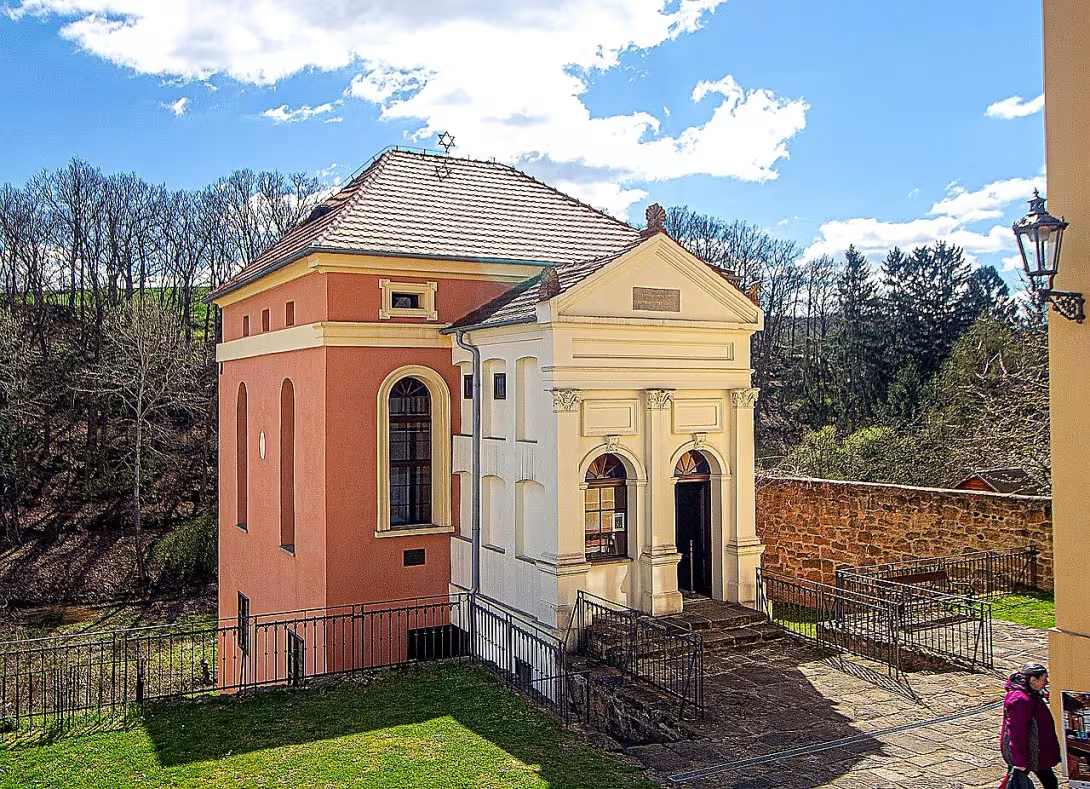
Synagoga v Úštěku is a classic monument situated in the western part of the city, on the edge of the rock massif in May 1st. This stone building, built between 1791 and 1794, is a unique architectural type within the Czech Republic. Today it serves as a Jewish regional museum and occasional service space.
The building was created at the site of the original wooden synagogue, which succumbed to the fire in 1773. The construction of the new building took place during the period of enlightened reforms of Joseph II, which gave the Jewish population greater legal recognition and religious tolerance. At the same time, Europe was in the era of political change caused by the French revolution.
The construction stands on a high suspicion of sandstone blocks in a steep slope. Thanks to this location, it acts from the front as a single-storey house, while from the back it has the character of a tower building. In 1851 the synagogue underwent extensive reconstruction according to the plans of local builder Wenzl Jahn. The building was increased by 1.2 meters, the women's gallery expanded and the hall was added. The interior of the prayer hall was decorated by Moorish and the basement space started to serve the Jewish school.
After World War II, during which the Jewish village of Úštěch had ceased to exist, the object had long been decayed. In the 1970s, a demolition site was even issued, and in the 1980s, the building was in an emergency state with a sunken roof and destroyed interior. The rescue took place between 1993 and 2003 thanks to the general reconstruction of the Federation of Jewish Municipality project supported by the International Holocaust Assistance Fund, the Czech State and the City of Ústěk. Today, the synagogue together with the neighbouring Rabbi house is a valuable monument.
The history of the building is linked to the changes of Jewish settlement in the region. Although several Jewish families, mostly chasides from Podkarpatské Rusi, came to Úštík after 1945, until 1950 they all moved to the USA and Israel. In recent years, however, the synagogue has returned to its original purpose. In 2018, the first Jewish wedding since the Holocaust period took place and in December 2024 the first public service associated with the Hanukkah Festival took place, during which Tomáš Kraus and his grandson lit the traditional Hanukiji.
Synagoga v Úštěku is a unique testament to the history of the Jewish community and its architecture represents a remarkable example of classical construction adapted to demanding terrain. Visiting this place offers the opportunity to become acquainted with the fates of the monument, which has passed the way from extinction to sensitive restoration. The tour can be recommended to everyone interested in regional history and cultural heritage.
Then and now
Drag the slider to compare how the landmark may have looked when it was built with the view today.
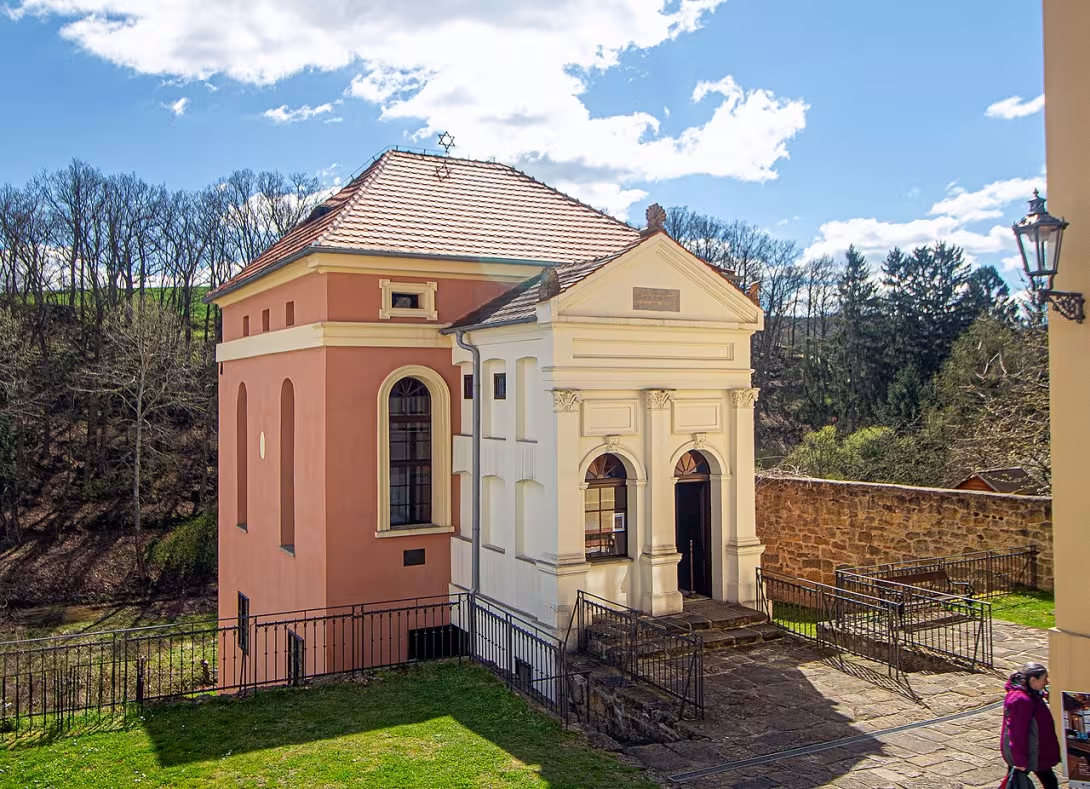

The historical appearance on the left is an AI-generated visualisation and serves as inspiration only.
Historical milestones
- 1791
- Construction of the new stone synagogue.
- 1851
- Rebuilding the synagogue according to the plans of builder Wenzl Jahn.
- 2003
- Completion of the overall reconstruction of the building.
- 2018
- Doing the first Jewish wedding since the Holocaust.
Architectural development
The original stone building was increased by 1.2 metres in 1851 and supplemented with a hall and an enlarged women's gallery. The interior of the prayer hall was decorated with Moorish motifs. The basement space was historically used as a Jewish school.
Historical events
1773: Fire of the original wooden synagogue. 1851: Extensive reconstruction and extension of synagogue. 1993- 2003: General reconstruction of the monument.
Owners
Federation of Jewish Communes
Points of interest
- The synagogue is a classical building built between 1791 and 1794 on the site of the original wooden synagogue which burned down in 1773. - Thanks to its location on a steep slope on a high suspicion, it looks like a one-storey house from the facade, while from the back it has the character of a tower building. - In 1851 the building went through a reconstruction, which increased it by 1.2 metres, the women's gallery expanded and the interior was decorated with Moorish decoration. - In the 1970s, a demolition site was issued for the building and in the 1980s the building was in an emergency state with a sunken roof. - In December 2024, the first public service connected with the Hanukkah Festival took place here, where the traditional Chanukiya was lit.
Guide
Show guide text
This text was created by artificial intelligence and has not been editorially reviewed. It may contain inaccuracies.
Welcome to Shrink. You just stopped in front of one of the most important and interesting buildings in this part of town. You are standing in the Czech Suburb district and before your eyes there is a synagogue that is much more than a brick building. Feel this moment, feel the atmosphere of a place where the natural force of the rock massif meets the human desire to build something lasting and sacred. Look around you at the surrounding terrain. The building is situated right on the edge of a steep slope, which is the first thing you must be interested in. This unusual position has a fundamental effect on how you perceive the building. If you're looking directly at her facade, you're probably under the impression she's standing in front of a simple, quiet, one-story house. It's a visual illusion that creates this very challenging geography. However, if you turn now and try to look at the building from the back, you will see a completely different picture. That's where the synagogue turns into a dominant, tower-shaped structure that rises up to the sky. This fascinating contrast between a home from one side and a tower of grandeur from the other side is one of the largest architectural unique features of this building.
To understand why this building looks just like this and why it's so important here, we need to go back deep into the past with you. Imagine the end of the eighteenth century. The story of this place is the story of overcoming obstacles. It didn't start with a stone, it started with wood. In this place, there was originally a wooden synagogue, which was the heart of the local Jewish community. But fate brought tragedy in 1773 when the fire destroyed this original object. This event was a profound intervention for local residents, but it also became an impulse for something new and more permanent. Instead of stopping history, people decided to build something that wouldn't crush the fire anymore. Thus the construction of a new stone synagogue began between 1791 and 1794. This stone structure was built in a classical style, which at that time expressed order, harmony and dignity. The synagogue has thus become not only a place of prayer, but also a strong symbol of the persistence of the Jewish settlement in the region.
Now pay attention to the details of architecture that you can observe right now. Although the building is classical, its malleability is constantly influenced by how it adapted to the rock. Notice how the building line is trying to integrate into the steep slope. This building is not just laid on the ground, it connects with this land and the rock. It is important to know that today's building is not the result of the original construction. There was a major reconstruction in 1851. That's when the builder Wenzel Jahn got involved. His planning and work have fundamentally shaped what you see before you today. Thanks to his vision and ability to work with demanding terrain he managed to preserve and further develop this unique character which combines the function of religious space with an unusual vertical structure.
When you look at these walls, remember that each of them witnessed human lives. This synagogue was not only an empty vessel, but a place where the destinies of generations were connected, where joy was celebrated, and where comfort was sought in difficult times. In the history of this place and in the wider context of the Polish Judaism, names appear that shaped the character of the entire area. One of them is Tomáš Kraus. Although his name may not be in every history book right away, to understand the soul of this place, it is crucial to know that people like him were part of that vibrant, vibrant community that gave this synagogue its life and its energy.
And now I want to invite you to think about something that may sound like a miracle or a profound mystery event that links a long past to the present. You might be thinking, after all these years, after all the storms and all the historical twists, this building is just a quiet museum. But this synagogue has a power that can overcome even the darkest shadows of history. After a long period of bankruptcy, this building was reborn thanks to a difficult and thorough reconstruction that was completed in 2003. And it was in 2018 that something happened that caused deep excitement in many hearts. The first Jewish wedding since the Holocaust has ended in these areas. Imagine the power of the moment when, in a place that was once a part of tragic history, the promise of love and the joy of a new life came again. It is a moment that gives this place a new meaning and which is called the true triumph of the human spirit over oblivion.
Now that you have gained a deeper insight into the history, architecture and emotions that this place carries, I urge you to explore again. Let the atmosphere of this place drift. The synagogue today serves as a museum and also as a space for various occasional events that revive its premises again. Walk around, see how the view of the building changes depending on exactly where you stand, and try to imagine the hundreds of years these walls have experienced. Thank you for choosing to devote your time and attention to this monument. We wish you a beautiful and inspiring rest of your visit to the beautiful Zážek.
Tips for visitors
The best time to visit is during the morning hours on working days when you avoid crowds and you can easily see the interior and exterior of the synagogue in a pleasant light. Due to the position on the rock massif, the afternoon sun is ideal for capturing the details of the classical facade.
You can reach Úšek comfortably by car and public transport. The current connection by public transport is recommended to be checked in the respective search engines.
We recommend comfortable shoes for a visit, as the historical center of the city and access to the synagogue include paving and a slight climb. Don't forget to take the camera because the unique location of the building on the edge of the rock massif offers very impressive compositions.
After a tour of the synagogue we recommend a walk to the Peace Square, which forms the heart of the historic city building. The surrounding area also offers fascinating views of rock masses that complete the unique character of the whole Úštěk.
For families with children, a visit is suitable as part of a sightseeing trip. Historical buildings and nearby rock formations can be an interesting specialization for children, but we recommend that you take caution close to the rock edges.
Frequently asked questions
Can the monument be visited?
Religious buildings are usually open mainly during services; at other times a visit is normally arranged with the parish or the operator. We have not verified specific times.
Where is the monument?
Location: Úštěk-České Předměstí, Ústecký kraj. The map on this page shows the exact spot.
Why is the monument protected?
It is listed in the Central List of Cultural Monuments of the Czech Republic as a cultural monument (register no. 1000155468).
Businesses nearby
Do you run a restaurant, accommodation, shop, museum, rental, wellness or other visitor service near this monument? Show yourself directly to the people heading to it — this is how they will see you in the app and on the web:
Nearby
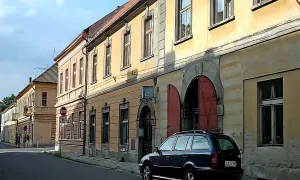
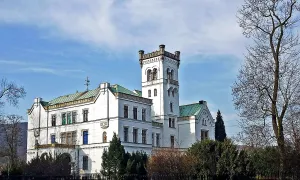
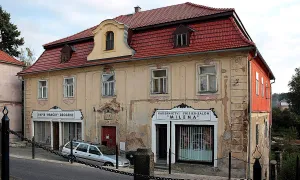
Peace Square in Úštěk, historical buildings of the city, rock massives in the surroundings.
Accommodation nearby
Trips and activities nearby
Guided tours, tickets and activities nearby from GetYourGuide
Affiliate link: if you buy from the partner, we may receive a commission. The price for you does not change.
Search tours and activities →Themed route
Thematic cruise route from Úšek
1. Synagoga v Úštěku (Monuments) We'll start with our trip to the synagogue, which is one of the Central European architectural pearls. This monument attracts its history and unique design. It is an ideal place to understand the cultural heritage of the village.
2. Peace Square in Úštětě (Square) After visiting the synagogue we move to the heart of the city where the Peace Square is located. This place is the centre of the historical development of Úštěk and offers a beautiful overview of the ancient architecture of the village. It is ideal for relaxation and sightseeing.
3. Historical buildings in the centre of Ústětus (Construction) Walk on the streets with historical buildings will allow us to appreciate the architectural features of the city. These buildings tell stories of past generations and show how the village evolved over the years.
4. Rock masses in the vicinity of Uštěcky (Nature) The final point of our route are rock masses that offer beautiful natural landscapes and the opportunity to explore the location in peace. These services are ideal for nature lovers and those looking for a place to relax after a tour of the city.
This route offers a combination of cultural heritage and natural beauty, making it ideal for a day trip.
Seasonal recommendations
Spring: Awakening nature and fresh greenery around the monument create an optimistic atmosphere. The light is fine during this period, which is ideal for observing the details of the construction. Because the weather may be variable, we recommend choosing layered clothing. The visit is best planned for the morning when there is the most quiet and fewer visitors.
Summer: In the main summer season the surrounding area is covered with bright sun and daylight takes a very long time. The atmosphere is alive, but it can be hot. To avoid the biggest crowds and heat, it is best to arrive early in the morning or late in the afternoon. Clothes should be light and airy, don't forget the sun protection.
Autumn: The golden colours of leaves and the occasional morning mist in the landscape give the place a nostalgic and deep touch. The light is softer in this period and the colours are more rich. It is advisable to wear a warmer jacket and comfortable shoes in case of wet surface. The best time to visit is in the afternoon when the sun creates interesting shadows on the facade.
Winter: In winter the synagogue has quiet and quiet, while frost and snow can give the architecture an unusual, rough look. The days are short, so we recommend a visit to plan around noon to make enough light. Very warm clothes are necessary.
Visualizations and artistic views


The visualisations are generated by artificial intelligence and serve as inspiration.
Photos from the area
Real photos taken near the monument


Zdroj a licence jsou uvedeny u každého snímku.
Atmosphere of the place
This atmospheric visualisation of the place and period was generated by artificial intelligence. It is not real footage of the location.
Tips from visitors
No tips yet. Be the first!
Log in and add your tip.
Sources and literature
Photos: VitVit / CC BY-SA 4.0 — Wikimedia Commons. The author and licence also appear when you hover over the image.
Faktickým podkladem tohoto textu byl článek na Wikipedii, jehož autory jsou přispěvatelé Wikipedie. Článek je dostupný pod licencí CC BY-SA 4.0.
Location on the map
More monuments – Úštěk-České Předměstí
Show all in the municipality
Příběhy a pověsti
Legendy, pověsti a příběhy spjaté s touto památkou
Fotografie návštěvníků
Zatím žádné fotografie. Buďte první, kdo přidá fotografii z návštěvy!
Log in a přidejte svou fotografii nebo hodnoťte.
Za ověřenou návštěvu v aplikaci získáte víc bodů — poznáme podle GPS, že jste na místě.
Reviews and comments