

synagoga ve Čkyni Synagogue
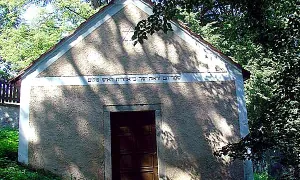
The synagogue in the village Čkyně in the district of Prachatice is a classical building from 1828. Together with the synagogue in Bechyni, it belongs to the oldest preserved Jewish shrine in southern Bohemia. Today it serves as a multifunctional cultural centre focused on the theme of Judaism.
The building was created as a replacement for an older synagogue from the High Court. The original building was converted into an economic building after 1827 and completely demolished in 1977. The new synagogue was designed in classical style. In addition to the prayers, there was a school and an apartment on the ground floor.
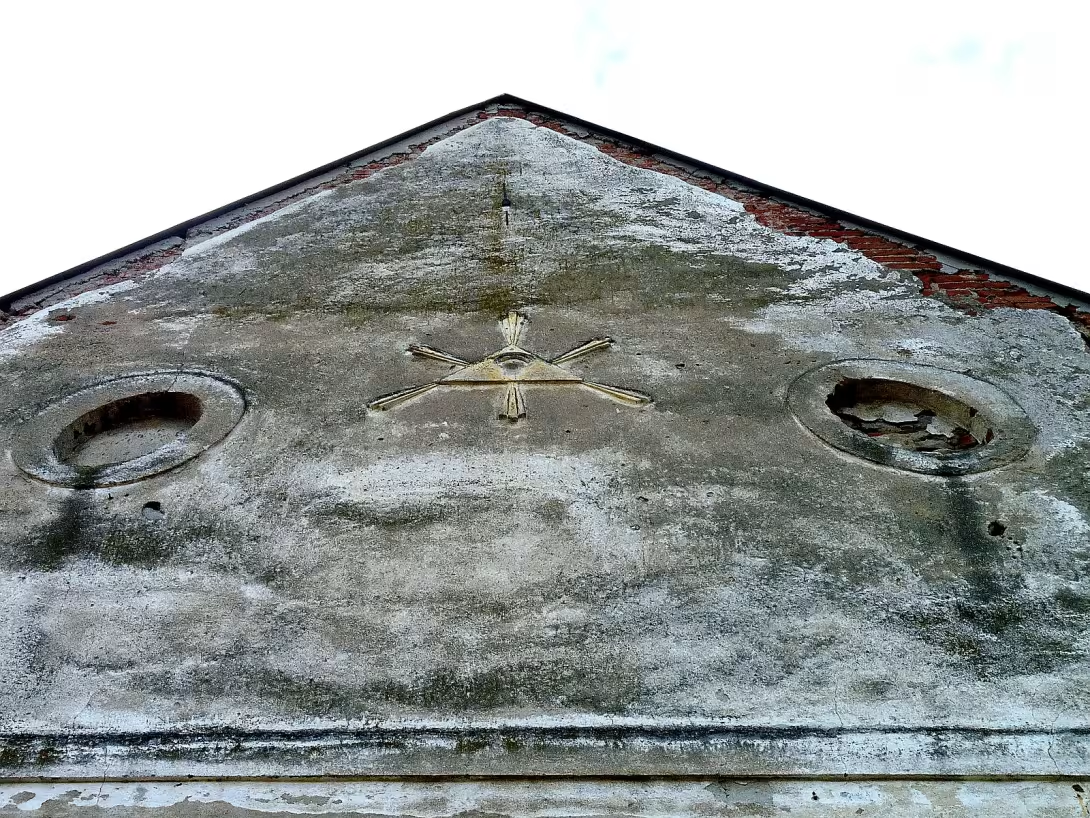
The characteristic architectural element is an unusual representation of the eye of God in the shield of the building. The interior includes the main and winter prayer house. In the winter, the original floor, the large Art Nouveau hanging light and the wooden closet on the Torah were preserved. The Torah itself was found in the attic during the reconstruction. The main prayer room contains an illusory altar and renovated original inscriptions. There is a list of the names of 14 people who died in Auschwitz on the entrance wall. The building also includes a former shelter for a hearse.
The fate of the building has been variable over the years. As a result of the mortality and migration of Jewish people to cities, the local community was abolished and transferred to Vimperk, where it built a new synagogue in 1925. The Čkyňská building stopped serving its purpose before 1920 and was sold in 1922. Subsequently, it was converted into a house with carpentry furniture, which lived until 1983. In 1988, Unita Vimperk bought the building, for which she began to lose her way.
The village of Čkyně redeemed the building in 1991, thus starting a long process of restoration. The work was done thanks to gifts, contributions from the Ministry of Culture and support of Petr Ráb and Bohumil Kucera. In 1999 the roof, ceiling, floor of the main prayer house and new windows were repaired. The complete reconstruction of the facade, floors and interiors was completed within the framework of the European cross-border project Landscape connects in cooperation with the castle Wolfstein in Freyung. Both buildings were declared a cultural monument of the Czech Republic in 1992.
The key moment of modern history was the re-initiation of the prayer house on 5 October 2013. It was attended by eighteen descendants of former Jewish inhabitants, including the first rabbi of the new synagogue. The building has been open to the public since 2014. The main hall is dedicated to four synagogues from nearby surroundings, which were not completely destroyed. There is a photo gallery of the history of the town Čkyně and exhibition premises in the former women's gallery. On the ground floor there is an information centre, a library with a study and projection hall. The premises also serve as concert and lecture halls for local residents.
The monument represents a unique testimony of the Jewish presence in the region and is the only prayer house in the South Bohemian region. Its visit offers insight into the history of the local community and the architecture of Classicism.
Then and now
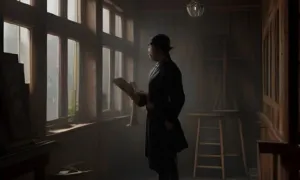
Drag the slider to compare how the landmark may have looked when it was built with the view today.
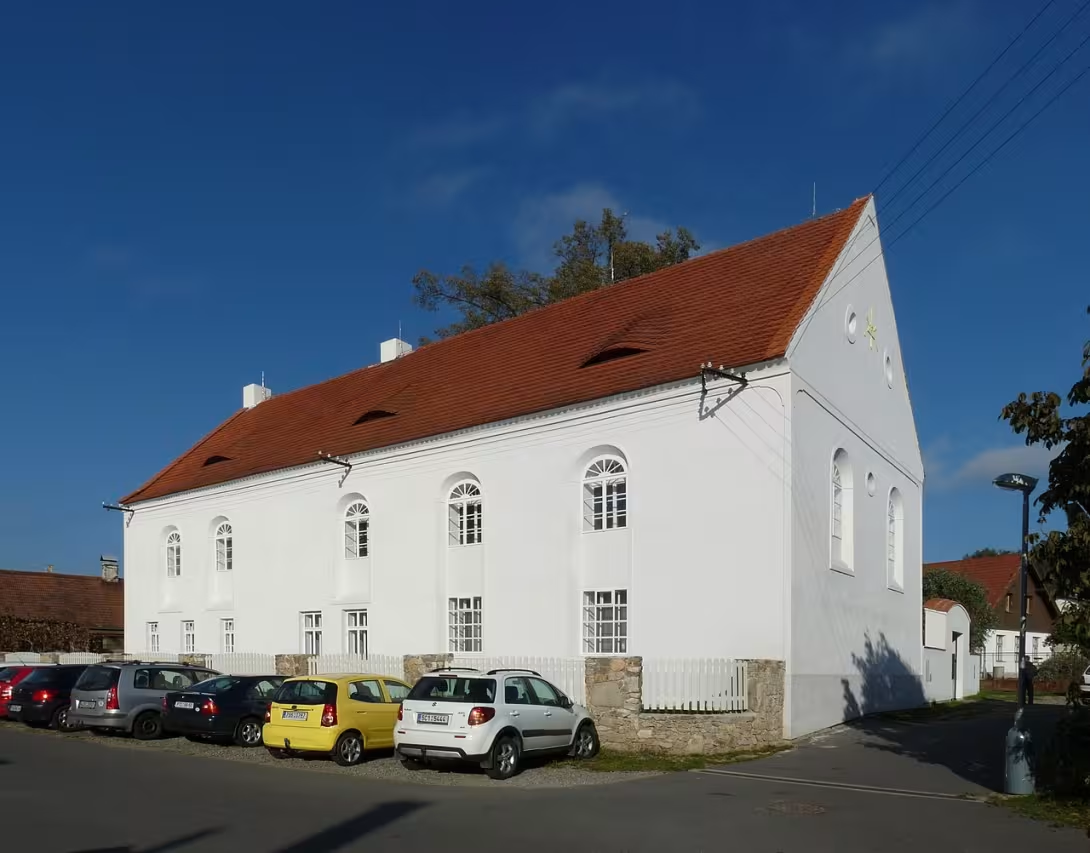
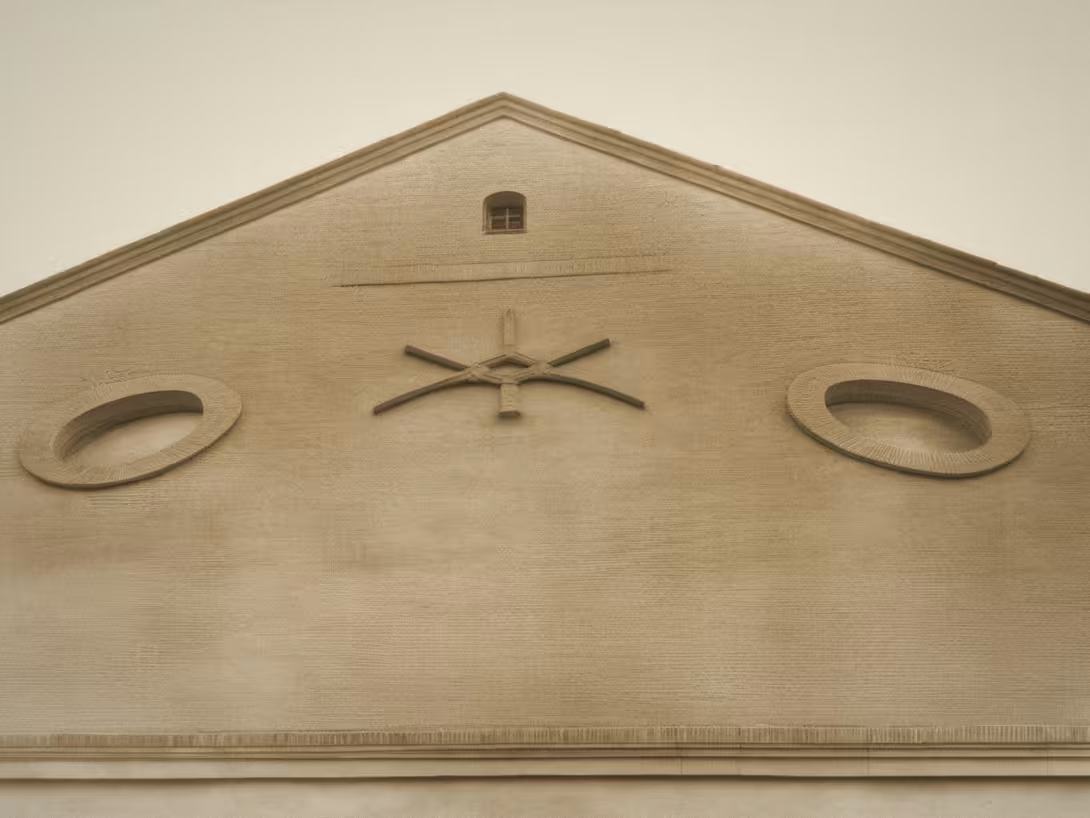
The historical appearance on the left is an AI-generated visualisation and serves as inspiration only.
Historical milestones
- 1828
- building a synagogue in classical style
- 1922
- sale of the jewish village building and subsequent conversion into a residential house
- 1992
- announcement of synagogue and shelter on the hearse by cultural monument of the Czech Republic
- 2013
- reinitiation of the prayer house with the participation of the descendants of jewish inhabitants
Architectural development
The building was built in a classical style. In 1922 it was converted into a house with carpenter's furniture. Comprehensive reconstruction of the roof, floors, windows, facades and interiors took place between 1991 and 2013.
Historical events
1922 - sale of the synagogue by jewish municipality, 1991 - redemption of the building into the property of the village, 2013 - re-initiation of the prayer house, 2014 - opening of the building to the public.
Owners
Jewish village (until 1922), private owner (residential house and carpentry workshop 1922-1988), Unita Vimperk (1988- 1991), municipality Čkyně (from 1991)
Points of interest
- The construction from 1828 belongs to the oldest preserved Jewish shrine in southern Bohemia. - There's an unusual image of God's eye in the building shield. - The original floor, wooden vault on the Torah and large Art Nouveau light were preserved in the winter prayer room. - The building served in the past as a residential building with carpentry facilities. - It's the only prayer house in the South Bohemia region.
Guide
This guide is narrated by a synthetic voice generated by artificial intelligence.
Show guide text
This text was created by artificial intelligence and has not been editorially reviewed. It may contain inaccuracies.
Welcome to Chka. You're standing in front of a building with a deep history of the Jewish community. In front of you is a synagogue, a building that radiates its appearance of peace and sobriety. If you look at it, you will see a house that, although it is quiet today, is one of the most valuable jewels of Jewish architecture for southern Bohemia. Feel the atmosphere of this place where faith, traditions and the fate of people who once lived and worked here meet.
Let us now move back in time by almost two decimals. This building was built in the year eight hundred twenty-eight. At that time, the Jewish community needed a new place for their prayers and meetings, because the oldest sanctuary in the High Court was no longer sufficient. That is why this object was created, which was designed very practically from the beginning. While the upper part of the building was intended for spiritual needs, on the ground floor there was a school for children and an apartment for the administrator or teachers. It was therefore a small centre of Jewish life in Čečka, where education, housing and prayer intertwined in one building.
Now pay attention to the architecture itself. The building is performed in a classical style, which means it bets on simplicity, clean lines and balance, without unnecessary decorations. Please look up, towards the top of the house. In the shield of the building you will see a very unusual detail, which is the depiction of God's eye. It is a symbol of the alertness and ubiquitous presence of the creator who guards his community. This element is quite rare at our ends and gives the building depth, which may not be visible at first sight. Take a look at the overall facade and note how harmonically the building is written into the surroundings.
But the history of this place is not only a story of ascension, but also a long period of oblivion. With the gradual decline of Jewish inhabitants in the region, the synagogue stopped fulfilling its original purpose a year ago before a thousand nine hundred twenty. In the year one thousand nine hundred twenty-two, the building was sold to a Jewish village and subsequently converted into a residential building. Over the years, for example, the carpentry workshop was located here. Imagine the contrast where the sounds of artisanal tools and the smell of wood began to ring up in the spaces where prayers were mentioned. The building thus survived decades of demise and changes in function, which in many ways is happiness, because it has been preserved until our days.
People who felt responsible for the preservation of cultural heritage contributed to saving and restoring this place. The personalities associated with this journey include Petr Ráb and Bohumil Kučera, for example, who helped to keep the synagogue from being forgotten. The turning point was the year one thousand nine hundred ninety-two, when the synagogue and the funeral home were officially declared a cultural monument of the Czech Republic. That was the first way to get the building back to its roots. The highlight of this process was the year of two thousand thirteen, when the prayer house was reinitiated. It was a very emotional meeting, because at the ceremony the descendants of the original Jewish people were present, who returned to their ancestral place after many years.
When you think about what's inside, let me take a few details that are unique to this place. Despite years of use as a house, the winter prayer house has preserved elements that are now irreplaceable. It is the original floor, which remembers the first steps of visitors from the nineteenth century, a wooden lock on the Torah scrolls and a large light in Art Nouveau style. These objects are silent witnesses to history and remind us that even though the functions of the building were changing, her spirit was preserved. It is fascinating to think that these things have survived all the changes and political upheavals that our country has been going through.
You are therefore standing in front of the construction, which is one of the oldest preserved Jewish shrines in southern Bohemia. It's a place that tells us about tolerance, about community, about decline, but also about the triumph of memory over oblivion. The synagogue in Chka is not just a pile of stones and wood, it is a living proof of the existence of the people who formed the identity of this region.
Now I invite you to look at the surroundings in peace, to perceive the silence of this place, and perhaps to think about how many stories have taken place in these walls. Look around the building and see the details we talked about. Thank you for walking together through the history of this extraordinary house. I wish you a pleasant rest of the day and many other discoveries in our beautiful region.
Tips for visitors
The best time to visit is late spring or autumn, when the surrounding nature beautifully accompanies the appearance of this classical building from 1828. Transport to the village is possible by car as well as by public connections, check the specific path in the maps.
To visit we recommend to take comfortable shoes, which is suitable for walking around the building and for walking to local sights. For photo lovers we recommend morning or late afternoon light that best excels on the facade of the building. The best angles for the images are from the front of the building.
In the immediate vicinity there is a Dolan stream and a Jewish cemetery which complement the overall impression of the place. For families with children it is ideal to combine a tour of the building with a short walk in the nature by the creek, which will help the children keep their attention.
Frequently asked questions
Can the monument be visited?
Religious buildings are usually open mainly during services; at other times a visit is normally arranged with the parish or the operator. We have not verified specific times.
Where is the monument?
Location: Čkyně. The map on this page shows the exact spot.
Why is the monument protected?
It is listed in the Central List of Cultural Monuments of the Czech Republic as a cultural monument (register no. 1000123187).
Businesses nearby
Do you run a restaurant, accommodation, shop, museum, rental, wellness or other visitor service near this monument? Show yourself directly to the people heading to it — this is how they will see you in the app and on the web:
Events nearby
Zdroj akcí: otevřená data měst a obcí ČR (Národní katalog otevřených dat) a kalendář akcí Národního památkového ústavu.
Nearby
🏰 Historic sites (49)
- památník padlým 1.sv.války 0.2 km
- sv. Jan Nepomucký 0.3 km
- Pomník obětem 1. světové války 1.6 km
- Zámek Lčovice 1.9 km
- Památník železničního neštěstí 2.1 km
- tvrz Bohumilice 2.4 km web
- Věnec 3.4 km
- Tvrz Smrčná 3.4 km
- Machův včelín 3.6 km
- Zdeněk Podskalský 4.2 km
- Mír 5.3 km
- zřícenina tvrze Čestice 6.1 km
- zámek Čestice 6.2 km
- sv. Jan Nepomucký 6.3 km
- sv. Jan Nepomucký 6.7 km
- Morový sloup 7.2 km
- Dobrš 7.2 km
- Městské muzeum 7.3 km Školní 744
- Svatá Anna Samotřetí 7.5 km
- Památník světové války 7.5 km
🍽️ Restaurants and dining (73)
- Jaromír Kainc 0.1 km
- Ve Votáčce 0.2 km
- Párty penzion Dolany 2.0 km Dolany 29 +42060324285 web
- Hostinec Pod Kostelem 2.1 km Bohumilice 56 +420 603 242 285 web
- Hospoda Pod kapličkou 3.0 km
- Malenická hospůdka 4.2 km
- U Lípy 4.6 km
- Hospoda Vacovice 4.6 km
- U Koryta 5.5 km
- Stop Cafe 6.2 km web
- Motorest Skalka 6.2 km 1. máje 595
- Restaurace Lidový dům 6.3 km
- Autoškola 6.9 km
- Hotel Boubín 7.0 km Špidrova 45/3 web
- Rafanda 7.0 km Klostermannova 367/26 web
- herna, bar 7.1 km
- Asian Wok 7.1 km Špidrova 190
- Kamenný dvůr 7.1 km
- Music bar 7.1 km K. Weise 8 +420 606 310 679
- Asia Bistro 7.2 km 1. máje 477 +420 608 840 688
🏨 Accommodation (48)
- Ubytování Marcela Malá 1.3 km +420 723 088 615 web
- zámek Skalice 2.4 km +420 777 157 600 web
- Anna Vaňková 3.0 km
- Penzion Vítovce 6.7 km
- Kemp a penzion Kateřinský mlýn 6.8 km
- Penzion Kamenný Dvůr 7.1 km Hrabice 1 +420 602 483 311
- Apartmá Apet 7.4 km Krátká 545 +420 734 682 580 web
- Hotel Zlatá Hvězda 7.5 km 1. máje 103/12 web
- Penzion U Prášků 7.7 km +420 606 552 961 web
- Kemp Vodník 7.7 km
- Amber Hotel Anna 7.7 km Kaplířova 168
- Hotel Vodník 7.8 km K Vodníku 614 +420 222 539 539 web
- Na Nové 7.8 km
- Haus Ried 7.8 km
- Penzion Volyňka 7.9 km
- Hotel Terasa 7.9 km Pasovská 34 web
- Rekreační středisko Křesánov 8.1 km web
- Pension U Jiroušků 8.1 km +420607619984; +420388414529
- Hájná hora 8.3 km Hájná Hora 600 +420 606 322 350 web
- Penzion Šumavous 9.2 km U Sloupů 11 +420 602 483 534 web
🚲 Rentals and sport (10)
- Tělocvična II. ZŠ Smetanova 7.0 km
- Tělocvična kotelna - Všeobecné a sportovní gymnázium 7.0 km Mírová 540
- Koupaliště 7.1 km
- Plavecký bazén 7.1 km
- Klematek 7.4 km
- Tělocvična ZŠ TGM 7.4 km
- Koupaliště Volyně 7.5 km
- Marek sport 7.7 km
- Vodník 7.8 km
- Kemp Hájná Hora 8.3 km
🥾 Hiking and nature (170)
- Altánek 0.5 km
- Na Skalnici 0.8 km
- Skalnice 1.3 km
- Křížovnice 2.1 km
- Chrastnice 2.2 km
- Na Kobyle 2.4 km
- Dobrovodská studánka 2.5 km
- U Spůle 2.5 km
- Ivovice 2.6 km
- Na Sládkově 2.8 km
- Na Mladých 2.8 km
- Kučka 3.1 km
- Vacovický vrch 3.3 km
- Za Horou 3.6 km
- Racinova hora 3.7 km
- Vantroky 3.8 km
- Dubovec 3.8 km
- PP Čistá hora 4.1 km
- Silná hora 4.1 km
- Čistá hora 4.2 km
Accommodation nearby
Themed route
Here is the design of the thematic route:
1. Jewish cemetery in Čka - place of funerals. It's a quiet place that resembles the history of the local community. 2. Synagogue in Čkka - the main building monument. A dominant building that served as a place of prayer and meeting. 3. Dolan stream - water flow. A natural road in the surroundings that offers a peaceful walk in nature.
Seasonal recommendations
In spring, the surroundings of the building awaken to life and the young green creates a fresh frame around the building. The sun gently illuminates the facade in the morning, which is ideal for observing the details of architecture. We recommend shoes suitable for wet terrain and a light wind jacket.
During the summer months, the landscape is dominated by green and bright, bright light, which highlights the purity of the state of the monument. It is best to visit the place in the early morning or late evening, when the air is colder. It is advisable to choose breathtaking clothes and take sun protection with you.
Autumn brings golden colour to the surroundings with leaves and a foggy atmosphere that gives the place depth and peace. Light is softer and golden in this period, which creates a nostalgic mood. It's practical to carry a waterproof coat and shoes that can handle fallen leaves and mud.
Zimą works in contrast to any layer of snow very high and clean. The landscape around it is quiet and emptied, which underlines the sacral nature of the place. To visit is necessary warm clothes, layering of clothes and solid winter shoes to make the stay in the cold pleasant.
Visualizations and artistic views


The visualisations are generated by artificial intelligence and serve as inspiration.
Photos from the area
Real photos taken near the monument


Zdroj a licence jsou uvedeny u každého snímku.
Tips from visitors
No tips yet. Be the first!
Log in and add your tip.
Sources and literature
Photos: Czeva / CC BY-SA 3.0 — Wikimedia Commons. The author and licence also appear when you hover over the image.
Faktickým podkladem tohoto textu byl článek na Wikipedii, jehož autory jsou přispěvatelé Wikipedie. Článek je dostupný pod licencí CC BY-SA 4.0.
Location on the map

Příběhy a pověsti
Legendy, pověsti a příběhy spjaté s touto památkou
Fotografie návštěvníků
Přidat fotografiiZatím žádné fotografie. Buďte první, kdo přidá fotografii z návštěvy!
Máte k místu vzpomínku nebo zajímavý příběh?
Log in a přidejte svou fotografii nebo hodnoťte.
Za ověřenou návštěvu v aplikaci získáte víc bodů — poznáme podle GPS, že jste na místě.
Reviews and comments