



Sovův mlýn Water mill
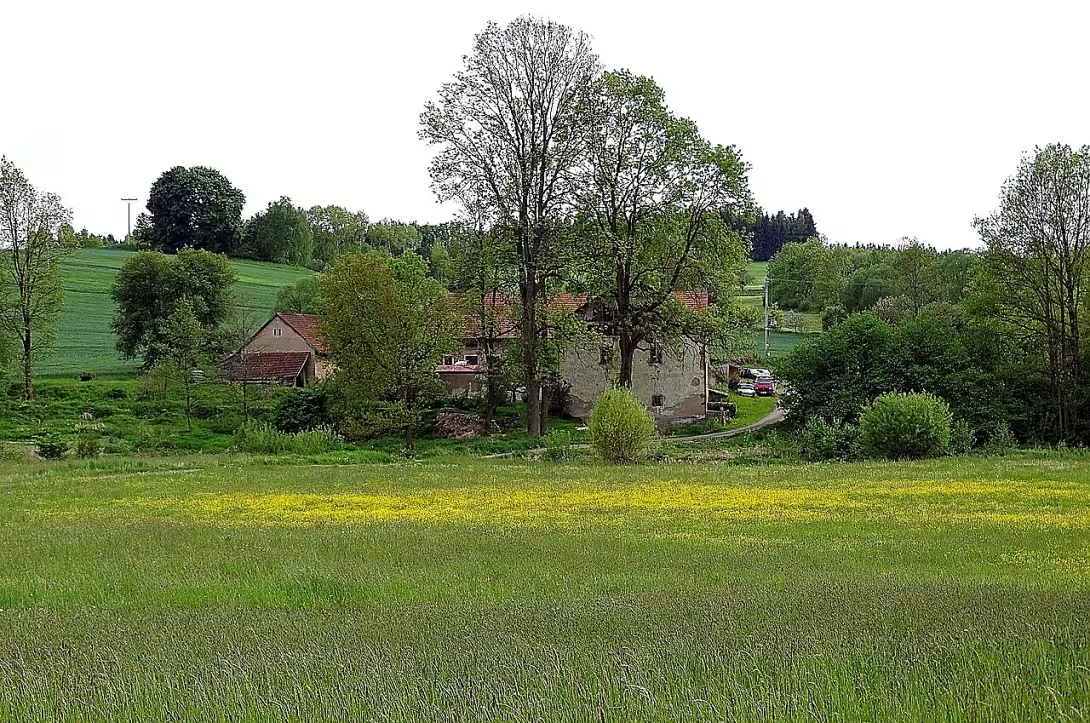
Sovův mlýn in Onšovice near Čkyně in Prachatick is a historic water mill on the river Spilka. The object in today's form dates back to the 18th century. It is protected as a real-estate cultural monument of the Czech Republic and stands out with preserved, carving decorated grinding equipment.
The first written mention of the wood mill in this place dates back to 1640. Historical sources suggest that the Owl mill family was based here before 1600. In the 18th century, when the mill acquired its present form, the Czech countries went through the period of the high baroque and subsequently enlightened reforms of Marie Theresa.
Architecturally, the building evolved as a closed four-wing complex with an irregular courtyard. During history, the object was rebuilt in the yard's tracks; However, the southern tract has not been preserved until today. In the interior of the mill there is part of the milling machine, which is remarkable with its carving decoration. The water came to the mill with a drive from the poison and the drain channel went back to Spilka. Originally the mill powered two wheels to the bottom water, later the drive was limited to one wheel.
Long-term continuity of ownership was provided by the House of Owls. As owners are documented in sources Daniel Sova (1656), Tomáš Sova (1670), Václav Sova (1677), Jiří Sova (1685), Jakub Sova (1716), Václav Sova (1716) and Vít Sova (1747).
Technical attractions include data from 1930. At that time, the mill drove one wheel to the bottom water with a flow rate of 0.11 cubic meters per second and a drop of 3 meters, corresponding to the power of 3 horsepower. The preserved gradients in the wall, however, confirm that in earlier times the mill was powered by two wheels.
Sovův mlýn is a valuable document of traditional milling industry in Šumava foothills. Visiting this place offers the opportunity to become familiar with the history of technical equipment as well as the architectural development of the rural economic building.
Historical milestones
- 1640
- The first documented existence of a wooden mill on site.
- 1656
- Daniel Sova documented as mill owner.
- 1930
- The mill drove one wheel to the bottom water with a flow rate of 0,11 m ³ / s.
Architectural development
It was originally a closed quadruple area with an irregular courtyard. Throughout history, the object was rebuilt in the yard's tracks. The original drive provided two wheels for the bottom water, later reduced to one.
Historical events
1640: First written mention of the wood mill in this place. 1930: The mill was powered by one wheel to the bottom water with 3 HP power.
Owners
House of Owls (Daniel Sova 1656, Tomáš Sova 1670, Václav Sova 1677, Jiří Sova 1685, Jakub Sova 1716, Václav Sova 1716, Vít Sova 1747).
Points of interest
- The object in its present form dates back to the 18th century and is protected as a real cultural monument. - The mill excels with preserved milling equipment, which is remarkable by its carving decoration. - The first written mention of the wood mill in this place dates back to 1640, while the Owl mill family was already based there before 1600. - Architecturally, the building has evolved as a closed four-wing complex with an irregular courtyard, while the southern tract has not been preserved until today. - In 1930, the mill was powered by one wheel to the bottom water with a power of 3 horsepower, although earlier gradients in the wall confirm the original drive of two wheels.
Guide
Show guide text
This text was created by artificial intelligence and has not been editorially reviewed. It may contain inaccuracies.
Welcome to one of the most important historical points in this area. You are standing in front of the Owl Mill, a place that carries the echo of centuries and the constant noise of water from the Spilka River. Before you go any further, stop for a moment and feel the atmosphere of this place. Before your eyes is a building that is not just a simple object but a living witness to the history that has been going on here for centuries. Feel the calm that brings the closeness of water, and at the same time the seriousness of the building that was built to withstand the time trials. This mill is a symbol of the workmanship and continuity that has lasted here in Onšovice since ancient times.
Let us now go back to the past together to understand how this object came into being and why it is so important to us today. Although the building you are currently observing has its present form, which we know from the eighteenth century, its roots extend far further into the dark and brighter times of our history. The first paper trail leading us to this place dates back to the year six hundred forty-one. At that time there was no stone palace, but a simple wooden mill, which was compatible with the nature and needs of the time. Imagine the world back then, when wooden architecture was the foundation of life and every movement of water in the river meant movement in human life. This mill has been designed from the beginning to serve people, to process crops and provide livelihood for the surrounding settlement. This role has not changed over the centuries, although materials and technology have changed.
Now pay attention to the architecture itself and to what you can see around you at this moment. Notice how this area is situated in close relation to the Spice flow. The water was absolutely necessary for the existence of the mill, its engine and its life. Originally, this space was not just a single building, but formed a complex, closed four-wing courtyard. This method of arrangement created a safe and focused background for miller activities and for family life. But if you look at the overall extent of the complex, you'll notice that this original harmony has been compromised. The southern tract of this court is no longer preserved, which reminds us that even the strongest history is subject to transformations and losses. Yet the current form of the 18th-century building seems very dignified and expresses the stability the miller sought in this place. This entire building is today protected as a real-estate cultural monument of the Czech Republic, which means that every part of it, every stone and every trace of history has its immense value, which we together have an obligation to preserve for future generations.
When we look at this mill, we can't just look at stones and wood, but we also need to see the people who lived and worked here. Sovův mlýn bears the name of a family that has become synonymous with this place. The Owls' miller family has lived here for many generations and their story is closely linked to the rhythm of flowing water. The first documented person to act as the owner of the mill in our records is in the year one thousand six hundred fifty-six. His name was Daniel Sova. His name was only the first in a long chain of men to keep this mill going, to develop it and pass it on to their children and grandchildren. Other names appear in the history of this place: Tomáš, Václav, Jiří, Jakub and Vít Sova. Each was part of this constant tradition. Imagine the continuity, the responsibility they had to bear to keep the miller's trade in Onšovice alive. They were people who understood water, who knew how to control the power of nature and how to use it to the benefit of their family and their entire environment. This mill was not just their workplace, it was their home and their heritage.
Now I want to invite you to focus on one of the biggest attractions this object has to offer. Although you're out now, feel the idea of what's inside the mill. That is where the real treasure is, which makes Sovův mlýn absolutely exceptional. It's a grinding machine that excels at its incredible carving decoration. It is a fascinating contrast between the rough, hard work of the miller and the fine, artistic expression you will find in the interior. At a time when most of the technical equipment was purely functional and without ornaments, here someone found the strength and desire to breathe into the machine beauty. These carvings are proof that there was a place for art and dignity in a demanding craft. The technical side of the mill is also very interesting if we look at the records from the year one thousand nine hundred thirty. At that time, the mill was powered by one wheel to the bottom water, which used a water flow of 0.11 cubic meters per second. Although these figures may seem small, it was an exact science that allowed the process to run smoothly and ensured that the grain would be turned into flour with the precision that the people at that time demanded.
When you look at this historical whole, you realize you're facing something much bigger than just an old building. You stand before a symbol of human effort, a family history that lasted centuries, and a work of art that was linked to technology. Sovův mlýn is a living proof of how people were able to connect with nature and how they could create something lasting even in a constantly changing world. Every generation of Owls has left a trail here, and today, thanks to protection as a cultural monument, we can see these tracks again and perceive their significance.
I hope this brief insight into the past has helped you better understand the place you're in right now. Keep this experience inside you and continue to explore this beautiful neighborhood. Perhaps the next time you look at Spilka's flowing water, you'll recall the names of the miller who stood here hundreds of years ago in the same place as you. Thank you for your visit and wish you a pleasant continuation in discovering the history of this region. We'll say goodbye, but we believe the stories you've just heard will remain in you for a long time.
Tips for visitors
For a visit we recommend spring or summer months, when the surrounding nature of the Šumava foothills is the most blooming and the level of the Spilka stream is a soothing impression. The light in the morning is ideal for capturing historical architecture of the mill.
Public transportation is recommended to verify in the current search engines connections that will lead you to the vicinity of the village.
Take fixed shoes suitable for field movement around the water stream. For photographers is the most interesting exterior mill from the 18th century and adjacent drive; The best lighting conditions for detailed façade images are during the morning.
In the surroundings you can visit the village Čkyně itself and enjoy a walk along the river Spolka. For families with children, the location is suitable as a stop during a trip to Šumava foothills, where children can observe the water flow and historical construction in a quiet environment.
Frequently asked questions
Can the monument be visited?
This is a technical monument. Some are open as exhibitions, others are out of use or on private land. We have not verified whether this one is accessible.
What are the opening hours and admission?
We have not verified the opening hours or admission. Current information is published by the operator.
Where is the monument?
Location: Čkyně, Jihočeský kraj. The map on this page shows the exact spot.
Why is the monument protected?
It is listed in the Central List of Cultural Monuments of the Czech Republic as a cultural monument (register no. 1000133040).
Businesses nearby
Do you run a restaurant, accommodation, shop, museum, rental, wellness or other visitor service near this monument? Show yourself directly to the people heading to it — this is how they will see you in the app and on the web:
Events nearby
Zdroj akcí: otevřená data měst a obcí ČR (Národní katalog otevřených dat) a kalendář akcí Národního památkového ústavu.
Nearby
Obec Čkyně, říčka Spůlka, šumavské podhůří v okrese Prachatice.
Accommodation nearby
Themed route
1. Village Čkyně (village) - Great place to start a trip and watch local life. 2. D Spareka (water flow) - Walk along the stream offers a quiet environment and proximity to the water. 3. Sovův mlýn (mill) - The main destination of the route, which represents an interesting historical construction. 4. Šumava foothills in the district of Prachatice (natural area) - The vast landscape surrounding the entire route offers beautiful views.
Seasonal recommendations
Spring - During the flowering trees and fresh spring light, Sovův mlýn is lost in the green grove of meadows and the first flowers appear along the stream. The light is soft and the shadows extend, giving historical construction a romantic touch. We recommend to come after the afternoon, when the sun is no longer too sharp, and avoid the weekend afternoon crowds that are slowly starting to gather in this period. Light laminated clothing is suitable - waterproof jacket for unexpected showers and comfortable shoes, because the roads to the mill can be muddy after rain.
Summer - In the summer months, the surrounding landscape is colored in rich green shades and the sun's rays clearly illuminate the stone wall of the mill, highlighting its architectural details. The main summer season is the highest attendance, which is why it is best to arrive early in the morning, even before the families with children are assembled. We recommend sunglasses, a hat and light, breathable clothes, but also a bottle of water because the temperature can rise quickly.
Autumn - Autumn fog and golden leaves around the creek create a melancholy atmosphere that underlines the historical character of the Owl Mill. The sunlight is often scattered in this period and shadows change quickly, giving each angle a different look. We recommend planning a visit for the late afternoon when the leaves are the most coloured and the crowds are smaller. Clothes should include a warmer sweater or jacket, because autumn mornings and evenings can be cold, and solid shoes because leaves and wet soil can be slippery.
Winter - In winter, Sovův mlýn is wrapped in quiet snow, which reflects the sun's rays and creates a white, almost mystical contrast to the stone walls. Short days and low temperatures mean that the light is weaker and the atmosphere calmer, which is ideal for photographers and lovers of history. Hot clothes are necessary - insulation jacket, hats, gloves and waterproof shoes, because the ways to the mill can be snowy and slippery. In winter, visitors are less numerous, so you can expect a quieter tour and the possibility to soak up the historic atmosphere in more detail.
Visualizations and artistic views


The visualisations are generated by artificial intelligence and serve as inspiration.
Photos from the area
Real photos taken near the monument


Zdroj a licence jsou uvedeny u každého snímku.
Tips from visitors
No tips yet. Be the first!
Log in and add your tip.
Sources and literature
Faktickým podkladem tohoto textu byl článek na Wikipedii, jehož autory jsou přispěvatelé Wikipedie. Článek je dostupný pod licencí CC BY-SA 4.0.
Location on the map


Příběhy a pověsti
Legendy, pověsti a příběhy spjaté s touto památkou
Fotografie návštěvníků
Zatím žádné fotografie. Buďte první, kdo přidá fotografii z návštěvy!
Log in a přidejte svou fotografii nebo hodnoťte.
Za ověřenou návštěvu v aplikaci získáte víc bodů — poznáme podle GPS, že jste na místě.
Reviews and comments