






Židovský hřbitov ve Čkyni Jewish cemetery
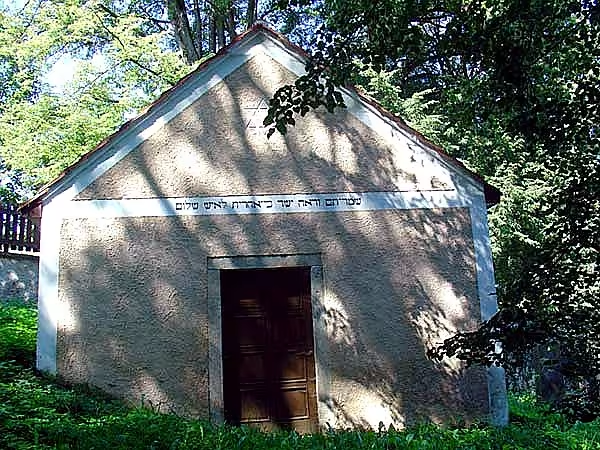
Židovský hřbitov ve Čkyni is a historical complex, probably founded at the end of the 17th century, which served to bury the inhabitants of the village and the wider surroundings. It is located south of the village in the forest above the railway line and features a set of tombstones from various epoch and special children's departments.
The oldest preserved grave dates back to 1688. The site was used to bury the local Jewish population and surrounding areas until 1942, when deportation to German concentration camps occurred, where most of them died.
The architectural ensemble includes tombstones from the Baroque period, classicism and modern elements. Part of the complex is a 19th century morgue with Hebrew inscription. An important element is the children's department at the west side of the wall. Unlike the other graves, oriented west, the ones in this part have an eastern direction.
Until 1938 the cemetery was managed by the Jewish religious community in Vimperk, where the seat was moved from Čkyně in 1897. After 1945, the administration switched to the Jewish religious community in Pilsen. Today the premises are owned by the Jewish village in Prague. The newer parts have suffered weather damage, vegetation growth and vandal attacks.
A complex reconstruction of the cemetery and the morgue took place in the years 1982- 1995 with the participation of the Municipal Office in Prachatice, the Jewish Community in Prague and the citizens of Čkyně. In the morgue there is a commemorative plaque reminiscent of the Jewish community of the village and the Holocaust victim, and also a plate dedicated to the victims of Nazism from Chynia.
The monument lies in the forest on the right side of the road leading to Hradčan, above the railway line. It represents an important place to understand the history of the local Jewish population and the tragic events of World War II. The visit offers insight into the history of the region through preserved tombstones and memorable elements.
Then and now
Drag the slider to compare how the landmark may have looked when it was built with the view today.
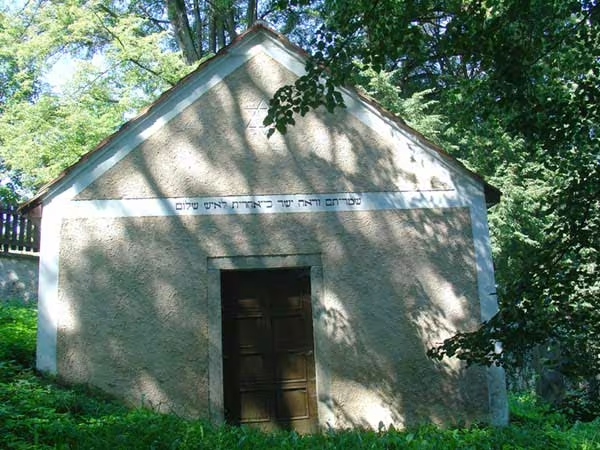
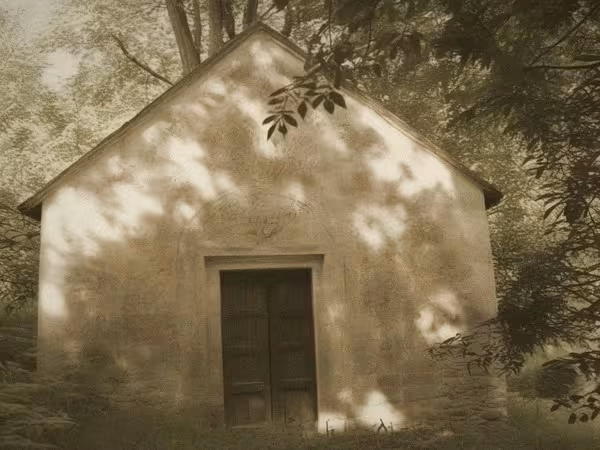
The historical appearance on the left is an AI-generated visualisation and serves as inspiration only.
Historical milestones
- 1688
- The oldest preserved tombstone in the cemetery.
- 1897
- Transfer of the seat of the religious community from Čkyně to Vimperk.
- 1942
- Deportation of the Jewish population and end use of the cemetery.
- 1982-1995
- Reconstruction of the cemetery with the morgue.
Architectural development
The cemetery gradually expanded and supplemented the tombstones of various epoch from Baroque to modern. A morgue was built in the 19th century. The complex reconstruction of the complex took place in 1982- 1995 with the participation of the village and Jewish village in Prague.
Historical events
1942: Deportation of local Jews to concentration camps and end funerals. 1982- 1995: Reconstruction of the cemetery and morgue.
Owners
Until 1938, the Jewish religious community in Vimperk, after 1945, the Jewish religious community in Pilsen, currently the Jewish community in Prague.
Points of interest
- The oldest preserved grave dates back to 1688. The area contains a special children's ward, where graves are oriented east, while others are heading west. - Part of the monument is a 19th century morgue with Hebrew inscription. - The architectural ensemble includes tombstones from the Baroque period, classicism and modern elements. - There are memorial records in the morgue that resemble the Jewish community and the victims of Nazism.
Guide
Show guide text
This text was created by artificial intelligence and has not been editorially reviewed. It may contain inaccuracies.
Welcome to the place where the silence of the forest is bound to a deep history that tries to tell the stories of people who once lived here, believed and worked. You're standing in front of a Jewish cemetery in Chka. Feel the atmosphere changing here. Once you enter this quiet space, the noise of the outside world, including the distant sound of the railway line that passes below this place, begins to retreat. You are in a space that is separated from the everyday rush, in places that have been chosen for rest and memory. Look around you. This forest corner south of the village surrounds you with its natural greenery and creates a protected, almost sacred space for those who rest here.
This cemetery is not just a set of tombstones; It is a living document about the existence of the Jewish community in this region. Its roots go deep into the past, probably to the end of the seventeenth century. At that time, this area was a key place for burial not only the inhabitants of the village Čkyně itself, but also the people from the wider surroundings. Imagine the times when people would gather here to say goodbye to their loved ones, and how this forest corner was an important symbol of their presence and roots in the land at that time. It is here, in this quiet hiding place, that the history of the local community has been formed for centuries.
Now pay attention to architecture and artistic elements, which are gradually being revealed to you. When looking at individual tombstones you can see the fascinating diversity of styles left behind. It's not just a single set of stones, but rather a varied mixture of period influences. Look at the shapes and ornaments. Some tombstones give you the dynamism and richness of the baroque era, while others give you the serenity and balance of classicism. In the area you will find newer tombstones that show us how the artistic expression changed over time. This mixture of styles creates a unique visual texture that follows you all the way.
When you walk on, you'll find one of the most important elements of this place - a 19th-century morgue. Give her some attention. It is a building that bears deep religious and historical significance. Note the inscriptions engraved on it. They are in Hebrew, a language that has resonated here for centuries and which gives this place its authentic, spiritual identity. These characters are not just ornaments, they are voices of the past that remind us of the culture and traditions of the people who thought this place was their home.
But the history of this place is also linked to periods of change and sadness. In the year one thousand eight hundred ninety-seven there was a significant shift when the seat of the religious community moved from Čkyně to Vimperk. This meant that the cemetery was no longer the heart of active community life, but remained a monument to earlier times. And then came the year one thousand nine hundred forty-two. That's the date that left an indelible and painful mark in the history of this place. Deportation of the local Jewish population meant the end of the era of using this cemetery. A place that served generations suddenly quieted and remained alone in the arms of the forest.
Although we do not know much about the specific persons that lie here, their presence is felt in every stone. Although we do not know the names of the great characters or famous architects who designed these tombstones, each one represents a specific life, a specific family and a specific story that was part of the fabric of the region. The oldest preserved tombstone you can see here dates back to a thousand six hundred eighty-eight. Imagine the long way of time this stone has traveled to tell us today about the beginnings of this place.
If you keep moving between the tombstones, you may encounter one very special and interesting thing that may surprise you. There is a special section for children. Notice how the orientation of the graves changes here. While the other tombstones in the cemetery are heading west, the graves in this children's section are oriented east. This difference is a fascinating mystery that makes you think about traditions, beliefs and how people tried to express respect and hope on such sensitive issues. It's a detail that requires a thoughtful eye and a moment of silence to understand it.
This cemetery has not been abandoned forever. Between a thousand and nine hundred and eighty-two and a thousand and nine hundred and ninety-five, there was an important reconstruction that included the morgue itself. Thanks to this effort, it is now possible to visit this space and perceive its beauty and its tragic history in a much better quality than would otherwise be. The reconstruction helped preserve this rare set of tombstones for future generations and ensured that the memory of the local Jewish community was not forgotten.
Now I suggest you continue your slow walk. Let yourself be guided by the atmosphere of this place. Look at the details of the tombstones, see the texture of the stone, and see how the light through the trees changes on the surface of old monuments. Every step can lead you to a new feeling, a new idea or a new question. This space is designed to let you think, to allow you to remain calm and to remind you how deep the roots of history are that unite us all.
Thank you for taking the time of this visit and for trying to understand this silent testimony of the past. Prabrig you in the next survey area and in the other quits that this journey will bring you. Please continue your examination with respect to the place you are visiting.
Tips for visitors
For the best experience we recommend a visit in late afternoon. The sunlight shining through the trees in the forest creates ideal conditions for shooting baroque tombstones and gives the place a peaceful atmosphere. You can reach the cemetery by car or public transport; Please check the current connection in the search engine. Parking is possible near the road leading to Hradčan. Due to the forest location, we recommend that you bring comfortable shoes, repellent and drinking water, which you will need in this environment. For families with children, walking in the forest above the railway line represents an interesting opportunity to discover nature. In the vicinity you can explore the way towards Hradčan. The most suitable places for photography are the Baroque elements of the cemetery, especially when the light is soft and scattered thanks to the trees.
Businesses nearby
Do you run a restaurant, accommodation, shop, museum, rental, wellness or other visitor service near this monument? Show yourself directly to the people heading to it — this is how they will see you in the app and on the web:
Events nearby

Zdroj akcí: otevřená data měst a obcí ČR (Národní katalog otevřených dat) a kalendář akcí Národního památkového ústavu.
Nearby
The cemetery lies in the forest above the railway line on the right side of the road leading to Hradčan.
Accommodation nearby
Themed route
Thematic cruise route: Židovský hřbitov ve Čkyni
1.Židovský hřbitov ve Čkyni * Type: * Historical landmark This cemetery is a unique cultural monument that shows the history of the Jewish community in the village. It is located in a picturesque forest above the railway line and offers peaceful walks between old graves. Visit him to remember an important part of local history.
2. Forest above the railway line * Type: * Natural space After visiting the cemetery, look at the surrounding forest, which provides a calm atmosphere and an opportunity for a short break. The forest is an ideal place for relaxing and enjoying the natural environment.
3. Road leading to Hradčan * Type: * Cultural path A walk along the road leading to the cemetery offers views of the local landscape and an opportunity to explore the surrounding area. This journey is part of the cultural heritage of the region and can also be a beautiful place for photography.
This trip offers a combination of historical knowledge and natural views, an ideal choice for those who want to explore the surrounding area of Čkyně.
Seasonal recommendations
Spring brings to the cemetery a sense of renewal, when along with the blooming vegetation the whole surrounding landscape awakens. Soft sunlight highlights the structure of old stones and young green leaves create fresh contrast. It is advisable to prepare your clothes in several layers because the morning temperatures may still be low. At this time the traffic is very quiet, which allows uninterrupted observation of details.
During the summer, the place is covered with thick greenery and is very lively. Intense sunlight creates deep shadows that give the memory a dramatic look. Due to the higher temperatures and possible increased interest of visitors I recommend to come in the early morning. For comfortable movement in the summer heat choose light and breathable clothes and do not forget to protect against the sun.
Autumn is a time when the cemetery receives a melancholy and deep breath. Golden and brown leaf colours together with morning fog create a very atmospheric experience for visitors. Due to the wet surface and the falling leaves, it is necessary to have high-quality, waterproof footwear on your feet. Prepare for colder weather and wear layered, wind-resistant clothes.
Winter in this location is very raw and dignified. Without leaves, the tombstones are better visible and frost or snow underline the quiet atmosphere of the place. Since the days are short in this period, plan a visit around noon when the lights are most. Due to low temperatures and open space, it is necessary to carry very warm clothes, including caps and gloves.
Visualizations and artistic views


The visualisations are generated by artificial intelligence and serve as inspiration.
Photos from the area
Real photos taken near the monument

Zdroj a licence jsou uvedeny u každého snímku.
Tips from visitors
No tips yet. Be the first!
Log in and add your tip.
Sources and literature
Fotografie: Kuklava. Original uploader was Kuklava at cs.wikipedia / Public domain — Wikimedia Commons. The author and licence also appear when you hover over the image.
Faktickým podkladem tohoto textu byl článek na Wikipedii, jehož autory jsou přispěvatelé Wikipedie. Článek je dostupný pod licencí CC BY-SA 4.0.
Location on the map
Příběhy a pověsti
Legendy, pověsti a příběhy spjaté s touto památkou

Fotografie návštěvníků
Zatím žádné fotografie. Buďte první, kdo přidá fotografii z návštěvy!
Přihlaste se a přidejte svou fotografii nebo hodnoťte.
Za ověřenou návštěvu v aplikaci získáte víc bodů — poznáme podle GPS, že jste na místě.
Reviews and comments