



Sýpka panská Granary
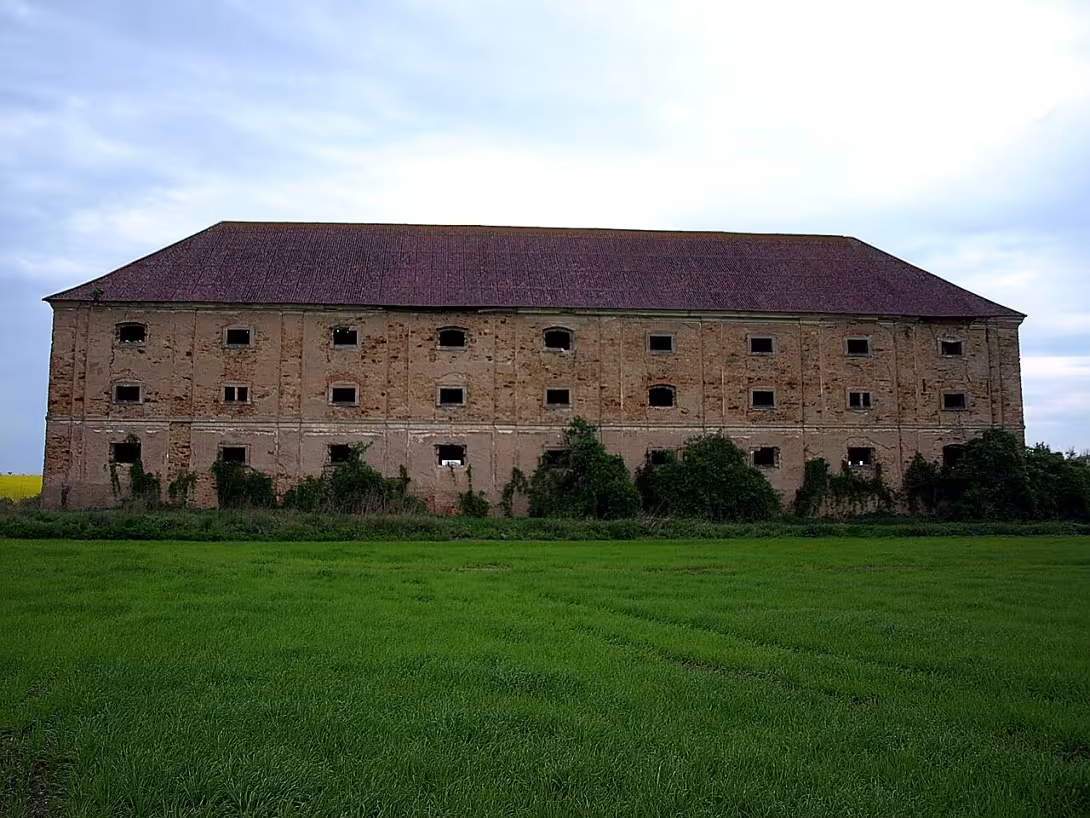
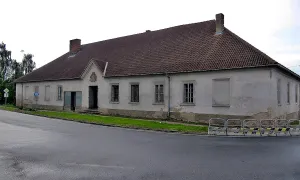
The German granary in the village Kounice in the district of Nymburk is an extremely valuable Baroque agricultural object from 1723. The building belongs to the Týnice Court and has been registered as a cultural monument since 10 February 1987.
We date the creation of the granary until 1723. This period in the Czech Republic characterized the boom of Baroque architecture and the development of extensive agricultural complexes in the manor courts. The building was built for gentlemen from Kounice.
This three-storey structure with a rectangular plan is made of quarry stone and reinforced with iron pliers. The Valb roof is covered with corrugated eternite plates and has a profiled roof ledge. The longer side of the object has nine window axes, shorter two. The facade is divided by pilasters with simply drawn heads and armour. The windows are fitted with bars, in the middle of which are divided pillars. Passages are inserted into the north and east facades. The original wooden ceilings with support columns are preserved in the interior.
A significant detail is the entrance with a distinctive stone lining, above which is placed a cartouche with the coat of arms of the gentlemen from Kounice. The granary stands on an elevated position above the two ponds system.
The current state of the monument has been evaluated as dismal since 1986. At that time, there were largely fallen outdoor plaster, broken window lining and broken part of the ledge on the east side. The building is still waiting for a complete reconstruction.
The German granary represents a rare example of baroque agricultural construction. Its visit offers the possibility to observe the authentic architecture of the court from the beginning of the 18th century.
Historical milestones
- 1723
- Building a Baroque granary for gentlemen from Kounice
- 1986
- Evaluation of the dismal state of construction
- 1987
- Registration of the object as a cultural monument
Architectural development
The construction was carried out in Baroque style of quarry stone and reinforced with iron pliers. The original wooden ceilings with support columns are preserved in the interior. The roof is currently covered by corrugated eternity plates.
Owners
gentlemen from Kounice
Points of interest
- It is a valuable Baroque agricultural building from 1723, which was built for gentlemen from Kounice. - The construction is three storey, made of quarry stone and reinforced with iron pliers. - The original wooden ceilings with support columns are preserved in the interior. - The entrance has a distinctive stone lining with cartouche on which is the coat of arms of the gentlemen of Kounice. - The granary is located in a high place above two ponds.
Guide
Show guide text
This text was created by artificial intelligence and has not been editorially reviewed. It may contain inaccuracies.
Welcome to Kounice. You're standing in front of a building that looks like a simple home at first sight, but it's actually one of the most important monuments of the old economy in the whole county. In front of you, there is a granary, a massive building that dominates the surrounding space with its presence. Feel the stability and calm that radiates. It is a place where a practical purpose is met with a period of taste and where every stone tells the story of how wealth in the form of cereals was managed in ancient times.
Let us now stop at how this building was created and why it is standing here at all. Let us go deep into the past, namely seven hundred twenty-three years. At this time the granary was built for gentlemen from Kounice and became part of the court of Těnice. At the time, it was not just a simple warehouse, but a strategic point of the entire estate. The granary was used to safely store the grains that were the basis of survival and wealth at the time. So imagine that in these walls, the most valuable that the country could offer was stored, and that this building was a hunger insurance policy and a symbol of the power of local nobles.
Now pay attention to the architecture itself, because it contains the greatest beauty of this object. Look at the overall shape of the building. It has a simple rectangular plan and its roof consists of a so-called valb, which means that roof surfaces fall from all four sides to the edges. It is a very stable and practical solution that gives the granary a balanced look. Notice the material from which the building is built. It's a quarry stone that gives the granary its characteristic texture and a sense of indestructible.
If you look closer at the facade, you will see that even this practical structure has not been removed from the ornaments. Notice the belt rims that horizontally divide the walls, and the pilasters, which are the rising vertical elements that resemble columns, but are part of the wall. These details add rhythm and grandeur to the building. But the entrance deserves the most attention. Look at the distinctive stone lining surrounding the door. Above it you will find cartouche, which is a decorative frame in which the coat of arms of the gentlemen from Kounice is located. This sign was a clear expression of who owns the granary and who rules it. It's a small detail that links this building to the history of the entire family.
While on the outside we see the rock power, the inner space of the granary hides its own secret. Even if you are now outside, try to imagine what's going on inside. The granary is three-storey and the original wooden ceilings are preserved within it. These ceilings are not just laid down, but reinforced by support columns, which bear the enormous weight of stored stocks. It's fascinating to think how much grain these wooden structures must have held for centuries. Moreover, the whole building is reinforced with iron pliers, which points to a high level of the then building art and the pursuit of maximum resistance.
But the history of the granary is not just about flourishing. Every building goes through its crises. If we look at the records, we'll find that in the year one thousand and nine hundred and eighty-six it was assessed that the building was in a dismal state. Time and humidity began to take their toll on stone and wood. However, it was timely to draw attention to its exceptional value. A year later, a thousand nine hundred eighty-seven, the granary was officially registered as a cultural monument. This step ensured that this unique agricultural object was not forgotten or demolished, but remained as a witness for future generations.
If we were looking for a mystery in this building, it would probably be a question of anonymity. Although the granary excels with its architecture and precise implementation, we do not know who was its particular architect. The name of the master, who in the year seven hundred and twenty-three designed this space and oversaw its construction from the quarry stone, remained in oblivion. It's paradoxical that a building that represents so much the Kounic family has hidden the name of the person who gave it its physical form. Yet his work has survived for three centuries and still fascinates us today.
Stop now for a moment and just feel the atmosphere of this place. The granary is a silent witness to changes in white liners, changes in agriculture and the rotation of generations. It's a bridge between baroque elegance and today's world. When you look at the rough stones and the fine details of the coat of arms, you realize how important the balance between utility and beauty was. This building is not just a stock, it is a monument to human work and the pursuit of endurance.
There's an object in front of you that survived wars, changes in regimes, and periods of extinction. It is proof that even an ordinary economic building can have a soul if built with care and respect for materials. The Kounice Mall is now one of the most preserved examples of its kind and its value lies in its authenticity.
Now I'm going to invite you to take a closer look at the granary from different angles. Go around, see the game of light and shadows on the quarry stone, and look again at the details in the entrance area. Note how the building is inscribed in the landscape around you. I hope this short trip to history has helped you better understand the importance of this place. Thank you for your attention and I wish you a pleasant continuation in discovering the beauty of Kounice and its surroundings. Goodbye.
Tips for visitors
The best time to visit is the late afternoon when the sun hits the quarry stone of the building from 1723 and highlights its texture. We recommend you to take with you a bandage with a fixed sole, because the granary is located on a height where the terrain can be uneven.
The best places for photo lovers are the shores of two ponds, from which you can see the granary as the dominant landscape. The best light for outside images is shortly before sunset.
Around the granary you can explore the two ponds that form the natural surroundings of this agricultural object. It's an ideal place for a short walk in nature.
We recommend families with children to focus on observing the surrounding nature by the water and to look together for details in the stone wall of the three-storey building, which may be an interesting game in finding historical elements.
Frequently asked questions
Can the monument be visited?
This is a residential or farm building, not a museum with opening hours. Please view it from public space and respect the owners' privacy. We have no information about access to the interior. According to the heritage register the structure is in poor condition – do not enter it and take care nearby.
Where is the monument?
Location: Kounice. The map on this page shows the exact spot.
Why is the monument protected?
It is listed in the Central List of Cultural Monuments of the Czech Republic as a cultural monument (register no. 1000140530).
Businesses nearby
Do you run a restaurant, accommodation, shop, museum, rental, wellness or other visitor service near this monument? Show yourself directly to the people heading to it — this is how they will see you in the app and on the web:
Nearby
Sýpka stojí na vyvýšenině nad soustavou dvou rybníků.
Accommodation nearby
Trips and activities nearby
Guided tours, tickets and activities nearby from GetYourGuide
Affiliate link: if you buy from the partner, we may receive a commission. The price for you does not change.
Search tours and activities →Themed route
Here is the design of the thematic route:
1. System of two ponds (water surface) - A walk around the water offers peace and a beautiful view of the surrounding countryside. 2. Sýpka panská (construction) - The main destination of the trip, which stands on the high rise and serves as a dominant monument in the area.
Seasonal recommendations
In spring, the surrounding area of the building wakes up in green and fresh air gives new energy to the place. The building in the morning light looks soft, which is ideal for a short walk. We recommend shoes suitable for wet grass and visit in the morning when dew is the most beautiful.
In the summer months the landscape is dominated by bright sun and hot air, which highlights the details of the old masonry. The atmosphere is calm and sleepy. The best time for arrival is the late afternoon, when shadows are longer and temperatures are more pleasant. Don't forget light clothes and a sun hat.
Autumn brings a colorful leaf colour to the area of the granary and a misty wound that gives the building a mysterious touch. It's a period of melancholy and peace. Layer clothes and solid shoes are suitable to avoid mud on the way to the building.
Zimą works in the freezing air of snow, especially if it is covered by a layer of snow. The landscape is quiet and white. A warm jacket, hat and non-slip shoes are essential for comfortable outdoor movement. Best to come here on a bright winter day, when the sun beautifully reflects the white color of the surroundings.
Visualizations and artistic views

The visualisations are generated by artificial intelligence and serve as inspiration.
Tips from visitors
No tips yet. Be the first!
Log in and add your tip.
Sources and literature
Photos: Kastelanka Praha / CC BY-SA 3.0 — Wikimedia Commons. The author and licence also appear when you hover over the image.
Faktickým podkladem tohoto textu byl článek na Wikipedii, jehož autory jsou přispěvatelé Wikipedie. Článek je dostupný pod licencí CC BY-SA 4.0.
Location on the map
Příběhy a pověsti
Legendy, pověsti a příběhy spjaté s touto památkou
Fotografie návštěvníků
Zatím žádné fotografie. Buďte první, kdo přidá fotografii z návštěvy!
Log in a přidejte svou fotografii nebo hodnoťte.
Za ověřenou návštěvu v aplikaci získáte víc bodů — poznáme podle GPS, že jste na místě.
Reviews and comments