






Třípanský sloup Border stone
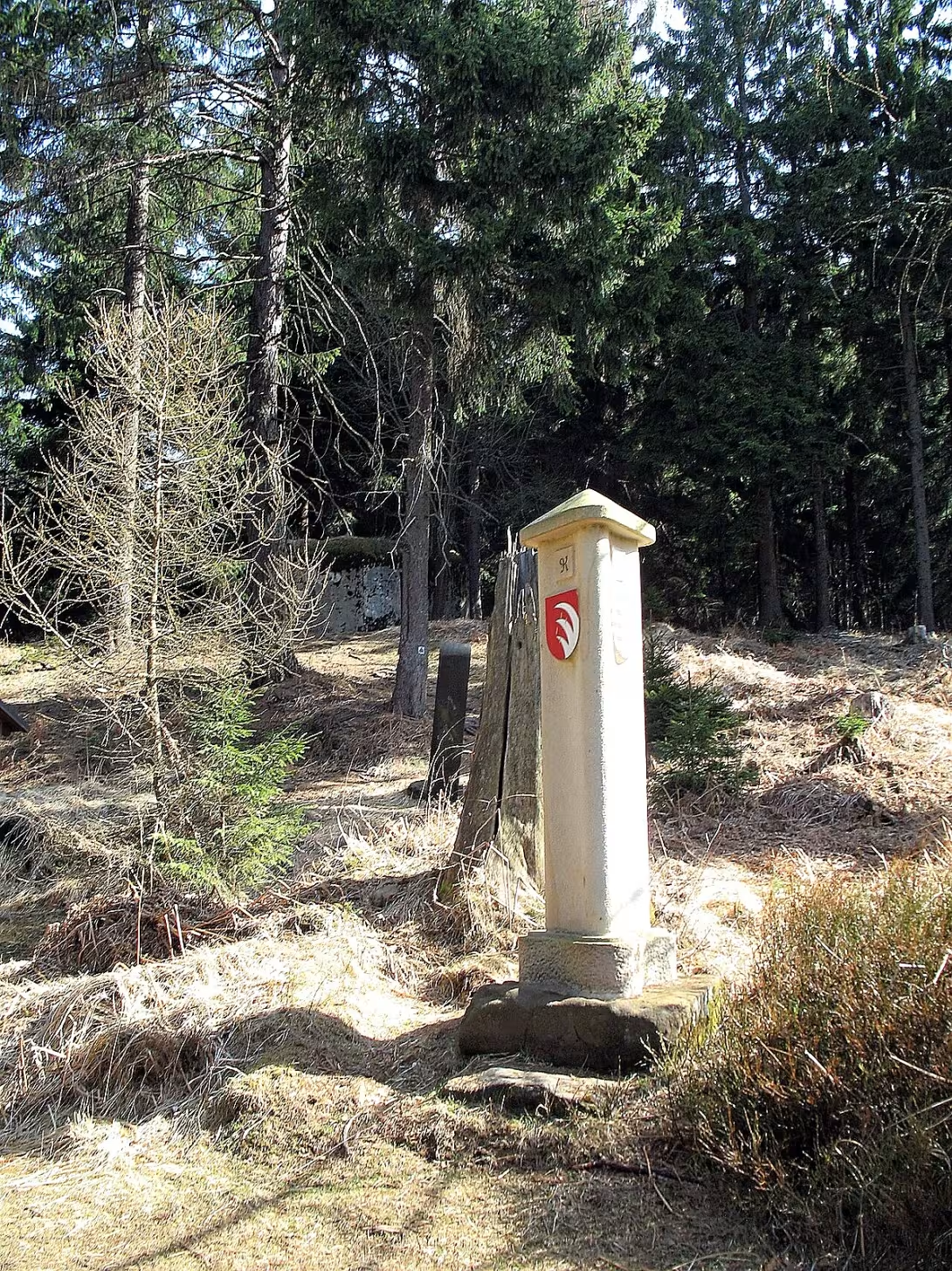
Třípanský sloup is a Baroque border monument from 1705. It is located in the Lusatian Mountains in the district of Děčín in the Ústí Region. Originally he defined the boundaries of three estates, today he is represented by a modern replica. The object served as a key landmark on the Old Prague Road. This was an important link between the Czech interior and the region of Lusatia until the end of the 18th century.
The column was erected on 29th July 1705 on the southwest slope of Konopac, also called Deer Rock. Replaced the older so-called Red Column. Its purpose was the precise definition of the disputed borders between the Czech, Tolstejn-Rusburg and the buyer. The importance of this place is confirmed by a map from 1745, which documented the disputes at the time.
The original monument was carved out of a tough Milstein quartz. This material was commonly used to produce mill stones. The column had a triangular shape with rounded ascending edges and measured approximately two metres. On top of it were carved coats of arms of the respective manor. The whole object consisted of a square sandstone foundation.
The column was repaired in 1927, but at that time his head was already missing with coats of arms. The Ministry of Culture declared the building as a cultural monument on April 22, 1991. In the autumn of 1999, the column's torso was stolen; only the lower part of the sandstone pedestal remained in place. With the support of the state enterprise Forests of the Czech Republic, a sandstone replica was placed on the original basis in July 2016. It was made by the children's stonemason Jan Pokorný. This copy is somewhat smaller than the original.
There are two other stone elements in the immediate vicinity. The first is the sandstone column of St. James, known as the Deer Column. It is probably from the beginning of the 18th century, carrying the relief of St. Gilji and was renovated in 2002. The second one is a 19th-century stone prism marked with IX and X forest areas. A number of border stones from the middle of the 18th century were previously located in the wider area between the Jelín Rock and the Stretch. Many were stolen in the late 20th century.
There's no road to the monument. Access is possible by train to Jedlová station, from where it leads a green and yellow-marked tourist route. The green road is towards the Deer Rocks, Cannabis, and further to the Stretch, where it connects to the European long-distance route E10. The yellow route leads along the Old Prague Road to Nové Huti.
Třípanský sloup and the surrounding pavements are witnessing ancient property disputes and transport history in the Lusatian Mountains. Visiting this place offers insight into the baroque landscape definition. It is a suitable destination for people interested in history and tourism.
Historical milestones
- 1705
- The raising of the Three Pillar in the place of the older Red Pillar.
- 1745
- Record the column on the map documenting the dispute over the estate boundaries.
- 1991
- Declaration for cultural monument by the Ministry of Culture.
- 1999
- Stealing a torza pole.
- 2016
- Location of the modern sandstone replica.
Architectural development
The original column was made from a Millennium quartz with sandstone square fundamentals. In 1927 the column was repaired but no erbowé head. In July 2016, a reduced sandstone copy was placed on the original pedestal.
Historical events
The height of the column in 1705, the declaration for cultural monument in 1991 and the theft of the torza column in 1999.
Points of interest
- Třípanský sloup is a Baroque border monument from 1705. - It is located in the Lusatian Mountains in the District of Děčín in the Ústí Region and originally defined the boundaries of three estates. - The building served as a key landmark on the Old Prague Road, an important link between the Czech inland and the region of Lusatia. - The original monument was carved out of a hard Milstein quartz and had three-sided shape with rounded edges, the coats of arms of the respective manor were carved on top. - In 1999, the column's torso was stolen; in July 2016, a sandstone replica was placed.
Guide
Show guide text
This text was created by artificial intelligence and has not been editorially reviewed. It may contain inaccuracies.
Welcome to the place where the roads meet and in the silence of the Lužice mountains there is a whisper of ancient years. You are standing in front of one of the most important historical signs of this region. Look at this column right in front of you. Even though it is part of a peaceful landscape today, its presence here is not random. Feel the atmosphere of this crossroads where earlier people from different worlds had to stop to know what soil they were standing on. This object, which you are now observing, is a symbol of clear borders and also witnessed many of the events that have taken place here over the last three centuries.
Now let's go deeper into time and understand why this column is standing here. Imagine 1705. The world around you looked quite different, but the need to have a clear line was as strong as it is today. In this place, there used to be another object known as the Red Column. However, with the growing need to precisely define the borders between different empires, it has decided to create something more permanent and more important. Třípanský sloup was built precisely to serve as an unquestionable border sign. It was not just an ordinary stone, but a legal instrument that separated three powerful mansions. One of them was Czechoslovakian, the other was called Tolstejn-Rumburian and the third was purchased. Imagine the complexity of the world back then, where every step beyond the border meant entering into a different legal order, another rule of law, and another administration. So this column was the key point that connected all of these worlds and separated them at the same time.
Now pay attention to the work itself and to what you are seeing. If you look at the shape of the column, you'll notice its triangular form. This tripartite was not random, but directly reflected its function in the crossroads and connections of three different territories. The original column, which stood here at the time of its creation, was carved from a very hard and durable material called the Millennium quartz. It was a stone that was meant to last centuries and the hardest weather conditions. At its peak, the coats of arms of the individual manor were placed, which clearly showed each passer-by what territory he was walking around. Today, what is right in front of your eyes is the modern form of this monument. It's a replica made of sandstone that was placed here in 2016. Although the material is different from the original work, it faithfully retains the shape and meaning that this object has for the whole area. Feel the beauty of the sandstone surface, trying to mimic the ancient size and dignity.
But the history of this place is not only about stones and borders, but also about human disputes and unexpected twists. In 1745, there were serious debates about this place. It was noted at the time that the boundaries of the estate were the subject of disputes, and the column was an important piece of evidence in solving these uncertainties on the maps. This stone was therefore of great value in the hands of the then officials and nobles. But the most dramatic story happened much recently, in our time. In 1999, this historical object was the victim of a theft. Someone came in and took the top of it, left only an incomplete torso. It was a great loss to the whole culture and to the people who love this place. Fortunately, however, history did not stop to grieve. Thanks to the reconstruction efforts and the fact that this monument was already declared a cultural monument in 1991, this historic point was restored. Thanks to the new sandstone form from 2016, this pillar can again proudly stand in its place.
I also want to tell you one very interesting thing that gives this place even more weight. This column was not just a boundary sign for the local estate. It was also a crucial landmark for travelers on the Old Prague Road. Imagine the journey as the main artery that connected the Czech interior with the region of Lusatia. They were merchants, pilgrims, and residents who traveled in this direction. For them, this column was a clear sign that they were on the right track and that they were approaching the important points of the landscape. Without such signs, the journey would be much harder and less safe. So this column was a light for anyone who wandered these mountains.
Now that you know the story of this place, I suggest you continue your walk. Lusatian mountains offer many more secrets and beautiful views. Don't forget to stop in other places that attract you, and feel the connection between the past and the present that you're feeling right now. Thank you for stopping by and taking the time to make this historic witness. We wish you a beautiful and inspiring journey further.
Tips for visitors
The best time to visit is spring or autumn months when the weather is most suitable for walking in Lusatian Mountains. For photography we recommend to use morning or evening light, which will highlight the texture of the stone and surrounding rock shapes.
You can reach the monument by car or public transport; please check the current connection and parking options in the search engine. For a comfortable trip, remember to bring drinking water and solid shoes suitable for uneven terrain.
In the surrounding area you can explore the column of St. James, the stone prism from the nineteenth century, the rock formation Konopac or the ridge of the Stretch. The road leads to the Old Prague Road.
It is interesting for families with children to travel around the area thanks to natural formations, but it is necessary to ensure safety when moving near the rocks.
Businesses nearby
Do you run a restaurant, accommodation, shop, museum, rental, wellness or other visitor service near this monument? Show yourself directly to the people heading to it — this is how they will see you in the app and on the web:
Nearby
V bezprostředním sousedství se nachází sloup sv. Jakuba (Jelení sloup) a kamenný hranol z 19. století s čísly revírů. Lokalita leží u Staré pražské cesty v blízkosti skalního útvaru Konopáč a hřebene Stožec.
Accommodation nearby
Themed route
1. Třípanský sloup (Memorial) - Main destination of the trip in the village Svor. 2nd column of St. James (Deer Column) - lies in a close neighbourhood and is worth a visit. 3rd stone prism from the 19th century with the numbers of the fields (Memorial) - shows the historical marking of the territory. 4. Old Prague Road (Path) - This historic road leads around all these places. 5. rock formation Konovac (Natural unit) - It offers a view of the rock shapes in this area.
Seasonal recommendations
Spring brings a particularly calm atmosphere to the surroundings of the Třepansky Column in the village Svor, where nature wakes up and the landscape is encapsulated with fresh greenery. The column, located in good condition, stands out against the background of flowering trees and fields, creating ideal conditions for a peaceful tour without disturbing influences. The lighting is already sufficient for a full day's stay, yet in the morning the air is colder and the sky often cloudy, which gives the scene a melancholy and thoughtful character. This period is most suitable for visitors because there are not yet large crowds of tourists that are typical of summer months. We recommend wearing layered clothes, such as a light jacket and raincoat, because spring weather is usually variable and rainy. The best time to visit is the morning hours when the light is soft and the air temperature is pleasant for walking around the sights.
Summer offers the longest days and brightest lighting on the column of Tripan, which reveals every detail of the stone building in full beauty. Nature is in full bloom and the landscape is vibrant and energetic, creating contrast with the age dignity of the historical monument. At this time, the atmosphere is the hottest and most lively, but also the busiest, as a large number of visitors from all over the region gather here. Practical advice for summer visits include the need to arrive in the morning, ideally before 9:00, to avoid the biggest crowds and high temperatures. Clothes should be light, breathable and light to allow the body to remove heat. The necessary part of the equipment is enough drinking mode and sun protection such as hat and sunglasses. The afternoon hours may be uncomfortable for a longer stay in the sun, so it is advisable to plan a tour to end before the onset of the peak heat.
Autumn brings a unique atmosphere of colors to Svor and surrounding the Tripan Column, when tree leaves change their shade into warm tones of yellow, orange and red. The lighting is lower and softer this season, creating a dramatic and photogenic contrast with a dark camera monument. Nature begins to relax and the landscape is quiet and thoughtful, which is ideal for those who seek peace and inspiration. The crowds of visitors are significantly reduced in the autumn months, which allows for a more intimate and private experience from the tour of the historical monument. Clothes should be laminated and heat-insulated, because temperatures are falling and mornings and evenings are cold. We recommend wearing a waterproof jacket, as autumn rains are a common phenomenon. The best time to visit is the late morning when the sun shines at a low angle and lights the column from the side, highlighting its reliefs and texture.
Winter transforms the surrounding area of the Třipansky Column into a quiet and often white landscape, which gives the historical monument a majestic and light look. The lighting is the shortest and coldest, creating a specific, almost mystical atmosphere, especially in late afternoon hours when shadows extend. Nature is in sleep mode and the landscape is sterile and clean, which allows you to focus exclusively on the architectural elements of the column. Visiting is minimal in the winter period, which guarantees complete peace and absence of any disturbing elements. Practical advice includes the need for warm clothes, including winter jackets, gloves and hats, as temperatures may fall below zero. It also requires good heel shoes to avoid slipping on any ice or snow. The best time to visit is in the morning, when the light is brightest and the air temperature is highest, while evening walks can be dangerous due to fast darkness and low temperatures.
Visualizations and artistic views

The visualisations are generated by artificial intelligence and serve as inspiration.
Photos from the area
Real photos taken near the monument

Zdroj a licence jsou uvedeny u každého snímku.
Tips from visitors
No tips yet. Be the first!
Log in and add your tip.
Sources and literature
Photos: Marie Čcheidzeová / CC BY-SA 4.0 — Wikimedia Commons. The author and licence also appear when you hover over the image.
Faktickým podkladem tohoto textu byl článek na Wikipedii, jehož autory jsou přispěvatelé Wikipedie. Článek je dostupný pod licencí CC BY-SA 4.0.
Location on the map
Příběhy a pověsti
Legendy, pověsti a příběhy spjaté s touto památkou

Fotografie návštěvníků
Zatím žádné fotografie. Buďte první, kdo přidá fotografii z návštěvy!
Log in a přidejte svou fotografii nebo hodnoťte.
Za ověřenou návštěvu v aplikaci získáte víc bodů — poznáme podle GPS, že jste na místě.
Reviews and comments