






Trojanův mlýn Mill
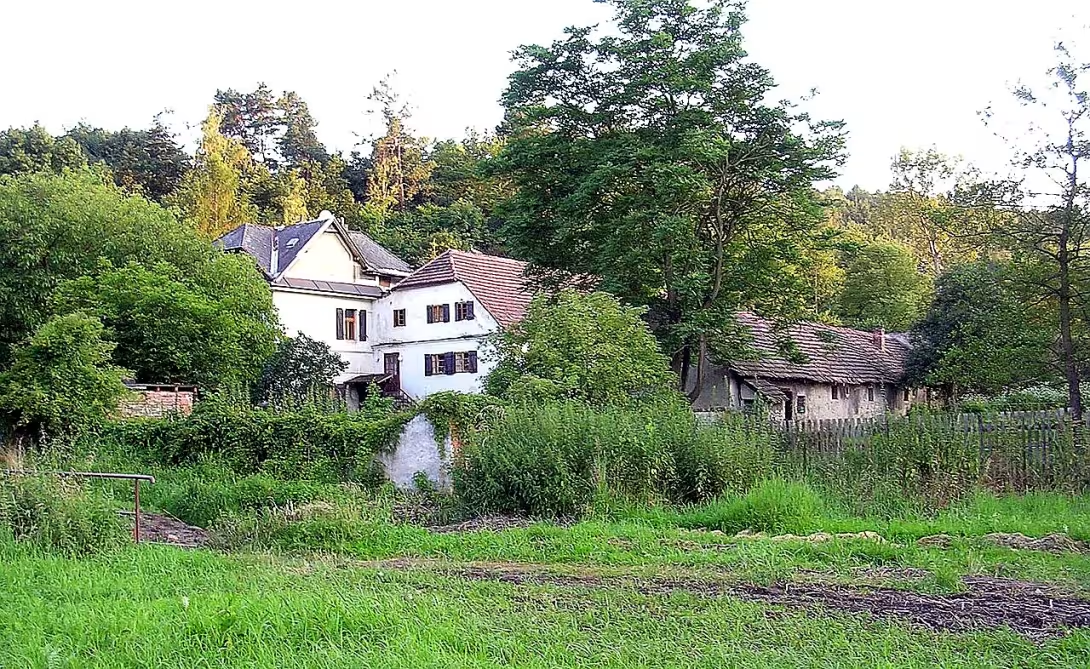
Trojanův mlýn is a historical water mill in Prague 6-Suchdole. It stands on the Utentic River in the Pacific Valley and since 30 May 2003 is protected as a real-estate cultural monument of the Czech Republic. The place is connected to the milling of grain since the middle of the twelfth century on the historic trail connecting Left Hradec to Prague Castle. This object represents a valuable example of historical miller architecture. Over the centuries, it has undergone a number of reconstructions from the wooden building to the stone complex serving gradually for agricultural purposes, innkeeper's operation and housing.
At the time of the inception of the first mills in the first half of the twelfth century, the Czech earthly principality was in power fighting among the premoniac monarchs. Meanwhile, Europe experienced the boom of Romanesque art, the establishment of monasteries and the development of medieval colonization. In the places originally called the front, the grain was grinding in the middle of the twelfth century. Between 1125 and 1140, kanovník Zbyhněv founded two mills in place. One of them was created about one water bike in agreement with the owner of the Suchdol farmhouse right where Trojanův mlýn stands. At the beginning of the thirteenth century, Suchdol owned the St. John's Monastery's abbess in Prague. Between 1360 and 1378, the wooden mill was originally converted into a stone mill along with the Suchdol Court and the village. At the end of the seventeenth century, the mill was extended to two water wheels. During the Thirty Years' War, the buildings were desolate, until 1173, the building is documented as the mill of Jiří Vodička. In 1730 the Trojanov family bought the mill, which owned it until 1857. Later, Ladislav Bayerle, the innkeeper, bought the estate in 1922, which cancelled and rebuilt the mill into a restaurant. In 1942, the builder Shašek modified the buildings into flats.
The architectural development of the complex includes the oldest part, which consists of a historical mill with original layout solution. Economic units are based on an irregular plan L. The main building is separated by an outdoor staircase with wooden railing. The sty is situated parallel to the mill and separated by a free yard. The buildings have massive walled supports. East of the mill is a barn built in the late eighteenth century. Its ground floor and the first floor light up the six-paneled paneling windows. In the mill, three wider windows form a glass band on each other, adding three simple six-table windows. Historical structures, details and wooden doors have been preserved. Massive entrance doors to the mill are probably a replica from the second half of the twentieth century. The new part of the mill built in the 1940s is connected from the southeast to the old building and retains historical elements. From a technical point of view, the mill in 1930 had one Francis turbine with a drop of 2.5 metres and 4 horsepower. Protecting historical care covers the entire building except for border walls, gates and gates.
During his existence he replaced the object with a number of owners and administrators. Among them were the St. John's monastery in Prague, the monastery of the Emmausian benedictines, the Trojanov family, Josef Müller, Ladislav Bayerle and the builder Shašek. At the end of the seventeenth century, the Emmausian benedictine monastery owned a mill with the court and extended it to two water wheels. The mill also included a larger fish tank for the monastery. The miller had an obligation to grind for a farm of 52 bags of grain weighing 94 kilograms and prepare barley for a brewery of malt. As a reward, he received grain waste and half a keg of beer from each brewery batch. Each year the miller paid 52 gold for the rent of the mill, 12 gold for the rent of 12 corks of fields and bows and 50 gold for the state taxes. The Trojanov family later bought out of robot liabilities, but had to sell the property due to financial difficulties. Václav Trojan purchased the chapel of St. Wenceslas in 1806 with an adjacent cemetery, repaired it and had it reconsecrated. Since 1821 he also owned a pub off the road. Since 1858 a reconstruction took place from the new owner and since 1870 Josef Müller set up a stand at the mill bakery. Ladislav Bayerle rebuilt the mill into a restaurant at the Trojans, added new pavilions and turned the mill tank into a swimming pool. The subsequent owner of the builder Shašek modified the buildings into flats and left one water wheel as a souvenir, which was used by another buyer for farming.
Among the key events and attractions are the residence of the prominent painter Mikolas Alš in this place. The mill is also a popular location for shooting movies and ads. There were scenes from the series There were once two scribes, from Bestiary, Head - Hands - Heart, Signal or American Images Agent without Past. In 2008 it was officially decided not to cancel the monument protection of this building.
Today, the Trojanův mlýn is located in the naturally valuable area of the Silent Valley on the Unotic River, which is ideal for walks. Although the building has undergone many building changes from medieval grinding to restaurant operations to residential use, preserved historical structures and outdoor architecture remind its deep roots in Czech history. Visit this remarkable place and discover authentic traces of miller craft in the tranquil natural environment of Prague's Suchdola.
Historical milestones
- 1150
- In the places of the mill called the front, the grain was grinding in the middle of the twelfth century.
- 1730
- Trojanov's family bought a mill that they owned until 1857.
- 2003
- The mill was declared a cultural monument of the Czech Republic.
Architectural development
The oldest part of the building consists of a historical mill with original layout solution. In the years 1360 to 1378, the wooden building was rebuilt into a stone building together with the Suhdol Court. At the end of the seventeenth century, the mill was extended to two water wheels and a barn was built at the end of the eighteenth century. The new part of the mill built in the 1940s is connected to older buildings and retains historical elements.
Historical events
Between 1125 and 1140 kanovník Zbyhněv founded two mills on Suchdole. Between 1360 and 1378, the wood mill was converted into stone mill. In 1730 the Trojanov family bought the mill, which owned it until 1857. In 1922 Ladislav Bayerle bought the estate, the mill was cancelled and rebuilt to a restaurant.
Owners
st. John's monastery in Prague, monastery of Emmausian benedictines, family of Trojanov, Josef Müller, Ladislav Bayerle, builder of Shašek
Points of interest
- Since the 30th of May in the year two thousand the third year Trojanův mlýn is protected as a real cultural monument of the Czech Republic. - The place is connected to the milling of grain since the middle of the twelfth century on the historic trail connecting Left Hradec to Prague Castle. - Originally, the wooden mill was converted into stone in the thirteenth century, along with the Suchdol court and village. - During the Thirty Years' War, the buildings were desolate, and in seventeen hundred thirty, the Trojanov family bought the mill, which owned it up to eighteen hundred fifty-seven. - In nineteen hundred and twenty, the innkeeper Ladislav Bayerle bought the estate, which cancelled the mill and converted it into a restaurant.
Guide
Show guide text
This text was created by artificial intelligence and has not been editorially reviewed. It may contain inaccuracies.
Welcome to the Silent Valley. You're standing in a place where time seems a little different, where the rhythm of life determines not the heat of the urban streets, but the constant movement of water and the roaring of trees. In front of your eyes is Trojanův mlýn, a historic place that is firmly rooted in the landscape of Prague's Suchdol. Before you go any further, stop for a moment and feel this atmosphere. Do you hear that soft, constant sound? This is the refugee stream that flows through here and has been the main engine of everything that's been going on in this valley for centuries. This stream is not just a water element, it is the heart of this place itself, a force that drove stones and that allowed people to live and work here. Feel the peace that this valley offers, and prepare to travel through the ages.
Let us now look together deeper into the history that is felt here in every stone. You might think this mill is just another object by the water, but you're actually standing in a place that has an incredibly long memory. The work of hanging in these particular places began in the mid-twelfth century. Imagine the time when our country was just forming, when roads were impenetrable and life was much simpler. At that time the mill was called the front and it was here that the grain was ground for the surrounding settlement. This place wasn't random. It is located on a very important historical trail, which since the Middle Ages connected Left Hradec to Prague Castle. Imagine the endless series of people who passed through here - merchants, pilgrims, messengers, and ordinary people who were looking for a way to the headquarters of kings. Trojanův mlýn was an important point for them to stop, a place where the journey connected with the need for basic food.
Now pay attention to the very construction that is ahead of you. Although it may seem to you that the mill has always stood here like this, his face has been fundamentally changing over time. Originally, this building was built of wood. Imagine the old wooden structure that was part of this wild landscape. It was a building that was close to nature, but also vulnerable to time and elements. But in the 14th century there was a major break. In order to better resist flowing water and changing weather, the mill was rebuilt into stone. It is this stone that you see now that forms a solid and indestructible face of this place. During its long existence the mill underwent many modifications, changing its internal form and how it was used, but its basic character as a water mill remained preserved. Now, when you look at his walls, feel the strength of the stone that has survived for hundreds of years, while the water beneath it continues to flow in the same rhythm.
The history of this place is not only a story about stones and water, it is also a story about people whose destinies were inextricably linked to this mill. It's not just an empty building, it's a place that passes through the names of specific personalities. We can mention here, for example, the Canon Zbyhrava, which was linked to this area. In history the name of Jiří Vodíčka appears here. And of course, we must not forget the Trojan family. They bought the mill in the 1970s and they owned it for a very long time, until the 1870s. It is because of their long work and care that the mill has become known under its current name, which is now known as Trojanův mlýn. This name has become part of the identity of this valley. And if you look at the broader cultural context, this place can also remind the creative spirit of great artists, such as Mikoláš Aleš, whose name is linked in Czech history to the beauty of our landscape and the history that you are experiencing here.
You may be interested in one very important thing that underlines the uniqueness of this place. Trojanův mlýn is not just an ordinary old booth. Since May 30, in the year two thousand and three, this building has been officially declared a cultural monument of the Czech Republic. This means that its value to our nation is recognised and protected. It's a precious piece of our heritage that allows us to touch the past and understand how our ancestors lived. It is proof that even a place like this, in the quiet of the Silent Valley, can be of great importance to the whole country.
We'll leave you to your next journey. Please continue along this historic path, which can lead you to other interesting places. Feel the silence of this valley, listen to the murmur of the water, and let the atmosphere that this place creates take you. Maybe if you look at the mill or walk along the creek, you'll see the details you missed in this short show. Thank you for coming to see Trojanův mlýn and for taking the liberty of stopping for a moment and listening to the stories that have carved the time here. We wish you a nice and peaceful walk in the beauty of the Silent Valley.
Tips for visitors
Best time to visit The Trojan Mill is early in the morning or in the morning when the quiet valley is quiet and the low sun lights up the historic building of the mill and the stream beautifully. You can use a passenger car or public transport for transport to the memory, and you can best verify a specific connection in an internet connection search engine. Take with you fixed shoes suitable for walking in nature, drinking water and a small snack, because there may be no open refreshments in the immediate vicinity. For photography, choose the shores of the Ukrainian creek, where you can capture the mill in picturesque green, especially in the morning side light. In the nearby area there is a valuable natural area of the Silent Valley on the Unotic River in Suchdole, Prague, which is ideal for peaceful nature walks. Families with children will appreciate a gentle journey along the creek where they can observe the water flow and surrounding greenery, the route is suitable for exploring the historical path dating back to the twelfth century.
Businesses nearby
Do you run a restaurant, accommodation, shop, museum, rental, wellness or other visitor service near this monument? Show yourself directly to the people heading to it — this is how they will see you in the app and on the web:
Natáčelo se zde
- Honza málem králem (1977) film
- Panna a netvor (1978) film
Zdroj: Wikidata (vlastnost „místo natáčení“) · Všechna filmová místa
Events nearby


Zdroj akcí: otevřená data měst a obcí ČR (Národní katalog otevřených dat) a kalendář akcí Národního památkového ústavu.
Nearby
Mlýn se nachází v Tichém údolí na Únětickém potoce v oblasti pražského Suchdola v přírodně cenném území vhodném pro procházky.
Accommodation nearby
Trips and activities nearby
Guided tours, tickets and activities nearby from GetYourGuide
Affiliate link: if you buy from the partner, we may receive a commission. The price for you does not change.
Search tours and activities →Themed route
Thematic cruise route: Silent valley of the Ukrainian creek
1. Trojanův mlýn (mill)
Why it is worth a visit: Trojanův mlýn is a historical monument that represents technology and life from past times. It is located in the picturesque environment of the Silent Valley, which makes it an ideal beginning to explore this place.
2. Silent valley (natural area)
Why is worth a visit: The Silent Valley is a natural area where you can relax and walk between the greenery. It is suitable for relaxing and observing wild flora and fauna in a quiet environment.
3. Utentic stream (water flow)
Why is it worth a visit: The refugee stream is a living element of this valley, which gives the landscape its water. Its surroundings offer beautiful views and places for quiet moments by the water.
4. Suchdol Forest Trails (Walk)
Why is worth a visit: Forest trails offer the opportunity to explore the natural environment of the Suchdola on your feet. They are ideal for long walks, running or just for relaxed walking between trees.
5. Suchdol Park (park)
Why is it worth a visit: Suchdol Park is a place for relaxation and social activities. It offers green spaces where you can relax or meet friends.
This route will guide you through the beautiful countryside of the Silent Valley of the Utentic River and offer the opportunity to enjoy both historical and natural attractions of the Suchdola region.
Seasonal recommendations
Spring brings to the surroundings Trojan's mill awakening nature, where the surrounding green gradually revives and the air is fresh and wet. The light is soft and scattered, which creates a calm atmosphere for walks. Practical advice includes layered clothes because spring weather is usually variable and can rain. It is recommended to visit a monument on Tuesday or Wednesday, where the attendance is lower than the weekend, and shoes should be resistant to mud that may appear on the waterfront.
Summer is the hottest time when the sun shines longer and the water in the river Vltava attracts to refresh. The atmosphere is more lively and full of energy, especially in the afternoon when families are gathering with children. The main summer season attracts large crowds, which is why it is ideal to come as early as in the morning, before ten o'clock to avoid unnecessary waiting and overcrowding. Clothes should be light and breathable, it is essential to have enough drinking and sun protection such as a hat or glasses.
Autumn offers a unique color game where leaves on the surrounding trees turn shades into golden and red tones. The light is warmer and lower, which gives the historical construction a romantic and slightly melancholic touch. The temperatures are falling, so it is advisable to put on a jacket and layers that allow temperature control. Visitors should count on the days to shorten and therefore it is best to plan a tour for the morning so that you can enjoy the atmosphere during the day. Wet autumn rain requires waterproof shoes and possibly umbrella.
Winter brings peace and quiet, when the landscape is often covered with snow and the air is sharp and clean. Short days and early twilight create an intimate and private environment, ideal for thoughtful walks. Warm clothes are absolutely necessary here, including gloves, scarf and cap to protect the visitor from freezing. Opening hours may be shorter in this period, so it is important to check the current conditions in advance. The morning frosty air and clear sky provide excellent conditions for the photography of the sights, while the afternoon falls rapidly and temperatures fall significantly.
Visualizations and artistic views

The visualisations are generated by artificial intelligence and serve as inspiration.
Photos from the area
Real photos taken near the monument


Zdroj a licence jsou uvedeny u každého snímku.
Tips from visitors
No tips yet. Be the first!
Log in and add your tip.
Sources and literature
Photos: Skot / CC BY-SA 4.0 — Wikimedia Commons. The author and licence also appear when you hover over the image.
Faktickým podkladem tohoto textu byl článek na Wikipedii, jehož autory jsou přispěvatelé Wikipedie. Článek je dostupný pod licencí CC BY-SA 4.0.
Location on the map
More monuments – Praha-Suchdol
Show all in the municipality
Příběhy a pověsti
Legendy, pověsti a příběhy spjaté s touto památkou
Fotografie návštěvníků
Zatím žádné fotografie. Buďte první, kdo přidá fotografii z návštěvy!
Log in a přidejte svou fotografii nebo hodnoťte.
Za ověřenou návštěvu v aplikaci získáte víc bodů — poznáme podle GPS, že jste na místě.
Reviews and comments