



Tvrz (1000129331) Fortress
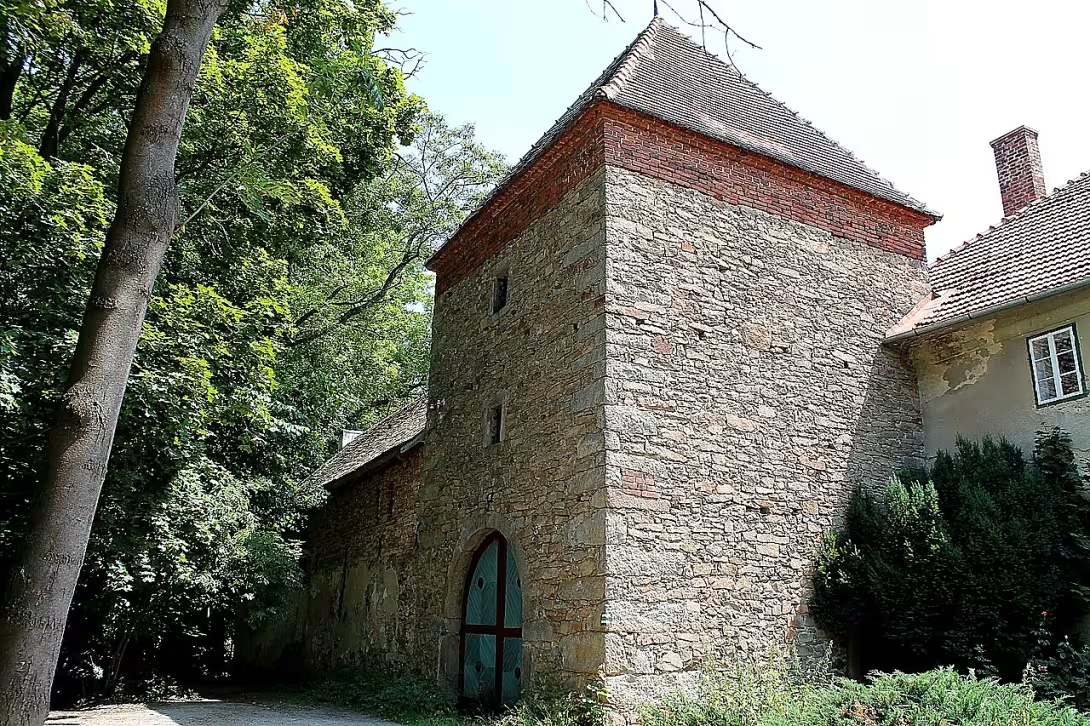
The area in Černíč in Jihlava is a historically valuable complex of water mill, which was created by reconstruction of the original medieval fortress. This monument, protected since 1972, represents a unique connection between the fortified courtyard and Renaissance mill operation situated under the dam of Černíč pond.
The water fort stood on the river Moravian Dyji probably in the 14th century. In the second half of the 16th century the object underwent a major transformation and was adapted to a water mill with a saw. This development reflected the expansion of economic courts and technical buildings in the Czech countryside.
The architectural whole consists of two wings - a residential building and an economic part - which connects the walled tower. It is located in the north-western part of the yard, it has arm corners and a passage with a valed vault. The living building is single storey, stands on a suspect and has a smooth facade with a rolled-up saddle roof. The economic wing east of the tower also ends the profiled crown ledge. Dendrochronological research confirmed the age of saws from 1766 to 1767 and stables from the turn of 1927 and 1928.
From the beginning of the 17th to the end of the 19th century the mill was held by the families of Jonah and Procházková. Around 1930 the area was owned by Otokar Šmejkal. In 1767 the building was hit by a massive fire followed by a reconstruction. In the past, it resembled a boulder on the top of a tower with an annual renewal.
The technical equipment of the mill has undergone significant development. While in 1874 it had four compositions, a grate and a saw driven around to the top water, in 1930 there was already a Francis turbine of 35 HP output. The water was brought into the turbine fountain with an embossed drive, which runs around the fortress and runs right under the tower.
Today the premises in Černíč are an important piece of evidence of historical economic construction and technical art of our ancestors. Visiting this place offers an opportunity to explore the changes in rural architecture and traffic that have adapted over the centuries to the needs of the time.
Historical milestones
- 1767
- The mill fire and subsequent tower reconstruction.
- 1930
- Operation of the mill equipped with the Francis turbine 35 HP.
- 1972
- The building is declared a cultural monument of the Czech Republic.
Architectural development
The original water fort was adapted to mill operation in the 16th century. The area consists of two wings of buildings connected by a wall tower with armored corners and a cove in the passage. Dendrochronological research confirmed the age of saws from 1766 / 1767 and stables from 1927 / 1928.
Historical events
1767: Large mill fire followed by reconstruction. 1972: Registration in the state list of cultural monuments.
Owners
From the beginning of the 17th century to the end of the 19th century rodina Jonášových - Procházková, around 1930 Otokar Šmejkal.
Points of interest
- The area in Cernich was created by rebuilding the original medieval fortress into a water mill. - The tower in the north-western part of the court has armored corners and a passage with a valley. - Dendrochronological research confirmed the age of the saws from 1766 to 1767 and the stables from the turn of 1927 and 1928. - In 1767, the building was hit by a massive fire followed by a reconstruction. - In 1930, Francis's 35 HP turbine was operating in the mill, with water flowing into the turbine fountain with the drive flowing directly under the tower.
Guide
Show guide text
This text was created by artificial intelligence and has not been editorially reviewed. It may contain inaccuracies.
Welcome to Blacksmith. You are standing right in front of an area that has layers of centuries and tells the story of a change of function, power and everyday work. In front of you is a complex of buildings that can act as a quiet economic courtyard at first glance, but if you look closely, you will see traces of a much older and different world. Note above all how the whole area is situated under the dam of Černich pond. It was water that was the key element of this place from the beginning, first as an impenetrable barrier, later as a tireless engine for local crafts.
Let us now return together in time to understand what really happened here. Imagine this place in the 14th century. It wasn't a mill at the time, it was a water fort. At that time, the water around the pond was a strategic element of defense. The fortress served as a safe port and a symbol of the power of the local masters who, safe behind the water walls, controlled the surrounding countryside. It was the time of the knights and the walls, when security and ininvulnerability were a priority. But as time progressed, the needs of society changed. In the second half of the 16th century, there was a fundamental change. The defensive character of the fort has ceased to be a priority and the need for economic development has taken place. It was at this time that the original medieval fortress was converted into a water mill with a saw. This transition from weapons to the mill wheel is a fascinating testimony about how society was changing in our regions.
Now pay attention to the architecture itself that you see before you. The area consists of several buildings, which are dominated by residential buildings and various economic objects. But the most important element to look at now is the characteristic tower in the northwest part of the yard. This tower is probably the most significant remnant of the original fortress. Notice its armored corners, which provide stability and monumentality to the building. If you look at the base of it, you'll see a passage through the vaulted vault. Try to imagine how many cars with wheels or wood have passed through here in the last few hundred years. It is this arch that is a silent witness to the thousands of common days that have taken turns here. The whole complex is connected in this way to effectively use the current of water from the pond that powered the mill wheels and saw.
However, this site was not only a collection of stone and wood, but mainly the home of people who breathed in his life. The history of the mill is closely linked to families that have worked and maintained operation here for generations. Among them were rodina Jonášových and rodina Procházkových, who left their trail here. Later, Otokar Šmejkal was connected to the site. These people were not only owners, but rather guardians of traditions, who had to understand both the milling technique and the operation of the saw and at the same time combat the adverse influence of moisture and water, which fed them, but at the same time slowly undermined the foundations of their homes.
When we say mill, we often get idyllic images, but the history of this place was full of dramatic events. Let's stop at 1767. This year, the site was consumed by a devastating fire. Fire is the greatest enemy for wooden buildings and mills, and the disaster at that time was considerable. It was because of this fire that a subsequent rebuilding of the tower that you see before you had to be carried out. It is fascinating that even such painful events leave a trail in architecture that we can study today.
In addition to the fire, we are accompanied by fascinating science. You might be wondering how we know exactly when parts of the buildings were created. The answer lies in dendrochronology, which is a method of dating with the use of wood rings. It is this research that has revealed the truth about the age of the roofs. Scientists have confirmed that the roofs of the saw dates from 1766 to 1767, which corresponds exactly to the time after the fire. On the contrary, the roof stables are much newer, dating back to 1927 and 1928. It's incredible that the wood itself in these buildings keeps an accurate record of time and when any piece of material was cut out of the forest.
If we move on to newer history, we'll get to 1930. At that time the mill was no longer just about traditional craft, but it started using modern technology. The mill was equipped with Francis' turbine back then. It had 35 horsepower output, which at the time represented a significant technological leap. The turbine has enabled more efficient use of water energy and has modernised the entire production process. Imagine the noise and vibrations that had to go through the area when the turbine was running at full power and the mill was working at full power.
All these layers of time, from the medieval fortress to the Baroque reconstruction to the industrial innovation of the twentieth century, have made this place a unique monument. This is why the building was declared a cultural monument of the Czech Republic in 1972. It is protected as an important proof of historical economic construction. It's a place where defense architecture meets with practical use of nature.
Now that you know the story of this place, I suggest you go through the premises in peace and quiet. Try to perceive the atmosphere of the place where the water meets the stone. Look at that tower again, touch its surface and imagine the people who lived here hundreds of years ago. Feel the contrast between the mass of the vault and the light flowing water under the pond dam.
This area in Chernič is not just a building, it's a book opened in time. Each element, from the armoured corners of the tower to the old roofs of the barn, is one word in this story of survival, adaptation and work. Thank you for accompanying me on this short journey through history. You are now fully entrusted with the space. Explore it, perceive its silence, and let yourself be carried away by the images of what morning awakening was like in the seventeenth century or the noise of the turbine in 1930. I wish you a pleasant rest of the tour and a beautiful day spent in the embrace of history. Goodbye.
Tips for visitors
The best time to visit is during late spring or early autumn, when the surroundings of Černíčský pond are the most photogenic and the weather wishes to walk along the river Moravian Dyje. At these times the complex is surrounded by lush greenery or colorful leaves, which underlines the historical atmosphere of the former water fortress.
If you travel by public transport, check the current connection to the village with available search engines. The roads in the area are suitable for hiking, so we recommend choosing fixed shoes suitable for the field.
For photography we recommend using soft light during the morning or shortly before sunset, when the pond level and the river Moravská Dyje shine beautifully. The best shots can be obtained from the bank of the pond, where the silhouette of historical buildings of the mill and the fort will stand out in contrast to the water surface.
In the vicinity of the monument is located the picturesque village Černíč, which offers a quiet environment for families with children. The walk around Černíč pond is easy and suitable for smaller children who can observe water birds and nature in the immediate vicinity of the historical complex.
When visiting with children, we recommend taking a snack and a drink with us, as refreshments may not always be provided on the premises. Do not forget the repellent and headgear, especially if you plan to stay longer in the vicinity of the water areas and bows around the river.
Frequently asked questions
Can the monument be visited?
Some buildings of this kind are open for guided tours, others serve another purpose or are privately owned. We have not verified whether and when this monument is open – please ask the operator.
What are the opening hours and admission?
We have not verified the opening hours or admission. Current information is published by the operator.
Where is the monument?
Location: Kraj Vysočina. The map on this page shows the exact spot.
Why is the monument protected?
It is listed in the Central List of Cultural Monuments of the Czech Republic as a cultural monument (register no. 1000129331).
Businesses nearby
Do you run a restaurant, accommodation, shop, museum, rental, wellness or other visitor service near this monument? Show yourself directly to the people heading to it — this is how they will see you in the app and on the web:
Events nearby
Zdroj akcí: otevřená data měst a obcí ČR (Národní katalog otevřených dat) a kalendář akcí Národního památkového ústavu.
Nearby
Obec Černíč, řeka Moravská Dyje, Černíčský rybník.
Accommodation nearby
Trips and activities nearby
Guided tours, tickets and activities nearby from GetYourGuide
Affiliate link: if you buy from the partner, we may receive a commission. The price for you does not change.
Search tours and activities →Themed route
1. Municipality of Cernič, village, ideal place to start a trip. 2. Blacksmith pond, water area, offers a quiet environment to rest by the water. 3. the river Moravská Dyje, a river, provides a picturesque route in nature. 4. Fortress (mill), historical monument, represents the main destination of the trip.
Seasonal recommendations
Spring: In spring, the fortress is surrounded by flowering shrubs and trees that create a vibrant and attractive green framework for historical construction. Sun rays are reflected on newly grown leaves, which gives the atmosphere a mild temperature and freshness. Visit the fort in the early spring season, when it is not yet hot noon, so you can enjoy a quiet walk without excessive crowds. Good clothes should include helmets and sun protection, as even in spring days the sun may prove strong.
Summer: In summer, the fortress of its liveliest glare grows. Long and warm days provide ideal conditions for tours, while evening visits can be illuminated by charming rays of sun setting beyond the horizon. Although this is the most popular period for tourists, we recommend you arrive in the morning or in the evening to avoid traffic peaks. Remember warm clothes and plenty of drinking, especially during the summer months.
Autumn: Autumn brings the golden shine of leafy trees, creating a unique atmosphere full of peace and beauty. Sunshine days are ideal for tours, while cooler evenings offer a lovely light. Visit the fort in the pre-Christmas weeks when the atmosphere is full of mild calm and romance. Dress in several layers because the temperature can be variable between sunny days and cold evenings.
Winter: Winter brings a quiet and peaceful atmosphere to the fortress. Freezing weather can highlight architectural details of the construction, while snow sheets provide a view of the painted frame of nature. Visit the fort in the early afternoon when it is open to visitors, and make sure you have warm clothes, wet flooring shoes and winter weather protection. Winter visit offers a peaceful and intimate experience without excessive crowds.
Visualizations and artistic views


The visualisations are generated by artificial intelligence and serve as inspiration.
Photos from the area
Real photos taken near the monument


Zdroj a licence jsou uvedeny u každého snímku.
Tips from visitors
No tips yet. Be the first!
Log in and add your tip.
Sources and literature
Photos: Harold / CC BY-SA 3.0 — Wikimedia Commons. The author and licence also appear when you hover over the image.
Faktickým podkladem tohoto textu byl článek na Wikipedii, jehož autory jsou přispěvatelé Wikipedie. Článek je dostupný pod licencí CC BY-SA 4.0.
Location on the map

Příběhy a pověsti
Legendy, pověsti a příběhy spjaté s touto památkou
Fotografie návštěvníků
Zatím žádné fotografie. Buďte první, kdo přidá fotografii z návštěvy!
Log in a přidejte svou fotografii nebo hodnoťte.
Za ověřenou návštěvu v aplikaci získáte víc bodů — poznáme podle GPS, že jste na místě.
Reviews and comments