



Tvrz (1000131620) Fortress
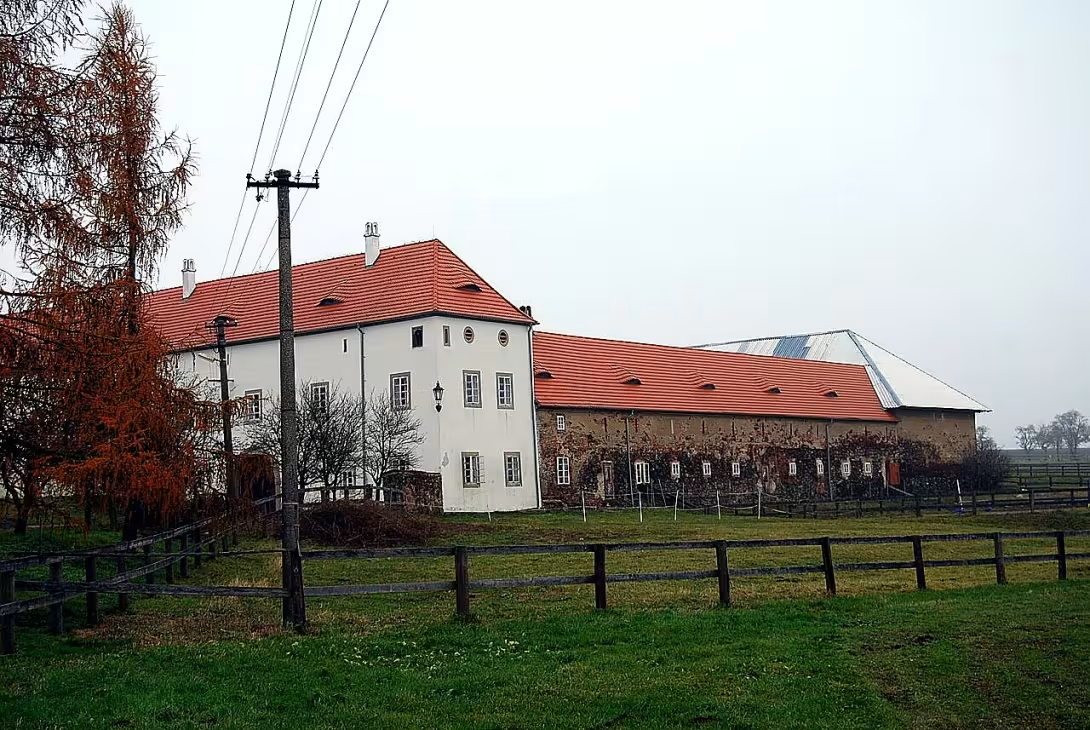
Drahenička's fortress is a two-storey Renaissance building, which together with three other lower buildings form a closed square area with a side of approximately 70 metres. It is located in Drahenicky, in a slightly wavy agricultural landscape between the towns of Sand and Rožmitál under Tremšín. This object is significant as evidence of the gradual transformation of the original mansion into a farm yard over several centuries.
The history of this place dates back to the 14th century, when Drahenice was first explicitly mentioned in 1323. This year Jan Lucemburský donated this area to Peter from Rožmberk. Originally, the fortress was part of the manhood belonging to the royal chateau of animal town. The existence of the backyard in the small Drahenice was recorded in the middle of the 16th century, when the original Renaissance building was probably built from a quarry stone.
In 1577 there was a significant change in the possession of property when the owner of the animal estate Kryštof ze Švamberka sold the entire village and with the court of Mrs. Voršile Vrabská of Bukov. After this sale, the fort was no longer a mansion, but was used for agricultural purposes. By gradually expanding with other economic buildings, today's form of square court was created.
The architecture of the building shows traces of different building periods. The original Renaissance fortress was built from a quarry stone and its parts are still visible to this day in the western corner of the yard, where historical building structures and fragments of the original painting decoration are preserved above the arched spaces on the ground floor. The Baroque adjustments are confirmed by 1717 on one of the stodols, while the economic objects contain classical flat vaults. The northern corner of the court was definitively closed until the reconstruction of the northeast wing in the mid-19th century.
Since 1963, the building has been protected historically. The whole area and adjacent pastures are privately owned and are used for horse breeding, which means that the monument is not commonly accessible to the public. The construction condition is satisfactory as a partial reconstruction has been carried out involving the repair of roofs, roofs, windows, doors and doors. The facade of the main northwest wing with the arched passage and follow-up squid has also been repaired. In the vicinity there is a photovoltaic power plant, a chateau in Drahenice, a church in St. Kliment and a bell tower in Mirovice or a chateau in Březnice with a Renaissance garden and an English park.
The fortress in Drahenicky represents an interesting example of architectural transformation from the mansion to the agricultural complex. It is a place where it is possible to monitor the rotation of Renaissance, Baroque and Classicist elements within one area.
Historical milestones
- 1323
- First explicit mention of Drahenice in connection with the gift of Jan Luxembourg Peter from Rožmberk.
- 1577
- Sale of the settlement Drahenička and the court of Kryštof from Švamberk Mrs. Voršile Vrábská from Bukov.
- 1717
- Baroque building modifications confirmed by the year on the barn.
- 1963
- The object was declared to be protected by memory.
Architectural development
The original Renaissance fortress was built of quarry stone. Baroque modifications are documented on a barn from 1717, while economic objects contain classical flat vaults. The northern corner of the court was closed by the reconstruction of the northeast wing in the mid-19th century.
Historical events
In 1323, Drahenicky was specifically mentioned for the first time; in the middle of the 16th century, the original Renaissance fortress of quarry stone was probably established; In 1577, the Voršile Vrábská estate of Bukova was sold.
Owners
In 1323 Jan Lucemburský donated Draheničky to Peter from Rožmberk; In 1577 Kryštof ze Švamberka sold the settlement and the court of Voršile Vrábské z Bukova.
Points of interest
- Drahenička's fortress is a two-storey Renaissance building, which together with three other lower buildings form a closed square area with a side of approximately 70 meters. - The history of this place dates back to the 14th century, when Drahenice was first specifically mentioned in 1323. - In 1577 there was a significant change in property ownership when Kryštof ze Švamberka sold the entire settlement with the court of Mrs Voršile Vrabskaya of Bukov. - The architecture of the building shows traces of various construction periods, including Renaissance, Baroque and classical elements. - Since 1963, the building has been protected historically.
Guide
Show guide text
This text was created by artificial intelligence and has not been editorially reviewed. It may contain inaccuracies.
Welcome to the gates of history, which are now welcoming you with an unusual and closed form. You are standing right in front of a unique space that immediately consumes you with its geometric harmony and calm. In front of your eyes, there is a square area of Drahenice's fortress. Feel the strange atmosphere that exists here, the feeling of stability and strength that radiates from these walls. The main point of your view is the massive, two-storey Renaissance building that dominates the whole focus with its height and stability. Together with three other objects that are slightly lower, this complex creates a solid, closed structure that now literally surrounds you. See how these buildings complement each other and how they form together a whole unit whose sides are approximately 70 metres long. This space is not just a set of structures, it is a closed world that separates you from the surrounding vibrations and allows you to enter another era.
However, in order to truly understand why this place looks just like this and what weight it carries, we must, together with you, travel far into the past. Imagine a period when power games took place on a completely different scale. The history of this place dates back to the 14th century. The first explicit mention of Drahenics appears in our records in 33. But it wasn't just random writing in the chronicle. This was an important political act which, at the time, affected the fate of the region. King Jan Lucemburský gave this land to Peter of Rožmberk. Thus, Drahenice became a solid part of the wider manor of the royal chateau of Bědkov. Imagine the time when this area was strategically important and closely linked to the power center around animal town. At that time, this building was not just an ordinary residence, it was a symbol of ownership, political influence and stability in the rapidly changing world of the Middle Ages.
But now look around you and try to realize the architecture you have right in front of you. Feel the interesting transformation this compound has been through over the centuries. What you see is the result of the gradual expansion and adaptation of objects to the needs of different times. The main Renaissance building you're looking at represents the core of the entire complex. Notice its two-story structure and the way it meets other lower objects. This whole square yard was shaped to create safe and functional space. It's fascinating to see the character of the place change. What once served as mansions and representative premises has gradually turned into a farm yard with various economic buildings over the long centuries. This transformation was visible in every newly added piece, in every extension of the objects that today form this closed unit. Even the Baroque building modifications that touched the barn in the eighteenth century, for example, left their mark in architecture and gave the site another layer of history. Although the function of the buildings was changed from a noble mansion to a practical economic area, the basic face and Renaissance spirit of this place remained.
However, the history of this place is not only about stones and raspberries, but above all about people who were masters here and who determined the rhythm of life here. Let's think about the fates that have crossed paths here in the past. Every era here has left its mark through the names of powerful personalities. In 15 hundred and seventy-seven, one of the most important changes occurred in the holding of this headquarters. Kryštof ze Švamberka then decided to sell the village of Drahenička with the whole court. The buyer was Mrs. Voršila Vrábská z Bukova. Imagine the woman who took responsibility for this vast and important area at the time. Every name we name here today, from the royal John of Luxembourg to the noble families that lived here, added a new piece to the story. These personalities here were not just names in documents, they were people who made decisions about fate, who managed their property here and who built their power here.
What is really fascinating about this place is the constant and relentless transformation that took place beneath the surface of ordinary life. How did it happen that the Renaissance residence was able to move so successfully into the role of the agricultural court while maintaining its dignity and solid structure? Is there any special force in this square arrangement that now holds you so firmly in your arms? This closure of the complex creates a sense of separation from the outside world, as if the time within these 70-metre sides ran a little differently than in the surrounding fields and forests. It is a space that has managed to maintain its integrity despite changes in political regimes and economic conditions. Even in modern times, when the object was declared to be remembered in the year one thousand nine hundred sixty-three, this space retained its unique identity.
But now I will no longer hold you in my words. I suggest you continue your search and be carried away by the atmosphere of this place. Take a look at the individual buildings in detail, perceive their structure, perceive their quiet presence and try to imagine the lives of the people who lived here, worked and made decisions hundreds of years ago. The precious girls have many things to say if you look at them with a more attentive eye. Let yourself be carried away by the history that is felt in every corner of this square yard. Thank you for your visit and we believe that this short journey has helped you better understand the importance of this place. We'll wait you out again on the next trip through history.
Tips for visitors
The best time to visit is late afternoon, when the low sun best highlights the details of the Renaissance facade of the main two-story building. For photographers are the most interesting views from the inner square area, which creates a set of four buildings.
We recommend taking with us comfortable shoes suitable for movement in the historical area and enough drinking.
Within the short trip in the surroundings we recommend visiting the chateau in Drahenice, the church of St. Kliment with bell tower in Mirovice, the chateau of Březnice with Renaissance garden or nearby photovoltaic power plant.
We recommend families with children to focus on exploring a closed courtyard and the idea of what life looked like in the manhood of the royal chateau of Bědkov in the past.
Frequently asked questions
Can the monument be visited?
Some buildings of this kind are open for guided tours, others serve another purpose or are privately owned. We have not verified whether and when this monument is open – please ask the operator.
What are the opening hours and admission?
We have not verified the opening hours or admission. Current information is published by the operator.
Where is the monument?
Location: Středočeský kraj. The map on this page shows the exact spot.
Why is the monument protected?
It is listed in the Central List of Cultural Monuments of the Czech Republic as a cultural monument (register no. 1000131620).
Businesses nearby
Do you run a restaurant, accommodation, shop, museum, rental, wellness or other visitor service near this monument? Show yourself directly to the people heading to it — this is how they will see you in the app and on the web:
Events nearby
Zdroj akcí: otevřená data měst a obcí ČR (Národní katalog otevřených dat) a kalendář akcí Národního památkového ústavu.
Nearby
There is a photovoltaic power plant, a chateau in Drahenice, a church in St. Kliment and a bell tower in Mirovice or a chateau in Březnice with a Renaissance garden.
Accommodation nearby
Themed route
1. Chateau in Drahenice (Type: Chateau) - A tour of the historical residence in its authentic environment. 2. Fortress (Type: Fortress) - The main destination of the trip is medieval architecture. 3. Church of St. Kliment and bell tower in Mirovice (Type: Church and bell tower) - Visit of sacral monuments and historical bell tower. 4. Březnice chateau with Renaissance garden (Type: Chateau with Renaissance garden) - A tour of the Renaissance complex and its beautiful garden.
Seasonal recommendations
Spring: During the spring season, the fort is lit with a quiet light, which gives the impression of a calm bloom. Flowers and trees begin to bloom, which enriches the surrounding landscape with colours and releases a sweet green perfume smell. This time of year is ideal for visiting the fortress due to mild weather, which allows long walks around historical walls without discomfort at extreme temperatures. We recommend visiting a monument in the early afternoons, when crowds can still be avoided and a quiet atmosphere can be enjoyed. Clothes should be of a medium nature, with possibly attached to a warm jacket or raincoat for colder spring days.
Summer: For years, the fortress is exposed to long sun days that highlight its historical architecture and bring a lively atmosphere. More visitors may appear this season, especially in the main summer season when the days are longest. We recommend arriving on the fort early in the morning or later in the evening to avoid heat and crowds. Clothes should be light and light, with sun protection such as a hat or hat, and water for hydration should not be missing.
Autumn: In autumn, the fortress is transformed into golden and red shades, adding a romantic element to its historical walls. Quiet weather is ideal for a tour without worrying about the sun or rainy floods. This period can also be suitable for visiting in advent time, when the atmosphere becomes even more fascinating. We recommend wearing warmer clothes and perhaps an umbrella, because autumn can bring sudden weather. Visit the fort in the early afternoons for the best experience.
Winter: The winter season offers a unique view of the fortress, where its architecture is illuminated by light and shadow, and can be covered with a light layer of snow. In the winter months the opening time is often shorter, so it is important to know about the current times before the visit. The atmosphere is calm and quiet, which allows you to enjoy historical walls in mild weather without crowds. Hot clothes, including shirts, jackets and moisture protectors, are essential for comfort during the visit.
Visualizations and artistic views


The visualisations are generated by artificial intelligence and serve as inspiration.
Tips from visitors
No tips yet. Be the first!
Log in and add your tip.
Sources and literature
Photos: Richenza / CC BY-SA 3.0 — Wikimedia Commons. The author and licence also appear when you hover over the image.
Faktickým podkladem tohoto textu byl článek na Wikipedii, jehož autory jsou přispěvatelé Wikipedie. Článek je dostupný pod licencí CC BY-SA 4.0.
Location on the map





Příběhy a pověsti
Legendy, pověsti a příběhy spjaté s touto památkou
Fotografie návštěvníků
Zatím žádné fotografie. Buďte první, kdo přidá fotografii z návštěvy!
Log in a přidejte svou fotografii nebo hodnoťte.
Za ověřenou návštěvu v aplikaci získáte víc bodů — poznáme podle GPS, že jste na místě.
Reviews and comments