



Usedlost Jezerka Theatre building
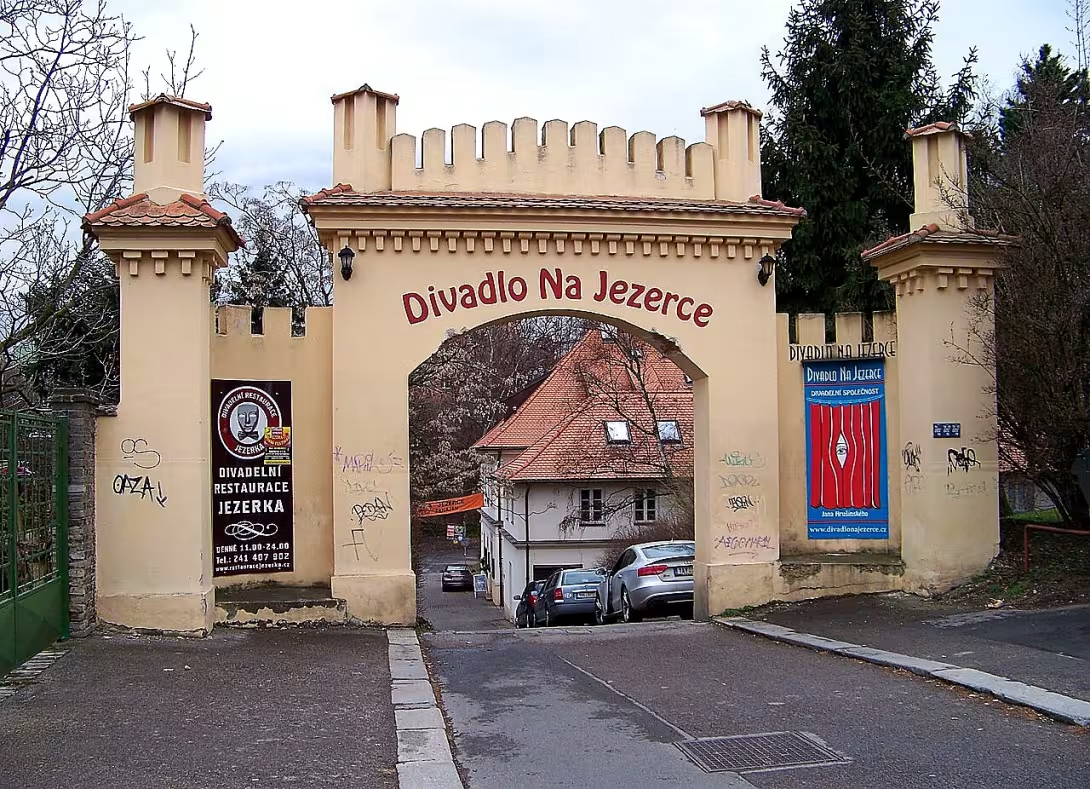
Usedlost Jezerka is a cultural monument in Prague 4-Nuslím, located in the park of the same name. Originally here in the Middle Ages there was the Šustrová vineyard. Later, the building became a castle and inn, since 2003 the Theatre Na Jezerce has been based here.
The oldest history of the place is related to Šustrová vineyard, after which the estate acquired its original name. The building belonged to the historical Michle cadastre and had a descriptive number 68. The current name of the Lake was obtained only in 1835 in connection with the conversion into a castle. In the middle of the 19th century, the artist Josef Navrátil painted the representative rooms, although these paintings were not preserved.
The building was single-storey and walled. On the ground floor there was a large guest room, two federal and beer rooms, kitchen and toilets, while on the first floor there were five rooms. A large dance and theatre hall was added to the building. The economic complex consisted of a building with stables for horses and cows, storerooms, refrigerators and a cellar for vegetables and potatoes. A musical pavilion was placed above it and an attachment for the staff was attached. The park with a total area of 16696 m ² was supplemented by a garden recital, a tennis court, a shed and a Baroque terrace in the slope with a vineyard above the pond.
In 1912 Michle bought the building in half with the Michele Civic Reserve. While the municipality planned to set up the park and parceldown the rest of the land, the Civic Reserve sold its part to Rudolf Zárub, who operated the restaurant with a café. Later, in 1924, Rudolf Zárub and Michle rented his half. There have been major changes after 1945. In 1948 the National Administration was imposed on Záruv's part, the restaurant was cancelled and the building was eventually acquired by the municipality Nusle. As part of the clean-up, the interior equipment was sold out. The valuable tile stove from the workshop Václav Jan Sommerschuh was awarded the Museum of Arts in Prague.
In the 1970s, the Lake was converted into a Czechoslovak TV studio. This stage left significant traces in the area: the pond was buried, parking was created and the Baroque terrace was replaced by a concrete balcony for musicians, from which only the basement remained. Since 1975, programmes have been broadcast from the studio. The Lake Studio and later Politics for everyone. After 1989, half of Zárubov's assets were recovered as part of the restitution, which was purchased in 1999 by the city of Prague 4. There was a reconstruction for cultural use in which the wine bar, garden restaurant, theatre hall and park were restored.
Water is an important part of the complex. Since time immemorial, there has been a clean spring, which in 1361 was surrounded by Vyšehrad capital and replaced wood pipes leading to Vyšehrad by stone. This spring was probably buried in the 1920s. In the park there is also a commemorative slab of maple tree from 1815. There are rumors about the place. Chronicle Václav Hájek of Libočan mentions that Princess Libuše visited the top of the lake and water from the spring was to fill her bath. Another legend speaks of a stone table on which Prince Přemysl was raised before he was transferred to Prague Castle.
Today the estate is a fully functional cultural centre, where the Theatre Na Jezerce has been active since 2003. The building presents a combination of historical architecture and renovated park space.
Visiting this place offers the opportunity to meet the history of Prague estates and rumours about the beginnings of the Czech state. It is an ideal goal for anyone who is looking for a peaceful environment associated with a cultural program.
Historical milestones
- 1361
- The Vyšehrad chapter had the well examined and replaced the wooden pipes with stone.
- 1835
- Rebuilding the estate into a castle and acquiring the name of the Lake.
- 1912
- The building was bought by Michle municipality in half with the Michele Civil Reserve.
- 2003
- The Theatre of the Lake began to reside in the estate.
Architectural development
The original estate was converted into a castle with representative rooms in 1835. Later, the building was expanded with a dance and theatre hall and an economic building. In the 1970s, there were interventions linked to the operation of television studios, including the flooding of the pond and the construction of a concrete balcony.
Historical events
1835: Rebuilding the estate into a castle and changing the name to Lake. 1948: Putting the national administration on the part of the estate. 1970: Rebuilding the building into a television studio.
Owners
municipality of Michle (1st half of 20th century), Rudolf Záruba (private operation), Municipality of Nusle (after 1948), Municipality of Prague 4 (since 1999)
Points of interest
- In the Middle Ages there was a village called Šustrová, after which the estate got its first name. - In 1361, Vysehrad's capitula surrounded the spring and replaced the wooden pipes leading to Vysehrad by stone. - In the park there is a commemorative maple-leaf platinum from 1815. - Rumor has it that Princess Libuše visited the top of the lake and water from the spring was to fill her bath. - Another legend speaks of a stone table on which Prince Přemysl was raised.
Guide
Show guide text
This text was created by artificial intelligence and has not been editorially reviewed. It may contain inaccuracies.
Welcome to the Nusla. You are standing in front of the lake estate, which will welcome you with its peaceful atmosphere at first glance. In front of you you can see an object that today serves as a home for the theatre, but which carries layers of many centuries of Prague history. It's surrounded by a beautiful park where you can feel a leak from the urban rush. Feel this space as a place where nature meets culture and where every stone tells its own story.
Let us now look together at how this place was created and how it evolved. The history of this complex dates back to the Middle Ages. Originally there was no castle, but a large vineyard called Šustrova. According to this name, the estate was known in the early days. Vinohradship was very important in this part of Prague and it was the wine that determined the character of this place. However, the use of the land changed over time. The vineyard became an estate which later took the form of a castle with an inn and a cafe where people rested and enjoyed the surroundings.
Now that you're looking at the facade of the building and its overall appearance, notice the harmony the object emits. Even though we see today the result of the extensive repairs that brought the building back to its cultural mission, there is a sense of a different era. In the year of the thousand eight hundred thirty-five there was a significant reconstruction, which turned the estate into a castle and at this very time it acquired its current name Lake. Take a look at the overall composition of the building and imagine how a coffee shop worked here in the nineteenth century, where people traveled from the city centre to relax in green.
Now pay attention to the people who have been linked to this place. The personalities who left their trail here include Josef Navrátil or Václav Jan Sommerschuh, for example. The history of the building is closely linked to local communities. In the year one thousand nine hundred and twelve, the building was purchased by the municipality of Michle together with the local civil reserve, which shows how important this place was for the locals. However, the building has also undergone more modern stages. In the second half of the twentieth century there was a TV studio of Czechoslovak Television, which made the building a centre of modern broadcasting, before the theatre Na Jezerce started to reside here in the year two thousand three.
Now let's move on to something that might surprise you. There is a secret in this compound that is much older than the castle itself. If you think about the name Lake, you'll find that water plays a major role in this place. Already in the year one thousand three hundred sixty one something very important happened here. In fact, Vysehrad's capitula has surrounded the source to protect it. At that time the water was transported through wooden pipes, but it was here that these old pipes were replaced with stone pipes, which led the water to Vysehrad. It is fascinating to think that water was flowing beneath your feet and around this park, which was crucial for life on the Schehrad rock.
Besides the water, there's another living witness to history in the park. Look around you at the trees. In the park there is a commemorative maple tree, which was planted in the year one thousand eight hundred and fifteen. This tree has been standing here for more than two centuries and has seen everything happening in the estate, from the time of the castle to the television studio to today's theatre performance.
And if we are to talk about mysteries and legends, we cannot forget one of the most famous characters in Czech legends. Rumor has it that Princess Libuše herself visited this place. Imagine the scene where this ancient oracle walked these lunes and perhaps here, in the silence of the Nusel gardens, she sought inspiration for her vision of the future Prague. It is a beautiful contrast when we realize that in the same place there is a myth about Libuše with modern theatre and television studio technology.
Now that you know the story of the lake estate, from its medieval vineyard to the stone water ducts to the current cultural center, I suggest you take a walk in the park for a while. Feel the smell of green, look at the majestic platinum and let the atmosphere of this unique place consume you. Explore the surroundings calmly and slowly, let your thoughts float between history and the present.
Thank you for coming through the history of the lake estate. We hope you enjoyed this short trip in time. We wish you a pleasant rest of the day in Nusla and enjoy everything this beautiful place offers you. Goodbye.
Tips for visitors
The best time to visit is when the park is rich vegetation, for example spring or summer. In these times the surroundings are the most lively and offer a pleasant environment for walks.
You can reach the place by car or public transport. We recommend checking current information about connections and travel via internet search engines.
For shooting we recommend using soft light during the morning hours or before sunset. The best angles for pictures of buildings can be found in the park area.
Until the visit we recommend to wear comfortable shoes suitable for walking in nature. For families with children, this place is suitable for quieter outdoor activities in the natural environment.
In the area within 30 minutes' walk you can visit the Park Jezerka, follow the course of the Botič stream or go to the historical place Vysehrad.
Frequently asked questions
Can the monument be visited?
Some buildings of this kind are open for guided tours, others serve another purpose or are privately owned. We have not verified whether and when this monument is open – please ask the operator.
What are the opening hours and admission?
We have not verified the opening hours or admission. Current information is published by the operator.
Where is the monument?
Location: Nusle. The map on this page shows the exact spot.
Why is the monument protected?
It is listed in the Central List of Cultural Monuments of the Czech Republic as a cultural monument (register no. 1000153194).
Businesses nearby
Do you run a restaurant, accommodation, shop, museum, rental, wellness or other visitor service near this monument? Show yourself directly to the people heading to it — this is how they will see you in the app and on the web:
Events nearby

Zdroj akcí: otevřená data měst a obcí ČR (Národní katalog otevřených dat) a kalendář akcí Národního památkového ústavu.
Nearby
Park Jezerka, potok Botič, Vyšehrad.
Accommodation nearby
Trips and activities nearby
Guided tours, tickets and activities nearby from GetYourGuide
Affiliate link: if you buy from the partner, we may receive a commission. The price for you does not change.
Search tours and activities →Themed route
Here is the design of the thematic route:
1. Vyšehrad (historical monument) - The trip begins in this elevated place, offering beautiful views of the city and deep history. 2. Flood Boot (water flow) - Follow the walk along the trough of this stream, which leads the way towards the goal. 3. Lake Park (green space) - A quiet area for relaxing in nature just before entering the estate. 4. Usedlost Jezerka (theatre and construction) - The main destination of the journey where architecture can be admired and cultural performances can be visited.
Seasonal recommendations
In spring, the surroundings of the estate awaken to life, and the gardens begin to bloom. Soft spring light highlights the details of architecture and fresh green creates a fresh frame around buildings. We recommend shoes suitable for wet ground and visit in the morning when the air is the cleanest.
In the summer months it dominates a space full of sun and rich green trees that provide a pleasant shade. The atmosphere is warm and relaxed, ideal for summer walks. It is advisable to choose light, breathable clothes and visit the place in late afternoon to avoid the greatest heat.
Autumn brings leaves and melancholy spirits to Nusel Gardens. The low sun falls at a sharp angle and creates deep shadows, which gives the memory a mysterious look. Practical is to carry a lighter jacket or coat against the wind and hit the road when the colors of nature are most intense.
Zimą makes the estate calm and quiet, often accompanied by freezing air and silence. The landscape around it is free of leaves, which allows better perception of the construction itself and its line. Hot clothing, lining of clothing and fixed footwear with anti-slip soles are essential, especially in periods where the surface can be covered with snow or frost.
Visualizations and artistic views

The visualisations are generated by artificial intelligence and serve as inspiration.
Photos from the area
Real photos taken near the monument


Zdroj a licence jsou uvedeny u každého snímku.
Tips from visitors
No tips yet. Be the first!
Log in and add your tip.
Sources and literature
Photos: ŠJů (cs:ŠJů) / CC BY-SA 3.0 — Wikimedia Commons. The author and licence also appear when you hover over the image.
Faktickým podkladem tohoto textu byl článek na Wikipedii, jehož autory jsou přispěvatelé Wikipedie. Článek je dostupný pod licencí CC BY-SA 4.0.
Location on the map

Příběhy a pověsti
Legendy, pověsti a příběhy spjaté s touto památkou
Fotografie návštěvníků
Zatím žádné fotografie. Buďte první, kdo přidá fotografii z návštěvy!
Log in a přidejte svou fotografii nebo hodnoťte.
Za ověřenou návštěvu v aplikaci získáte víc bodů — poznáme podle GPS, že jste na místě.
Reviews and comments