



Nuselský most Bridge
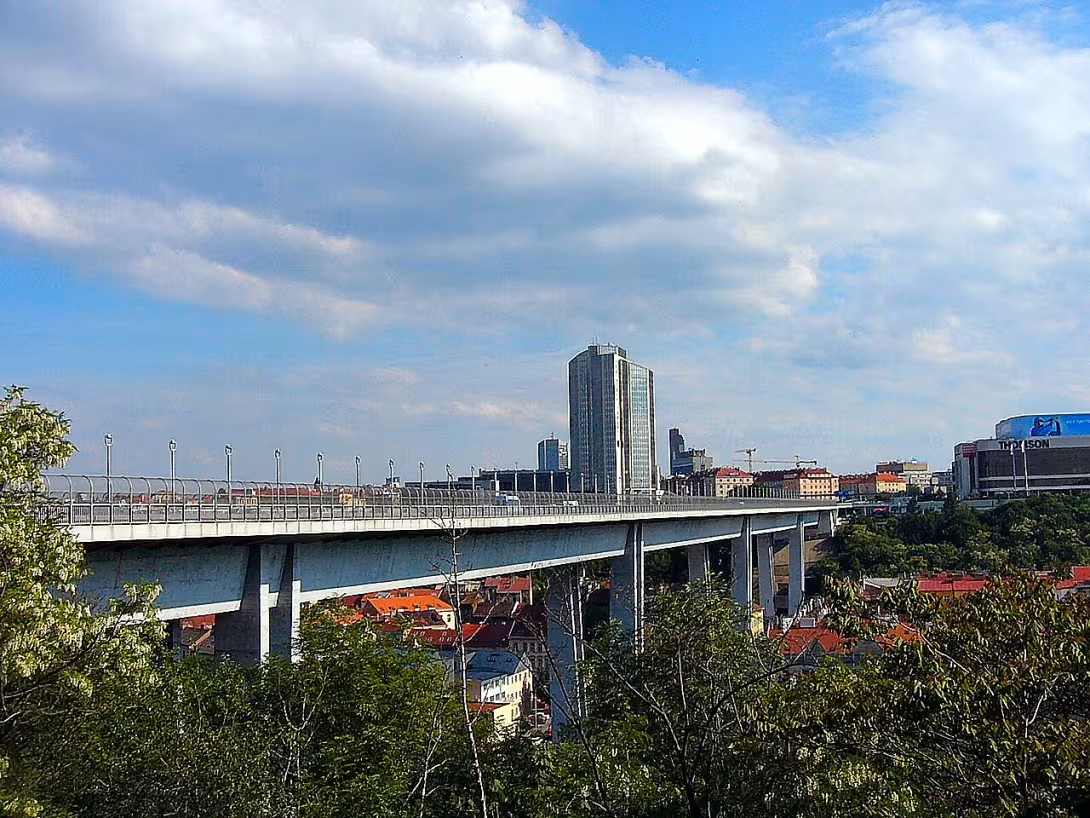
Nuselský most is a pretension concrete construction in Prague, which surpasses the Nusel Valley and connects Pankrác with the city centre. The construction was completed in 1973. Thanks to the unique concept, including the inner tube for the metro and the upper six-lane magistrate, it represents one of the most busy transport hubs in the Czech Republic.
The bridge of the Nusel Valley was already considered in the early 20th century. The design of the reinforced concrete bridge was developed after the creation of Czechoslovakia by Stanislav Becyne. In 1927, there was a competition that came up with 28 proposals. Already in 1932, the possibility of setting up a lower bridge for a speedway was envisaged. However, the implementation took place only in connection with the massive construction of settlements on the Pankrák plaza in the 1960s. The construction itself began in 1967 by demolishing 17 houses at the bottom of the valley. The original design of the subsurface tram was changed to metro in 1968, which required additional modifications to the construction.
The object is 485 meters long and 26.5 meters wide. It consists of five fields of prestressed concrete with four pillars. The average height above the valley is 42.5 metres. The inner tube for metro lines C has a trapezoidal cross-section and walls 30 to 110 centimetres thick. The project involved architects and engineers Jan Vítek, Miroslav Sůra, Robert Bucháček, Svatopluk Kobr, Vojtěch Mikhalek and Stanislav Hubička.
From 1975 to 1989, the construction was called the bridge of Klement Gottwald. The operation started on 22 February 1973 and the long-distance transport on the Magistrates was fully operational on 30 April of the same year. Since May 9, 1974, subway sets started to come through the tube. Due to the higher weight of Soviet Ečs subway sets, compared to originally planned vehicles, a special steel grid of 822 tonnes had to be installed into the bridge. This was repaired in 1997 due to fatigue cracks and the bridge underwent extensive reconstruction for CZK 288 million between 2012 and 2017.
Technical attractions include a static load test from November 1970, where 66 tanks from the cancer regiment were used. The dynamic test was subsequently performed with rocket engines. During the measurement of the steel grid, there was a complication: the grid worked as an antenna for radio broadcasting. The measurements had therefore to take place on the night when the station Prague did not send.
Today, Nuselský most is a key link, on which thousands of cars and metro line C pass daily, transporting over 300,000 people in 750 sets. The bridge surpasses the Park of Folimanku, the Botič stream and the railway line. For visitors, it is an important example of the engineering construction of the 20th century, which fundamentally influenced the form of Prague transport. This monumental technical construction, even after decades, fulfils its irreplaceable role in the infrastructure of the capital.
Historical milestones
- 1967
- The construction of the 17-house demolition block in Nusel Valley.
- 1970
- Perform static load test 66 tanks.
- 1973
- Completion of bridge construction.
Architectural development
The bridge has a reinforced concrete beam structure with a chamber section and four pillars. The inner tube for metro has trapezoidal cross-section and walls up to 110 cm thick. The construction was realized as a monolithic construction made of prestressed concrete.
Historical events
1967: Construction of demolition houses in the valley. 1970: Static load test using 66 tanks. 1973: Completion and commissioning of the bridge.
Points of interest
- The bridge is a pretension concrete construction that has an internal tube for the subway and the upper six-lane magistrate. - 66 tanks were used in a static loading test in 1970 and the dynamic test was performed using rocket engines. - The steel grid in the bridge worked as an antenna for radio transmission, so the measurements had to take place at night. - Due to the higher weight of the subway sets, a steel grid of 822 tonnes had to be installed into the construction. - Construction started in 1967 by demolition of block 17 houses at the bottom of the valley.
Guide
Show guide text
This text was created by artificial intelligence and has not been editorially reviewed. It may contain inaccuracies.
Welcome to the Nusel Bridge, one of the major monuments of our city, which links history to modern life. You are standing in front of an impressive concrete structure, which, with its five fields, turns elegantly over the Nusel Valley. The bridge is not only a key transport artery for cars and metro, but also a reminder of the architectural ambitions of the 20th century.
Let's dive into his history. In 1967, construction of this bridge started, which required demolition of the entire block of houses in the Nusel Valley. The goal was to create a robust connection between Pankrack and the centre of Prague. After several years of intensive work, including a static load test carried out using 66 tanks in 1970, the bridge was completed in 1973. In this test, not only was the weight and pressure used; dynamic load has also been tested by rocket engines.
Now look up at the bridge, which is a pretension concrete structure with an internal tube for a subway and a six-lane magistrate. These elements not only ensure its functionality, but also show the architectural talent of those who designed it - Stanislav Hubička, Robert Buchaček, Jan Vítek and Miroslav Suru. Their work here is visible to anyone who looks at the bridge.
The interesting thing about this place is the steel grid in the bridge, which once worked as an antenna for radio broadcasting. This detail resembles the time when technology and communication were on the threshold of new possibilities.
The key personality associated with this monument is Klement Gottwald, after which the bridge wore a name between 1975 and 1989. His influence on Czech history is reflected in this architectural work.
So let's look at more details and prepare for the next steps of your city survey. Nuselský most is just the beginning of a journey through the history and architecture of Prague. Let you enjoy your walks and discover the other beauty of our city. Now, if you have time, let's keep looking.
Tips for visitors
For the best experience of tour of concrete construction I recommend a visit during the golden watch before sunset, when light highlights massive pillars and construction geometry. For photography is ideal angle from the bottom of the valley, where the monumental bridge above the Botič stream stands out. Get ready to walk in the field under the bridge and camera with wide-angle lens to capture the entire range. In the immediate vicinity you can visit the Park Folimanka, which offers a quiet environment for relaxation and interesting views of the pillars, or take a walk around the Botič stream. Families with children will appreciate the space of the Park Folimanka, where there is enough space for the movement and observation of the technical building from a safe distance, and the Nusel Reform Schools with historical architecture are nearby.
Frequently asked questions
Can the monument be visited?
This is a structure in a public space that can usually be seen from outside free of charge. We have not verified that this particular one is freely accessible.
Where is the monument?
Location: Nusle. The map on this page shows the exact spot.
Why is the monument protected?
It is listed in the Central List of Cultural Monuments of the Czech Republic as a cultural monument (register no. 1999994993).
Businesses nearby
Do you run a restaurant, accommodation, shop, museum, rental, wellness or other visitor service near this monument? Show yourself directly to the people heading to it — this is how they will see you in the app and on the web:
Events nearby

Zdroj akcí: otevřená data měst a obcí ČR (Národní katalog otevřených dat) a kalendář akcí Národního památkového ústavu.
Nearby
Park Folimanka, potok Botič, stanice metra Vyšehrad, nuselské reformní školy.
Accommodation nearby
Trips and activities nearby
Guided tours, tickets and activities nearby from GetYourGuide
Affiliate link: if you buy from the partner, we may receive a commission. The price for you does not change.
Search tours and activities →Visualizations and artistic views

The visualisations are generated by artificial intelligence and serve as inspiration.
Photos from the area
Real photos taken near the monument

Zdroj a licence jsou uvedeny u každého snímku.
Tips from visitors
No tips yet. Be the first!
Log in and add your tip.
Sources and literature
Photos: User:Jklamo / CC BY-SA 2.5 — Wikimedia Commons. The author and licence also appear when you hover over the image.
Faktickým podkladem tohoto textu byl článek na Wikipedii, jehož autory jsou přispěvatelé Wikipedie. Článek je dostupný pod licencí CC BY-SA 4.0.
Location on the map

Příběhy a pověsti
Legendy, pověsti a příběhy spjaté s touto památkou
Fotografie návštěvníků
Zatím žádné fotografie. Buďte první, kdo přidá fotografii z návštěvy!
Log in a přidejte svou fotografii nebo hodnoťte.
Za ověřenou návštěvu v aplikaci získáte víc bodů — poznáme podle GPS, že jste na místě.
Reviews and comments