






Váchalův mlýn Water mill
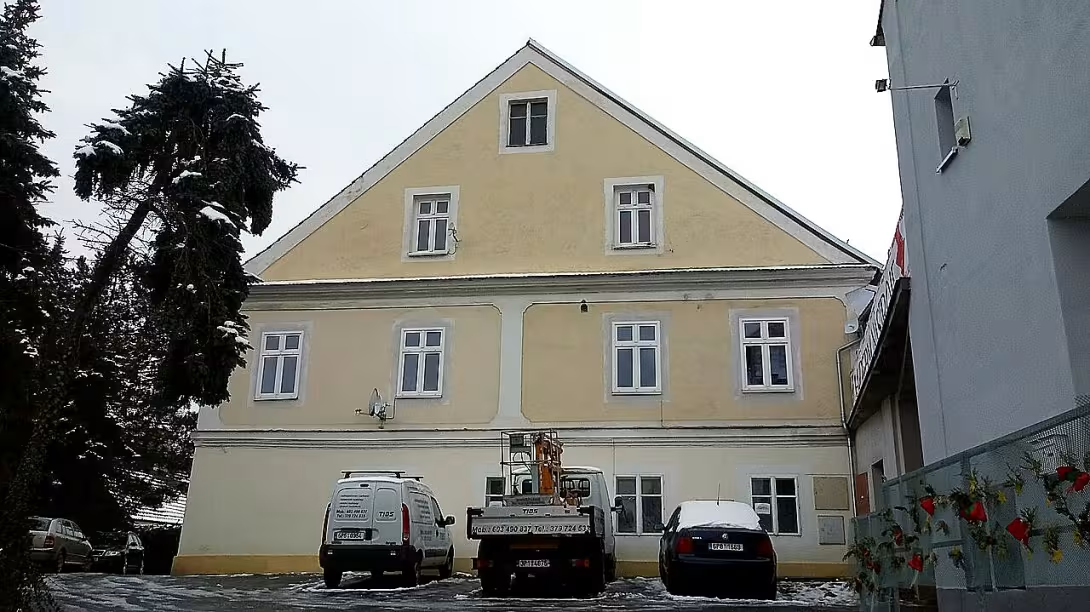
Váchalův mlýn, located in the centre of Domažlic west of Peace Square, is a historic water mill with a rich past. Originally powered by water from a driving wheel from the river Zubrona, it served not only for traditional mill activities, but also offered additional services such as bleaching laundry. The mill underwent several proprietary changes and reconstructions, especially after a tragic fire in 1936, when there was a sad accident with the fall of the shield. It is remarkable by its history and architectural changes that reveal changes in the industrial era in Bohemia.
The mill has roots dating back to the beginning of the 16th century, when it was mentioned in the sales agreement between the seller Lvik and the new owner Václav Jindra. This period represents the beginning of its history as an important industrial building in the region. There were significant changes in the 19th century when Jan Pavlík had a large reconstruction according to the plans of Václav Kostný in 1839. This modernization was part of the broader trends of the industrial revolution, which also affected the way many traditional crafts operate in the Czech Republic.
The mill passed through several stages of development. After the fire in 1936 another reconstruction was carried out during which a tragic accident occurred with the fall of the shield. In the 1950s there were changes related to the removal of mill equipment and the use of the premises for company needs, when the West Bohemian mills Domažlice were set up. Despite these changes, only the first floor of the mill preserved the original character.
The mill underwent several proprietary changes, starting with Lionfish and Václav Jindra in the early 16th century. Jan Pavlík became owner in 1839, whose son Antonín took over the mill subsequently. After a number of other changes, the mill was bought in 1915 by the Czechoslovak bank Prague and sold a year later to Váchal's husbands who held it until nationalization. After several further changes to the owner, the mill was returned to the family of the original owner in the 1990s.
The mill became the site of key events such as the establishment of a water brand on 23 October 1877 and a tragic accident during the reconstruction after the fire in 1936. These events reflect not only technological but also social changes in the region.
Today Váchalův mlýn is a monument with rich history and architectural heritage. Although the original equipment was removed, it stands as a witness to industrial development in Bohemia. It's a place worth visiting for those who want to understand the history of local industry and architecture. If you visit the mill, you will learn about its past and appreciate its importance for regional heritage.
Historical milestones
- around 1500
- First mention in the purchase agreement between Lion-O and Václav Jindra
- 1839
- Extensive reconstruction of the mill under the direction of Jan Pavlík
- 1877
- Establishment of a water label on 23 October
- 1915
- Purchase of the mill by Czechoslovak bank Prague
- 1936
- Fire and tragic accident with shield fall during reconstruction
- 1950s
- Removal of mill equipment and use for company needs
Architectural development
The mill underwent several stages of development, beginning with its mention in the sales contract from the beginning of the 16th century to extensive reconstruction in 1839 according to the plans of Václav Kostný. After the fire in 1936 another reconstruction was carried out during which a tragic accident occurred. In the 1950s there were changes related to the removal of mill equipment and the use of the premises for company needs.
Points of interest
- Váchalův mlýn is a historic water mill located in the centre of Domažlice. - The mill was originally powered by water from a drive from the Zubrona river and served for traditional mill activities and additional services such as bleaching. - The mill has roots dating back to the beginning of the 16th century, when it was mentioned in the sales agreement between Lvik and Václav Jindra. - In the 19th century there was a significant reconstruction according to the plans of Václav Kostný, which he had made Jan Pavlík in 1839. - After the fire in 1936 another reconstruction was carried out during which a tragic accident occurred with the fall of the shield.
Guide
Show guide text
This text was created by artificial intelligence and has not been editorially reviewed. It may contain inaccuracies.
Welcome to Domazlice. Right now you're standing in front of one of the most interesting historical points in this city, in front of Váchal's mill. Before we go into his story, try to stop for a moment and perceive the atmosphere of this place. You are in the heart of the city, just a short walk from Peace Square, in the part that still bears traces of ancient times when life was a rhythm of water and work. In front of you is a building that, although no longer serves to grind grain, still carries a strong spirit of the past and reminds us of a time when the mill was the heart of the local economy.
Let's go back deep into the past together to understand how this object came into being. The roots of Váchal's mill date back to the beginning of the 16th century. This is an incredible time when the first mention of this place appeared in a purchase agreement between two men named Lviček and Václav Jindra. Imagine those ancient times when trade was different and the mill was an absolutely necessary place for every person around. This mill was not just an ordinary building, it was a living organism that was driven by the power of nature.
Notice its position. The mill was strategically located so that it could use the water from the drive that led directly from the river Zubrona. This river was crucial for mill activities. It was thanks to the constant flow of water that the mill could perform its main role - grinding. But Váchalův mlýn was much more than just a place to make flour. It was also a place of additional services which were very important at the time. One of them was bleaching laundry. Imagine the process of using laundry for these purposes near running water, which required not only water strength, but also expertise and patience.
Now pay attention to how the building changed over the centuries. Even though we do not know today the names of the particular architects who would design this construction, we can see that it has undergone many changes. Each generation of owners tried to adjust the mill to meet the needs at the time. One of the most important moments was the extensive reconstruction in the year one thousand eight hundred thirty-nine. That's when Jan Pavlík oversaw the process. It was thanks to his work that the mill acquired a form that allowed it to flourish again. Another important step was the establishment of a water brand, which happened in October of the year a thousand eight hundred seventy-seven. This waterworks was an important control point which ensured correct measurement and use of watercourses.
Over time, however, the ownership of the mill changed. In the year a thousand and nine hundred and fifteen it was purchased by the Czechoslovak bank Prague, which shows how important this property was even in a more modern era. But history isn't always about flourishing and building. We must also touch on the sadder chapters that are linked to this place.
If you look at the structure of the building, you might start thinking about its details. It is important to know that in the year one thousand nine hundred thirty-six a truly tragic event took place here. During the reconstruction, there was a fire, followed by an accident, in which the building's shield fell. This event was very painful for the local community and left a deep mark in the history of the mill. It's a reminder of how fragile history can be and how unexpectedly things can change.
Within the history of the mill there are many names that deserve your attention. In addition to the mentioned Lion and Václav Jindry, we must remember the family of Pavlík. Jan Pavlík was a key figure for the 19th century reconstruction, but names like Antonín Pavlík or Ludvík Pavlík are also inseparably linked to this place. And, of course, we must not forget Váchal's husband himself, after whom the mill has its name today. Their family was one of those who left their mark in this place and helped keep the mill going in its later years.
The interesting thing that may surprise you is how the function of the mill changed completely during the twentieth century. A major decision was made in the 1950s. The mill facilities, the huge wheels and machines that were the heart of the operation, were removed. The mill was no longer a mill in the true sense. Instead, he started serving for the needs of a company. This transformation from traditional craft to industrial use is a typical example of how the world around us changes.
Today, when you're standing here, you see a building that survived fires, reconstructions and changes in political and economic systems. Even if you no longer hear the sound of grinding stones or see the movement of the water that drives the wheels, this building still speaks. They talk about the people who worked here, the families who lived here, and the power of the Zubrona River, which was their greatest ally.
If you look at the building, try to imagine in your mind what it looked like at the time of its greatest bloom. Imagine the noise of water, the smell of freshly ground flour and the constant movement of people coming here to serve. Váchalův mlýn is not just a wall and a roof, it is a record of human efforts and efforts to live in close proximity to nature.
Now, please continue your walk around this building. Look at its surroundings, perceive its presence in the urban landscape and try to find peace in its history. Domažlice has many other secrets and historical treasures waiting for you. Thank you for spending this moment with us and for being interested in the story of Váchal's mill. We wish you a beautiful continuing journey around our city and hope you enjoyed this short journey through history. Goodbye.
Tips for visitors
The best time to visit Váchal Mill is in the summer months when the weather is favourable and you can enjoy beautiful outdoor views. Visit him in the morning or in the evening for a lighter light that highlights historical architecture.
Parking can be found near Peace Square. For those travelling by public transport, the place is well accessible by bus or tram; Check the exact connection with an online search engine.
When visiting, bring suitable clothes, especially in the winter months. The protective glasses and the sun hat could be an additional element.
The best place for photography is at the mill itself, especially in periods when light is finely scattered, like morning or evening. Sunset provides a beautiful atmosphere for images.
In the vicinity of Váchal Mill is located the Square of Peace, which is suitable for a short walk and exploring local architecture. For families with children, this place is ideal for comfort and relaxation.
Businesses nearby
Do you run a restaurant, accommodation, shop, museum, rental, wellness or other visitor service near this monument? Show yourself directly to the people heading to it — this is how they will see you in the app and on the web:
Events nearby

Zdroj akcí: otevřená data měst a obcí ČR (Národní katalog otevřených dat) a kalendář akcí Národního památkového ústavu.
Nearby
🏰 Historic sites (89)
- Petr Hana 0.1 km
- Antonín Příhoda 0.4 km
- Antonín Steidl 0.5 km
- Božena Němcová 0.5 km
- Chodsko obětem nacismu 0.5 km
- Alois Jirásek 0.5 km
- Jaroslav Vrchlický 0.5 km
- Rodný dům Karla Matěje Čapka Choda 0.6 km
- Jakub Royt 0.6 km
- Dorka 0.6 km
- Karel Jaromír Erben 0.7 km
- Jindřicha Jindřicha 1.0 km
- Pomník Svobody 1.0 km
- Památník bitvy u Domažlic 2.5 km
- Kozinův statek 3.5 km
- Pamětní deska padlým 1914-1918 3.6 km
- Virgil Paul Kirkham 3.7 km
- Panna Marie 4.3 km
- Chodský pes 4.4 km
- Kozinův pomník 4.4 km
🍽️ Restaurants and dining (106)
- Moskyto 0.0 km Kozinova 46
- Hostinec Štika 0.0 km
- Bageterie DejSi 0.1 km
- U Golema 0.2 km
- Bowling U Pekla 0.3 km
- Jídelna 0.3 km
- Fit Café 0.3 km
- Xing Long 0.3 km +420379428307
- V Alejích 0.4 km
- Mazi kebab 0.4 km
- J&R Coffee 0.4 km
- Kovárna 0.5 km
- Asia bistro 0.5 km
- H2O jezte 0.5 km
- Restaurace Pivovar Domažlice 0.5 km Pivovarská 10 +420777 999 219 web
- Pivnice Domažlice 0.5 km +420 606 044 688
- Sokolský dům 0.5 km náměstí Míru 121 +420 379 720 084 web
- U sedmi andělíčků 0.5 km
- Restaurace Zubřina 0.5 km Hruškova 592 +420 379 768 957 web
- Hejtu 0.5 km
🏨 Accommodation (37)
- Penzion Viola 0.4 km
- Sokolský dům 0.5 km
- U Chodského Hradu 0.5 km
- U Chodského Hradu 0.5 km
- Hotel Zlatá včela 0.6 km náměstí Míru 131 web
- Zlatá Včela 0.6 km web
- Cafe Pension Tiffany 0.6 km náměstí Míru 131 web
- Konšelský Šenk Pension 0.7 km
- Pension u Martina 0.7 km
- Podveský mlýn 4.1 km
- Autokemp Babylon 6.4 km web
- Hotel Bohmann 6.4 km Babylon 11 +420 379 793 226 web
- Delta Podhájí autokemp 7.5 km
- Hotel Lesana 7.9 km +420 602 677 286 web
- Hotel Game 7.9 km
- Sádek 9.7 km +420773598481;+420379422899 web
- Černý Orel 10.1 km
- Penzion Apex 10.1 km +420 770 130 380 web
- Hotel Gurmán 10.1 km
- Pension Janka 10.2 km Vodní +420 379 734 377 web
🚲 Rentals and sport (16)
- TJ Sokol 0.3 km
- Aquacentrum Domažlice 0.5 km
- Podestát 0.5 km
- Sport pod Hradem 0.6 km
- Sport pod věží 0.7 km
- Start 0.7 km
- Ramala 0.8 km
- Turek 1.1 km
- Mrákov 4.8 km
- Babylon koupaliště 5.9 km
- Spartak Klenčí pod Čerchovem 6.7 km web
- koupaliště Podhájí 7.9 km
- Tělocvična - TJ Sokol Postřekov 8.7 km
- Na kobyle 9.5 km
- koupaliště 9.9 km
- koupaliště 11.1 km
🥾 Hiking and nature (177)
- Hanův park 0.2 km
- Modelová železnice 0.3 km web
- sady Antonína Příhody 0.4 km
- Steidlův park 0.4 km
- Na šibenici 0.9 km
- Na Bábě 1.0 km
- Malý Škarmaň 1.5 km
- Na Kole 1.6 km
- Velký Škarmaň 1.9 km
- Jalovčí 2.0 km
- Na zámku 2.4 km
- Dlouhá hora 2.4 km
- Baldovské návrší 2.5 km
- Veselá hora 2.5 km
- Dmout 2.9 km
- Dubová hůrka 3.1 km
- Boučkova skála 3.4 km
- Kubíčkova skála 3.6 km
- Přední skála 3.9 km
- Na skále 4.2 km
Accommodation nearby
Themed route
1. Váchalův mlýn, Water Mill. The main target that shows the history of grinding grain. 2. Tanks, area. Space directly at the building suitable for the observation of architecture. 3. Milk exhibition, exhibition. Here you can see historical machines and mechanisms.
Seasonal recommendations
Seasonal recommendation for visiting the historical monument. Monuments: Váchalův mlýn (water mill), Domažlice Status: preserved
In spring, the surroundings of the mill turn green and nature wakes up. The water in the tank is starting to flow more energetically and the air is very fresh. The lighting is fine and soft during this period, which is ideal for observing the details of the construction. I recommend visiting in the morning when there are even fewer people. Dress well to cope with variable temperatures between morning and day.
In summer there is most life and thick leaves of trees provide a pleasant shade. The sun shines the strongest, creating a bright and cheerful atmosphere. Due to the large number of visitors I recommend you come as early as possible in the morning to enjoy the quiet before the biggest noise. Get dressed lightly, put on your headgear and have plenty of water with you.
Autumn brings the colours of gold and fog, which lazily floats above the water surface. The atmosphere is calm and very soothing. It's the best time for those who want to escape the crowds and enjoy the silence. Prepare a waterproof jacket and tight shoes because the soil can be wet and slippery. The best is to visit a place in the afternoon when the sun shines below.
Winter brings silence and cold air. If snow falls, the mill looks like a fairy tale and everything is covered with a white layer. The light is weak in this period and the days are short, so plan to visit around noon hours. It is necessary to have very warm clothes, scarf and quality shoes because the proximity of water increases the feeling of cold.
Visualizations and artistic views

The visualisations are generated by artificial intelligence and serve as inspiration.
Photos from the area
Real photos taken near the monument


Zdroj a licence jsou uvedeny u každého snímku.
Tips from visitors
No tips yet. Be the first!
Log in and add your tip.
Sources and literature
Photos: Jan Macura / CC BY-SA 4.0 — Wikimedia Commons. The author and licence also appear when you hover over the image.
Faktickým podkladem tohoto textu byl článek na Wikipedii, jehož autory jsou přispěvatelé Wikipedie. Článek je dostupný pod licencí CC BY-SA 4.0.
Location on the map
Příběhy a pověsti
Legendy, pověsti a příběhy spjaté s touto památkou

Fotografie návštěvníků
Zatím žádné fotografie. Buďte první, kdo přidá fotografii z návštěvy!
Log in a přidejte svou fotografii nebo hodnoťte.
Za ověřenou návštěvu v aplikaci získáte víc bodů — poznáme podle GPS, že jste na místě.
Reviews and comments