



Vajgarský jez Water structure
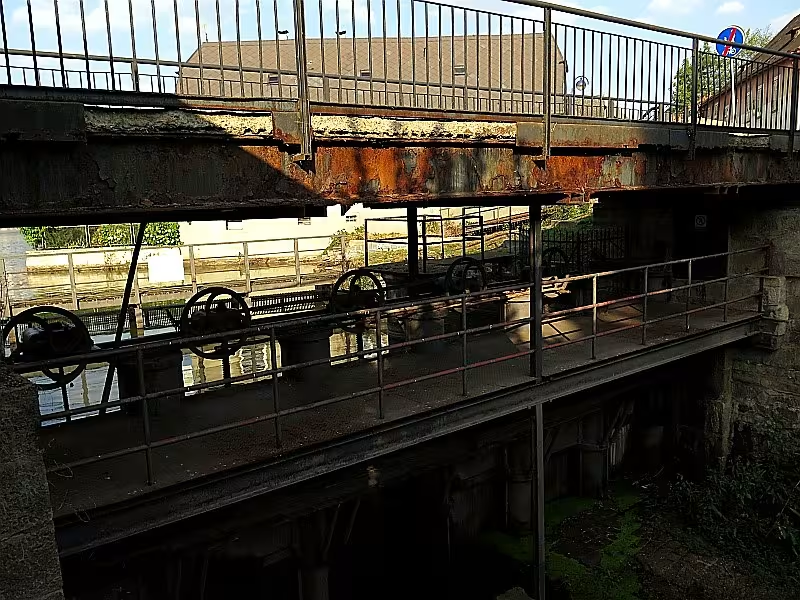
Vajgarský jez is a medieval water work from the 13th century, located on the Vajgar pond in South Bohemia. This important technical monument is used to regulate the pond level and it has acquired its present form during reconstruction in the 17th and 19th centuries. The building is a functional document of historical water management architecture in the location Jindřichův Hradec III.
The creation of the lake itself in the 13th century falls into the time of the great expansion of the pond industry in Czech countries. This era has brought about the creation of water works and the construction of technical installations in the landscape that served to manage water flows and water management. There are no detailed reports on specific historical owners, but the development of the building is closely linked to the expansion of the local pond network.
Technically, this object is a sophisticated complex designed to control water flow efficiently. Part of the eater is a challenge and a heifer swim. The appearance and construction of the work were formed gradually, and today's appearance was achieved thanks to extensive modifications in the 17th and 19th centuries. Above the course there is a bridge that provides transport and walking connections in this area.
The importance of the construction for the technical heritage was officially confirmed in the second half of the 20th century. In 1958, Vajgarský jez was recognised as a technical monument and in 1963 it was followed by its registration in the monument register.
This monument still performs its original function and serves to regulate the water level of the Vajgar pond. For visitors it represents a document of continuity of water-based construction from the Middle Ages to the New Ages. A tour of this functional water work offers an authentic view of the historical technical solution in the South Bohemian landscape.
Historical milestones
- 13th century
- The emergence of medieval water works during the expansion of the pond industry.
- 17th century
- Significant reconstruction and modification of the technical construction of the Jez.
- 19th century
- Extensive modifications by which the work gained its present form.
- 1958
- Official recognition of the building as a technical monument.
- 1963
- Writing a water work into a state landmark register.
Architectural development
The construction was built in the 13th century and was gradually modified in subsequent centuries. In the 17th and 19th centuries, the eatery underwent extensive reconstructions that gave it its present form.
Points of interest
- This medieval water work dates back to the 13th century and was created during the great expansion of the pond. - The current appearance of the building was obtained by modifications that took place in the 17th and 19th centuries. - This technical unit also includes an assignment and a heifer swim in addition to the actual course. - There is a bridge directly above the water section that provides both transport and walking connections. - The construction was recognised as a technical monument in 1958 and still performs its original function.
Guide
Show guide text
This text was created by artificial intelligence and has not been editorially reviewed. It may contain inaccuracies.
Welcome to the water. You're standing right where the power of the flowing river is combined with the wisdom of the human hands that have worked here for centuries. In front of your eyes, Vajgarský jez, a significant water work, is a solid part of this landscape. Feel the calm but constant movement of water flowing through the Hamer stream. You may only hear the sound of the current and feel the humidity, but know that right here, at this point, there is a constant process of regulating water that has deep roots in the ancient past. This view of water, how it spills over, and how it is rectified, is the first step towards understanding what you see here.
Let us now move further into time together and understand why this place was created. Imagine the period around the 13th century. This was the period when the pond industry began to develop massively in these Czech regions. People understood that water was the most valuable treasure and that they had to be able to control it in order to farm and breed fish. It was during this period, at a time of great expansion of these water farms, that this original medieval work was created. It was not just a random water head start, but a sophisticated system designed to ensure stability for the Vajgar pond. Although this construction may seem to you as part of the natural landscape, its origin is deeply human and technical. It was the result of a man's need to control the breeding power of the stream and use it for his benefit.
Now pay attention to what you see right in front of you. Even though the foundations of this place are hundreds of years old, today's form is the result of successive changes and adjustments that took place in later times. If you look at the structure, notice its complexity. You know that this building underwent major reconstructions in the seventeenth and nineteenth centuries. It's the modifications in these centuries that gave you the whole look that you can see right now. Notice the different elements that have to work together perfectly. You can see here the latch used to control the water level. It's a key element that allows people to decide how much water stays in the pond and how much they have to go on.
Next, look at the way the water is kept aside. Do you see a heifer swim? This is the part of the structure that ensures that water can flow even when the pond level is low. It's like a safety road for water so it never gets lost and the system works in less favourable conditions. And of course, in order for people to move through this water unit, there's a superstructure over it. This bridge is not only a path for pedestrians, it is an integral part of the entire technical complex. All of these parts, from the bay to the swim to the bridge, form one integrated and functional unit, which had to be designed with great precision to withstand water pressure and changing flooding.
You may be asking who was behind this construction. Even if we do not find the names of specific architects or builders in the historical records, we must realise that each of these modifications was the hand of masters who understood the water and materials of their time. These people in the 13th century worked without modern machines, only with what nature and their own skill offered. The later builders in the seventeenth and nineteenth centuries then followed their work, repaired it and extended its possibilities to meet the growing needs of mankind. It is a constant dialogue between generations that takes place right here in the stream of water.
But there is also something that may interest you and perhaps a little surprise. It's the incredible persistence of this place. Imagine this work has been standing here since the 13th century. It has surpassed hundreds of years of change, wars and climate problems. His importance was so great that in the year one thousand nine hundred fifty-eight he was officially recognised as a technical monument. This means that its value is not only practical, but also historical and scientific. A few years later, in the year one thousand nine hundred sixty-three, this water work was entered into the State Heritage Register. This is proof that even a simple thing like water regulation can be the treasure of the whole country. This building is not just a piece of technology, it is a living witness to history that teaches us how people managed to control their future through working with nature.
Now that you know more about what you see and why this place is so special, I suggest you continue your walk around the water. Feel the atmosphere of this place, listen to the sound of the stream and watch the water pour over different parts of the lake. Every detail you see here has its purpose and its history. Thank you for stopping by and paying attention to this historic monument. We wish you a wonderful journey and other interesting experiences while exploring the surroundings of Henry Hradec.
Tips for visitors
The best time to visit the Vajgar Jez is early morning or late afternoon light, when the sun's rays irradiate the surface of the Hamer creek and the historical surroundings. The morning mist above the water gives the place a unique atmosphere.
For transport to the technical monument you can use the walk from the center of Jindřichov Hradec. In the immediate vicinity there is a pond Vajgar and Hamer stream, from where easy access to the lake is possible on local paths for pedestrians.
Take a walk with you to the water part with you, with comfortable fixed shoes, because the banks of the creek may be wet. In warmer days, you can also use insect repellent and a small snack with a drink, as you will not find shops at the historic building.
For photography lovers, the best shots offer a view from the shore of the Hamer creek, where you can capture the historical technical design combined with the surrounding nature. The best light for images is during the golden watch before sunset.
In the immediate vicinity of the sights, families with children can take a walk around the Vajgar pond or follow the flow of Hamer creek. Children can discover water birds and natural corners within a few minutes' walk of the city centre.
Frequently asked questions
Can the monument be visited?
This is a structure in a public space that can usually be seen from outside free of charge. We have not verified that this particular one is freely accessible.
Where is the monument?
Location: Jindřichův Hradec III, Jihočeský kraj. The map on this page shows the exact spot.
Why is the monument protected?
It is listed in the Central List of Cultural Monuments of the Czech Republic as a cultural monument (register no. 1000159458).
Businesses nearby
Do you run a restaurant, accommodation, shop, museum, rental, wellness or other visitor service near this monument? Show yourself directly to the people heading to it — this is how they will see you in the app and on the web:
Events nearby

Zdroj akcí: otevřená data měst a obcí ČR (Národní katalog otevřených dat) a kalendář akcí Národního památkového ústavu.
Nearby
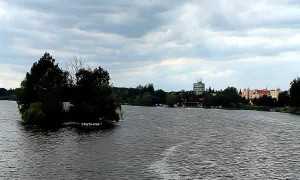
V bezprostřední blízkosti se nachází rybník Vajgar a Hamerský potok.
Accommodation nearby
Themed route
Thematic cruise route around the Vajgar Jez
1. Vajgarský jez (Water Works) Type: water construction Why is worth a visit: This historic water dam complex was built to regulate the flow of Hamer creek and provides a view of its peaceful waters. It is an ideal place to relax at the water and explore the history of local water works.
2. Vajgar pond Type: pond Why is it worth a visit: The pond is part of the system around the Vajgar Jez and offers opportunities to relax, look at wildlife or even a small cruise. Its peaceful waters are an ideal place to relax after visiting the lake.
3. Hamer creek Type: inflow Why is it worth a visit: This stream, which originates near the Vajgar Lake and the Vajgar pond, offers beautiful landscapes for walks. Its peaceful flow is an ideal place for relaxing and observing natural aquatic animals.
Visiting order: Start your route at the Vajgar Lake, where you will enjoy the view of his historic water work. Then you will look at the Vajgar pond, which offers a quieter environment for relaxing and observing nature. Finally, immerse yourself in the landscape of the Hamer creek, where you can explore its peaceful waters and surrounding green areas.
This route offers a combination of historical and natural attractions that are ideal for a day's visit.
Seasonal recommendations
Spring: Vajgarský jez offers beautiful views of flowering shrubs and trees that come to life after winter sleep. The sun rays illuminating the water work add a magical shine to it. This time is ideal for those who are looking for a quiet moment, as the crowds increase until the main summer season. We recommend clothes suitable for mild weather, while it is good to have a choice of something warmer for a colder afternoon. The best time to visit is in the morning or later in the day.
Summer: In summer, Vajgarský jez becomes a popular destination for local and tourist alike. Yet the atmosphere is full of life and joy. It is recommended to visit early in the morning so that visitors enjoy milder temperatures and avoid peak hours. Clothes should be light and light, sun-ready and perhaps even a rain apron for sudden storms.
Autumn: In autumn the Vajgarský jez becomes melancholic beauty, when tree leaves turn into living colors. The atmosphere is calmer and nature offers breathtaking views for lovers of photography. Visitors enjoy a slower pace as a result of less frequent visitors and milder weather. It is recommended to wear clothes suitable for colder days, with the addition of a warm apron or sweater to protect against storms. The best times are morning and late in the day.
Winter: The winter visit to the Vajgar Jez offers a unique view, when the water works are transformed under a light cover of snow. The atmosphere is calm and quiet, allowing you to enjoy the solitude and beauty of the room. Moreover, open times are usually shorter due to winter conditions. We recommend warm clothes, including fur and hat to protect yourself from cold. Visiting in the morning is ideal because sunlight can improve the visual impression of snow cover.
Visualizations and artistic views


The visualisations are generated by artificial intelligence and serve as inspiration.
Photos from the area
Real photos taken near the monument


Zdroj a licence jsou uvedeny u každého snímku.
Tips from visitors
No tips yet. Be the first!
Log in and add your tip.
Sources and literature
Photos: Sovicka169 / CC BY-SA 4.0 — Wikimedia Commons. The author and licence also appear when you hover over the image.
Faktickým podkladem tohoto textu byl článek na Wikipedii, jehož autory jsou přispěvatelé Wikipedie. Článek je dostupný pod licencí CC BY-SA 4.0.
Location on the map


Příběhy a pověsti
Legendy, pověsti a příběhy spjaté s touto památkou

Fotografie návštěvníků
Zatím žádné fotografie. Buďte první, kdo přidá fotografii z návštěvy!
Log in a přidejte svou fotografii nebo hodnoťte.
Za ověřenou návštěvu v aplikaci získáte víc bodů — poznáme podle GPS, že jste na místě.
Reviews and comments