



Kostel svatého Václava (Jindřichův Hradec III) Church
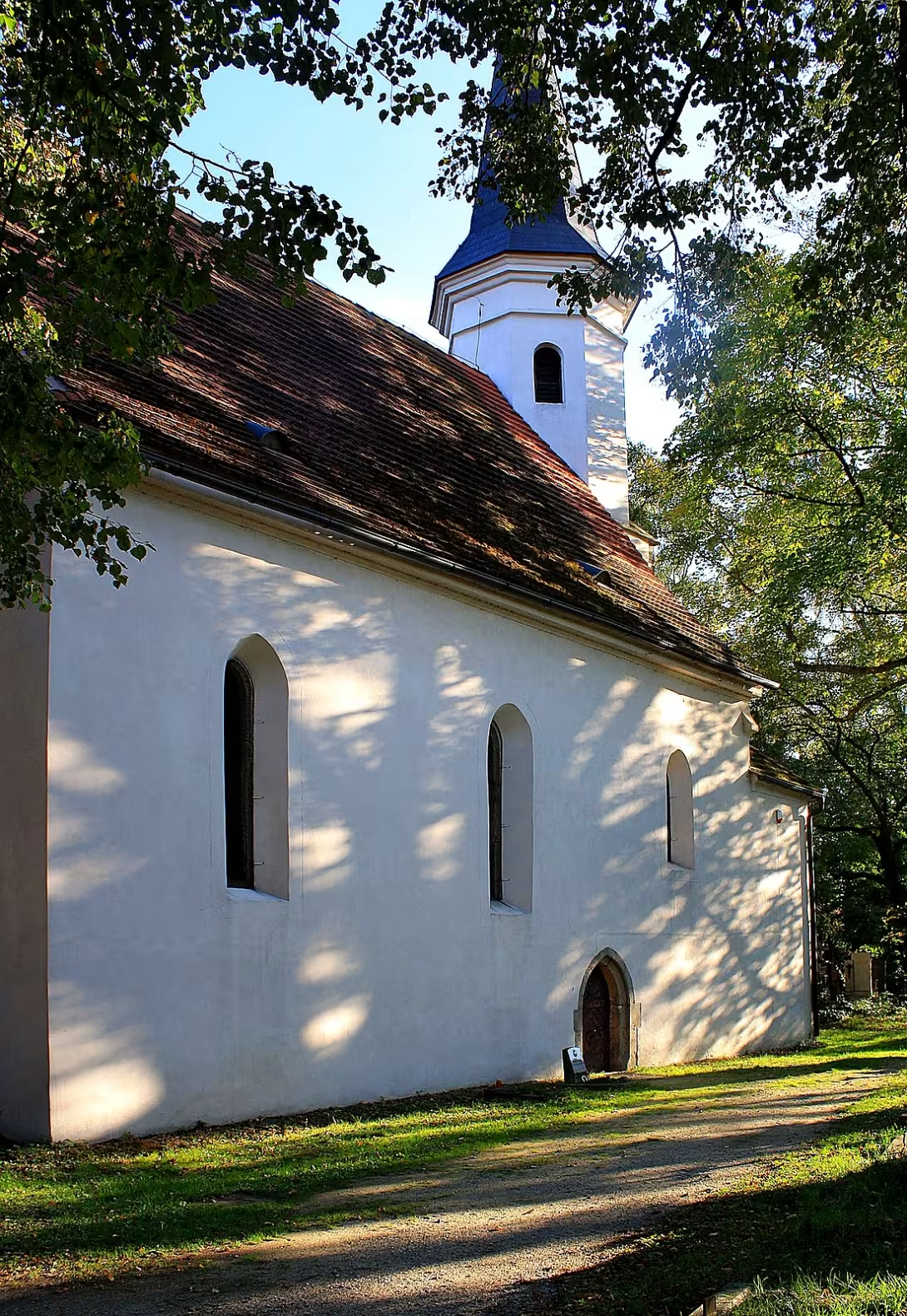
The church of St. Wenceslas stands in the suburb of Jindřichov Hradec south of its centre. It is a single-boat church protected as a cultural monument of the Czech Republic, which dates back to 1399 when the first mention of its existence comes.
The construction was built as Gothic. In the second half of the 15th century, the Franciscan who took care of the church settled here. The following century, however, brought decline - during the 16th century the church was not properly maintained and gradually decayed. A major breakthrough came in the early 17th century when the Jesuits repaired it in 1606. But their efforts weakened the disaster in 1618, when the church was burned by General Dampier's army. But the pimples got used to sudden twists: in 1621 he had a renewal, in 1647 he had a new main altar. But the great fire of the city in 1801 caused great damage - the church was almost completely destroyed. The long road to its rediscovery was closed only in 1991, when it received the entire restaurant.
The construction features an interesting architecture. The presbytery is created in the form of a pentagon with a rib arch of Gothic style. The facade is dominated by a four-sided tower that turns into an eight-sided tower on the top floor. An open chapel with 19th century mural is adjacent to the tower. The exterior is decorated with many tombstones with figural relief.
The interior deserves attention mainly thanks to details. The statue of St. Wenceslas probably dates back to 1647. The church is also equipped with coloured windows that provide pleasant lighting. Four altar paintings were painted by Bedřech Kamarít and dates back to 1866, adding the value of art in the 19th century to the church.
The cemetery at the church served as a burial ground until the 20th century and commemorates the long ages of use of the place. Today, by its history and architecture, the church is a testament to the complicated history of Henry Hradec and the godly life of his inhabitants.
Then and now
Drag the slider to compare how the landmark may have looked when it was built with the view today.
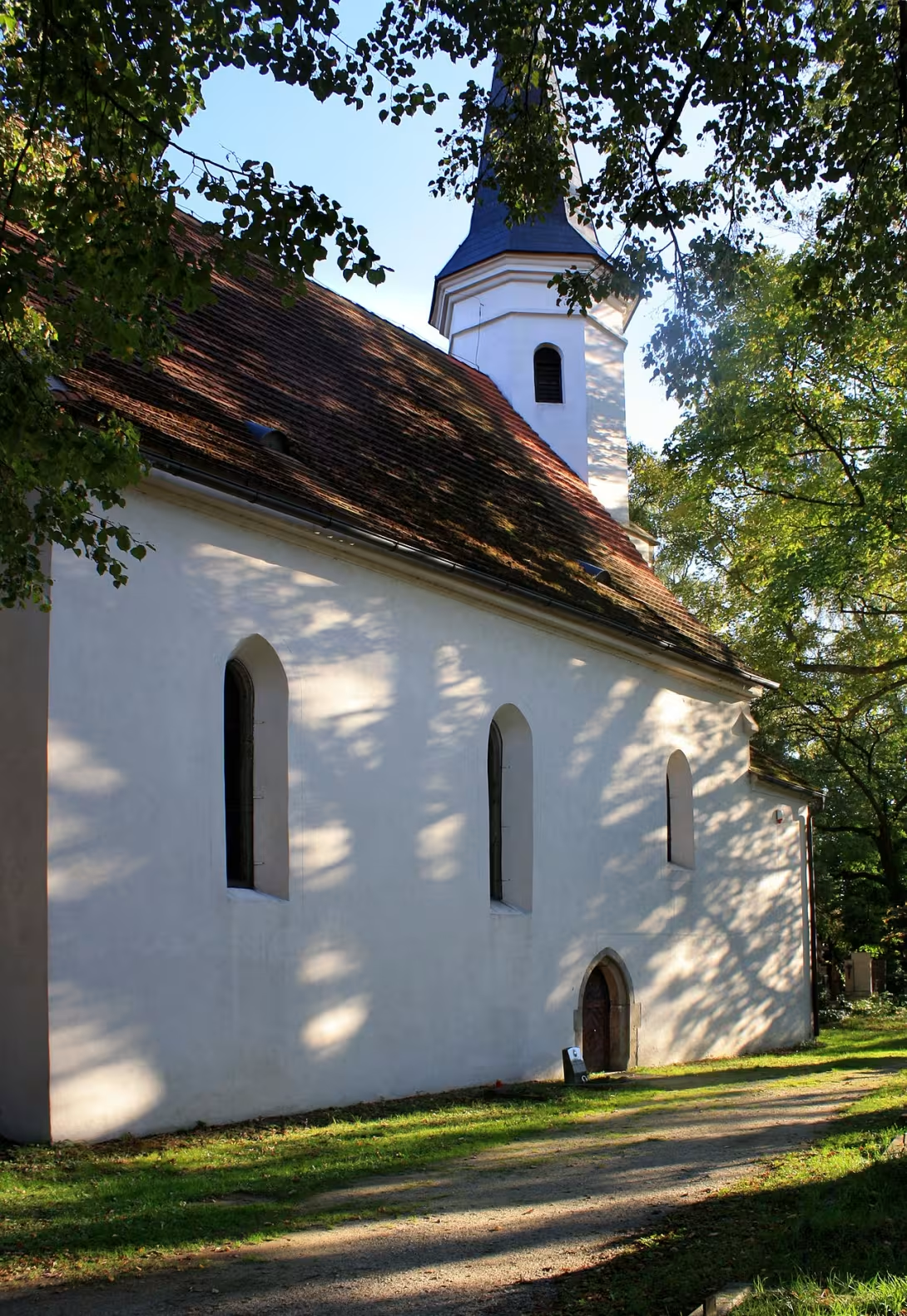

The historical appearance on the left is an AI-generated visualisation and serves as inspiration only.
Historical milestones
- 1399
- First written mention of the church
- 1606
- Correction of the Jesuit Church
- 1647
- Production of the statue of St. Wenceslas and installation of the main altar
- 1801
- Destroying the church with a big fire
- 1991
- Last extensive repairs of the church
Architectural development
Originally a Gothic church was built probably in the late Middle Ages. In the 16th century it disappeared and was abandoned until the Jesuits restored it in 1606. After the fire in 1801 it passed through Baroque reconstruction and in the 19th century it was built a chapel with wall paintings. In the 20th century, canning work took place.
Historical events
In 1618, the church was burned by the Imperial Army during the Thirty Years' War. A big fire in 1801 destroyed most of the building. The last extensive repairs took place in 1991.
Points of interest
- The first written mention of the church dates back to 1399.
- The church was originally built in Gothic style and later repeatedly damaged, for example burned in 1618.
- In 1647 the church was installed a new main altar and statue of St. Wenceslas.
- In 1801, a big fire almost destroyed him, until in 1991 his entire restaurant took place.
- The interior is decorated with four altar paintings by Bedřich Kamarit from 1866.
Guide
This guide is narrated by a synthetic voice generated by artificial intelligence.
Show guide text
This text was created by artificial intelligence and has not been editorially reviewed. It may contain inaccuracies.
The Church of Saint Wenceslas at the cemetery is a single-nave chapel on the outskirts, south of the center of Jindřichův Hradec. It is protected as a cultural monument of the Czech Republic.
The first mention of this originally Gothic chapel dates from 1399. In the second half of the fifteenth century, Franciscans were active here. In the sixteenth century, however, no one maintained the church and it fell into disrepair. In 1606, the Jesuits renovated it, but already in 1618 it was burned down by the imperial army of General Dampierre. It was restored in 1621 and in 1647 it received a new main altar. During the great fire of the city in 1801, the church was almost completely destroyed. It underwent complete repairs only in 1991.
From the outside, the tower is particularly striking. At the bottom it is square-shaped and on the floor it transitions into an octagonal shape. An open chapel with wall paintings from the nineteenth century adjoins the tower. A number of tombstones with figurative reliefs have been preserved by the church. The cemetery here was used for burials until the twentieth century.
Inside, the Gothic presbytery is particularly worth noting. It is pentagonal and vaulted with ribbed vaulting. The statue of Saint Wenceslas, which apparently dates from 1647, and the colored glass in the windows also deserve attention. Four altar paintings by Bedřich Kamarýta are from 1866.
Tips for visitors
Best time to visit the church of St. Wenceslas is during the morning hours, ideally on Monday to Wednesday when there are fewer visitors. The sunny morning provides a pleasant light for a tour of the interior while avoiding the heat of the afternoon hours. If you are interested in photography, a visit in natural light is recommended, preferably in the morning or afternoon, when light falls favourably on the Gothic elements of the church.
It is recommended to use public transport as far as possible and to find a stop closest to the church. The location is well accessible by car along the road leading from the city centre.
When visiting the church, wear comfortable clothes and shoes as it is a historic building with stone stairs and uneven surface. The interior is cold, so bring a light sweater or jacket. For convenience, you can also take a small laptop or city map to see other attractions in the surroundings.
Photography is allowed in the church of St. Wenceslas, but care must be taken to respect other visitors and not touch statues or walls. The best places for photography are presbytery with its rib arch and main altar. Use the natural light from the window openings that illuminate the interior for quality images. In the exterior, it is advisable to take pictures in clear weather, when gothic details of the facade are well displayed.
The historical centre of Jindřichov Hradec with its picturesque streets and castle Jindřichův Hradec is worth visiting around St. Wenceslas church. In half an hour by car or public transport you can reach the Castle Český Krumlov, which is listed on the UNESCO World Heritage List.
For families with children, the visit to St. Wenceslas' church is interesting thanks to its historic atmosphere and the possibility to become acquainted with Gothic architecture. Children can see the statues and detailed interior decoration. In the vicinity of the church you can also visit the playground or parks in the city centre where children can relax and have fun. An interesting tour of the castle Jindřichův Hradec, which offers interactive exposition, may be for children older.
Frequently asked questions
Can the monument be visited?
Religious buildings are usually open mainly during services; at other times a visit is normally arranged with the parish or the operator. We have not verified specific times.
Where is the monument?
Location: Václavská, Jindřichův Hradec III, Jindřichův Hradec, Jihočeský kraj. The map on this page shows the exact spot.
Why is the monument protected?
It is listed in the Central List of Cultural Monuments of the Czech Republic as a cultural monument (register no. 47242/3-1708).
For kids
Imagine going back to when Jindřichův Hradec was a small town surrounded by a chateau. The church of St. Wenceslas stood in the suburbs, as if it were a small pearl in the whole city.
How did it look here? There were people here who lived for a living in agriculture and trade. They were lumberjacks, craftsmen, women who made dresses and men who caught fish in rivers. The church of St. Wenceslas was their common prayer house.
Businesses nearby
Do you run a restaurant, accommodation, shop, museum, rental, wellness or other visitor service near this monument? Show yourself directly to the people heading to it — this is how they will see you in the app and on the web:
Events nearby
Zdroj akcí: otevřená data měst a obcí ČR (Národní katalog otevřených dat) a kalendář akcí Národního památkového ústavu.
Nearby
The surrounding area is the city of Jindřichův Hradec with historical core and castle Jindřichův Hradec. Within 5 km is also Castle Český Krumlov (exactly 15 km, but in the wider surroundings) and nature reserve Red Pond.
Accommodation nearby
Themed route
Thematic cruise route: Gothic and Nature in Henry's Hradec
1.Kostel svatého Václava (Jindřichův Hradec III) * Type: * Gothic church from the 14th century with remarkable architecture and historical fresco. * Why visit? * A unique example of late Gothic sacral art in southern Bohemia, associated with the legend of the founding of the city. The interior with preserved paintings and Gothic portals is a rare example of medieval art.
2. The historical core of Henry Hradec * Type: * City Monument Reservation with Renaissance and Baroque houses and square. * Why visit? * It keeps the original Middle Ages available with the dominance of St. Wenceslas church and the town hall where the history of the city developed. The square with fountain and historical buildings offers the atmosphere of the past centuries.
3. Castle Jindřichův Hradec * Type: * Large chateau with preserved walls, towers and exhibitions about the history of the region. * Why visit? * One of the most important chateaux in the Czech Republic, connected with the Přemyslívov and Hussite history. From its fleas is a panoramic view of the city and surrounding landscape, including the church of St. Wenceslas down in the valley.
4. Natural Reserve Red Pond * Type: * Protected wetland with rich fauna and flora, ideal for walks. * Why visit? * Provides a quiet relaxation zone in the middle of a historic environment. The reservation is home to rare species of birds and plants, and its surroundings offer picturesque cycling paths for connection to the church or chateau.
* The route is designed to combine the spiritual and natural values of the region without diverting from the designated locations. *
Seasonal recommendations
Spring: In the spring period, the Church of St. Wenceslas in Jindřich Hradec is revived by sunlight, which particularly highlights the architectural beauty and color of flowering shrubs around. The atmosphere is full of recovery and hope, making the visit peaceful and pleasant. Due to mild temperatures, it is not necessary to wear winter clothes but to avoid wet grass after rain with suitable shoes. The best time to visit is in the middle of the day when the sun illuminates the church most beautifully and the crowds are not too many.
Summer: Summer brings long days of light, which increases the attractiveness of St. Wenceslas Church. Sun rays illuminate the interior and create impressive shadows that add a mystical atmosphere to the church. Summer is also the most sought after time for visiting, which means a larger crowd. Early arrival is recommended to avoid long fronts and anxiety. Wearing light clothes and sunglasses is suitable for sun protection.
Autumn: Autumn offers the Church of St. Wenceslas a unique atmosphere when tree leaves in the surroundings turn the landscape into a colourful calendar. Sun lighting is less intense, giving the church a calm and quiet character. The temperatures are warm, but in the winter months they are starting to cool, so it is advisable to bring a warm shirt. The best time to visit is the end of the day when the atmosphere is calm and pleasant.
Winter: Winter brings a mild mystery to the Church of St. Wenceslas. The low sun illuminates the church with fine, long shadows and the glow of snow or clouds gives the place a magical look. The temperatures are cold, so it's important to wear warm clothes, including a shirt and hat. The atmosphere is calm and quiet, which allows you to use a place to relax and escape from winter frost.
Visualizations and artistic views


The visualisations are generated by artificial intelligence and serve as inspiration.
Photos from the area
Real photos taken near the monument


Zdroj a licence jsou uvedeny u každého snímku.
Atmosphere of the place
This atmospheric visualisation of the place and period was generated by artificial intelligence. It is not real footage of the location.
Tips from visitors
No tips yet. Be the first!
Log in and add your tip.
Sources and literature
Photos: This file is available under Creative Commons BY-SA license. Basically: You can use this picture for any purpose, provid / CC BY-SA 3.0 — Wikimedia Commons. The author and licence also appear when you hover over the image.
Faktickým podkladem tohoto textu byl článek na Wikipedii, jehož autory jsou přispěvatelé Wikipedie. Článek je dostupný pod licencí CC BY-SA 4.0.
Location on the map
More monuments – Jindřichův Hradec III
Show all in the municipality




Příběhy a pověsti
Legendy, pověsti a příběhy spjaté s touto památkou
Fotografie návštěvníků
Zatím žádné fotografie. Buďte první, kdo přidá fotografii z návštěvy!
Log in a přidejte svou fotografii nebo hodnoťte.
Za ověřenou návštěvu v aplikaci získáte víc bodů — poznáme podle GPS, že jste na místě.
Reviews and comments