



Valentův mlýn Water mill
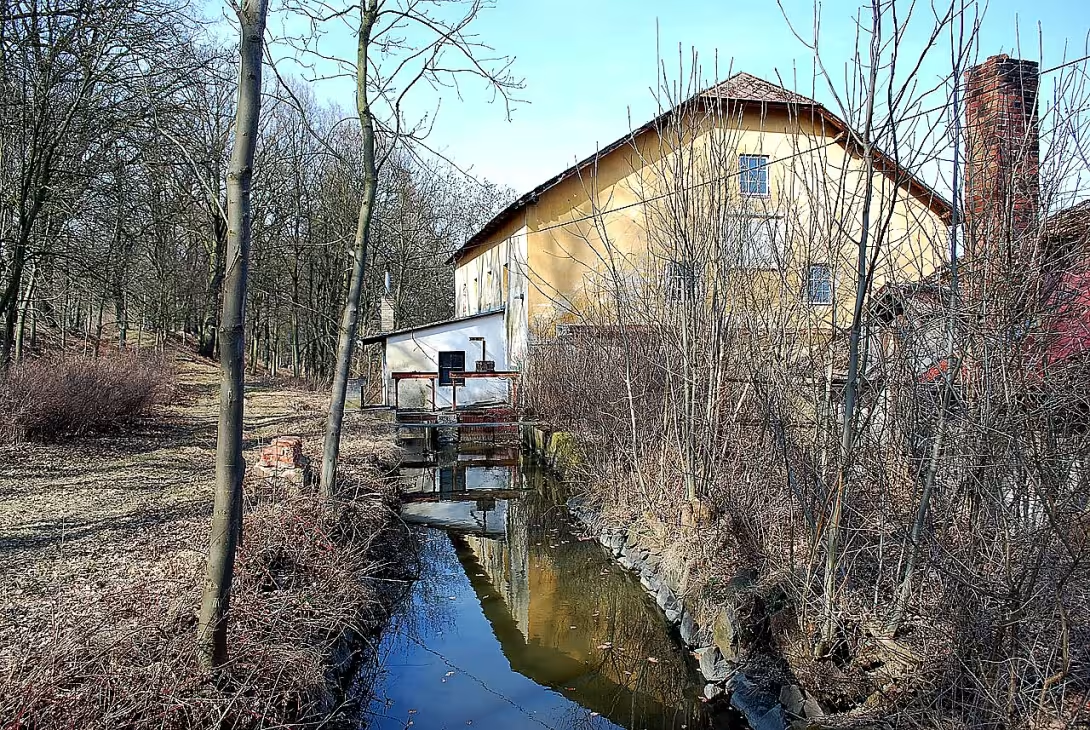
Valentův mlýn is located near Lomnice nad Lužnicí in the village Záblatí near Ponedraž in the district of Jindřich Hradec. It is a Renaissance water mill with a rich history. Since 2020 it has been protected as a real-estate cultural monument. The building is an important witness to technological advances and architectural trends. The mill boasts unique elements such as sgraffiti and Schwarzenberg characters that increase its historical value.
The mill was founded in 1575 Vilém z Rožmberka on the recommendation of Jakub Krčín. The project was related to the completion of the Golden Sewerage and the expansion of the Zablatian Pond. This was a strategic step towards improving water infrastructure in the region. The miller Matěj Nosek worked on the construction site. He was devoted to the place where the monastery was supposed to be.
Valentův mlýn has an interesting Renaissance character. The building consists of a one-storey north building and a two-storey south part, which was extended to the second floor in 1926. The western facade is decorated with a sgraffiti in the shape of rectangular letters and a Schwarzenberg character. His author is Solomon Gottfried. In the interior there was preserved an arched Renaissance hall and a mill structure. It was modernized in 1930 by replacing the original stone water wheels with Francis' turbine.
The mill ownership has undergone several changes. After it was founded, it was operated by the family of Tobias Charvát. She rented it from Schwarzenberg to 1958. In 1948 the object was nationalized after the communist coup. This ended his operation as a business company. The restitution didn't happen due to the death of the last owner of Milos Valentine.
The mill burned for its history several times (between 1615, 1690 and 1897). This led to reconstruction during the period of Classicism and in the second half of the 19th century. Another interesting thing is the small metal cross between the building and the road leading up the Záblatský pond dam. According to the legend, there was a monastery here. I heard the nuns escaped from it outside Jan Zížka underground corridor.
Today Valentův mlýn serves as a witness to the historical development of technology and architecture. As a protected cultural monument, it is an important part of the local cultural heritage. Visiting the object offers a unique view of the past. It also reminds of prominent personalities like Vilém z Rožmberka, which shaped the history of the region. The mill is therefore not only a local monument, but also an important point for understanding the wider cultural and technological development of the Czech Republic.
Historical milestones
- 1575
- Vilém z Rožmberka founded a Renaissance water mill
- 1615
- The first recorded fire of the mill building
- 1690
- The second event when the mill burned down
- 1897
- Third fire leading to subsequent repairs
- 1926
- Extension of the south part of the building by the floor
- 1930
- Modernization of the mill in exchange of wheels for turbine
Architectural development
The mill underwent several reconstructions during the period of Classicism and in the second half of the 19th century. In 1926 the second floor of the main building was added, the original stone water wheels were replaced by a Francis turbine in 1930.
Historical events
- 1615
- Fire
- 1690
- Fire
- 1897
- Fire
Owners
In 1575 he founded Vilém z Rožmberka, followed by the family Tobias Charvát (until 1958), then nationalized after the communist coup in 1948. There was no restitution due to the death of the owner Milos Valentine.
Points of interest
- It is a Renaissance water mill which has been protected since 2020 as a real-estate cultural monument. - The mill was founded in 1575 Vilém z Rožmberka. - Western facade is decorated with sgraffiti in the shape of rectangular letters and a Schwarzenberg character. - An arched Renaissance hall and a mill construction were preserved in the interior. - The mill burned several times between 1615, 1690 and 1897.
Guide
Show guide text
This text was created by artificial intelligence and has not been editorially reviewed. It may contain inaccuracies.
Welcome to Valentine's Mill. You are standing in a place that is deeply linked to the history of this country and the rhythm of flowing water. In front of you is a Renaissance water mill, which is a solid part of the village Záblatí. Before you take another tour, stop for a moment and feel the atmosphere of this place. Do you hear the sound of water nearby? The stream, the Golden Sewer, which flows just along the right bank, has been the main engine of everything that has happened here for centuries. The mill is not just an ordinary building, it is a living witness to events that took place here hundreds of years ago. Feel the calm that exists here, and at the same time remember how much this place must have changed so that it could still happen here.
If we now go into a deep past together with me, until a new order was formed in these regions, we will come across a year of 15 hundred and seventy-five. It was this very important year that the very beginning of the existence of this place took place. The mill wasn't built randomly. Its creation was the result of decisions and the influence of powerful people. Thanks to the recommendation of Jakub Krčín, a man who at the time had a huge influence and knowledge of local conditions, here Vilém z Rožmberka decided to establish this water mill. The Rožmberks were at this time one of the most important families whose tracks can be found in many places in this country. This mill was therefore part of a wider economic expansion and its water location was absolutely crucial for its future functioning and prosperity.
Now pay attention to what you see right in front of you. Look at the facade of the building, especially its west side. See those interesting geometric shapes and patterns? They're sgraffiti. This technique of decorating, which was very popular at the time of the Renaissance, lies in the fact that several layers of plaster of various colours are applied to the wall and then scraped into the top layer of the pattern, thus revealing the color of the bottom. Here are these patterns in the shape of rectangular letters, which gives the whole house a very noble, harmonious and geometric look. If you look even more carefully, you will also see the black mark of the Schwarzenberg family, which decorate the wall here and resembles the period when this property belonged to this important noble family. These details tell us that this mill was not just a job, but it also had an aesthetic and representative value.
But the history of this mill was not just about beauty and peace. It was also a constant struggle with fate and destructive elements. The mill had to face several major disasters that could have led to its complete demise. It was a struggle between the human struggle for development and the irresistible force of nature. The first of these tests was a fire that was recorded already in 16 hundred and fifteen. Then, in the year sixteen hundred and ninety, something similar happened again and the building burned down. But people never gave up. This resistance is fascinating. Although in the year one thousand eight hundred ninety-seven a fire broke out again, which required extensive repairs, the mill was always lifted from the ashes. This ability to recover is one of the most important stories of this place. In a thousand and nine hundred and twenty-six, the southern part of the building was extended to a whole new floor to better meet the growing needs. And when the time came for modernization in the year thousand nine trăm thirty, the old water bike was replaced by a modern turbine, which meant a great technological leap in the efficiency of the work.
Who worked here and who made the decisions here? In addition to the powerful Rožmberks and influential Krčín, Matěj Nosek may have worked here. Every stone and every wooden structure here can bear traces of people who spent their days here grinding grain. Even though we are looking at a building from the outside today, within it is preserved an arched Renaissance hall and a mill structure that allows us to imagine what the inner space looked like at the time of its greatest bloom. You can imagine the noise of machines, the smell of grain and the constant movement of water that was part of everyday life.
But there is also something that can really interest you and you can think about. This mill is not just an ordinary old box that just stands. It is a monument that survived three major fires and still stands firmly on the shore of the Golden Sewers. Since 2000 thousand twenty, this mill has been officially protected as a real-estate cultural monument. This means that its history, its unique appearance and its souls are now safe and will be preserved for future generations. It's fascinating how this little piece of history managed to cope with time, fire, and technological changes.
Now that you know the story of Valentine's Mill, I suggest you continue your tour. Feel the calm of this village Záblatí, listen to the splits of water and enjoy the beauty of this Renaissance architecture that has now revealed itself to you. Take another look at the facade from another angle to better understand the beautiful patterns. Thank you for stopping by and paying attention to this historic monument. We wish you a beautiful and inspiring walk around Lomnice nad Lužnice.
Tips for visitors
The best time to visit is spring and autumn months, when the landscape around Záblatí shines with colors and water levels are the most pronounced. For best photos we recommend morning or late afternoon hours, when soft light will highlight the Renaissance details of the construction and water bike.
You can reach the mill by car or public transport; We recommend checking the specific connections and current timetables in the internet search engine.
Take comfortable shoes suitable for rural terrain and plenty of drinking water. Since it is a historical object in nature, we recommend to have an insect repellent.
For families with children, the visit is a great opportunity to familiarize yourself with the history of miller and water propulsion. The walk around the mill is safe and offers space for exploring nature.
Frequently asked questions
Can the monument be visited?
This is a technical monument. Some are open as exhibitions, others are out of use or on private land. We have not verified whether this one is accessible.
What are the opening hours and admission?
We have not verified the opening hours or admission. Current information is published by the operator.
Where is the monument?
Location: Záblatí, Jihočeský kraj. The map on this page shows the exact spot.
Why is the monument protected?
It is listed in the Central List of Cultural Monuments of the Czech Republic as a cultural monument (register no. 1999993538).
Businesses nearby
Do you run a restaurant, accommodation, shop, museum, rental, wellness or other visitor service near this monument? Show yourself directly to the people heading to it — this is how they will see you in the app and on the web:
Events nearby


Zdroj akcí: otevřená data měst a obcí ČR (Národní katalog otevřených dat) a kalendář akcí Národního památkového ústavu.
Nearby
🏰 Historic sites (62)
- Padlým vojínům 1.5 km
- Jakub Krčín z Jelčan 3.2 km
- Pomník obětem 1. světové války 3.8 km
- Památník obětí 2. světové války 3.8 km
- Památce padlých a nezvěstných rodáků zdejší obce ve světové válce 1914 - 1918 5.7 km
- 1918–1928 10 let Československé republiky 5.9 km
- Fuglhaus 6.1 km
- Obětem války 1914-1918 6.8 km
- Skanzen Ludmila 7.2 km
- Památce vojínům 1914-1918 7.2 km
- Socha Sv.Jana Nepomuckého 7.4 km
- 20 let ČSL státu - 1938 7.6 km
- Na památky zlaté svatby knížete Adolfa Josefa a Idy ze Schwanzenbergu 7.7 km
- Čertova šlápota 7.7 km
- U Prokšů 7.9 km
- Jan Hus 8.1 km
- Tvrz Hamr 8.1 km
- Šimon Lomnický z Budče 8.2 km
- Miloš Silovský 8.2 km
- Blatské muzeum 9.0 km náměstí T. G. Masaryka 111
🍽️ Restaurants and dining (133)
- Hostinec na návsi 0.1 km
- Hospůdka Ponědraž 1.6 km
- Smržovská hospoda 3.4 km
- Farská louka 3.5 km
- U Biciho 3.6 km +420 777 885 528
- Eden 3.7 km +420384792331
- Hostinec u chovatelů 3.7 km
- U Kačerů 4.7 km
- Občerstvení Měruše 5.0 km
- Vlčí bouda 5.4 km +420 728 864 938
- Vlkovská hospoda 5.6 km web
- Občerstvení pod hrází 6.1 km
- Hospůdka Na Kopečku 6.6 km
- Občerstvení Na Kopečku 6.8 km
- Vlkovská pískovna 7.1 km
- Ponorka 7.4 km
- Rožmberský sklípek 7.5 km +420 607 876 896
- Zmrzlina u jezárka 7.5 km 70473656
- Občerstvení Na Pískovně 7.6 km
- U Pavla 7.8 km +420 724781531
🏨 Accommodation (79)
- Ubytování Naděje 3.5 km
- U Radnice 3.7 km web
- Rodinný hotel Bohemia 3.8 km +420608313344 web
- U Kačerů 4.7 km web
- Mobilní dům Měruše 4.9 km web
- Chalupa Měruše 4.9 km web
- Měruše 5.0 km +420 773 515 021 web
- Chata u Lomečku 5.4 km
- Penzion U Dančí Obory 5.4 km +420 721 736 967 web
- Penzion Kravín 5.4 km +420 776 131 807 web
- Chalupa Vlkov 5.6 km
- Hotel Vlkov 5.6 km web
- Ubytování Vlkov 5.7 km
- U Faflíka 5.8 km
- Chata U Marešů 5.9 km
- Ubytováni 6.0 km
- Ubytování Vlkov 6.0 km
- U Faflíka 6.0 km
- Ubytování Vlkov 6.2 km
- Penzion U Hájovny 6.4 km
🚲 Rentals and sport (15)
- COP Slověnický mlýn 8.1 km
- Prodoli 8.6 km A. Jiráska 171
- SK Ševětín 8.8 km
- Cyklo Suchý 9.8 km třída Československé armády 162 web
- lanový park Vávrovka 11.2 km
- Sportcentrum Mrkáček 11.2 km
- Sokolovna 11.7 km
- Fitness Reprezentant 11.7 km
- Střelnice 11.8 km
- Electropower 11.8 km
- Modelářské letiště Pleše 12.1 km
- Veloservis Kocanda 12.5 km
- MEPO 13.0 km
- Ostende 13.7 km
- Tělocvnična 15.0 km
🥾 Hiking and nature (53)
- vyhlídková věž Lomnice 2.6 km
- Dvořiště 5.1 km
- Milenec 5.2 km
- písečný přesyp 7.0 km
- Na Boru 7.0 km
- Studánka sv. Ant. Paduánského 7.8 km
- Ficlovka 8.1 km
- U Valacha 8.3 km
- bývalá bobrovna 8.4 km
- Na Vlčku 9.2 km
- studánka 9.4 km
- Dunajovická Hora 9.4 km
- U Novotného 9.5 km
- Památné stromy 9.6 km
- U hromady 10.3 km
- Klení 10.4 km
- bývalá vojenská střelnice 10.5 km
- U Spáleného lesa 10.5 km
- Baba 10.7 km
- Doubí u Žíšova 11.0 km
Accommodation nearby
Trips and activities nearby
Guided tours, tickets and activities nearby from GetYourGuide
Affiliate link: if you buy from the partner, we may receive a commission. The price for you does not change.
Search tours and activities →Themed route
1.Valentův mlýn Type: Water mill. Why to visit: Discover the beautiful architecture and exterior appearance of the building.
2. Mill courtyard Type: The immediate area. Why to visit: Walk around the building and enjoy a quiet atmosphere.
3. Internal exposure Type: Exhibition in object. Why to visit: Learn more about the history and see the inner devices.
Seasonal recommendations
Seasonal recommendation for visiting the historical monument. Monuments: Valentův mlýn (water mill), Záblatí Status: Good
Spring: In spring, the surroundings of the mill awaken to life. The trees start to green and the flow of water in the mill raid is strong thanks to the melting snow. The light is fine and scattered in this period. We recommend a visit in the morning when the air is freshest. Dress well, because the morning temperatures may still be low.
Summer: In summer there is the largest gathering of people and nature is in full bloom. The sun hits the wooden structure directly and creates sharp shadows. Due to increased interest in the high summer season, it is best to arrive early in the morning to avoid the biggest crowds. Prepare light clothes and sun protection.
Autumn: Autumn brings gold and brown to the landscape. Leaf falling into the water creates a melancholy and calm atmosphere. The best time to observe colors is in the afternoon when the sun shines at a low angle. Due to wet soil and falling leaves, we recommend to wear solid and waterproof shoes.
Winter: Winter turns the mill into quiet and freeze covered object. If snow falls, the landscape seems very lonely and calm. The light is weak and the day ends very soon. It is necessary to wear very warm clothes and a sufficient layer of insulation against cold. In this period the road to the mill can be more difficult due to snow.
Visualizations and artistic views


The visualisations are generated by artificial intelligence and serve as inspiration.
Photos from the area
Real photos taken near the monument


Zdroj a licence jsou uvedeny u každého snímku.
Tips from visitors
No tips yet. Be the first!
Log in and add your tip.
Sources and literature
Photos: Chmee2 / CC BY 3.0 — Wikimedia Commons. The author and licence also appear when you hover over the image.
Faktickým podkladem tohoto textu byl článek na Wikipedii, jehož autory jsou přispěvatelé Wikipedie. Článek je dostupný pod licencí CC BY-SA 4.0.
Location on the map



Příběhy a pověsti
Legendy, pověsti a příběhy spjaté s touto památkou
Fotografie návštěvníků
Zatím žádné fotografie. Buďte první, kdo přidá fotografii z návštěvy!
Log in a přidejte svou fotografii nebo hodnoťte.
Za ověřenou návštěvu v aplikaci získáte víc bodů — poznáme podle GPS, že jste na místě.
Reviews and comments