



Vávrův mlýn (Nové Město) House
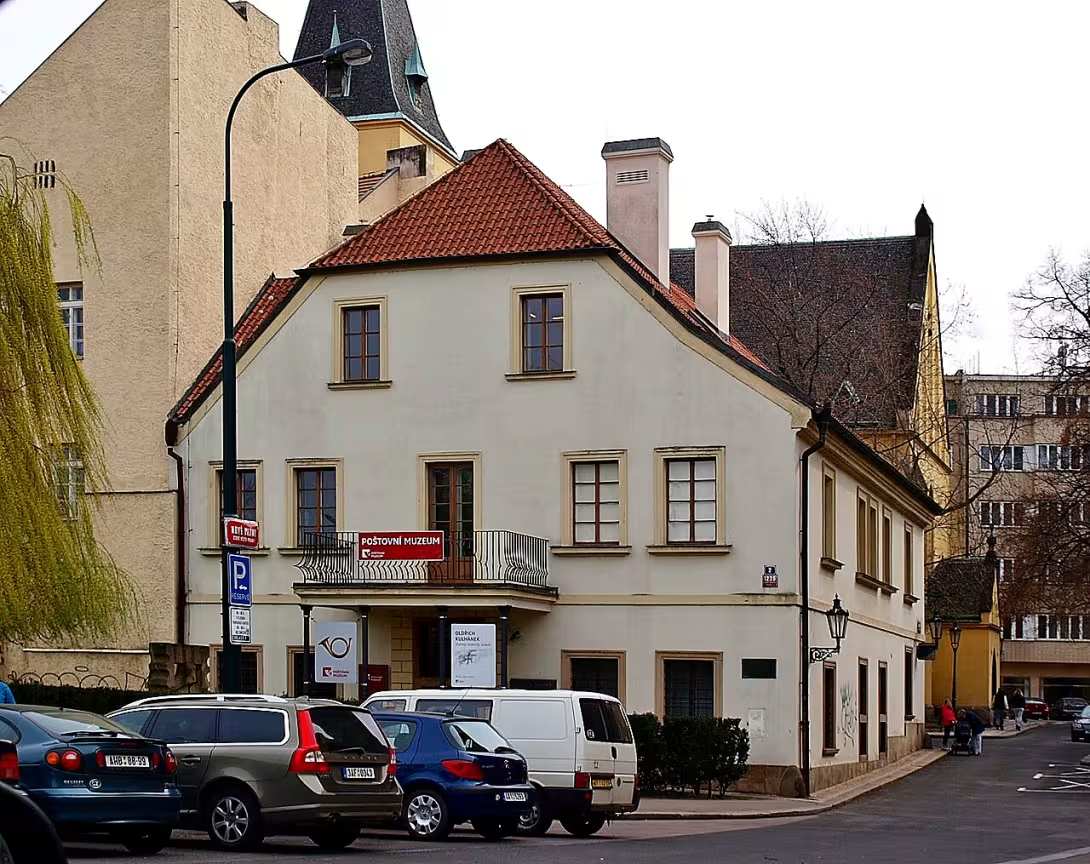
Vávre Mill is a baroque residential house in Prague 1 in Novomrnská street. It is particularly remarkable with unique interior painting from the mid-19th century. Although it is traditionally listed in the list of sights of the capital city of Prague as Vávre's water mill, it was never really a mill, but it served as a dwelling for the miller. Currently in the building is the Postal Museum Prague.
Fishermen, lasers or miller have been living on the property of today's house and around it since the 13th century. In the Middle Ages there were pools whose water served for the spa of St. Kliment. The site dates back to the last quarter of the 14th century. The exact location of the house No. 1239 / II is attributed either to the fishermen Machsanto from 1379 or to the Fance Nuremberg mill from 1380. In the middle of the 16th century the house belonged to a new town. The original building was probably wooden and burned in 1689 in a large fire. From this time the Renaissance basement walls with a later Baroque vault were preserved.
The existing stone building was built in 1689- 1690 together with the reconstruction of New mills on the river, which also belonged to the New Town of Prague. The object was essentially preserved in this form. In the first half of the 18th century the city started renting mills for a long time. In 1750 he won the New Mill at the church of St. Kliment and with the building of the miller František Klik. Later, in 1788, the mill purchased Josef Vorlová at the hand of his minor son Václav Michalovice.
Václav Michalovic, who finally redeemed the mill with a residence in 1800 from the property of New Town, was an art lover and collector. His son Václav Karel Michalovic was a member of the table company Nimrodi in the brewery U Kléblat. This is where he met Josef Jungmann and painter Josef Navratil. Michalovic ordered a house decoration in 1847. The property remained in the Mikhalovice family until the late 1980s, when it was bought by the entrepreneur JUDr. Václav Cicvárek. Since approximately 1900, the house was owned by the baker's master Zdeněk Vávra and his wife Marie, from whom the building gained its traditional name. In 1948 the house was nationalized and handed over to OPBH, although the family of owners lived there in the 1970s.
Interior decoration from 1847, made by oil tempera, belongs to the peaks of Czech decorative art in the middle of the 19th century. On the first floor of the north wing there is an Alpine salon with eight veducs in plastic gilded frames. Five of them depict Alpine landscapes, one Turin under Monte Superga and two others represent the castle Kamýk on Litoměřík and the waterfall in Adršach. In this salon, a monogram of Václav Michalovice (WM) is shown in the painting of Swiss Altdorf on a flour bag. The owner himself is to be depicted as a man with a wand behind his back at the Abrasche waterfall.
Miniature medals with mythological, historical and theatrical scenes, such as Libushin Court, the Occupation of Přemysl Orač, Faust and Margaret and the Golden Rhine are located in the Theatre Lounge. The dining room is decorated in a supraport door still life with fruit and a glass of wine. The house also includes three tile stove with relief from Roman mythology by Václav Jan Sommerschuh. On the mezzanine floor of the staircase is a wooden statue of Genius postage from 1928, carved by Chenek Vosmík.
The building was restored in the 1950s by Prof. Bohuslav Slanský, but it subsequently faded. In the late 1970s it was taken over by the Prague Post Office and in the years 1986- 1988 it underwent a comprehensive reconstruction. The Postal Museum of Prague is located in the building today. While mills on the river died in its regulation, Vávre's house remained in the Prague Monument Reserve thanks to its unique painting decoration.
The monument presents a rare insight into aesthetics and lifestyle of the rich township of the National Rebirth. A visit to this building offers the possibility to see a unique connection of Baroque architecture and precise decorative painting of the 19th century.
Historical milestones
- 1689
- A big fire followed by a new construction.
- 1847
- Creating a painting decoration in the house by the painter Josef Navratil.
- 1948
- Nationalizing the house and handing over the OPBH.
Architectural development
The original wooden installation was replaced by a stone building in 1689-1690. The Renaissance basement walls were preserved with a later Baroque vault. In 1847 an oil tempera decoration with landscapes and medallions was created in the interior.
Historical events
1689: A big fire in which the original wooden structure burned most of the time. 1847: Implementation of rich interior decoration. 1948: National of the object and transfer of OPBH.
Owners
New town village (until the 18th century), František Klika (from 1750), Michalovice family (from 1788, final purchase 1800), JUDr. Václav Cicvárek (late 1980s), Vávre family (from about 1900 to 1948), OPBH (from 1948).
Points of interest
- The building is a remarkable unique interior painting decoration from the mid-19th century. - Although it is registered as a water mill, it was never really a mill, but it served as a home for the miller. - The Postal Museum Prague is currently located in the building. - In the Alpine salon there are paintings of Alpine landscapes, Turin, castle Kamýk and waterfall in Adršach. - There are miniature medallions in the Theatre Lounge with mythological, historical and theatre scenes.
Guide
Show guide text
This text was created by artificial intelligence and has not been editorially reviewed. It may contain inaccuracies.
Welcome to the heart of Prague, the part called Nové Město. You're standing right in front of a building that can make you look like a napalm of the first look, but it's got fascinating stories in it. In front of you is a house that many of us know under the name Vávre Mill. Stop for a moment, take a breath and feel the atmosphere of this place, which is closely confused with the history of our capital city. Look at the facade of the building and perceive its character, which is indicative of centuries that have passed by. It is a place where the everyday life of artisans with high art is met and memories of distance and communication are now hidden.
Now let's look together at how this building actually came into being. To understand its beginnings, we must go back deep into the past, namely by the end of the seventeenth century. In the year of a thousand six hundred and eighty-nine, Prague experienced a devastating big fire, which it left in many parts of the city a incinerator. It was from the ashes of this disaster that new construction came. In the years of one thousand six hundred eighty-nine and one thousand six hundred ninety, this building was built as part of a wider complex called the New Mill. At the time, it was not a luxury mansion, but a practical residence for people who worked in the area. They were miller workers, people who with hard work provided grinding grain and running local facilities. So imagine how there was a noise of work in these walls, how people gathered here in working clothes read the news from the city and how this house served as a safe haven for the families of those who kept the mills running.
Now that you're standing in front of the house, pay attention to his overall appearance. Even though the building is peaceful and noble today, its history is very practical. Notice the detail of the facade and think about how the building changed over time. Although we don't know the names of the particular architects who designed this house, it's obvious that it was built to last centuries. It's a building that represents its time with its simplicity and strength. It is written in the list of sights of the capital city of Prague, which means that its value is not only in the material but in what it symbolizes. It is a monument to the recovery period after the fire and witness to the changes that Prague was going through.
But when we move from external appearance to what's inside, we get to the rarest part of this place. If you are able to enter, I suggest you focus mainly on interior painting. It's a real jewel that originated in the middle of the nineteenth century. Specifically, in the year one thousand eight hundred forty-seven here was the painter Josef Navrátil. His work left an unforgettable mark. Imagine the colors and details that brought life and elegance into the house at the time. One of the most significant elements is the so-called Alpine salon. It's a space that will carry you thousands of miles away from the streets of Prague. On the walls here you will find images of Alpine landscapes, which at the time of their creation served as a window into the world. At that time, the road to the mountains was not available to everyone, so these paintings allowed people to dream of snowy peaks and clean mountain air while they were in the center of a busy city.
Interesting personalities are also associated with this place. In addition to the already mentioned painter Josef Naval, who left his work here, names such as Václav Michalovic or an important language guide Josef Jungmann appear in history. The presence of such personalities in the vicinity of this house suggests that there were people from various social classes, from craftsmen to intellectuals and artists. It is fascinating to think how the paths of people who formed culture and society of their time intersect in these spaces.
And now we come to the part that may surprise you. It's one of those little historical mysteries that makes city guides fun. If you have noticed that the building is traditionally referred to as the Vávre Water Mill, I must tell you that this marking is incorrect. Yes, you heard right. Although this name has been taken up and used very widely, this building has never actually been a mill. There was never water running the mill wheel and there was never any grain. The building served exclusively as a residence for miller workers who worked in other parts of the New Mill complex. It is a fascinating example of how over time the perception of one building can change and how practical housing can become a mill in people's memory. This little inaccuracy in the name does not gain anything from the building, but it gives it some charm and secrets that you can now share with others.
Time went on and the building adapted to new times. In the year one thousand nine hundred forty-eight there was a change of ownership. The house was nationalized and handed over to the administration of the organization for the administration of the buildings of the capital city of Prague. It was a new chapter in the life of this house where private space became the property of the city. This change has helped to ensure the protection of the building and its unique interior equipment for future generations.
Today, the miller doesn't live in the building and we're not looking for water bikes. The Postal Museum Prague is currently located in this building. It is very symbolic that a house that once served as a home for people working in one of the most important industrial complexes of their time, today serves as a place where the history of communication and transport is preserved. The post office, the letters and the reports that connected people across the continents now find their home in premises that once joined people in a single craft.
If you look at the building again, you see it a little differently, don't you? It's not just an old house in the center of Prague. It's a place that survived a great fire that hosts artistic dreams about the Alps and teaches us that even in names, a myth can hide. It's a place where the history of living, art and communication meets.
I suggest you come in slowly now, if you have such an option, and let yourself be executed by the Post Museum premises. Don't forget to look for the Alpine salon and try to feel the calm and exceedingly beautiful views of the mountains that the painter Navre carried to the heart of Prague. Go through all the corners, see the details of the painting and enjoy a moment of silence in a place that so faithfully tells stories from the past.
Thank you for a common walk through the history of Vávre's mill. I hope you're interested in this short story and that you will leave with the feeling that you have discovered one of the little secrets of our city. I wish you a pleasant rest of the day in beautiful Prague and enjoy the further discovery of the places that make up the soul of this city. To a reunion.
Tips for visitors
The best time to visit is the spring or autumn season, when the colors of the old town are the most striking and temperatures pleasant for walks. The building is located in the centre of Prague, so it is best to use public transport or walk from nearby stops; Check the current connection in the maps.
When visiting, we recommend taking comfortable shoes suitable for historical streets. Since it is a residential house, we recommend to be respectful of the surroundings and respect the privacy of the people.
For the best photos we recommend morning or late afternoon light, which will highlight the details of the facade from the end of the seventeenth century. The most interesting views offer a view from the street of the house itself, which once served as the dwelling of the miller.
Near is the waterfront of the Vltava and the church of St. Kliment, which are ideal for a short walk. It is interesting for families with children to tell a story about how mills used to work in this area and how the life of miller workers in New Town looked.
Frequently asked questions
Can the monument be visited?
Some buildings of this kind are open for guided tours, others serve another purpose or are privately owned. We have not verified whether and when this monument is open – please ask the operator.
What are the opening hours and admission?
We have not verified the opening hours or admission. Current information is published by the operator.
Where is the monument?
Location: Nové Město. The map on this page shows the exact spot.
Why is the monument protected?
It is listed in the Central List of Cultural Monuments of the Czech Republic as a cultural monument (register no. 1000152091).
Businesses nearby
Do you run a restaurant, accommodation, shop, museum, rental, wellness or other visitor service near this monument? Show yourself directly to the people heading to it — this is how they will see you in the app and on the web:
Events nearby

Zdroj akcí: otevřená data měst a obcí ČR (Národní katalog otevřených dat) a kalendář akcí Národního památkového ústavu.
Nearby
Budova se nachází v Novomlýnské ulici v Praze 1, v blízkosti nábřeží Vltavy a kostela svatého Klimenta.
Accommodation nearby
Trips and activities nearby
Guided tours, tickets and activities nearby from GetYourGuide
Affiliate link: if you buy from the partner, we may receive a commission. The price for you does not change.
Search tours and activities →Themed route
Here is the design of the thematic route:
1. Church of St. Kliment - religious building. It's an important historical temple near the target. 2. Vltava waterfront and promenade. It offers a pleasant walk along the river towards the mill. 3. Vávre Mill - Museum. The main destination of the trip, where you can see the history of the milling industry in New Town.
Seasonal recommendations
In spring the surroundings of the mill awaken to life and the landscape around New Town green. The air is fresh and light soft, which creates a pleasant atmosphere for walks in nature. We recommend shoes suitable for wet terrain and laminated clothing, because morning cold can still be felt. The best time to visit is late morning hours.
Summer brings full sun and rich colors of surrounding vegetation. The atmosphere is playful and dynamic, typical of the main holiday. It is advisable to choose light, breathable substances and not forget the sun protection. Because of the heat, it's best to go out in the early hours of the morning when the air is the cleanest and coldest.
The surroundings of the mill are painted in gold and brown tones, which gives the place a melancholy touch. Lighting is soft and low, which is ideal for capturing the beauty of architecture in nature. It is practical to carry a waterproof coat and solid footwear that can handle fallen leaves and mud. An ideal visit is during the afternoon hours.
In winter there is peace and quiet in the area, which can be underlined by snow. The atmosphere is dreamy and raw, typical of cold days. It is necessary to choose warm, waterproof shoes, wool socks and a fat sweater. The most suitable is a visit around noon, when daylight is the strongest and temperature slightly higher.
Visualizations and artistic views

The visualisations are generated by artificial intelligence and serve as inspiration.
Photos from the area
Real photos taken near the monument


Zdroj a licence jsou uvedeny u každého snímku.
Tips from visitors
No tips yet. Be the first!
Log in and add your tip.
Sources and literature
Photos: VitVit / CC BY-SA 4.0 — Wikimedia Commons. The author and licence also appear when you hover over the image.
Faktickým podkladem tohoto textu byl článek na Wikipedii, jehož autory jsou přispěvatelé Wikipedie. Článek je dostupný pod licencí CC BY-SA 4.0.
Location on the map
More monuments – Nové Město
Show all in the municipality


Příběhy a pověsti
Legendy, pověsti a příběhy spjaté s touto památkou
Fotografie návštěvníků
Zatím žádné fotografie. Buďte první, kdo přidá fotografii z návštěvy!
Log in a přidejte svou fotografii nebo hodnoťte.
Za ověřenou návštěvu v aplikaci získáte víc bodů — poznáme podle GPS, že jste na místě.
Reviews and comments