



Velká pinka na Komáří hůrce Other
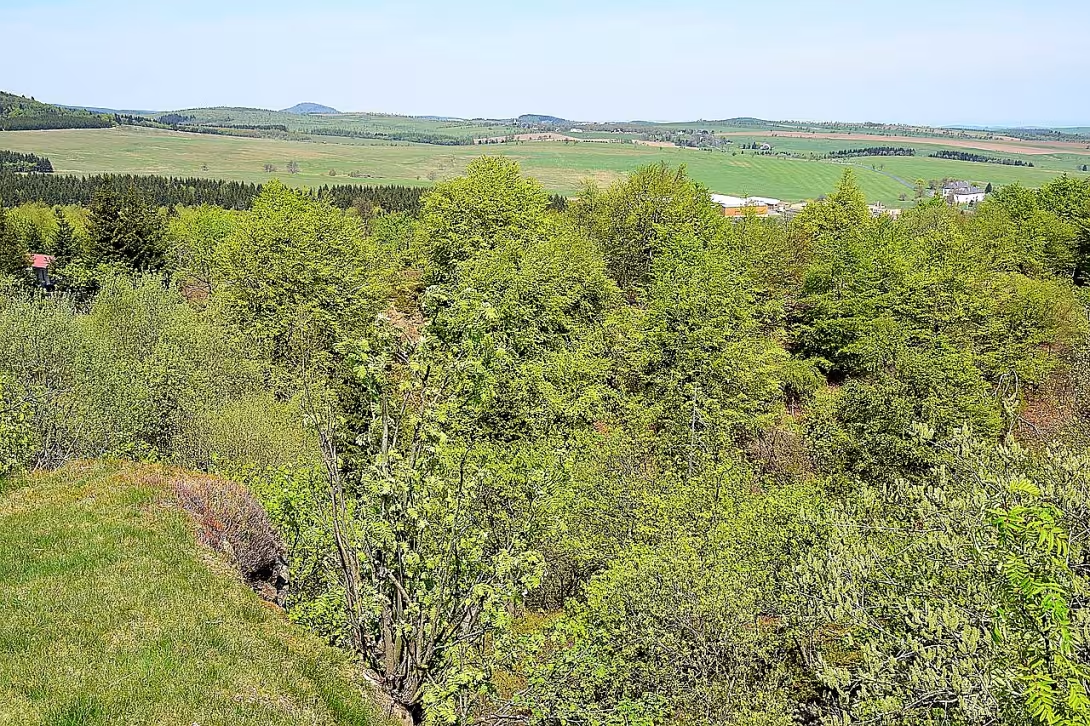
Velká pinka na Komáří hůrce is a remnant of baroque mining works in the Erzgebirge Mountains near the village of Krupka, where tin ore was extracted. It is one of the biggest pinky in the Czech Republic and has been protected as a cultural monument since 2014. The object is evidenced by extensive historical mining in the cadastral territory of Fojtovice.
The first written mention of mining in this site dates back to 1416, although the main mining period lasted from the eighteenth to the early nineteenth century. The production concentrated on a greisen body of 140 × 45 m, which contained minerals of casiterite, chalkopyrite and pyrite. These ingredients were dispersed in rock massively, not in the veins, so initially there was maybe surface mining. Deep mining was started by miners after the surface reserves were exhausted.
Pinka was created in the Baroque as a result of the fall and connection of older and newer mining works. It is already marked on the 19th century maps. It has an oval floor plan of 5,000 m ² and the arched bottom lies at a depth of 75 m The edge of the pinky is lined with a small reduced gallery, probably a remnant of the surface-extracted space.
There were a couple of mine cannons under the pen. The oldest was the Dürrholz Stol, which had favored here at the end of the 15th century. Later, Antoni I, Antoni II, Josef and Martin stones were dug out. The youngest was a mound on May 5th, set out after World War II. At the southwest edge of the pinky in the 1880s, the Glatz mine, also known as Göpelschacht or the Mentour shaft, reached the depth of 200 m. The only visible remnant of it is today rolled out in the turn of the road below the peak of the mosquito hill. Müntzer and Nikolai mines were located nearby.
In 1955 - 1960 a geological survey took place during which the Glatz mine was partially restored. Today the Great Pinka is protected as a cultural monument and commemorates the technical development of the region.
The location offers a unique view of the history of mining in the Erzgebirge Mountains. We recommend to visit her and observe the traces of ancient human activity in the landscape.
Then and now
Drag the slider to compare how the landmark may have looked when it was built with the view today.
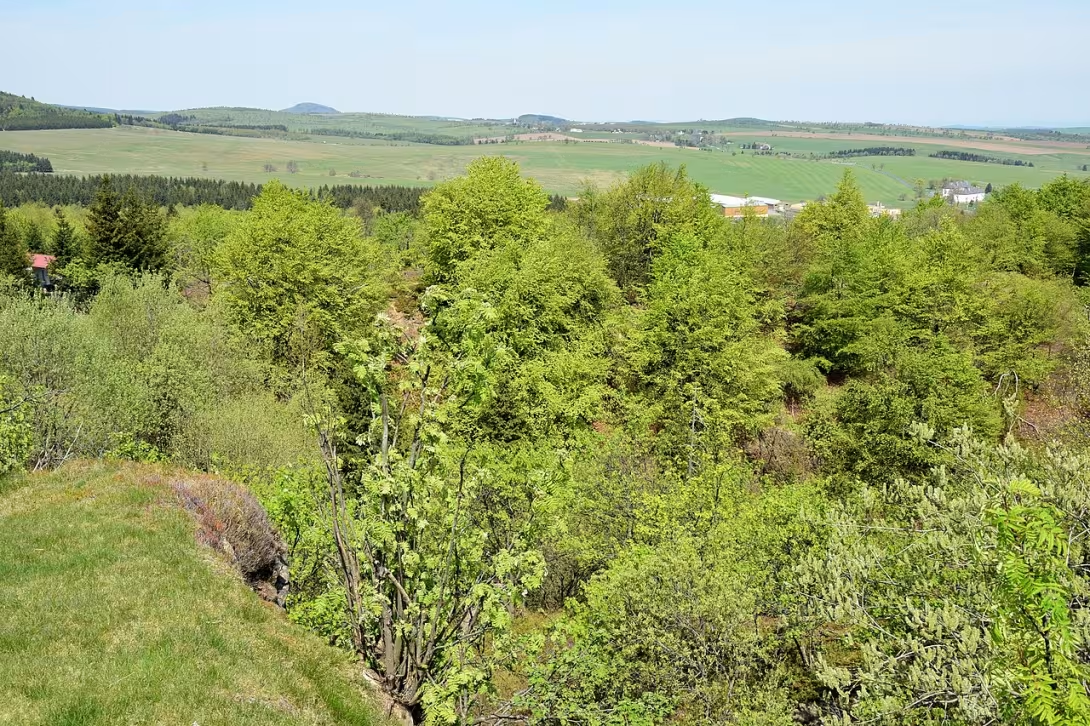
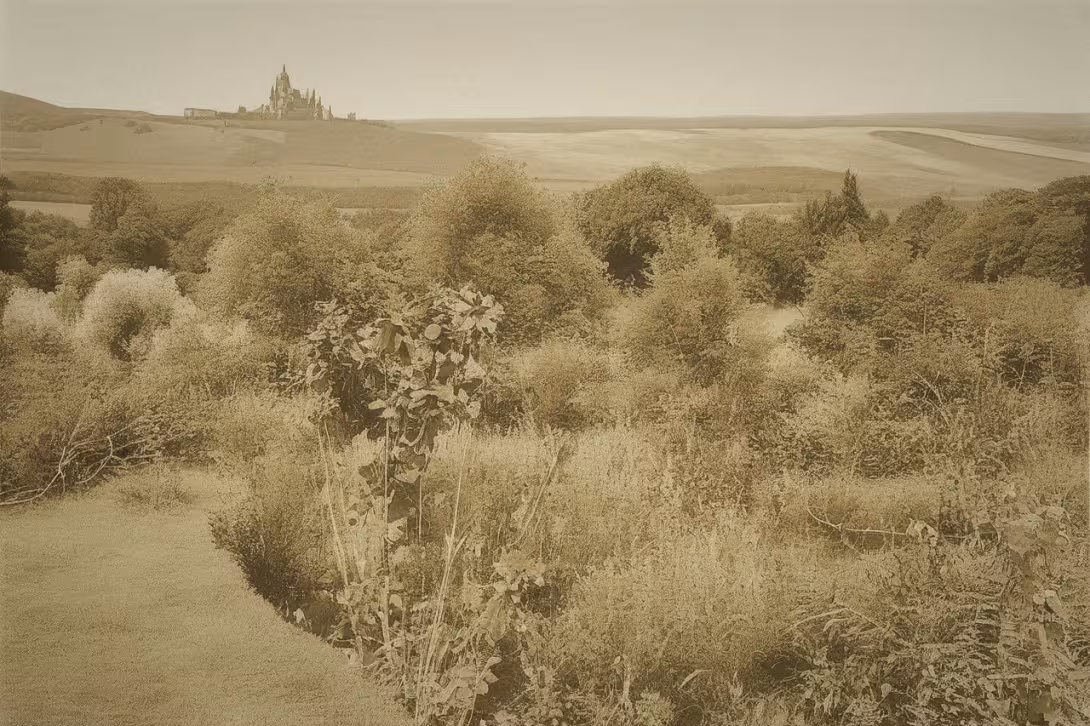
The historical appearance on the left is an AI-generated visualisation and serves as inspiration only.
Historical milestones
- 17th century
- The Glatz mine reached a depth of up to 200 meters.
- 1955-1960
- Partial reconnaissance of mining works.
Architectural development
Pinka was created by the fall of older and newer mining works during the Baroque period. Originally, surface reserves were extracted, and then it went to deep mining.
Historical events
- 1416
- First written mention of mining in the site.
- 18th to early 19th century
- Main mining period of tin ores.
Points of interest
- It is one of the biggest pinky in the Czech Republic and has been protected as a cultural monument since 2014. - The first written mention of mining in this site dates back to 1416. - Pinka was created in the Baroque because of the fall and connection of older and newer mining works. - It has an oval plan of 5,000 m ² and its bottom lies at a depth of 75 m - There were several mining works under it, such as the Glatz mine, which reached the depth of 200 m.
Guide
Show guide text
This text was created by artificial intelligence and has not been editorially reviewed. It may contain inaccuracies.
Welcome, honored visitors, to the heart of the Ernest Mountains, where the history of the earth meets the depths beneath our feet. You're standing in front of the Big Boner on the mosquito hill in Krupek. The first impression of this place may be strange. You don't see any construction in front of you with high walls, no columns or roofs. You see a vast deepening in the landscape, which at first sight can act as a natural phenomenon, but in fact it is a deep trace that man began here and his relentless desire for precious metals. Feel the atmosphere of this place, the silence of the surrounding nature, and imagine what noise and hustle it must have been centuries ago.
In order to understand what a pinka is and why it is here, we must go back to the past together. This site is not just a random slump. It's a remnant of extensive mining works that once served to mine tin ore. Tin was a highly valuable material in these mountains, and people were willing to risk their lives to get as far down as possible. The first written mention of the exploitation in this area dates back to a thousand four hundred and sixteen. So imagine that these hills were used in the late Middle Ages. The mining took place for generations, the tunnels connected, new shafts dug, and the old ones left.
Now pay attention to the shape and dimensions of what you see before you. Big dick isn't just a little hole. It has an oval plan and its surface area is truly impressive, dating back to 5,000 square meters. If you look down, you realize that this depth is going down to 70 meters. It is one of the biggest pink in the Czech Republic. Notice how naturally this space is entered into the field, and yet there is something unnatural in it, something that was created as a result of a dramatic phenomenon.
This huge deepening was not a planned open mine. Its origin is linked to the Baroque period. At that time there was a fall in the surface caused by the connection of older and newer mining works. Imagine the moments when the ground began to collapse under the weight of the earth and due to the exhaustion of the support in the depths. The old corridors, which no one could remember, connected with new exploratory shifts and the surface just collapsed into emptiness. This is how this characteristic form was created, which we now call a pinky.
Now let's think about how deep the people in this area really ventured. In the seventeenth century there was a mine called Glatz. He was the real technical miracle of his time at the time. He reached a depth of up to 200 meters below the surface. That's almost three times the depth of the pinky itself you see. Imagine the thousands of hours of hard work, darkness, moisture and constant danger that accompanied every miner that descended into the depths of the Glatz mine. Although we do not know today the names of the particular architects or builders of these works, their invisible work is etched in this landscape forever. They were thousands of nameless men who, through their sweat and effort, formed the industrial history of our region.
Although this place seems to be a forgotten corner today, scientists and historians have not stopped interested in it. Between a thousand and nine hundred and fifty-five and a thousand and nine hundred and sixty, a partial renewal survey of mining works was carried out in this area. These experts tried to map again what was left of the ancient shafts and corridors to understand exactly how mining took place and how the subsequent sinks occurred. Thanks to these works, we now know much more about the Great Penguin and can see it as a valuable historical document.
The interesting thing that might interest you is that this site is officially protected today. Since two thousand fourteen, Velká pinka na Komáří hůrce has been recognised as a cultural monument. This is a very significant recognition because it is not a classic building with a facade, but a monument to a type of negative architecture. It's a monument to emptiness, a trace of what is no longer there, but what still tells its story about human ambition and human relationship to nature. It is fascinating to think that something that has emerged as a disaster in the form of a decline has today become the protected glory of our mountains.
Now, when you look around you, try to imagine what secrets the depths beneath your feet still hide. Who knows how many other forgotten corridors and shafts are located deep beneath the surface that have never been discovered or mapped. This landscape is like an open book, but some of its pages remain forever covered by layers of clay and stone. The big feather is just one of many windows into this hidden world.
Now I'm leaving you to look in peace and quiet around this fascinating abyss. Walk around the edge of it, perceive the expansiveness of this space, and think about how powerful a man can hit the face of the earth. If you have time, explore the surrounding terrain where you may find yourself near other, smaller traces of ancient mining.
Thank you for spending a moment with us at the Great Pink on Komarí horice. We hope that you are interested in this short trip to the depths of history and that you are leaving with a new look at the Krušnomountain landscape. We wish you a pleasant continuation in your discovery of the beauty and mystery of our region. Goodbye.
Tips for visitors
The best time to visit the Great Pinky in Komáří horrnice is in the spring or autumn season when the weather is favourable and vegetation offers a beautiful view. There are also fewer visitors in these months compared to winter.
Transport to the place is possible by car and public transport.
On a trip to Komáří hornka to bring suitable clothes because the weather can be unpredictable. Also important is something to drink and light eating. In addition, we recommend protective glasses and shoes suitable for walking on uneven terrain.
For shooting the Big Pinky is best selected the time close to dawn or dusk when light is less intense and offers beautiful shading. The best places for the photo can be found after walking around the pinky.
In the vicinity of Komáří hořka, which is available within 30 minutes, there is Krupka, a city known for its historical monuments and cultivated landscape. The place is suitable for families with children due to natural prospects and possibilities for short walks.
Frequently asked questions
Can the monument be visited?
This is a ruin. Such sites are often freely accessible, but some can only be visited with a guide or are closed for safety reasons. We have not verified the current situation – take care and respect any restrictions.
Where is the monument?
Location: Krupka, Ústecký kraj. The map on this page shows the exact spot.
Why is the monument protected?
It is listed in the Central List of Cultural Monuments of the Czech Republic as a cultural monument (register no. 1417931467).
Businesses nearby
Do you run a restaurant, accommodation, shop, museum, rental, wellness or other visitor service near this monument? Show yourself directly to the people heading to it — this is how they will see you in the app and on the web:
Nearby
🏰 Historic sites (176)
- Prohlídková štola Starý Martin 1.4 km
- památník obětem pochodu smrti 1.4 km
- Skanzen důlní techniky 1.4 km
- Památník na bývalé sousedy v ČSR 2.1 km
- Muzeum Krupka 2.4 km Husitská 21/45
- Ferdinand Arlt 2.5 km
- Hrad Krupka 2.5 km Horská 12
- svatého Ducha 2.6 km
- Kyšperk 2.7 km
- hrad Kyšperk 2.7 km
- tvrz Starý dvůr 2.9 km
- Důl V 3.9 km
- Památník 313 obětem pochodu smrti 4.1 km
- Truntschkův kámen 4.1 km
- svatého Prokopa 4.2 km
- Francouzský pomník 4.4 km
- Hromadný hrob 4.7 km
- Francouzský kámen 4.8 km web
- bývalý hřbitov Adolfov 4.8 km
- Pomník bitvy 1813 ve Stradově 4.9 km web
🍽️ Restaurants and dining (298)
- Komáří vížka 0.1 km +420 417 861348 web
- Na růžku 2.9 km
- U Žida 2.9 km 1. Máje 34
- Na střelnici 3.0 km
- Pizzeria bar Týna 3.0 km
- Relax bar 3.1 km web
- Hospůdka Pohoda 3.1 km Bohosudovská 373/11 +420 720 512 801
- Bar Herna 999 3.1 km
- EscoBar 3.1 km
- Mňam kebab & pizza 3.1 km web
- U Hanka 3.1 km
- Maxi club Koloseum 3.2 km +420 777 177 117 web
- Hotel & Restaurant Pod Kaštany 3.2 km
- Hotel & Restaurant Pod Kaštany - areál 3.2 km
- U Václava 3.6 km +420 417 861 700 web
- Chata Florian 4.5 km
- Adolfovský Dvůr 4.6 km
- Kiosk Cvičná louka 4.8 km
- Sokolovna 5.0 km
- Kiosk Buben 5.0 km
🏨 Accommodation (117)
- Horský hotel Komáří Vížka 0.1 km +420417861348 web
- Hotel Horal 3.0 km
- Zur Bergwiese 3.0 km Dorfstraße 14 +49 35054 29660 web
- Mini Hotel 3.9 km
- Bikehütte Rehnhäusl 5.2 km Müglitztalstraße 11 web
- Tereziny lázně 5.6 km Lázeňská 21/3 web
- Hammerschänke 5.9 km Müglitztalstraße 1 +49 35054 25716 web
- Chatová osada a autokemp Chabařovice 6.1 km Přestanovská 685 +420475225518
- Ferienhaus Maaß 6.3 km Kleinsiedlung 23 +49 35056 23550 web
- Ferienhaus Tandler 6.5 km Lindenallee 11 +49 35056 31904 web
- Manhattan 6.5 km
- Hostel im Osterzgebirge 6.6 km Löwenhainer Straße 26 +49 35056 23996 web
- Grumbtmühle 6.6 km Rosengrund 13 +49 35056 35823 web
- Miami 6.6 km
- Ferienwohnung Renner 6.7 km web
- JGH Zinnwald Jägerhütte 7.0 km Bergmannsweg 8 +49 35056 32361 web
- Zlatý Kříž 7.1 km Masarykova třída 2417/43 +420 417 531 343 web
- Waldhotel am Aschergraben 7.1 km Teplitzer Straße 36 +49 35056 23400 web
- Zinnwaldbaude 7.2 km Geisingstraße 4 +49 35056 22552 web
- Hönig 7.3 km Am Huthaus 6 +49 35056 35891 web
🚲 Rentals and sport (40)
- Plavecká hala Krupka 3.5 km U Stadionu 617
- Sport Vision 5.0 km +420 417 533 508
- Killtec 5.1 km +420 417 564 106
- FITNESS shop 5.1 km +420 604 506 441
- D-Sport 5.2 km +420 417 531 406 web
- Sportisimo 5.2 km +420 777 729 068
- Decathlon 5.3 km Srbická 464 +420411134550
- FOOT - BALL SPORT 6.2 km +420 777 590 355 web
- PI SKI SERVIS 6.4 km
- Regal Bike 6.5 km
- Koloshop.cz 6.7 km +420 417 532 677 web
- Sokol Trnovany 6.7 km
- plochá dráha - moto klub Chabařovice 6.8 km
- Armyshop MILITARY RANGE 7.0 km Celní 3369 +420 606 640 545 web
- Sport Lohse 7.1 km Hauptstraße 48 +49 35056 31604 web
- Alpin sport 7.3 km +420 417 534 644 web
- Intersport 7.9 km +420 724 447 788 web
- Ski Zinnwald 7.9 km Neugeorgenfeld 12 +49 1723754007
- A3 SPORT 7.9 km
- Lanový park Teplice 8.0 km
🥾 Hiking and nature (252)
- důlní vozík 0.1 km
- Komáří hůrka 0.2 km
- Komáří vížka 0.2 km
- Holý vrch 1.0 km
- Liščí vrch 1.1 km
- Supí hora 1.9 km
- U hranice 1.9 km
- Sedmihůrská Vyhlídka 2.0 km
- Lysá hora 2.1 km
- Lázeňský vrch 2.5 km
- Loupežník 2.5 km
- Hrad Krupka 2.6 km
- Schillerova výšina 2.6 km
- park Na Plovárně 3.0 km
- Park Herty Lindnerové 3.3 km
- Medvědí vrch 3.4 km
- Traugotthöhe 3.5 km
- Pfarrhöhe 3.7 km
- U Žabáka 3.8 km
- Strádovský vrch 3.9 km
Accommodation nearby
Trips and activities nearby
Guided tours, tickets and activities nearby from GetYourGuide
Affiliate link: if you buy from the partner, we may receive a commission. The price for you does not change.
Search tours and activities →Themed route
Route for a trip from Krupa with a visit to the Great Pinky on Komáří horrka
1.Velká pinka na Komáří hůrce - Type: Historical landmark - Why is it worth visiting: This important statue is a symbol of the history and culture of the region. Her character resembles important events from the past, which makes her not only a visual, but also an emotional center for visitors.
2. Krupka - historical centre - Type: City district - Why it is worth a visit: Krupka offers a beautiful opportunity to explore ancient architectural elements and street landscapes. It's a place where history projects into the present, allowing visitors to feel the atmosphere of past times.
3. Krupka - local museum - Type: Cultural institutions - Why is worth a visit: The museum offers a rich exhibition about the history and culture of the area, including exhibitions related to the memory of the Great Pinky. It is an ideal place for a deeper understanding of the context and meaning of this statue.
4. Krupka - local park - Type: Green Zone - Why is worth a visit: The park provides an opportunity to relax and relax after exploring historical places. It is a place where you can enjoy the natural beauty of the area in a quiet environment.
5. Krupka - traditional restaurant - Type: Gastronomy - Why is it worth a visit: Here you can explore local culinary specialities and learn what is characteristic of regional food. It's a great way to end a day of discovery.
This route offers a meaningful journey from the main sights of the Great Pinky to other attractions around Krupka.
Seasonal recommendations
Spring: In the spring period, the unforgettable experience of the newly reviving nature is spreading in Komáří horice, where trees and shrubs begin to bloom. The sun illuminates the old marble columns of the large pinky with a softer light, creating unique atmospheric effects. Visitors can enjoy a peaceful visit without excessive crowds while looking at the first flowers on the surrounding slopes. It is recommended to visit the height early in the day in order to enjoy the peace and natural lighting without having to face excessive temperatures.
Summer: In summer, Komáří horka is a popular destination for visitors who enjoy bright days and warm sunshine. The view of the surrounding countryside is the most beautiful because everything shines with life. At the top you can enjoy the cool air and beautiful views to the distance. It is advisable to come to a place earlier in order to avoid the larger crowds that often gather here. A gift for bodily well-being is light clothing and sun protection.
Autumn: In the autumn months Komáří hroka melancholic but also beautiful view. Tree leaves turn into a colour palette from yellow to red and orange. The sunlight shines through the fog, giving the ruins a romantic character. This time is ideal for a calmer visit where you can enjoy natural beauty without excessive crowd pressure. It is recommended to visit at noon to record the best lighting and have fun comfortably.
Winter: The winter visit to the mosquito hill offers a unique view of the snow-covered ruins where every detail is amplified in a frosty light. The atmosphere is calm and quiet, which allows you to enjoy solitude between historical walls. It is recommended to wear warm clothes, including leather shoes, and come early in the morning to enjoy a quiet visit.
Visualizations and artistic views


The visualisations are generated by artificial intelligence and serve as inspiration.
Photos from the area
Real photos taken near the monument


Zdroj a licence jsou uvedeny u každého snímku.
Tips from visitors
No tips yet. Be the first!
Log in and add your tip.
Sources and literature
Photos: Petr Kinšt / CC BY-SA 4.0 — Wikimedia Commons. The author and licence also appear when you hover over the image.
Faktickým podkladem tohoto textu byl článek na Wikipedii, jehož autory jsou přispěvatelé Wikipedie. Článek je dostupný pod licencí CC BY-SA 4.0.
Location on the map


Příběhy a pověsti
Legendy, pověsti a příběhy spjaté s touto památkou
Fotografie návštěvníků
Zatím žádné fotografie. Buďte první, kdo přidá fotografii z návštěvy!
Log in a přidejte svou fotografii nebo hodnoťte.
Za ověřenou návštěvu v aplikaci získáte víc bodů — poznáme podle GPS, že jste na místě.
Reviews and comments