






Velký mlýn Water mill
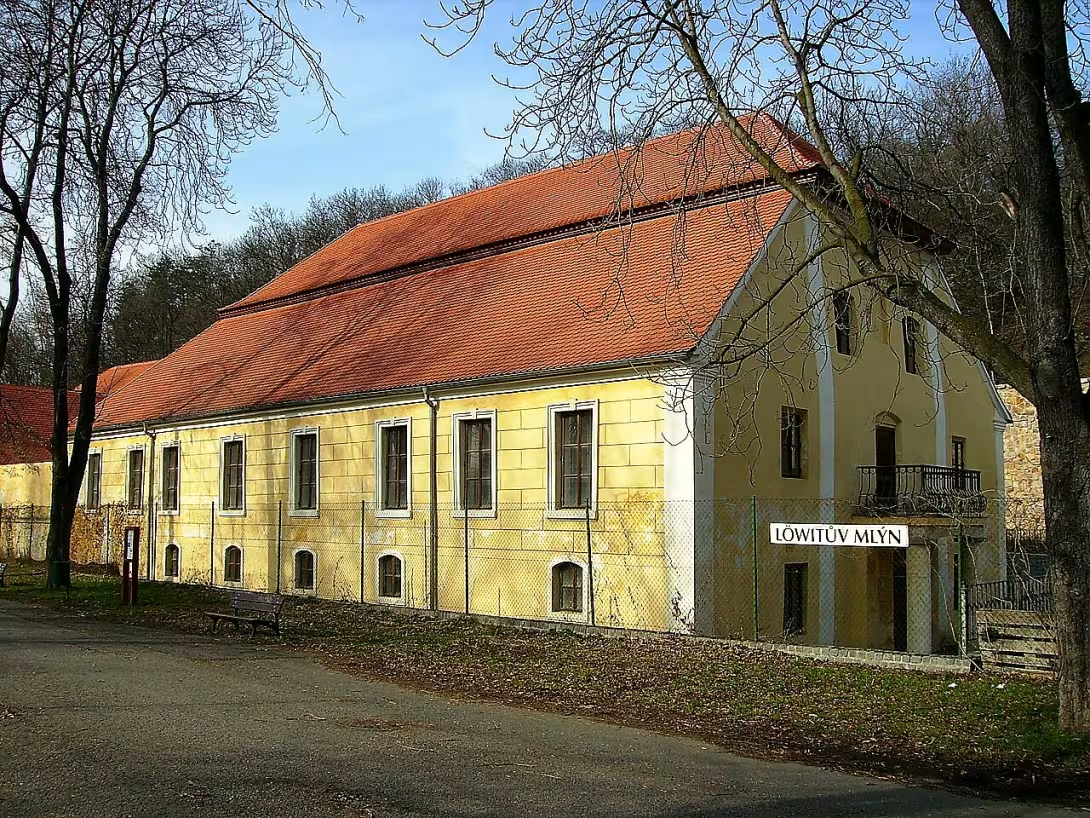
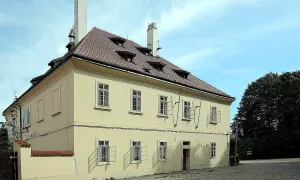
Velký mlýn, also known as the Löwi Mill, is a Baroque building and a cultural monument located in the Thomayer orchards in Prague 8 by the Rokytok River. The current form of the building dates back to 1747 and has been a cultural centre since July 2023.
The first mention of the mill under the Libernese claim states that in 1530 Petr Vosovský z Adleru expanded it with a rag mill for paper production. In 1662 Old Town of Prague bought from Jan Hertvik from Nostic, a liberal estate, which included this mill. During the wars on the Austrian heritage between 1741 and 1744 Libeň was looted and the mill probably destroyed. The building was restored in 1747 and on 10 February 1748 by Jan Sousa under strict conditions.
The main building has a rectangular plan. Originally, the construction was storey, but after increasing the surrounding terrain it is now ground floor with a semi-basement. The ground and floor interior consists of one large space with ceiling supported by a series of carved wooden columns. The original complex also included a saw and water plant, which powered the Liberian castle with a sailing yard.
During the 18th and 19th centuries, the owners were often replaced, among them František Herrl, Eva and Matej Jelinek, miller Alois Ronz or Josef Hála. In 1872 the Vltava River was regulated, during which the mill arm was dried and the mill was abolished. In 1883 he bought the buildings Jáchym Löwit, which had them converted into a bakery. In 1906 the Prague village became the owner of the building. In the 1950s, the building used, for example, as a potato warehouse, and in the 1960s it took over the S. K. Neumann Theatre to store the certificates.
Among the attractions are artificially established islands called the Shrub, which was located between the mill and copper hamro and provided the drive of both devices. The Great Flood in August 2002 flooded the mill up to the roof, which practically destroyed the results of the previous reconstruction from 2001.
In the years 2022 and 2023, the building was adapted in the framework of the project Stop in the mill, whose aim was to revive the unused space and open it permanently to the public. The cultural centre Velký mlýn with cafe and branch of the City Library in Prague was opened on 24 July 2023. In the basement there was a cultural hall designed for concerts or lectures, while on the ground floor there is a library, study room and cafe. Exhibition spaces are built in the attic. The investor of the construction was the association Velký mlýn and the architectural design was developed by AFI and AMBIT studios.
Restoring this historical building allows visitors to explore the history of Libna in a modern cultural environment. We recommend a visit for people interested in history and contemporary cultural events.
Then and now
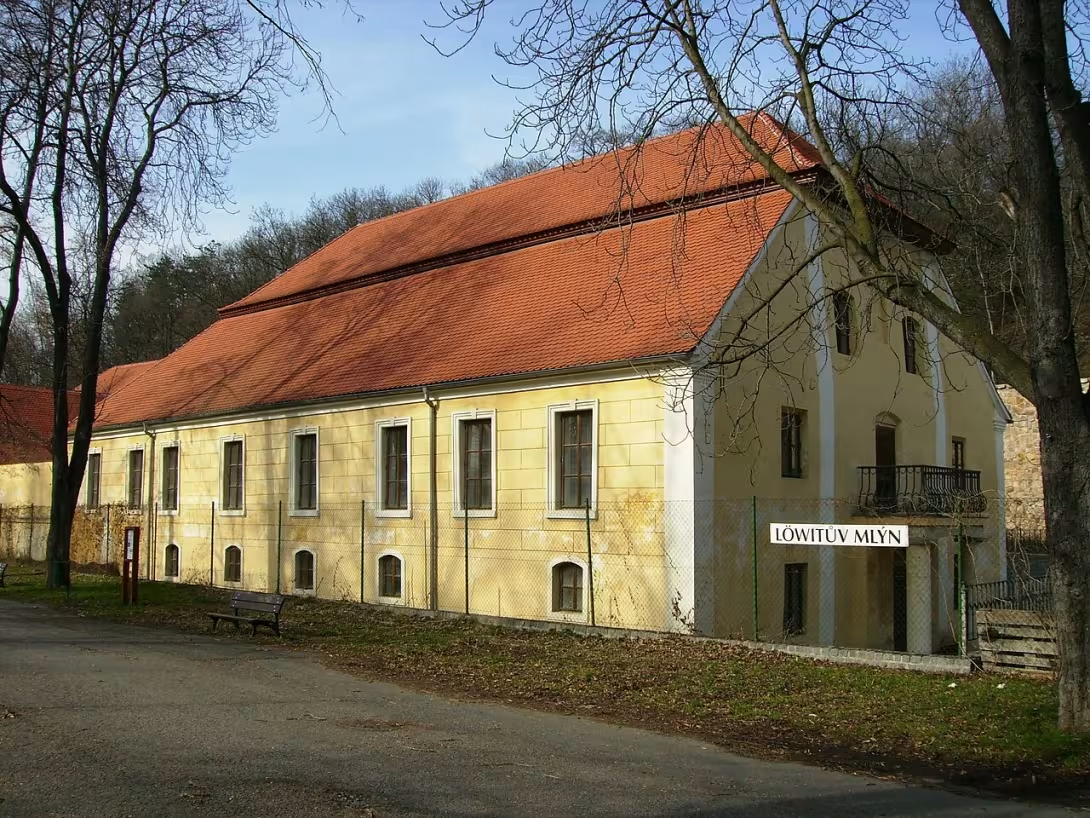
Drag the slider to compare how the landmark may have looked when it was built with the view today.
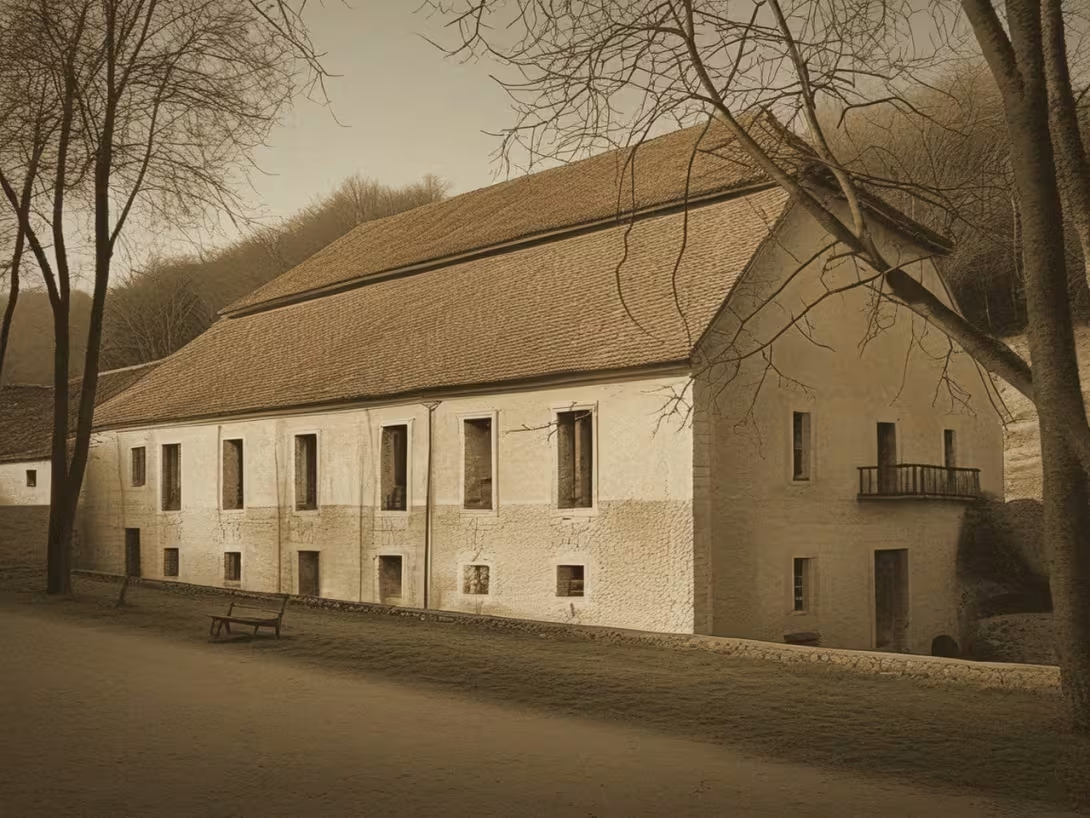
The historical appearance on the left is an AI-generated visualisation and serves as inspiration only.
Historical milestones
- 1530
- extension of the mill to the rag mill for paper production
- 1747
- restoration of the mill after destruction during wars
- 1883
- conversion of the building to the bakery Jáchym Löwitem
- 2023
- opening of the cultural centre Velký mlýn
Architectural development
The building has a rectangular plan with a beam ceiling carried by carved wooden columns. Originally, it was a storehouse, but due to the terrain increase, it is now a ground floor with a semi-basement. In 1883 it was converted into a bakery and in 2022-2023 it was adapted to a cultural centre.
Historical events
1530: extension with a rag mill for paper production; 1741-1744: destruction during the Austrian heritage wars; 1872: cancellation of the mill due to the regulation of the Vltava; 2002: flooding the building with large floods up to the roof.
Owners
Petr Vosovský z Adleru (1530), Old Town of Prague (1662), Jan Soush (1748), František Herrl, Eva and Matìj Jelínek, Alois Ronz, Josef Hála, Jáchym Löwit (1883), Prague village (1906), n.p. Zelenina Praha (50. l. 20 st.), Theatre S. K. Neumanna (60. l. 20 st.), town area Praha 8, association Velký mlýn (investor renewal 2022 / 2023).
Points of interest
- Velký mlýn is also known as the Löwi Mill and is located in Thomayer orchards near the Rokyk River.
- The first mention of the mill indicates that Petr Vosovský z Adleru expanded it with a rag mill for paper production in 1530.
- During the wars on Austrian heritage, Libeň was looted and the mill probably destroyed, but the building was restored in 1747.
- An artificial island called the Shrub was located between the mill and the copper hamer and provided the drive of both devices.
- The Great Flood in August 2002 flooded the mill up to the roof, which practically destroyed the results of the previous reconstruction from 2001.
Guide
Show guide text
This text was created by artificial intelligence and has not been editorially reviewed. It may contain inaccuracies.
Welcome to Libni. You are standing right where the history of Prague meets the calm of the green and noise of the water. In front of your eyes is Velký mlýn, a building that carries within itself a mast of many different epoch. Feel this atmosphere surrounding you. You're in Thomayer orchards, in a space where the Rokytka River is quietly flowing just outside these historic walls. Look at the building around you. Even though her face was changing over the centuries, you still feel the weight and stability that she had to have in order to survive centuries and half a century of uncertainty, wars and natural disasters.
Now let's go back deep into the past together to understand why this place is so special. The story of this place is not just the story of the house, but the story of the human struggle for development and renewal. The first clues that history has left us about this place go back to 1500. During this period, a major event took place here, which determined the direction of future use of this place. Petr Vosovský z Adleru decided to expand the mill and added a rag mill for paper production. Imagine the activity at the time, the constant movement of the water that was powered by the machines, and the specific process of paper production that was at that time absolutely crucial to the spread of knowledge.
But history has not always been about work and progress. The libertine you are in has been through difficult times. During the wars on Austrian heritage this area was filled and the mill was probably destroyed. What you see before you today is the result of a major recovery that took place in 17, 47. It is this reconstruction that has given the building its present, historical form, which you can now perceive. It is proof that even after complete destruction, the place can regain its glory and continue its mission.
Now pay attention to the architecture and how the function of this object changed depending on the needs of the time. If you look at the structure of the building now, feel its mass. Even though her appearance has transformed, you still feel the legacy of those old crafts. Over the centuries, the mill has ceased to be used for grinding grain or making paper and has started to serve other purposes. One of the most significant breakthroughs was the reconstruction in the year of the thousand eight hundred eighty-three. That's when the object became a bakery. Imagine the huge contrast - instead of the noise of water and paper production there was the ubiquitous smell of freshly baked pastries and the noise of people working at the ovens. This transformation process was performed by Jáchym Löwit. It is thanks to him that this object in people's memory has also become known as the Löwi Mill.
The names you can hear here are not just the names in the textbooks. Jáchym Löwit, Petr Vosovský z Adleru and Josef Hála are characters that are closely connected to this place. Each of these personalities has brought a piece of their lives and vision into this space. Now when you look at the walls and the facade, remember that every floor and every corner of this building have passed through the hands of the people who built their existence here.
But there is also a shadow side to this story that gives a special melancholy to the place. Notice how easy the Rokytok is now flowing. But in the year two thousand and two, this river left a trail of devastating flooding around. Velký mlýn was hit hard after this disaster and subsequently remained unused for a long time. It was a period of silence and emptiness when the building stood abandoned and waited for what would come next. This era of uselessness may have meant the end of this place, but instead it became a waiting period for a new beginning.
And it is this new beginning that is what you are experiencing today. Velký mlýn has undergone an incredible transformation. From an industrial facility, from a bakery and from a warehouse he became a modern cultural center. Since July in the year two thousand and twenty-three years life has been pulsing here again, but in a completely different rhythm than when the ground grain or bread was baking here. Today it is a place of meeting, art and culture, which once again connects people, just like the mill did centuries ago, in a different way.
In front of you, a space is opening up that is ready to invite you into its inner space. Let yourself drift through the atmosphere of this place, explore its new premises and realize that right now you are becoming part of another chapter of its long and fascinating history. Velký mlýn is no longer just a monument to the past, it is a living part of the present.
Thank you for sharing this story with us. We wish you a pleasant walk through the Thomayer orchards and many other interesting experiences in the next survey of this beautiful part of Prague. We'll say goodbye, but we believe we'll meet you in the next historic corner.
Tips for visitors
For the best experience we recommend a visit during the late afternoon when the light is softer and the surrounding greenery in Thomayer's orchards are most peaceful.
The mill can be easily reached by public transport and by car; please check the current traffic connections and parking possibilities in this part of Prague before travelling.
Take with you comfortable shoes suitable for nature walks and plenty of drinking water. If you plan to stay in the area longer, it is good to have some refreshments with you.
For the best photos we recommend to use the reflection of the historical building in the Rokoda River surface. The best light to capture details of architecture is during late afternoon hours.
Within a short walk you can visit A Liberian castle or walk along the River Rokytok. For families with children are ideal Thomayer sets that offer plenty of room for free movement and rest.
Businesses nearby
Do you run a restaurant, accommodation, shop, museum, rental, wellness or other visitor service near this monument? Show yourself directly to the people heading to it — this is how they will see you in the app and on the web:
Events nearby

Zdroj akcí: otevřená data měst a obcí ČR (Národní katalog otevřených dat) a kalendář akcí Národního památkového ústavu.
Nearby
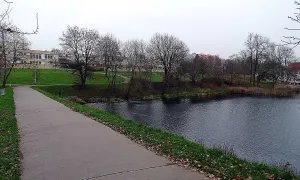
Thomayer orchards, River Rokytka, Liberian Castle.
Accommodation nearby
Trips and activities nearby
Guided tours, tickets and activities nearby from GetYourGuide
Affiliate link: if you buy from the partner, we may receive a commission. The price for you does not change.
Search tours and activities →Themed route
1. Liberian Castle (Castle) - A historical object that serves as a great introduction to the discovery of this location. 2. Thomayer sets (park) - Ideal place to relax in a pleasant green environment. 3rd River Rokytka (water flow) - A natural route guide that offers a view of the local water landscape. 4.Velký mlýn (mill) - The main destination of the trip, which represents a fascinating technical monument.
Seasonal recommendations
In spring the surroundings of the mill awaken to life and the fresh green in combination with the mild sun creates a fresh atmosphere. It is an ideal time for walking along the water when the light is fine and suitable for photography. I recommend wearing layered clothes because morning cold can be tricky. The best thing is to visit the memorial in the morning before the first hikers start gathering here.
The summer season brings intense lighting and a full bloom of surrounding nature, which gives the place dynamism and energy. The air is hot and the surroundings of the mill are very lively. Due to the main summer season expect larger crowds of visitors, therefore come first thing in the morning. Choose light, breathable clothes and don't forget enough fluids to enjoy a hot tour in peace.
Autumn paints the landscape around the mill into golden and brown tones, while the morning mist above the water gives the memory a mysterious and melancholy mood. The light is softer and greener in this period, which highlights the details of the construction. It's practical to carry a waterproof jacket and tight shoes. I recommend a visit in the afternoon when the atmosphere is most calm.
In winter, the Velký mlýn works silently and monumentally, especially when the landscape is covered with snow or freeze. Short days and dim light create an intimate mood that is typical of advent time. Don't forget to wear very warm clothes and high-quality shoes so that the freezing air by the water doesn't discourage you. Pay attention to opening times that are shorter in this period.
Visualizations and artistic views


The visualisations are generated by artificial intelligence and serve as inspiration.
Photos from the area
Real photos taken near the monument

Zdroj a licence jsou uvedeny u každého snímku.
Tips from visitors
No tips yet. Be the first!
Log in and add your tip.
Sources and literature
Photos: Petr Vilgus / CC BY-SA 3.0 — Wikimedia Commons. The author and licence also appear when you hover over the image.
Faktickým podkladem tohoto textu byl článek na Wikipedii, jehož autory jsou přispěvatelé Wikipedie. Článek je dostupný pod licencí CC BY-SA 4.0.
Location on the map
Příběhy a pověsti
Legendy, pověsti a příběhy spjaté s touto památkou

Fotografie návštěvníků
Zatím žádné fotografie. Buďte první, kdo přidá fotografii z návštěvy!
Log in a přidejte svou fotografii nebo hodnoťte.
Za ověřenou návštěvu v aplikaci získáte víc bodů — poznáme podle GPS, že jste na místě.
Reviews and comments