



Věnec Hillfort
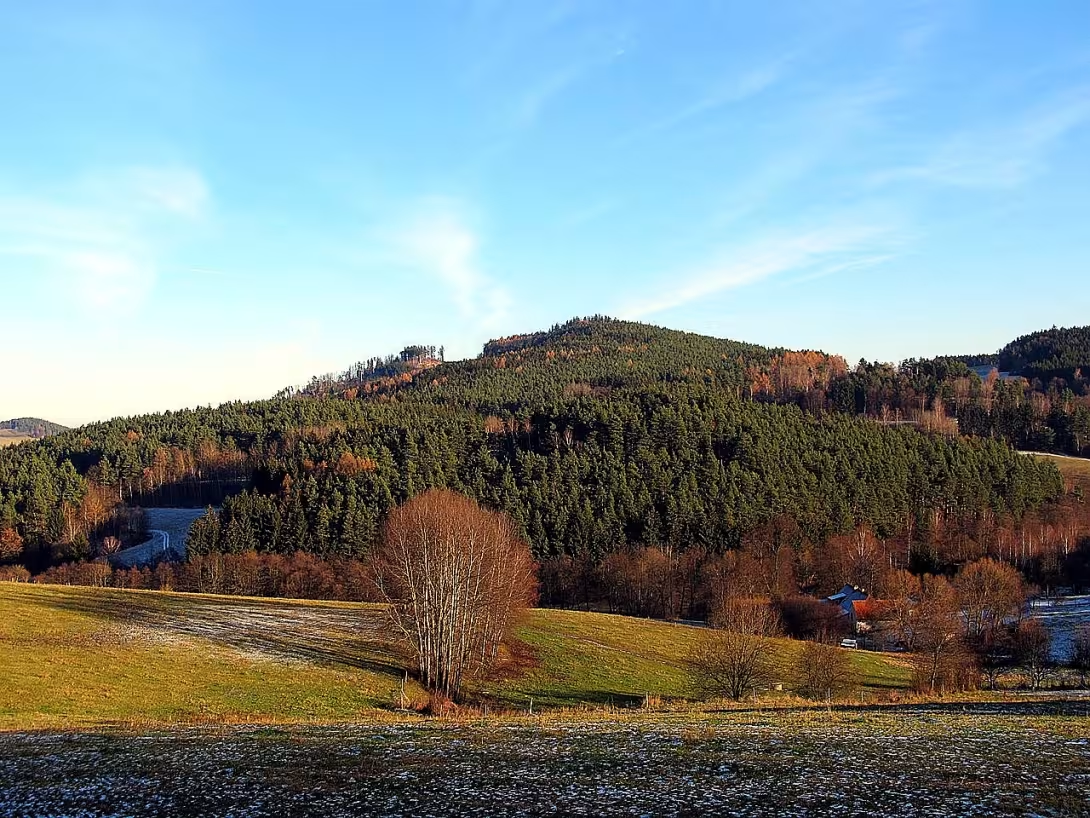
Věnec is an archaeological site located at the top of the same-name hill in the Bohemian foothills, two kilometers southeast of Zalezel. This ancient site is a remarkable history dating back to the late period of the Halštat and the early period of the Latin, when it was created as a high settlement. Although its precise function remains uncertain, it could be a place of cultural, commercial or representative importance. The peak of Vranice is protected as a cultural monument and its area is approximately eight hectares.
The first mention of the castle on the Reich was made by Johann Gottfried Sommer in 1840. The history of this place is rich; The archaeological examination was carried out by Jan Nepomuk Woldřich and J. V. Želízko in the second half of the nineteenth century. However, the most important information came from the research of Bedřich Dubský from 1919-1920. During it were found cultural layers with fragments of ceramics and metal objects, including part of bronze belt from the 6th to 5th century BC. These findings suggest that the castle was created late in the Hallatian to early in the Latin era, while the use of the site continued at the end of the Latin era. Interestingly, the Věnec served as a high settlement in the Stone Age.
The fort uses natural protection on the north side of the hill. This section is defined by a 270 m long rock wall with a perpendicular profile and a height of 10 to 15 meters, which forms the dominant acropolis. The total length of the perimeter fortification is about 1530 metres. The acropolis on the north slope has an area of approx. 0.5 ha and its entrance is located on the south side. In the New Testament, the gate was adapted for easier wood welding. The rest of the castle demarcates the outer wall in the southwest part, which separates the vast eastern and northern territories. This wall was partially damaged in forestry work. The original wall was probably made up of drywall stones, reinforced on the outside by a face wall.
The peak of Vrice is freely accessible thanks to tourist routes. The blue marked path leads from Hradčan to the railway stop Lčovice on the Strakonice- Volary track, while the red route turns straight to the top of the acropolis. The location offers not only historical findings, but also beautiful views of the surrounding landscape.
Today, Věnec is an attractive target for lovers of archeology and tourists interested in Czech history. Accessibility and rich past places make it an ideal destination. The peak offers a unique view of the past, where ancient fortifications mingle with the natural beauty of Šumava. Exploring the castle is not only a way to history, but also an opportunity to think about the development of human societies and their interaction with nature. Visiting this place is an excellent opportunity to get to know one of many historical monuments in the Czech Republic.
Historical milestones
- about 800 bc.
- The use of a place as a high settlement in the Stone Age.
- end of 6th to beginning of 5th century b.c.
- Finding part of the bronze belt, which suggests the formation of the castle in the late period of the Hallatians.
- 1840
- The first mention of the castle on the Vranice was made by Johann Gottfried Sommer.
- second half of the 19th century
- The archaeological examination was carried out by Jan Nepomuk Woldřich and J. V. Želízko.
- 1919-1920
- The most important research was carried out by Bedřich Dubský, which discovered cultural layers with ceramics and metal objects.
Architectural development
The fort uses a natural 270 metres long rock wall on the north side. The other parts of the acropolis and the outer circle are defined by the walls of dry laid stones, probably reinforced by the face wall. In the new age, the entry into the acropolis was modified to facilitate the tying of wood.
Historical events
In 1840, the first mention of the castle was in the work of Johann Gottfried Sommer. In 1919-1920 there was a comprehensive archaeological research of Bedřich Dubský.
Points of interest
- Věnec is an archaeological site located on top of the same-name hill in Šumava foothills. - The first mention of the castle on the Reich was made by Johann Gottfried Sommer in 1840. - The most important information came from the research of Bedřich Dubský from 1919-1920 when cultural layers with fragments of ceramics and metal objects were found. - The fort uses natural protection on the north side of the hill, which is defined by a rock wall with a perpendicular profile. - The peak of Vrice is freely accessible thanks to tourist routes and offers not only historical findings, but also beautiful views of the surrounding countryside.
Guide
Show guide text
This text was created by artificial intelligence and has not been editorially reviewed. It may contain inaccuracies.
Welcome, distinguished visitors. Please stop for a moment, take a breath and look around you. Right now you are standing on the top of Mount Věnec, in the beautiful Šumava foothills, just a short walk from the village of Zalezel. What you see before you may not look at first glance like a monumental building we know from cities, but beneath your feet and in the surrounding terrain is a fascinating story of thousands of years of human existence. You are standing in the place of a primordial castle that carries traces of many generations of people here looking for safety, sanctuary, or maybe even a connection with higher forces.
If you look at the area of this place, you realize that you're moving in a space that occupies approximately eight hectares. It is a considerable area, which, in times of its greatest fame, must have been very dominant in the surrounding landscape. To understand how this place happened, we need to move very far into the past in our minds. The use of this hill as a high estate began already in the Stone Age, thousands of years ago, when people were looking for strategic points in the landscape that gave them an overview of the surroundings and natural protection. Imagine the first people who came here, watched the valley, and decided that this very summit would be their home.
But, over time, people's needs have changed and the way they used this place. Around the eighth century BC, something much more complex began to develop here. In the late period of the Halštatian and then in the early period of the Latin, the castle itself formed here. This was no longer just an easy settlement, but a fortified space. Although we do not see tall walls of stone today, at that time there were probably barriers that separated the inner space of the castle from the outside world. Notice the terrain around you and try to imagine the effort that the people had to make to adjust this peak for their needs.
The key to understanding this place was the findings that tell us stories today about the people who lived here. One of the most important evidence of the origin of the castle from the period of the Halštats was the finding of part of the bronze belt. This subject, although it may sound like a minor detail today, was a vital clue for archaeologists. The bronze belt tells us about the social status of the people who lived here, their craftsmanship and trade relations with the surrounding areas. Imagine a man wearing this belt walking around the same place you're standing now.
The history of this site is not only about prehistoric, but also about the people who tried to decipher it in the newer times. The first one was Johann Gottfried Sommer, which in the year eight hundred and forty presented the first mention of the castle on the Gentiles. Sommer was a man who saw more than trees and stones in the landscape, and could read the traces of ancient history. His observations opened the door for other researchers. In the second half of the nineteenth century, Jan Nepomuk Woldřich and J. V. Želízko joined the research. These men, with patience and care, examined the surface and layers of soil to understand what once happened here.
However, Bedřich Dubský wrote the most important chapter in getting to know the wreath in the years one thousand nine hundred nineteen to one thousand nine hundred twenty. It was his research that brought the most answers. Dubský discovered cultural layers which were full of ceramics and metal objects. Every piece of clay dishes, every piece of metal was like a word in a forgotten book. Thanks to his work today we know that Věnec was not just a random gathering of people, but an organised place with a clear structure.
But now we get to the part that is perhaps most fascinating. Despite all research and findings, the function of this premises remains uncertain. That's the big mystery of Vence. Was it just a fortified settlement where people lived and protected their property? Or did the buildings have a different purpose here? Some experts suggest that the fort could serve as a cult place. Imagine this - a place where people gather to worship their gods, sacrifice gifts and seek answers to the questions of life and death. The peak of the mountain, the proximity of the sky and the isolation from the ordinary world make it an ideal place for religious rituals. Is it possible that Věnec was a spiritual centre for the whole area? This question remains open and is left to your imagination.
Now, when you look around, feel the atmosphere of this place. Věnec is today protected as a cultural monument, because it is a unique testament to how mankind evolved in our borders. From simple stone age hunters and collectors to bronze and iron masters to modern scientists trying to reconstruct the past. All these layers of time are present at the same time.
Notice how quiet this space is, and think about how many voices there were a thousand years ago. This is probably where important things were decided, where people met in conflict or here in the room they grew their crops and raised animals. Every meter of land you walk on can hide other secrets that have not yet been revealed.
Now let's move on slowly. I ask you to walk quietly throughout the castle area. Follow the lines of the terrain, feel the wind in the trees and try to imagine what this peak looked like two thousand years ago. Do not search here for ruins in the form of high walls, but look for them in a sense of place and landscape that is the best archive of our history.
Thank you for spending time with us on the wreaths. We hope you are interested in this journey to the depths of time and that you are leaving with a new look at the landscape of Šumava's foothills. We wish you a pleasant continuation in exploring the surroundings and the joy of discovering other hidden treasures of our history. Goodbye.
Tips for visitors
For the best visit experience we recommend to arrive in spring or autumn months. In this period nature is the most beautiful around the castle and temperatures are more pleasant for walking in the field.
Transportation to the place is possible by car or public transport. For current transport connections we recommend using internet search engines.
Since this is an archaeological site in nature, remember to bring comfortable shoes, plenty of drinking water and small snacks. There is no permanent service on site.
For lovers of photography are the best moments at sunrise or sunset, when light beautifully highlights the shapes of the castle. For families with children this location is ideal for a common walk and exploring history in the forest.
Frequently asked questions
Can the monument be visited?
This is an archaeological site. Often there is little to see on the ground and the land may be private. We have not verified access.
Where is the monument?
Location: Jihočeský kraj. The map on this page shows the exact spot.
Why is the monument protected?
It is listed in the Central List of Cultural Monuments of the Czech Republic as a cultural monument (register no. 1000139119).
Businesses nearby
Do you run a restaurant, accommodation, shop, museum, rental, wellness or other visitor service near this monument? Show yourself directly to the people heading to it — this is how they will see you in the app and on the web:
Events nearby

Zdroj akcí: otevřená data měst a obcí ČR (Národní katalog otevřených dat) a kalendář akcí Národního památkového ústavu.
Nearby
Hradiště se nachází v Šumavském podhůří v blízkosti obce Zálezel a železniční zastávky Lčovice.
Accommodation nearby
Themed route
1. Ločovice, railway stop, ideal place to start the journey by train. 2. The climbing, the village, the passage through this settlement will lead you to the goal. 3. The Bohemian foothills, the area, this part of the route will guide you through the beautiful landscape. 4. Věnec, archaeological site, main destination of the trip where you can explore the ancient castle.
Seasonal recommendations
In spring the site comes alive thanks to lush green and blooming flowers that gently cover old stones. The atmosphere is full of hope and light is soft, which helps in observing the details of ruins. We recommend to wear more layers of clothing and wear waterproof shoes, as the roads can be muddy after the rains. It's best to visit the place in the morning.
The summer season brings a sharp sun and rich color landscape, where dry grass surrounds the remains of buildings. The air shakes the heat and the monument acts monumentally under the clear sky. Due to the great crowds in the high season, come very early in the morning. Don't forget the hat, sun cream and light, breathtaking clothes.
The autumn turns the surroundings into a sea of golden and red leaves that create melancholy contrast with grey ruins. The frequent fog gives the place a mysterious touch, and the silence is deeper. Suitable shoes with fixed soles and waterproof jacket. The ideal time to visit is the late afternoon when the sun paints stones into warm tones.
In winter, the ruins are covered with white snow, highlighting their outlines and creating a calm, almost dream scene. Nature sleeps, and there is absolute silence in the surroundings. It is necessary to wear warm winter clothes and firm shoes against slipping. Count on shorter opening times and we recommend a visit at noon when the most light is.
Visualizations and artistic views


The visualisations are generated by artificial intelligence and serve as inspiration.
Tips from visitors
No tips yet. Be the first!
Log in and add your tip.
Sources and literature
Photos: Krabat77 / CC BY-SA 3.0 — Wikimedia Commons. The author and licence also appear when you hover over the image.
Faktickým podkladem tohoto textu byl článek na Wikipedii, jehož autory jsou přispěvatelé Wikipedie. Článek je dostupný pod licencí CC BY-SA 4.0.
Location on the map




Příběhy a pověsti
Legendy, pověsti a příběhy spjaté s touto památkou
Fotografie návštěvníků
Zatím žádné fotografie. Buďte první, kdo přidá fotografii z návštěvy!
Log in a přidejte svou fotografii nebo hodnoťte.
Za ověřenou návštěvu v aplikaci získáte víc bodů — poznáme podle GPS, že jste na místě.
Reviews and comments