



Větrný mlýn ve Tvarožné Windmill
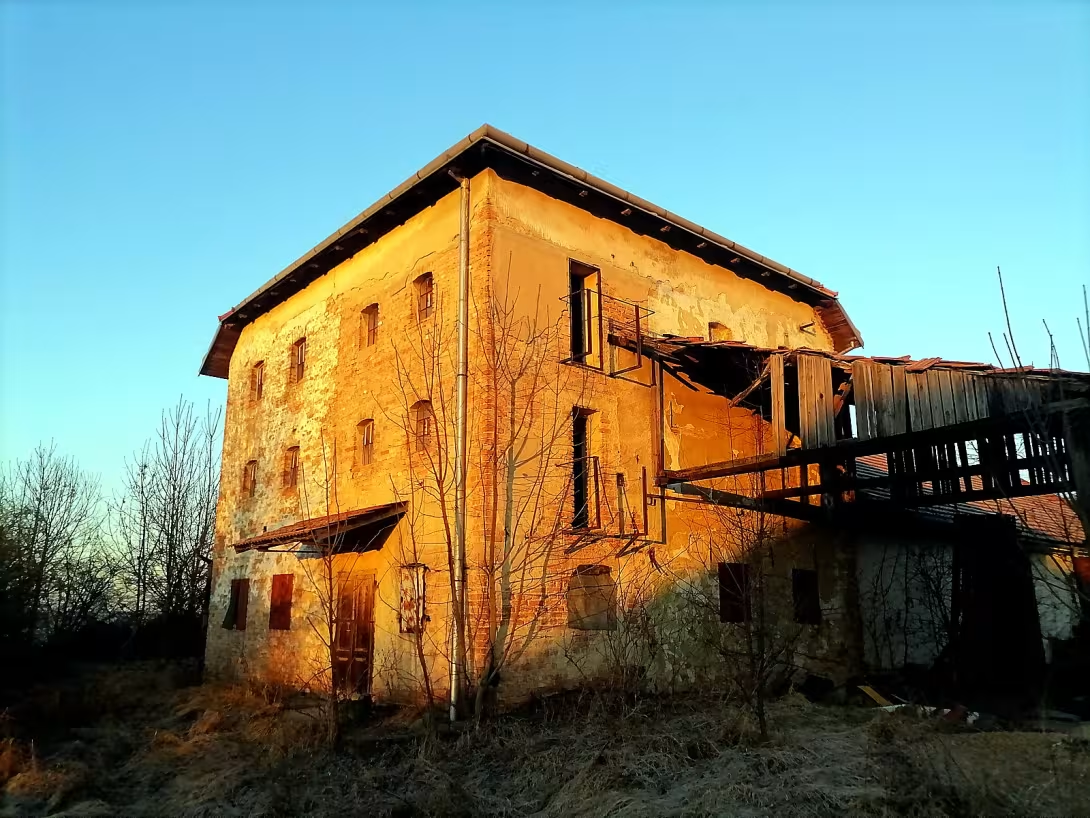
Větrný mlýn ve Tvarožné is a former mill of German type. It stands southwest of the village on the border of the natural monument of Santon in the district of Brno-rural. It is important with its unique technical construction with turbine on the roof and since 1992 it has been protected as a real-estate cultural monument of the Czech Republic.
The mill with four blades was built by the local carpenter master František Formánek. Its existence is already documented in 1880. Over time, the construction unit underwent several technological modifications that reflected the industrial development at the time and efforts to modernise the operation.
The building body of the mill has a three-storey construction on an almost square plan with dimensions of 10 × 10 meters. The total height is 12.6 meters. The roof is covered with eternity and has a specific shape - from two sides it is mansarde and from two sides it acts as saddle. In the main facade there is an asymmetrically located rectangular entrance with a counter roof. The floors are broken by four segmented sealed windows with bars. From the northeast side of the mill is added a plank annex with a counter roof. The facade of the house next to this annex contains rectangular entry holes on the first and second floors. On the second floor there are also two segmental arched window openings. On the opposite side facade are asymmetrically placed two now walled rectangular holes, while in the floors it is located after one segmented window.
His daughter Bahnerová owned the mill after František Formanek. Her three sons were also miller, of whom Karl remained in the Shakra. Historical sources suggest that modernization with the installation of the Halladay turbine on the roof probably occurred around 1890. In 1900, the building was already equipped with this turbine. After World War I, the mill went through another significant reconstruction. A three-storey building was built and a dynamo was installed with a triplicate of gingerbread for electricity generation. In the 1920s, the turbine was replaced by a petrol engine and later by a gas engine. During World War II, the widow Bahnerová was blacked out, which led her and her associates to end up in Nazi prison. After the war, she ran the mill until she died in 1955.
The technical solution of the mill was unusual for the time being because the turbine was placed on the roof platform on the mast. It had a diameter of at least 14 metres and had two wreaths of blinds which were controlled together. The change in their inclination made it possible to use wind energy better, while protecting devices with strong wind or wind. A double directional rudder was used to automatically rotate the turbine upstream of the air current, which increased power. The remains of original technical equipment have been preserved in the attic.
Currently, the mill is accessible within the tourism area. In its vicinity leads a yellow marked route 7540 from Šlapanice to Hosterádek-Rešova and also the bike route "Napoleon." The area is attractive to visitors thanks to the neighbouring natural monument of Santon.
The object represents a rare example of the technical history of wind grinding. Its architecture testifies to gradual modernization over the centuries. It is a suitable destination for tourists who are interested in the technical monuments and history of the region.
Historical milestones
- 1880
- Position of windmill František Formánek.
- 1900
- Modernization with the Halladay turbine and other modifications.
- 1918
- Installation of dynamo for power generation after World War I.
Architectural development
The mill experienced several stages of development. The original construction from 1880 was modernized by the installation of a turbine and later dynamo for electric energy. Over the years the mill was rebuilt, which included the construction of a three-storey building.
Historical events
- 1890
- Modernization of the mill by installing the Halladay turbine.
- 1918
- Further modernization after the First World War with three storey building and dynamo for power generation.
- 1955
- The death of Bahner, who ran the mill after World War II.
Owners
František Formánek (1880), Bahnerová and her son Karel (after 1900)
Points of interest
- It has a unique technical construction with a turbine on the roof platform on the mast. The turbine had a diameter of at least 14 meters. - It was built by a local carpenter master František Formánek and its existence is documented in 1880. - During World War II, the widow Bahnerová was blacking out, which is why she ended up in Nazi prison. - After World War I, a dynamo was installed for electricity generation. Later, the turbine was replaced by a petrol and gas engine. - Since 1992 it has been protected as a real-estate cultural monument of the Czech Republic.
Guide
Show guide text
This text was created by artificial intelligence and has not been editorially reviewed. It may contain inaccuracies.
Welcome to this special place, which is a living witness to human work and the power of nature. You're standing in front of a windmill in Sharožny, and you're probably the first to be approached by the view of his silhouette, as it stands against the sky. Feel this space, feel this air flowing here. You are in a place where you touch the boundaries of the natural monument of Santon, in an area where nature and history form one inseparable whole. Look around you and let yourself drift through the atmosphere of this place, which has been standing here for over a hundred and forty years watching the changing world.
Now let's go back deep into the past together to understand how this mill came into being. More than 14 decades ago, exactly in the year of the 1880s, this building began to be built here. It was not the work of an unknown builder, but the work of a man who knew and loved this country. Built by a local carpenter master, a man named František Formánek. Imagine his efforts, his hands, which had to carefully carve and connect wood to form such a durable and functional structure. This mill was built according to the German model, which manifests its specific technical solution and overall appearance. Since its inception this mill has been an important point for the local community and its importance has been so great that since the year one thousand nine hundred ninety-two it has now been protected as a real-estate cultural monument of the Czech Republic.
Now pay attention to what you see right in front of you. Notice the four large blades that are so typical of this type of mill. These are the parts that in the past were constantly spinning under the wind and turning its invisible power into useful work. But if you look up, you'll see something really unusual. Look at the roof platform and the mast that stands out. There was a very special and advanced technical component, a wind turbine. This construction was at that time absolutely exceptional and technically very demanding. The turbine had a huge dimension, its diameter was at least 14 meters. Imagine the monumental nature of this huge device spinning high above the ground to capture every breath of wind.
This mill was never a static thing, it was constantly evolving and adapting to new times. In the year of a thousand and nine hundred there was a significant modernization when this new wind component was added to the construction to increase its efficiency. And then there was another major breakthrough. After World War I, around a thousand nine hundred and eighteen, the mill became even more modern. It has installed an electrical power plant. Imagine the revolution where the force of the wind turned not only into the motion of machines, but also into light and electricity, which changed the lives of people around it.
But every such building also carries human destinies, which are often much stronger than the wood and stones themselves. In addition to Formanek's founder, we must mention the name Bahnerová here. Her story is linked to a very difficult and ambiguous time. During World War II, something unusual happened when the world collapsed into chaos and fear. The widow Bahnerová was here in secret, in secret. It must have been a job full of tension and constant threat, working in silence and secrecy to ensure essential needs while there was great unrest around. This mill wasn't just a building for her, it was a survival tool at a time when everything else was uncertain.
The interesting thing that may surprise you is the extraordinary technical design you saw looking up. This mill is not just a simple mill, it is a unique technical machine, which, thanks to its turbine on the mast, was a technological peak throughout the region. That vast area of wind equipment, which revolved high above the roof, must have been a sight for the people at the time, which was both astonishing and respectful of human ingenuity.
Now I won't hold you any longer. I'm going to ask you to stop for a while, perceive the atmosphere of this place, and let your imagination carry you. See the surrounding landscape, see the calm that exists here, and realize how much this mill fits into it. It's part of the landscape that stands here and lasts. Thank you for spending this moment with us in discovering the history of this place. I wish you a nice continuation of the tour and enjoy every moment in this wonderful nature.
Tips for visitors
The best time to visit is late afternoon when the sun hits the mill at a pleasant angle and highlights the details of its German architecture.
We recommend to take with you comfortable shoes suitable for the field, as the mill lies on the edge of the natural area and there are pavements in the surrounding area.
For the best photos look for angles that capture the mill and surrounding landscape. The ideal light is shortly before sunset.
In the immediate vicinity is the natural monument of Santon, where the tourist route leads, which is also a great destination for families with children.
Frequently asked questions
Can the monument be visited?
This is a technical monument. Some are open as exhibitions, others are out of use or on private land. We have not verified whether this one is accessible.
What are the opening hours and admission?
We have not verified the opening hours or admission. Current information is published by the operator.
Where is the monument?
Location: Tvarožná, Jihomoravský kraj. The map on this page shows the exact spot.
Why is the monument protected?
It is listed in the Central List of Cultural Monuments of the Czech Republic as a cultural monument (register no. 1000122146).
Businesses nearby
Do you run a restaurant, accommodation, shop, museum, rental, wellness or other visitor service near this monument? Show yourself directly to the people heading to it — this is how they will see you in the app and on the web:
Events nearby


Zdroj akcí: otevřená data měst a obcí ČR (Národní katalog otevřených dat) a kalendář akcí Národního památkového ústavu.
Nearby
K přírodní památce Santon vede turistická trasa, což činí oblast atraktivní pro návštěvníky.
Accommodation nearby
Trips and activities nearby
Guided tours, tickets and activities nearby from GetYourGuide
Affiliate link: if you buy from the partner, we may receive a commission. The price for you does not change.
Search tours and activities →Themed route
1. Větrný mlýn ve Tvarožné (Monument) - A tour of the historical crop grinding machine. 2. The mill (Area) - Walk in the immediate vicinity of the building. 3. Natural monument of Santon (Natural area) - Tour of beautiful nature in this protected area.
Seasonal recommendations
Spring: In spring the surroundings of the mill awaken to life and the colors gradually turn to fresh green. The first flowers and fine morning light create a very pleasant and optimistic atmosphere. It is the best time for those who seek peace and want to observe nature without large groups of visitors. I recommend wearing layered clothes because the weather can be very variable in this period.
Summer: In the summer months there is most light and the days are very long. The landscape is rich green and the sun illuminates the wooden building in full beauty. Due to a higher number of people and a warmer number of people, I recommend planning a visit for early morning hours. It is good to have a headgear, sun protection and plenty of fluids to avoid heat fatigue.
Autumn: Autumn brings golden and brown shades to the landscape thanks to falling leaves. Morning fog gives the place a melancholy and mysterious touch, which is ideal for photography. The sun is already below the horizon and creates long shadows. Since the mill is in an open place, I recommend you take a wind-proof jacket and comfortable shoes for walking in leaves.
Winter: Zimą is at the mill most quiet and the landscape can be covered with snow or freeze. The atmosphere is quiet, lonely and very clean. Since the days are short and the light is weaker, it is best to come around noon. It is necessary to have very warm clothes, including gloves and hats, because in the open area the frost can be very felt.
Visualizations and artistic views


The visualisations are generated by artificial intelligence and serve as inspiration.
Photos from the area
Real photos taken near the monument

Zdroj a licence jsou uvedeny u každého snímku.
Tips from visitors
No tips yet. Be the first!
Log in and add your tip.
Sources and literature
Photos: David Kennedy / CC BY-SA 4.0 — Wikimedia Commons. The author and licence also appear when you hover over the image.
Faktickým podkladem tohoto textu byl článek na Wikipedii, jehož autory jsou přispěvatelé Wikipedie. Článek je dostupný pod licencí CC BY-SA 4.0.
Location on the map


Příběhy a pověsti
Legendy, pověsti a příběhy spjaté s touto památkou

Fotografie návštěvníků
Zatím žádné fotografie. Buďte první, kdo přidá fotografii z návštěvy!
Log in a přidejte svou fotografii nebo hodnoťte.
Za ověřenou návštěvu v aplikaci získáte víc bodů — poznáme podle GPS, že jste na místě.
Reviews and comments