






Vila čp. 1414 Villa
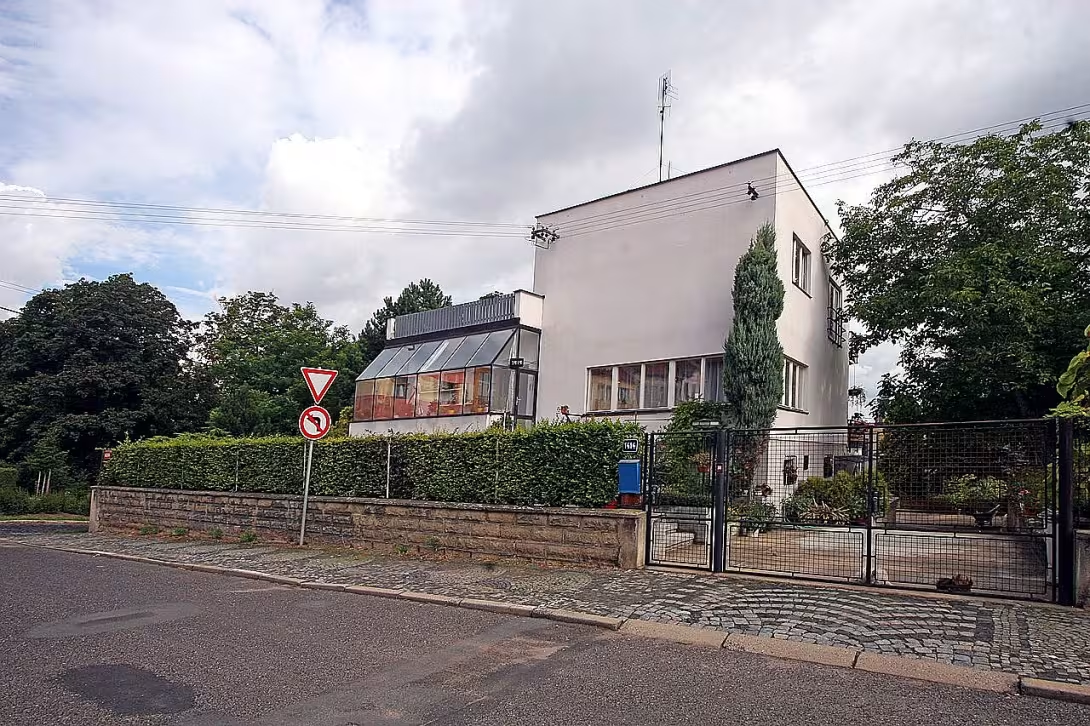
Vila čp. 1414 in Roudnice nad Labem is one of the most important examples of functionalist architecture of the interwar period, located on the corner of Máchov and Komenská street in the city centre. This three-storey building from 1934-1935 is considered to be the most valuable architectural building in the family house district Roudnice nad Labem and belongs to the local monument zone. Designed for Felix Lewis, the son of the owner of the company Kork Lewi, became the cultural heritage of the Czech Republic and is registered in the Central List of Real-Estate Cultural Monuments.
The villa was built during the first Czechoslovak Republic, when functionalism was promoted as a response to the historiological styles of the last century. This style reflected modern trends and national identity, as evidenced by the works of architects Jaroslav and Karel Fišerova, who worked out the project in 1934. The Fisher brothers were well-prepared professionals; Jaroslav studied at Prague Academy of Fine Arts under Josef Gočár and also in Vienna and The Hague, while Karel graduated from Czech Technical University in Prague. In addition, Jaroslav Fišer worked on the design of lighting technology for Philips.
The villa is an example of functionalism with its characteristic cubic layout, belt windows and multi-storey terraces. The construction consists of two blocks which are locked by longer sides. The surrounding terrain is connected with a glazed porch and a large terrace facing the garden. The roof is flat and covered with asphalt surface. The garden, which is part of the monument protection, was designed as a relaxation zone for property owners and equipped with original lamps of original outdoor lighting.
The history of the villa is linked to the dramatic events of World War II. During the Nazi occupation, the Lewis family had to leave the house because of their Jewish origins. After the end of the war, she returned to the villa they used under the changed name of Land until the 1980s. Since then, the villa has been bought by other private owners.
A number of original details have been preserved in the interior, which increase the historical value of the building. These include doors and windows with original fittings, central heating radiators, cork floors, closets, metal lamps, bars, parts of railings, some pieces of furniture and marble parapet in the living room. These elements demonstrate the original spirit of functionalism.
Today Villa No. 1414 is not only an architectural monument, but also a place full of history and stories. Its preservation allows visitors to feel the atmosphere of the interwar period and appreciate the importance of functionalism in Czech architecture. For those interested in history and architecture, this villa is not only an attractive destination, but also an exciting testimony of the past.
Vila čp. 1414 stands as a monument to the time when Czech architecture tried to find a new meaning and form within a modern context. Her history, linked to the fate of the Lewis family during World War II, gives this place deep emotional value. Exploring this villa is not only a way to the past, but also a reminder of the importance of monument protection and recognition of cultural heritage.
Then and now
Drag the slider to compare how the landmark may have looked when it was built with the view today.
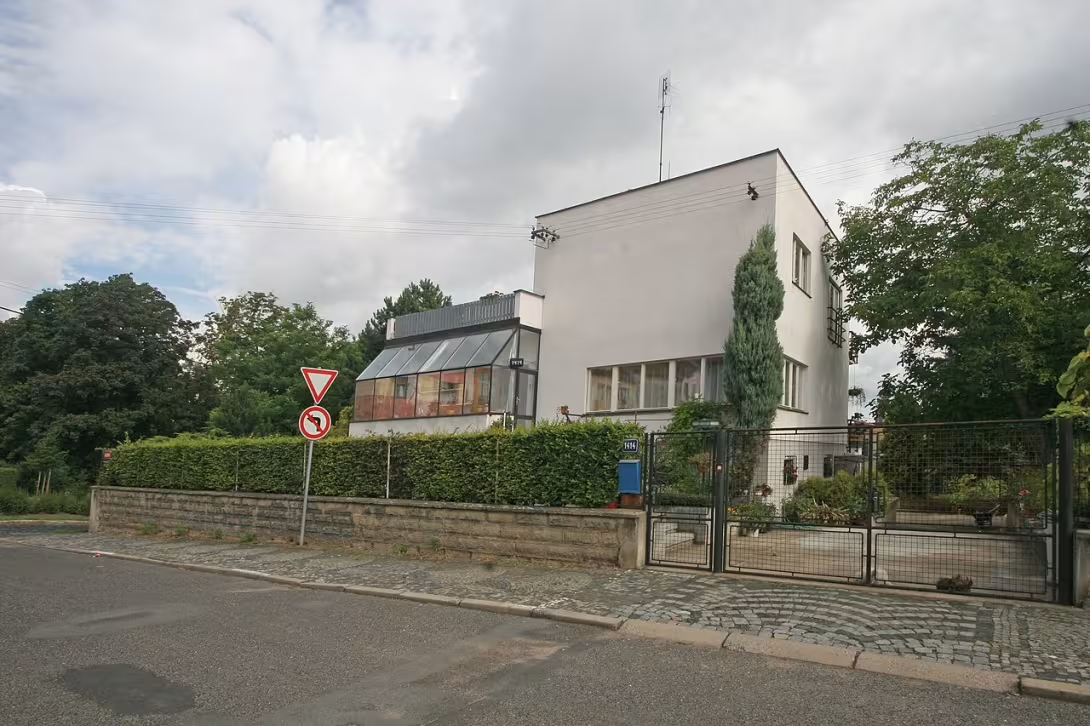
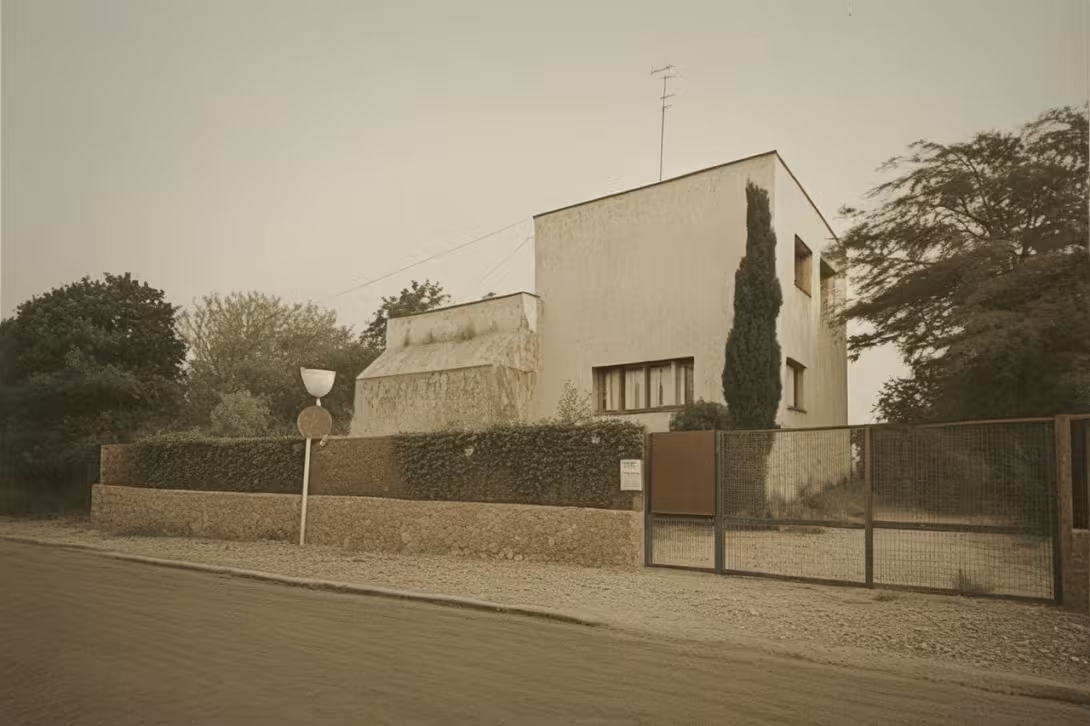
The historical appearance on the left is an AI-generated visualisation and serves as inspiration only.
Historical milestones
- 1934
- The base stone or the opening of the building of the villa according to the project of the Fišerová brothers.
- 1934
- Moving the Lewis family into a completed villa.
- 2007
- Registration of the villa into the Central List of Cultural Monuments of the Czech Republic.
Architectural development
The villa was built as a three-storey brick building with a flat roof and characteristic functionalist elements such as belt windows and terraces. The mass of the building is connected with the surrounding area by a glazed porch and a large terrace. The interior preserved original details, including doors, windows, cork floors and furniture designed in the spirit of functionalism. Materials include bricks, glass, metal and marble. The villa is an example of interwar architecture with the influence of European functionalist trends studied by its authors on Prague's AVU and abroad.
Historical events
- 1934
- The opening of the building of the villa according to the project of the Fišerová brothers for the Lewis family.
- 1934
- Moving the newlyweds to the villa after returning from their honeymoon.
- 1945
- The Lewis family returned to the villa under the changed name of Land after World War II.
- 2007
- The villa has acquired cultural heritage status including garden and original interior elements.
Owners
- 1934-1945 (until occupation), 1945-1980 (under the name of Land after the war)
- since the 1980s
Points of interest
- Vila čp. 1414 is one of the most important examples of functionalist architecture of the interwar period. - This three-storey building from 1934-1935 is considered to be the most valuable architectural building in the family house district Roudnice nad Labem and belongs to the local monument zone. - The villa was built for Felix Lewis, son of the owner of the company Kork Lewi, and is part of the cultural heritage of the Czech Republic. - Architects Jaroslav and Karel Fišer designed a villa; Jaroslav studied at Prague Academy of Fine Arts under Josef Gočár and worked on the design of lighting technology for Philips. - The history of the villa is linked to the dramatic events of World War II, when the Lewis family had to leave the house for Nazi occupation.
Guide
Show guide text
This text was created by artificial intelligence and has not been editorially reviewed. It may contain inaccuracies.
Welcome to one of the most interesting interwar buildings in Roudnice nad Labem! You stand in front of a villa, which is like a hidden treasure among ordinary houses - its clean lines, geometric shapes and modern expression distinguish it from everything around it. It's a building that tells you about a time when architects were looking for a new way to combine functionality with beauty. Let's go together and see what this villa is hiding.
In front of you stands Villa No. 1414, built between 1934 and 1935 according to plans of brothers of architects Jaroslav and Karl Fišerova. It was created for the Lewis Jewish family, who found her home here. At that time, such architecture was rare - simple but highly artistic, with emphasis on light, air and comfort. The villa is one of the most important examples of functionalism in the region and is one of the few preserved examples of what modern housing looked like before World War II.
Look closely at her facade. See how the construction is divided into square and rectangular surfaces? This is typical of the functionalist style - no unnecessary decorated elements, just clean shapes and a harmonious ratio between the spaces. The belt windows you may have seen, not only are they letting light in, but they also create a game of light and shadow that gives life to the house. On the terraces that are part of the villa, imagine how the Lewis family spent summer evenings here. These details are not just an architectural trick - they are proof that even in everyday life there can be beauty.
Now pay attention to what this villa represents. Its author is architect Josef Gočár, who was one of the most important representatives of Czech modernity. Although he himself did not design the villa, his influence on the Fišera brothers is evident - like him, they sought a way to combine tradition with new ideas. The Lewis family, for whom the villa was built, lived here until the war years. Felix Lewi, her member, was a businessman and philanthropist who deserved to develop the city. His story is a reminder that every building is behind people, their lives and dreams.
The interesting thing is that this villa is one of the most valuable buildings in the whole family house district. Its location and architectural expression make it unique. In 2007 it was registered in the Central List of Cultural Monuments of the Czech Republic, which confirms its importance not only for Roudnice but also for our whole architecture. Imagine what she looked like at a time when she was new - freshly plastered, with cork floors that supplied heat and muted sounds. These details, although you may not see them today, are proof that the construction was designed with care for every detail.
In front of you is not only a monument, but a piece of history. Vila čp. 1414 reminds us of what modern living in the 1930s looked like, what were the efforts of architects and how people's lives intertwined with the development of art. It is a place that is worth exploring not only from the outside but also from the inside - if you get here, you will see how functionality and aesthetics have come together here.
Before leaving, look again at its shapes, lines and details. Every stone, every window, and every terrace tells a story. Vila čp. 1414 is proof that even in times of change and unrest we can develop works that will excite us even after decades. Thank you for coming to see her - let her modern beauty inspire you as well. If you want to learn more, visit the local museum or browse the area where you will find other hidden treasures. May you be accompanied by an interest in history and the beauty that the architects have devoted their time to. Goodbye!
Tips for visitors
The multi-annual villa is interesting both in the summer months, when the outdoor space of parks and gardens is in full expansion and in winter, when you can observe historical architecture without busy human activity. We recommend a visit in the first half of the day when light is pleasant and visitors are less numerous. In summer it is ideal to visit before the afternoon heat, when the villas inside space is colder.
The location is located in the heart of the city, so it is very well accessible. By car, you can park in nearby parking lots, for example in the parking lot near Máchov Street or in the parking lot near Roudnický Gymnasium (public parking is also available around the monastery). There are plenty of parking places in the streets for pedestrian visitors, but it is recommended to use public transport during the summer months. Public transport is a place accessible by bus or tram, which stops near Komenský Street. The current connection and prices can be found on the carrier's official information.
When visiting villas and surroundings, it is advisable to wear comfortable shoes because most of the routes are on solid surfaces, but in the park and garden is the possibility to walk on grass. We also recommend sunglasses and sunscreen, especially in the summer months. For families with children it is useful to have games or small toys because there is enough free space in the vicinity of the monastery and park for games. In winter, do not leave warm clothes and suitable shoes.
The villa and its surroundings offer many beautiful photo opportunities. The villa itself is ideal for outdoor photography, especially from the bustle of Komenský Street or from the parking lot opposite the villa. The interior of the villa is accessible only with the previous arrangement, so the interior photography is limited. Josef Hora Park is great for shooting natural elements, especially in the garden section opposite the villa. The best light for photography is the morning or afternoon sun, which illuminates buildings pleasantly and avoids hard shadows. Near the monastery there is also the possibility to capture historical elements of the church which are interesting for photographers.
The monastery is one of the oldest and most important historical objects in the region. The Gothic church is architecturally interesting and there are several sights in its surroundings such as monastery halls and historical gardens. There is also an important work of art in the church, which is suitable for families with children because it is also accessible to the public.
The church is open all day, but in the summer months it is advisable to visit it early in the afternoon to be less busy. In the vicinity of the church there is a possibility to relax in the monastery gardens, which are also suitable for children. It is also close to Roudnice Gymnasium, where there is a historic building with rich decoration that can be interesting for students and tourists.
The Gymnasium is not only an educational institution, but also a historical building with a rich past. The exterior facade is interesting for architectural details that are typical of the period when the villa was built. The inner space is accessible only for students and teachers, but the surroundings are suitable for walking and observing the surroundings.
The park is ideal for relaxing and walking. In it you can find garden elements that are suitable for families with children, and also green areas where you can relax. Near the park there is a garden villa, which is part of the whole and offers a pleasant environment for photography and relaxation.
In the park there is a possibility to take with you games or books because there is plenty of free space. In winter the park is great for walking and watching nature, especially if you have children who can play on snow. It is also appropriate to monitor the animal world around, for example, birds that often occur here.
Josef Hora Park offers many possibilities for children. You can build sand forts here or play the playgrounds near the villa. In the summer months, it is advisable to monitor insects and plants that occur here and children can play in garden elements. In winter the park is great for snow games if there is snow cover in the region.
The monastery and Church of the Birth of the Virgin Mary are interesting for children in terms of history. You can explain why the monastery was built and what importance it had in the past. In the church you will find works of art that can be interesting for children and historical decoration is also interesting. Children can also see the monastery halls, which are suitable for walking and observation.
For families with children it is advisable to choose comfortable shoes and start a visit in the morning when there are fewer people and children can play in the park without the busy surroundings. We also recommend visiting the villa garden, which is suitable for relaxation and games. In the vicinity of the park and the villa, you will also find land and trees that children can explore and observe.
Businesses nearby
Do you run a restaurant, accommodation, shop, museum, rental, wellness or other visitor service near this monument? Show yourself directly to the people heading to it — this is how they will see you in the app and on the web:
Nearby
Nachází se na rohu Máchovy a Komenského ulice v centru Roudnice nad Labem.
Augustiniánský klášter s gotickým kostelem Narození Panny Marie (severozápadním směrem)', 'Roudnické gymnázium (v blízkosti kláštera)', 'Park Josefa Hory (naproti vile na druhé straně Komenské ulice)
Zahrada vily sousedí s pozemky, na nichž stojí historická zvonice z roku 1715.
Accommodation nearby
Themed route
Thematic cruise route: Roudnice nad Labem
1.Vila čp. 1414 (villa) Type: Architectural monument This villa, located on the corner of Máchov and Komenská Street, is an attractive start for your tour. Its elegant architecture and historical significance make it an essential part of the Roudnice nad Labem centre.
2. Augustinian monastery with Gothic church Birth of the Virgin Mary Type: Historical and cultural monuments From anywhere in the city centre, this monastery is easily accessible. His Gothic church is a great opportunity to explore the history and architecture of the past centuries, which adds a deeper context to the local heritage.
3. Roudní Gymnasium Type: Educational institutions with historical significance Located near the monastery, this high school is an important part of local culture and education. Its location here resembles a long tradition of education in the city.
4. Josef Mountain Park Type: City Park Walk through this park, which lies opposite the villa on the other side of Komenská Street, offers a quiet break and beautiful green spaces. It's an ideal place to relax after exploring historical monuments.
5. Historical bell tower Type: Architectural monument The bell tower, built in 1715 and adjacent to the villa grounds, is another important historical element. Its architecture and ancient bells add to the local cultural environment.
This route offers a view of the diversity of Roudnice nad Labem, from historical monuments to quiet green spaces.
Seasonal recommendations
Spring: In the spring season Villa No. 1414 is lit with warm rays of the sun that shine on newly grown trees and blooming grass around. The atmosphere is full of reviving peace and nature offers a wonderful view. The best time to visit is in the morning or evening when you avoid crowds and enjoy a quiet walk around the gardens. It is recommended to wear clothes suitable for mild temperatures because it may still be cold in the morning, but it rises during the day.
Summer: In summer Villa No. 1414 offers ideal conditions for visiting with long sunny days and warm evenings, which are ideal for relaxing on garden platforms. The atmosphere is full of vitality and attracts many visitors, especially in the main summer season. It is recommended to take with you a sunscreen and light, light clothes for sun protection and warmth. It is advisable to visit the memory earlier in the day to avoid the biggest crowds.
Autumn: In the autumn period Villa No. 1414 offers a view of the magical coloured leaves of trees and mild temperatures that are ideal for wandering around historical places without excessive heat effort. The atmosphere is calm and quiet, which creates an unforgettable feeling. The best time to visit is in the afternoon, when the sun is still warm but not overheating. It is recommended to wear laminated clothing because temperatures can be variable.
Winter: In winter, Villa 1414 offers a unique atmosphere of peace and quiet with covered snow areas that add magic to the historical environment. Due to shorter opening times, it is best to visit the memory early in the day. It is important to dress warm, with attached blanket and protective leg because extraordinary winter temperatures can be very low. This season is ideal for those looking for a quieter adventure without crowds.
Visualizations and artistic views


The visualisations are generated by artificial intelligence and serve as inspiration.
Photos from the area
Real photos taken near the monument


Zdroj a licence jsou uvedeny u každého snímku.
Tips from visitors
No tips yet. Be the first!
Log in and add your tip.
Sources and literature
Photos: Petr1888 / CC BY-SA 3.0 — Wikimedia Commons. The author and licence also appear when you hover over the image.
Faktickým podkladem tohoto textu byl článek na Wikipedii, jehož autory jsou přispěvatelé Wikipedie. Článek je dostupný pod licencí CC BY-SA 4.0.
Location on the map

Příběhy a pověsti
Legendy, pověsti a příběhy spjaté s touto památkou
Fotografie návštěvníků
Zatím žádné fotografie. Buďte první, kdo přidá fotografii z návštěvy!
Log in a přidejte svou fotografii nebo hodnoťte.
Za ověřenou návštěvu v aplikaci získáte víc bodů — poznáme podle GPS, že jste na místě.
Reviews and comments