



Vila Kavánova 400 Villa
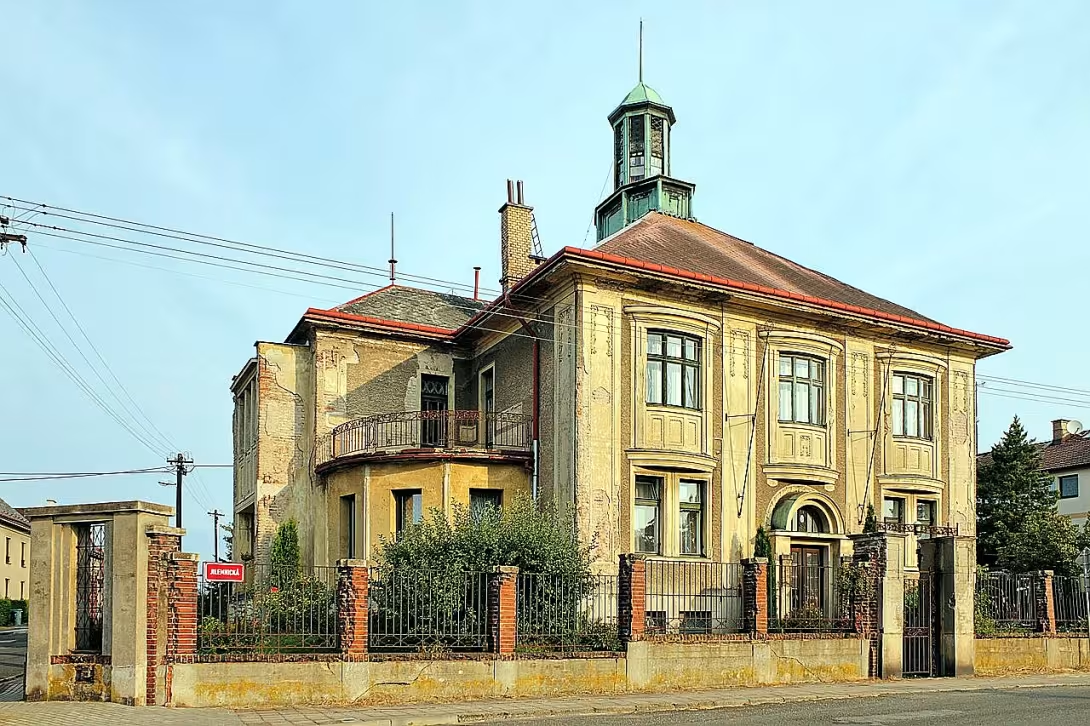
The villa of František Horák, also known as the Křížova villa, is a late Art Nouveau building in the village Lomnice nad Popelkou. The building from 1912 to 1914 is a unique testament to the lifestyle of rich factories from the first half of the 20th century. Since 2013 it has been declared a cultural monument.
The villa was created for František Horák, the younger son of the manufacturer and lover Josef Horák. The project was developed by the Prague architect František Xaver Sander at a place called the manor barn. The construction was carried out by the builder Václav Slaba. The building was completed on January 20, 1914, and eight days later, its approval was granted.
The architectural building reflects the transition from Art Nouveau to modern. The dominant is a six-wall lighthouse tower with coloured glass. On the facade there is a sign referring to the original manor barns and fragments from the poem Home from Svatopluk Bohemia. The interior is preserved, dominated by a central hall with a staircase. In 1936 Alois Wachsmann made modifications on the second floor. In the past, sport facilities, especially tennis courts, were part of the villa, but they were destroyed due to additional housing.
The ownership of the villa over the years reflected social changes. After the death of František Horák, in 1923 she became the property of his wife Zdenka and daughters Mary and Zdenka. After the death of the mother in 1928, the building remained in the hands of the daughters. After the February coup, half of the villa was nationalized and transferred to an apartment company because Zdenka Wachsmann did not pay a millionaire's tax. The second half of Mary's assets were transferred in 1946 to her son Jaroslav Cross, who was fully implemented in connection with this transfer.
Currently, half of the building is privately owned and the other part was donated to the city of Lomnice nad Popelkou Jaroslav Kříž.
Thanks to its preservation, the villa provides an authentic picture of the housing of the industrial elite before World War I. It is an important architectural element of the village, which is worth visiting in terms of history and aesthetics of late Art Nouveau.
Historical milestones
- 1912
- Beginning of building a villa for František Horák
- 1914
- Completion of building and building approval
- 1923
- Moving the villa into the property of the wife and daughters after the death of the founder
- 1936
- Modifications on the second floor carried out by Alois Wachsmann
- 1946
- Transfer of part of the property to Jaroslav Cross
- 2013
- Declaration of the Villa for Cultural Heritage
Architectural development
The construction took place in 1912-1914 according to the design of Prague architect F. X. Sander. In 1936 there were modifications of the interiors on the second floor, which was realized by Alois Wachsmann. The building is two storey and is dominated by a central hall with a staircase.
Historical events
1914: completion and housekeeping of the villa; 1946: transfer of part of the villa to Jaroslav Cross; 2013: declaration for cultural monument.
Owners
František Horák (construction), Zdenka, Marie and Zdenka Horáková (from 1923), Jaroslav Kříž (from 1946 - part), City Lomnice nad Popelkou (part)
Points of interest
- The building from 1912 to 1914 is a late Art Nouveau building that testifies to the lifestyle of rich factories. - The building is dominated by a six-wall lighthouse with coloured glass. - On the facade are inscriptions referring to the original government barns and fragments from the poem Home from Svatopluk Czech. - In the past, the villa included sports facilities, especially tennis courts. - After the February coup, half the villa was nationalized because the owner didn't pay a millionaire's tax.
Guide
Show guide text
This text was created by artificial intelligence and has not been editorially reviewed. It may contain inaccuracies.
Welcome to Lomnice over Cinderella. You're standing in front of a building that immediately draws attention to its appearance and transfers us to another time. In front of you is Villa Kavanova, a beautiful building jewel that carries the spirit of the beginning of the last century. If you look at her now, you'll see a house that radiates the elegance and ambition of its creators. It's a place where family history meets high art building.
Let's stop together to see how this building came into being. Imagine the period over a century ago, namely the years of a thousand nine hundred twelve to a thousand nine hundred fourteen. It was at this time that the villa was built for František Horák, the son of the successful manufacturer Josef Horák. At that time, it was customary for rich industrial families to build houses that were not just apartments, but real palaces to demonstrate their social status, wealth and taste. This villa is just such a unique testament to the lifestyle of the then rich factories from the first half of the twentieth century.
Now pay attention to the architecture itself. The building is performed in late Art Nouveau form, which was a style that emphasized smooth lines and decorative elements. The author of this proposal was František Xaver Sander. Please look up and notice the most distinctive element of the entire building. The dominant feature of the whole look is the lighthouse tower. It's a six-wall building that's filled with coloured glass. This turret gives the house a maritime feel and makes it a completely unmistakable landmark.
Now, if you focus on the front of the house, the facade, I suggest you look for details that tell stories. Notice the inscriptions you will find here. Some refer to the original manor barns, which reminds us how the landscape around the villa changed over time. But even more interesting are the extracts from the poem Home from Svatopluk Czech Republic. It is fascinating that the builders wanted to imprint the very walls of the house with a poetic word to express their love for the country and culture.
Let us now think a little more about the people who lived in these walls and who formed the fate of this house. As mentioned earlier, the founder was František Horák. But life is full of changes and after his death in the year one thousand nine hundred twenty-three the villa passed into the property of his wife and daughters. The house thus remained in the family circle, where tradition and family life continued. In time, however, ownership changed. In the year one thousand nine hundred and thirty-six there were modifications on the second floor which Alois Wachsmann carried out to match the needs of the house. Later, in the year one thousand nine hundred forty-six, part of the property was transferred to Jaroslav Cross, making the building in the folk memory also known as the Cross Villa.
It's fascinating how one house can be associated with so many names and fates. From the son of the manufacturer to his family to Mr. Cross. Each one of them put a piece of his life in the villa. It is this layery of history that makes the building more than just an ordinary house. It's a monument to human effort and ambition.
Let's stop by one of the interesting things you may have missed. Notice the colored turret again. Imagine how she must have worked in her greatest glory when the sun hit the glass or when it was lit up at night. It was a brave architectural choice at the time to highlight the uniqueness of the entire mansion. This entire object is so valuable that since the year two thousand thirteen it has been officially declared a cultural monument. This means that the State recognises its historical, artistic and architectural value to be protected for future generations.
When you stand before this villa today, feel the atmosphere of peace and stability it radiates. It's where time stopped. The Art Nouveau style with its fineness and monumentality reminds us of the era when many care and details were invested in the buildings, which are often forgotten in modern construction today. Take another look at the overall composition of the building, the harmony between the main part of the house and the dominant tower. It is a perfect example of how architecture can tell the story of success, family ties and national feelings.
Now that you've become familiar with the history and the Villa Cavanova, I suggest you go around it for a while and watch from different angles how her silhouette changes. Try to imagine what the days of a thousand nine hundred fourteen were like, when the construction was just finished and for the first time the voices of its inhabitants were heard. Feel the silence of the surroundings and let yourself be carried away by memories of the times of the first factories who helped develop this place.
Thank you for walking together through the history of this house. I hope Villa Kavanova with her lighthouse turret and poetic inscriptions caught your eye. Now you can continue to discover other beautiful corners of Lomnice nad Popelkou. I wish you a pleasant rest of the day and many other unforgettable experiences during your journey. Goodbye.
Tips for visitors
The best time to visit is late spring or summer, when the surrounding green beautifully complements the details of the facade of this late Art Nouveau building. The building is available by car and public transport; Check the current connection in the search engine.
To visit we recommend taking comfortable shoes to walk around and a quality camera. As it is a residential building, it is important to maintain discretion and remain in public areas.
For the best photos we recommend the morning or late afternoon light to highlight the plastic elements of the facade. The most interesting angles are from a street view, where the whole architecture of the villa is visible.
Families with children can use a visit to tell about the life of factory workers from the early 20th century and find Art Nouveau ornaments on the walls of the house.
Frequently asked questions
Can the monument be visited?
This is a residential or farm building, not a museum with opening hours. Please view it from public space and respect the owners' privacy. We have no information about access to the interior.
Where is the monument?
Location: Lomnice nad Popelkou. The map on this page shows the exact spot.
Why is the monument protected?
It is listed in the Central List of Cultural Monuments of the Czech Republic as a cultural monument (register no. 1579019421).
Businesses nearby
Do you run a restaurant, accommodation, shop, museum, rental, wellness or other visitor service near this monument? Show yourself directly to the people heading to it — this is how they will see you in the app and on the web:
Nearby
🏰 Historic sites (159)
- Mistr Jan Hus 0.4 km
- Morový sloup 0.4 km
- Městské muzeum 0.4 km
- 1914-1918 2.1 km
- Kozlov 3.6 km
- Zřícenina Bradlec 5.8 km
- Šárka 5.9 km
- Vašek 5.9 km
- hrad Kumburk 6.9 km web
- památce Karla Hynka Máchy 6.9 km
- Místní vlastivědné muzeum v Železnici 7.0 km Muzejní 181 +420732836309 web
- 1914-1918 7.2 km
- Pomník obětem války 1866 7.3 km
- Sv. Václav 7.8 km
- Městské muzeum 8.0 km
- Morový sloup 8.0 km
- Dr. František Ladislav Rieger 8.0 km
- Sloup se sochou Panny Marie 8.0 km
- Pomník 8.1 km
- zřícenina Brada 8.1 km
🍽️ Restaurants and dining (203)
- pizzeria Al Capone 0.2 km
- Aion Club U Krbu 0.3 km Josefa Jana Fučíka 95 +420 602 412 580
- U Marcely Cukrárna 0.4 km Husovo náměstí 46
- Babylon 0.5 km
- Hostinec Na Košově 2.4 km
- Hostinec Na Ploužnici 2.6 km
- Penzion Tábor 2.8 km
- Hostinec 5.0 km
- Restaurace Na Klepandě 5.5 km
- LudeksCoffeeDrive 6.5 km Žlábek +420733171651
- Antonin Helfer 6.6 km
- Mikulovská vinárna 6.9 km Náměstí Svobody +420 493 523 359 web
- U Zlaté brány 6.9 km
- U Muzea 7.0 km
- Hostinec Podmošnou 7.0 km +420 605 903 496
- Café Pod Vinicí 7.0 km Nádražní 195 +420733533611 web
- Hospoda u Jindry 7.1 km web
- U starýho záložníka 7.8 km web
- Restaurace SC 7.8 km 3. května 327 +420 481 623 334;+420 731 102 882 web
- Roka Bar 8.0 km 28. října 69 +420 481 621 231 web
🏨 Accommodation (81)
- Rodinný penzion Sudkovi 4.8 km
- Penzion Bradlecký Mlýn 5.3 km +420 608 222 304
- Ranč na Kamenci 5.6 km +420 493 532 822
- Český ráj 5.7 km
- Rustic Camp 5.8 km
- Palda - rekreační středisko 6.6 km Liščí Kotce 10 +420 770 660 775 web
- Penzion Libuň 6.6 km web
- Penzion Světlá 7.0 km +420 481 621 059 web
- Pension u Jindra 7.1 km
- Penzion Žernov 7.9 km
- Chatový Tábor Jinolice 8.0 km +420 493 591 929 web
- penzion Brada 8.0 km +420 493 539 731
- Hotel Prostřední mlýn 8.2 km
- Eden 8.2 km
- Oldřich Vrabec - Staropacká sokolovna 8.6 km
- Farma Lanska 8.8 km web
- Ubytování v podkroví 9.4 km
- Chalupa u Jandů 9.5 km +420 724 324 821 web
- Hotel Pod Šikmou věží 9.7 km Horní Lochov 32 +420 739 747 374 web
- Chata Svinčice 10.2 km +420602173073
🚲 Rentals and sport (28)
- Letní stadion generála Ludvíka Svobody 0.4 km
- Koupaliště 1.4 km
- Skokanský můstek K70 1.9 km
- Koupaliště Nová Ves nad Popelkou 2.9 km
- Sportovní hala 7.8 km web
- Little David's 8.1 km
- Sportovní hala 8.2 km
- koupaliště Kruh 8.3 km
- Sokolovna 9.2 km
- Sportovní areál a Koupaliště Mříčná 10.2 km web
- Koupaliště Kníže 10.3 km
- Aqua centrum 10.4 km
- Squash 10.7 km
- Cyklocentrum Souček 10.7 km Kollárova 43 +420493534061
- Sokol Nová Paka 10.8 km
- Tenis Nová Paka 10.9 km
- R.K. BIKE 11.5 km Pražská 515
- Bazén Nová Paka 11.5 km web
- Sportisimo 11.5 km Riegrova 1263 +420724484985
- SKI Areál Hraběnka 12.0 km
🥾 Hiking and nature (821)
- U Kordovny 1.4 km
- Babylon 1.6 km
- Na Cikánce 1.8 km
- Na kopci 2.0 km
- Císařova hůra 2.2 km
- Smetanova vyhlídka 2.5 km
- Smetanova vyhlídka 2.5 km
- Skuhrovský vrch 2.5 km
- Křížovka 2.5 km
- Tábor 2.9 km
- Stránsko 3.0 km
- Smíta 3.3 km
- Ředice 3.3 km
- Kněžsko 3.5 km
- Kozlov 3.6 km
- Chocholka 3.8 km
- Hůra 3.9 km
- Pavlenka 4.1 km
- Holenická vyhlídka na Trosky 4.2 km
- Chotice 4.2 km
Accommodation nearby
Themed route
Here is the route design focused on the tour of the building itself:
1. Vila Kavánova 400 (building) - The main destination of the trip where you can admire the architecture and history of this building. 2. Villa area (outdoor area) - Walk in the immediate vicinity of the house, which allows you to perceive the atmosphere of the place. 3. Interior of the villa (interior) - A tour of rooms and details of equipment that reveal life in this house.
Seasonal recommendations
Spring: May brings fresh green colors around the villa and the smell of blooming trees. The light is soft and rough in this period, which highlights the details of the construction beautifully. I recommend arriving early in the morning when the air is still fresh and nature is awakening. Dress well, because the morning cold can still feel when the sun is shining.
Summer: In the summer months, the building is surrounded by dense foliage and the surrounding landscape is very lively. The sun shines the most, so for the best observation of detail, choose late afternoon hours when shadows are longer and colors are warmer. It is advisable to carry sun protection and choose light, breathable clothes. There are more people on the road in the high summer season.
Autumn: Autumn season offers the most impressive colour palette, when the leaves change colour to gold and brown. The morning mist gives the place a mysterious atmosphere and highlights the loneliness of the house. It is good to wear waterproof shoes and warmer layers of clothing because moisture and cold can spread rapidly in the forest. The best time to visit is just after sunrise.
Winter: Zimą villa becomes part of the snow landscape and bare branches of trees reveal its face in full beauty. The light is weak at this time and the days are short, so plan a visit around noon to use the most daylight. The need is for quality winter clothes, including hat and gloves, so that the freezing air does not discourage you from looking from the outside.
Visualizations and artistic views

The visualisations are generated by artificial intelligence and serve as inspiration.
Photos from the area
Real photos taken near the monument

Zdroj a licence jsou uvedeny u každého snímku.
Tips from visitors
No tips yet. Be the first!
Log in and add your tip.
Sources and literature
Photos: Miloslav Rejha / CC BY 4.0 — Wikimedia Commons. The author and licence also appear when you hover over the image.
Faktickým podkladem tohoto textu byl článek na Wikipedii, jehož autory jsou přispěvatelé Wikipedie. Článek je dostupný pod licencí CC BY-SA 4.0.
Location on the map



Příběhy a pověsti
Legendy, pověsti a příběhy spjaté s touto památkou
Fotografie návštěvníků
Zatím žádné fotografie. Buďte první, kdo přidá fotografii z návštěvy!
Log in a přidejte svou fotografii nebo hodnoťte.
Za ověřenou návštěvu v aplikaci získáte víc bodů — poznáme podle GPS, že jste na místě.
Reviews and comments