






Vila Lothara Grohmanna Villa
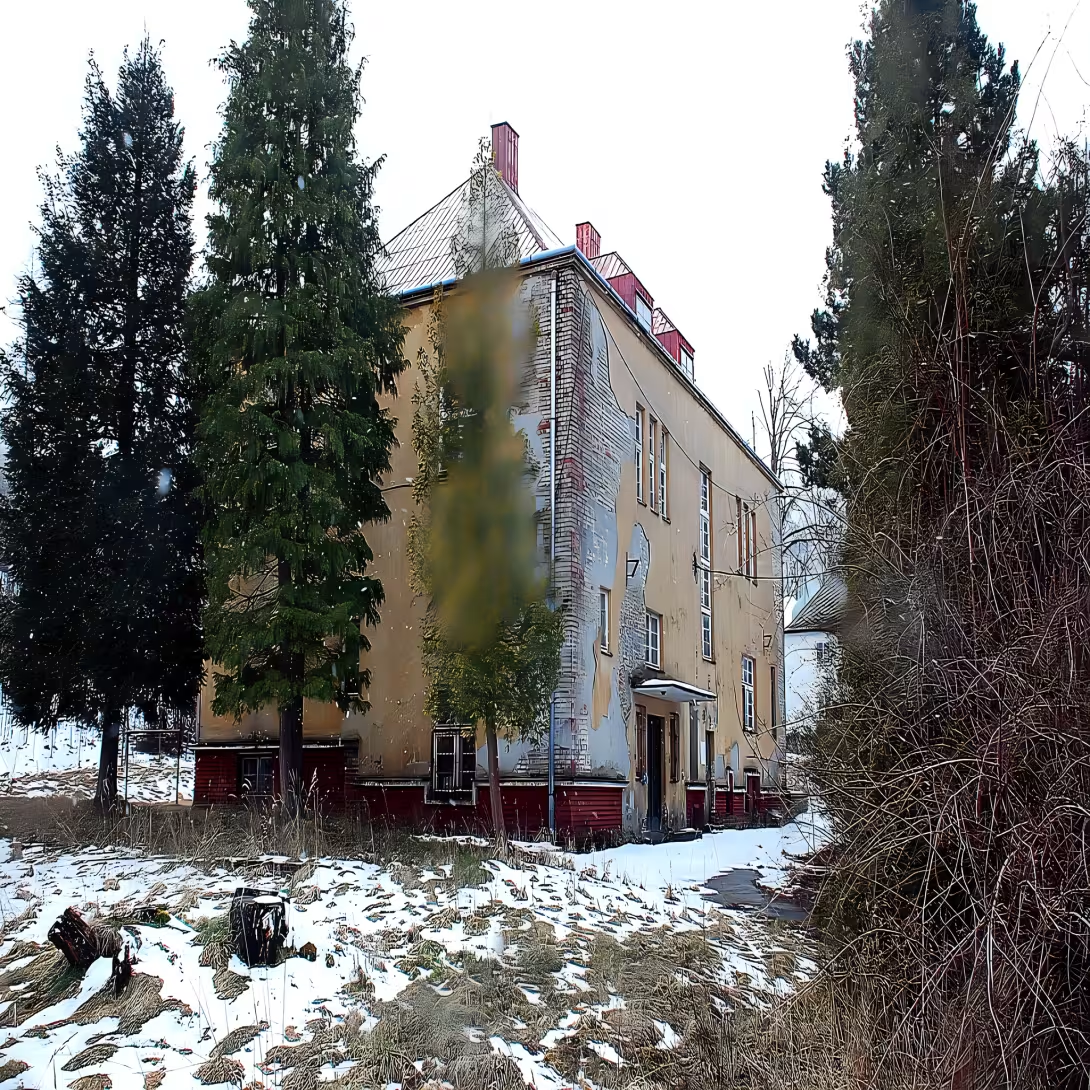
Vila Lothara Grohmann, a purist villa, stands in Vrbno pod Pradědem, built between 1929 and 1930. Designed by Viennese architect Josef Hoffmann, it is a recognized cultural monument of the Czech Republic, exemplifying the shift towards simplicity and utility during the interwar period.
The villa was constructed for Lothar Grohmann. The prominent industrial entrepreneurs, the Grohmann family, owned factories in Vrbno, Pochni, Markvartice, Rákospalota (Hungary), and Temešváru (Romania). Construction began in 1929 and finished in 1930, coinciding with Czechoslovakia's period of economic growth and modernization.
The building is a single-story masonry structure with a basement and attic, featuring a rectangular floor plan. A hipped roof covers the villa, including two dormers. The northwest facade boasts a ground-floor winter garden, while a staircase leading to the garden was added later.
The interior ground floor begins with a staircase hall containing sanitary facilities, connecting to the main salon. This salon provides access to the garden and winter garden. Other interconnected rooms branch off from the salon, featuring visible beams. A former bedroom contains a dark wood-paneled alcove that served as a ladies' resting corner. The upper floor consists of bedrooms and a terrace above the winter garden, while the mezzanine holds sanitary facilities. A multi-flight wooden staircase connects the levels, with built-in wardrobes in the hallway. The attic features one residential room.
Originally owned by the Grohmann family, the villa later changed hands. In 2011, it was owned by Avenced Plastic s.r.o., which requested revocation of its cultural monument status but was denied.
The villa has served various purposes over the decades, including a kindergarten in the 1980s. It was officially declared a cultural monument of the Czech Republic in 2000. On January 10, 2018, it was offered for sale.
Located in Bruntál's district, the villa remains a testament to purist style and Josef Hoffmann's legacy. It is an architectural site of value for those interested in the region's industrial history. Visitors can appreciate its disciplined form and historical significance.
Historical milestones
- 1929
- Construction of the villa began.
- 1930
- Construction of the villa was completed.
- 2000
- The villa was declared a cultural monument of the Czech Republic.
- 2018
- The villa was offered for sale on January 10.
Architectural development
The villa is a single-story masonry building with a basement, attic, and a rectangular floor plan. It features a hipped roof with two dormers and a ground-floor winter garden on the northwest facade. A rear staircase leading to the garden was added at a later date.
Historical events
1929-1930: Construction of the villa. 2000: Declared a cultural monument of the Czech Republic.
Owners
Owned by the Grohmann family; owned by Avenced Plastic s.r.o. in 2011.
Points of interest
– The villa was built between 1929 and 1930 as a purist villa in Vrbno pod Pradědem.
– It is a recognized cultural monument of the Czech Republic, exemplifying the shift towards simplicity and utility during the interwar period.
– The building features a rectangular floor plan with a basement and attic, and a hipped roof with two dormers.
– The interior ground floor has a staircase hall containing sanitary facilities, connecting to the main salon that provides access to the garden and winter garden.
– The villa has served various purposes over the decades, including a kindergarten in the 1980s.
Guide
Show guide text
This text was created by artificial intelligence and has not been editorially reviewed. It may contain inaccuracies.
Welcome to Vrbno pod Pradědem. Please, take a moment to settle in, adjust your headphones, and simply look ahead. You are standing before one of the most striking architectural statements in this region: the Villa Lothar Grohmann. As you gaze at the building, let your eyes wander over its form. There is a certain stillness and a deliberate clarity to what you see. It does not shout for attention with ornate carvings or excessive decoration; instead, it commands respect through its proportions and its unwavering commitment to a specific vision of modernity.
To truly understand what you are looking at, we have to travel back nearly a century, to the closing years of the 1920s. The construction of this villa began in 1929, a time of immense social and artistic transition across Europe. This was the interwar period, an era defined by a desire to break away from the heavy, cluttered styles of the past and move toward something cleaner, more honest, and more functional. The villa was completed in 1930, serving as a residence for the Grohmann family. The Grohmanns were not merely local residents; they were prominent industrial entrepreneurs whose influence and factories stretched across Central Europe. For a family of such standing and vision, a standard home would not suffice. They required a residence that reflected their status as modern leaders of industry—a place that mirrored the efficiency and precision of the factories they managed.
To achieve this, they turned to one of the most celebrated minds of the era: the renowned Viennese architect Josef Hoffmann. When you look at the villa, you are seeing Hoffmann's philosophy translated into stone and mortar. Hoffmann was a master of geometry and a pioneer of the modern movement. By commissioning him, the Grohmann family ensured that their home would be more than just a shelter; it would be a piece of avant-garde art.
Now, I invite you to pay close attention to the architecture itself. As you observe the building, notice the overall shape. You will see that it is characterized by a rectangular masonry structure. This is not an accidental choice. In the world of architecture, this approach is known as purism. I want you to really think about that word for a moment: purism. In the context of the late 1920s, purism was a bold rejection of the unnecessary. It was a shift toward simplicity and utility.
Look at the lines of the building. Notice how they are clean and decisive. There are no unnecessary flourishes here. The beauty of the Villa Lothar Grohmann lies in its discipline. The architect wanted the form to follow the function, ensuring that every element of the building served a purpose. This commitment to utility was a hallmark of the interwar period, reflecting a world that was becoming more industrialized and streamlined. When you look at the facade, try to feel that sense of order and balance. The rectangularity provides a sense of stability and permanence, a physical manifestation of the Grohmann family's industrial success and their place in the social hierarchy of the time.
As you stand here, imagine the people who once walked these grounds. Lothar Grohmann was the central figure here, a man whose life was intertwined with the rapid industrialization of Central Europe. Imagine the conversations that took place within these walls—discussions about trade, engineering, and the future of industry, all happening within a space designed by one of the greatest architects of Vienna. The villa was designed to be a sanctuary of modern living, a place where the private life of an entrepreneur could exist in harmony with the cutting-edge aesthetic of the time. The Grohmann family lived at the intersection of business and art, and this building is the physical evidence of that intersection.
Beyond its role as a family home, the villa holds a deeper significance for the history of the Czech Republic. Because it so perfectly exemplifies the transition toward simplicity and the architectural bravery of the 1930s, it was officially declared a cultural monument of the Czech Republic in the year 2000. This designation recognizes that the Villa Lothar Grohmann is not just a local landmark, but a piece of national heritage. It stands as a testament to a time when Vrbno pod Pradědem hosted a vision of the future that was daring, minimal, and sophisticated.
However, every great house has a story that continues to evolve, and the Villa Lothar Grohmann is no exception. While it has stood as a silent witness to the decades passing by, its recent history has brought its own set of interests. For instance, on January 10, 2018, the villa was offered for sale. This event sparked a renewed interest in the property, reminding us that while a building can be a monument to the past, it is also a living entity that must find its place in the modern economy and the current century. It makes one wonder about the future of such a space—who will walk through its doors next, and how will the legacy of Josef Hoffmann and the Grohmann family be preserved for the next generation?
As you spend a few more minutes here, I encourage you to simply absorb the atmosphere. Notice how the building interacts with the surrounding environment of Vrbno pod Pradědem. Contrast the rigid, purposeful lines of the purist architecture with the natural landscape around you. There is a fascinating tension between the organic world and the calculated, rectangular precision of the masonry. This tension is exactly what makes the villa so compelling; it is a human imposition of order and logic upon the world, executed with an elegance that only a master like Josef Hoffmann could achieve.
Take one last look at the facade. Appreciate the bravery it took to build something so simple yet so powerful in 1930. Remember that you are not just looking at a house, but at a manifesto of modernity—a statement that utility and simplicity are, in themselves, a form of high art.
Thank you for joining me for this brief journey into the history of the Villa Lothar Grohmann. I now invite you to walk around the perimeter of the building, observing how the light hits the rectangular forms from different angles, and to reflect on the industrial spirit that brought this masterpiece to life. Enjoy your further exploration of Vrbno pod Pradědem. Farewell for now.
Tips for visitors
The best time to visit the Vila Lothara Grohmanna is during spring or autumn, when the weather is mild and sunny. This allows you to fully appreciate the villa's architecture and surroundings.
Visitors can park their vehicles near the villa or use public transportation, which stops nearby. For those arriving by car, be aware that parking spaces are limited.
When visiting the Vila Lothara Grohmanna, it is recommended to bring comfortable walking shoes and a camera to capture the stunning views of the surrounding landscape.
The best spots for photography are around the villa's exterior and in the nearby gardens. The golden hour, just before sunset, offers the most flattering light for capturing the villa's architectural details.
Businesses nearby
Do you run a restaurant, accommodation, shop, museum, rental, wellness or other visitor service near this monument? Show yourself directly to the people heading to it — this is how they will see you in the app and on the web:
Accommodation nearby
Themed route
Thematic Tour Route
Main Goal: Lothar Grohmann Villa (villa)
Location: Vrbno pod Pradědem, Czech Republic
Route:
1. Vrbno pod Pradědem: A charming town with a rich history and culture. Visit the town square to get a feel for its quaint atmosphere. 2. Lothar Grohmann Villa: The main attraction of this tour, this beautiful villa is a must-see. Learn about its history and architecture while exploring its interior. 3. Křinov Hill: Take a short walk to the top of Křinov Hill for breathtaking views of the surrounding landscape.
This route offers a unique blend of culture, history, and natural beauty, all centered around the stunning Lothar Grohmann Villa. Enjoy your tour!
Seasonal recommendations
Spring
As you visit Vila Lothara Grohmanna in the spring, you'll be greeted by a lush green landscape and mild temperatures. The villa's surroundings are particularly beautiful during this time, with blooming flowers and trees providing a picturesque backdrop. Take advantage of the pleasant weather to explore the area on foot or by bike.
Practical tips: Avoid visiting during peak hours (10 am-2 pm) when possible, as the villa can get crowded. Wear comfortable shoes and clothing suitable for mild spring weather. The best time to visit is early in the morning or late afternoon, when the sun is not too strong.
Summer
In the summer, Vila Lothara Grohmanna comes alive with vibrant colors and warm temperatures. The surrounding nature is at its peak, with lush greenery and colorful flowers adding to the villa's charm. Be prepared for larger crowds during peak season (July-August), especially on weekends.
Practical tips: Plan your visit early in the morning or later in the afternoon to avoid the heat and crowds. Wear light-colored clothing and comfortable shoes suitable for warm weather. Don't forget to bring sunscreen, a hat, and sunglasses.
Autumn
As autumn arrives, Vila Lothara Grohmanna is surrounded by a stunning display of fall foliage. The cooler temperatures make it an ideal time to explore the area on foot or by bike. Take in the vibrant colors and crisp air, but be prepared for shorter opening hours (9 am-4 pm) due to the changing seasons.
Practical tips: Dress warmly and wear comfortable shoes suitable for cooler weather. Avoid visiting during peak hours (10 am-2 pm) when possible, as the villa can get crowded. The best time to visit is early in the morning or late afternoon, when the sun is not too strong.
Winter
In the winter, Vila Lothara Grohmanna takes on a serene and peaceful atmosphere, surrounded by snow-covered trees and a quiet landscape. Take advantage of the shorter opening hours (9 am-3 pm) to enjoy a more relaxed visit. Be prepared for cooler temperatures and potential snowfall.
Practical tips: Dress warmly and wear comfortable shoes suitable for winter weather. Avoid visiting during peak hours (10 am-2 pm) when possible, as the villa can get crowded. The best time to visit is early in the morning or late afternoon, when the sun is not too strong.
Visualizations and artistic views

The visualisations are generated by artificial intelligence and serve as inspiration.
Photos from the area
Real photos taken near the monument


Zdroj a licence jsou uvedeny u každého snímku.
Tips from visitors
No tips yet. Be the first!
Log in and add your tip.
Sources and literature
Fotografie: Wesalius / CC BY-SA 4.0, rozlišení zvýšeno umělou inteligencí — Wikimedia Commons. The author and licence also appear when you hover over the image.
Faktickým podkladem tohoto textu byl článek na Wikipedii, jehož autory jsou přispěvatelé Wikipedie. Článek je dostupný pod licencí CC BY-SA 4.0.
Location on the map


Příběhy a pověsti
Legendy, pověsti a příběhy spjaté s touto památkou
Fotografie návštěvníků
Zatím žádné fotografie. Buďte první, kdo přidá fotografii z návštěvy!
Přihlaste se a přidejte svou fotografii nebo hodnoťte.
Za ověřenou návštěvu v aplikaci získáte víc bodů — poznáme podle GPS, že jste na místě.
Reviews and comments