



Vodní mlýn čp. 16 Water mill
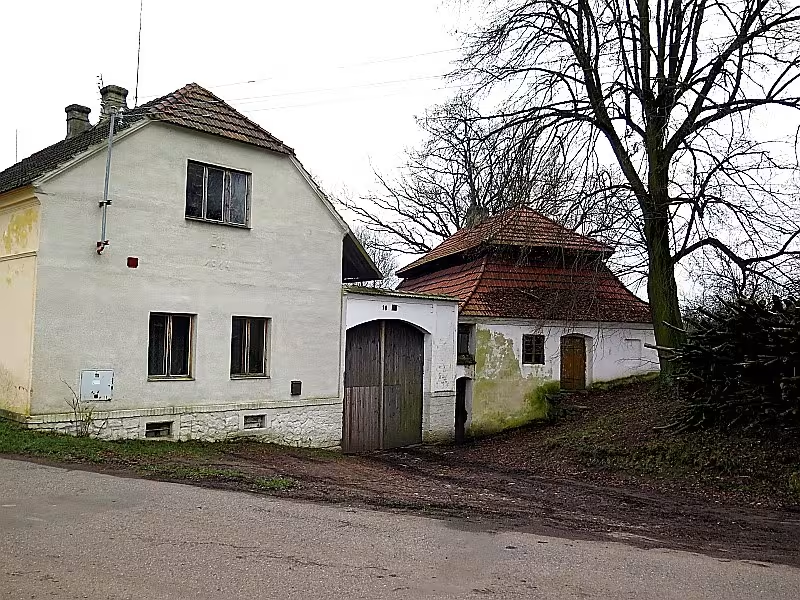
The Tuchlovický mill, located on the Tuchlovický stream in the village Tuchlovice in the Kladno district, is a protected Baroque water monument. The mill, first mentioned in 1748 in the Terezian cadastre as a mill with one wheel on unstable water, has a rich history and architectural features. Its importance is further highlighted by the discovery of the remains of Roman settlement in the surrounding area.
The mill was officially recorded in 1748, indicating its importance to the area. In 1841 he became the property of Anton Hnitka and appeared on the indicator sketch as an inburnt building. During World War II, the miller Václav Jerman was arrested for possession of grain and unregistered radio, leading to his imprisonment. After the war he continued to try to grind again, but the mill definitely stopped working in 1950.
The Tuchlovický mill is interesting by combining various building elements. The original building has a rectangular floor plan and a Mansard roof, with a walled western part made of mixed masonry and a grafted eastern part at the height of the windows. The mills have been preserved as the original wooden structure, indicating the possible extraordinary age of the construction. The mill was equipped with two water wheels for the top water, which led to a kilometer drive.
The ownership and management of the mill went through different stages. After Anton Hnitka went into the hands of the Jerman family who held him until 1938. During the war, the miller Václav Jerman found himself at the heart of dramatic events.
Apart from the mill itself, the key interest is the archaeological site east of it. Here were discovered the remains of the settlement from the Roman Empire, including wooden structures and products such as bowls and ladders. These findings provide unique evidence of the history of the region.
Today, the Tuchlovický Mill serves primarily as a warehouse and faces decay. Although it is no longer in operation, its historical value and architectural elements remain an important part of the cultural heritage of the Czech Republic. The mill is worth visiting not only for its history, but also as a reminder of past times and technologies.
Thus, the Tuchlovický mill is more than just an abandoned industrial plant; It is a monument bearing the heritage of many generations. Its history and architecture offer a rich overview of the region's past and its importance to the local population. Visiting this place is a journey to the past and a reminder of the importance of protecting cultural heritage.
Historical milestones
- 1748
- First mention in the Terezian cadastral as a mill with one wheel on unstable water.
- 1841
- Record in the indicator sketch, owner was Anton Hnitka.
- 1950
- Termination of milling activity.
Architectural development
The original building has a rectangular floor plan and a Mansard roof, the eastern part is grafted on the floor. The area was later supplemented by a newer residential building with an economic part and two barns. The residue of the mill drive and the accumulation tank were preserved.
Historical events
1748: First mention in the Terezian cadastral. World War II: The prison of the miller Václav Jerman in the concentration camp for keeping grain and holding the radio. Around 1950: End of operation of the mill.
Owners
Anton Hnitka (1841), Jerman family (until 1938)
Points of interest
- It's a protected Baroque water monument. - It was first mentioned in 1748 in the Terezian cadastral as a mill with one wheel on unstable water. - The rest of the Roman settlement, including wooden structures, bowls and ladders, were discovered in the area. - The building has a rectangular floor plan and a mansard roof. - The mill was equipped with two water wheels for the top water and a kilometer drive.
Guide
Show guide text
This text was created by artificial intelligence and has not been editorially reviewed. It may contain inaccuracies.
Welcome to Tuchlovice. You have just arrived at one of the most important historical sites in this part of the landscape. You're standing right in front of the water mill number 16. Before you take your first step towards the buildings, I suggest you stop for a moment and just be. Feel the air, feel the calm, and look at what's right in front of you. In front of your eyes, there is an area that once formed the heart of local life. You can see the walled gate that serves as the entrance to the entire space. The gate leads you to the inner courtyard where the buildings are set up to form a closed and harmonious whole. This whole space seems like a small world in itself, where time seems different than out on the road. Feel this atmosphere of peace and history that has settled here for centuries.
To understand why this place is so special, we need to look back in time. The history of this mill is not short and goes deep into the past. The first mention of him appears in documents dated seven hundred forty-eight. In the then Terezian cadastrum, the mill was registered as a place with one wheel, but with one important difference. The water that powered the wheel at the time was not stable. This means that the miller had to be very skillful and able to work with what nature offered them at that moment. They had to be prepared for changes in levels and constant water movement. However, the situation has changed over the years. The mill grew, became a more stable and important point for the whole community. Although there has been no milling activity here since the year one thousand and nine hundred and fifty, its presence still dominates the Tuchlovický creek and reminds us of the time when water was the main engine of human progress.
Now look carefully at the mill building itself. It's a fascinating example of how in the past, what the country has offered was linked to what the human hand has done. The building has a clear rectangular plan, which gives it a sense of stability and strength. If you raise your eyes to the sky, you'll see this amazing Mansard roof. This roof construction is very characteristic and gives the whole mill its Baroque face. Notice how the roof ripples and what shapes it creates against the sky. It's a detail that gives the building its unmistakable profile.
When looking at the walls of the building, notice an interesting combination of materials. The lower part is built from mixed masonry, which means that different types of stone and bricks have been used here, which in time have interconnected beautifully and formed a solid base. However, if you look at the top floor, you'll see something completely different. The grafted structure is used. This wooden treatment gives the building the softness and warmth that would be missing from a purely stone building. It's a beautiful contrast between the hardness of masonry and the organic beauty of wood. This combination shows how people adapted to the needs and available materials.
And what did this mill serve before? Imagine the noise and power of water that once ruled here. The mill was equipped with two water wheels. And it wasn't any bikes. It was a bicycle for the top water. This means that the water wasn't just coming from the ground, but it had to be brought from above to work effectively. In order to do that, a very long drive had to be built. This drive led the water to the mill from a long distance, over several kilometers. Imagine the incredible work that people had to do to create a water system that could power machines in this place. It was the height of technical skill back then.
Every such place has its own stories and people who have left their mark. In the history of this mill, names appear that help us to see this place not as a mere building, but as a home and a place of hard work. In the year one thousand eight hundred forty one was the owner of the mill Anton Hnitka. The records from that time tell us that the mill was already fully developed and operational. Another name associated with this place is Václav Jerman. These people lived their days here, solving problems with water, our business and everyday life, which was closely linked to the rhythm of the Tuchlovický creek. Their existence here has left an invisible but tangible mark on every stone in this area.
Now I want to take you on a different path. While you're looking at baroque architecture, realize that under your feet and in the surrounding soil there is an even older secret. This country has layers of history that are far deeper than it seems. In the vicinity of this mill were found traces belonging to the ancient Roman settlement. Archaeologists have discovered the remains of wooden structures that are much older than the mill itself. They also found different bowls and even wooden ladders. That means this place was habitable thousands of years ago. Maybe right here, near the water, there were people from ancient times who used objects similar to what you could imagine. This connection between the baroque mill and the ancient Roman past gives the whole place incredible depth and mystery.
I hope this short guide helped you open your eyes to the beauty and history that is around you. The mill hasn't worked since the year one thousand nine hundred fifty, but his soul is still here. Continue the tour now, walk around, feel the atmosphere and enjoy this quiet corner of history. Look at the details of the buildings, see the structure of the wood and stone and let yourself be drifted by imagination. We thank you for your visit and wish you a beautiful rest of the day when exploring this place.
Tips for visitors
The best time to visit is early morning or late afternoon, when fine light best excels on old walls and in the mill area.
Transport is possible by car and public connections; Check the current connection in the Internet search engine.
We recommend to bring comfortable shoes, because the state of the monument is bad and the terrain can be uneven.
The most interesting places for photographers are the walled gate and the mill building at the creek itself.
In the vicinity, specifically in the east, visit the archaeological sites of the second and third centuries with remains of Roman settlement and iron furnaces. Families with children will appreciate the survey of the courtyard and observation of the flow of Tuchlovický creek.
Frequently asked questions
Can the monument be visited?
This is a technical monument. Some are open as exhibitions, others are out of use or on private land. We have not verified whether this one is accessible. According to the heritage register the structure is in poor condition – do not enter it and take care nearby.
What are the opening hours and admission?
We have not verified the opening hours or admission. Current information is published by the operator.
Where is the monument?
Location: Tuchlovice, Středočeský kraj. The map on this page shows the exact spot.
Why is the monument protected?
It is listed in the Central List of Cultural Monuments of the Czech Republic as a cultural monument (register no. 1000131390).
Businesses nearby
Do you run a restaurant, accommodation, shop, museum, rental, wellness or other visitor service near this monument? Show yourself directly to the people heading to it — this is how they will see you in the app and on the web:
Events nearby
Zdroj akcí: otevřená data měst a obcí ČR (Národní katalog otevřených dat) a kalendář akcí Národního památkového ústavu.
Nearby
Východně od mlýna se nachází archeologické naleziště z 2. a 3. století našeho letopočtu, kde byly v bažině nalezeny zbytky římského osídlení, dřevěné výrobky a pece na zpracování železné rudy.
Accommodation nearby
Themed route
Thematic cruise route "Archaeological and historical background of the mill no. 16"
1. Mill No. 16 (Mill) Type: Historical monument Why is it worth a visit: This water mill is an example of a traditional industry that reflects the history of local settlements. Visit and see the ancient machines and technologies used for the meal of grain.
2. Archaeological site (archaeological site) Type: Archaeological site Why is it worth a visit: This place is important for understanding the history of the area where the remains of Roman settlement were discovered. The findings include wood products and iron-processing furnaces, indicating the industrial importance of this area already in the 2nd and 3rd centuries.
3. Swamp (natural location) Type: Natural environment Why is it worth a visit: The swamps are not only an important archaeological site, but also a nature rich in wild flora and fauna. They are an ideal place to relax and observe the natural environment.
This route offers a combination of historical discoveries with nature, which allows a deeper understanding of the past and present life in the Tuchlovice area.
Seasonal recommendations
In spring the mill will surround the fresh green and awakening nature, creating a strong contrast to its neglected state. The atmosphere is full of hope, but the surrounding terrain is often wet and muddy. We recommend waterproof shoes and a visit in the morning when the air is the cleanest.
The summer season brings sharp light and thick leaves, which teilweise covers up the ruin. There are more people at the sights in the season, so it is better to come early in the morning to avoid crowds. Dress light, breathable substances and do not forget enough fluids to carry them.
In autumn, the surroundings turn into golden tones, and morning fog gives the place a mysterious, even frosty touch. It's the perfect time to capture the melancholy of a crumbling building. Layer clothes and late afternoon planning are suitable when natural light is softest.
In winter the mill is lonely, especially if it is covered by snow, which highlights its poor technical condition. There is absolute peace and quiet. Don't forget to wear very warm clothes and tight shoes with a slip-proof sample. Count on a shorter accessibility time and previously entering darkness.
Visualizations and artistic views


The visualisations are generated by artificial intelligence and serve as inspiration.
Photos from the area
Real photos taken near the monument


Zdroj a licence jsou uvedeny u každého snímku.
Tips from visitors
No tips yet. Be the first!
Log in and add your tip.
Sources and literature
Photos: Sovicka169 / CC BY-SA 4.0 — Wikimedia Commons. The author and licence also appear when you hover over the image.
Faktickým podkladem tohoto textu byl článek na Wikipedii, jehož autory jsou přispěvatelé Wikipedie. Článek je dostupný pod licencí CC BY-SA 4.0.
Location on the map





Příběhy a pověsti
Legendy, pověsti a příběhy spjaté s touto památkou
Fotografie návštěvníků
Zatím žádné fotografie. Buďte první, kdo přidá fotografii z návštěvy!
Log in a přidejte svou fotografii nebo hodnoťte.
Za ověřenou návštěvu v aplikaci získáte víc bodů — poznáme podle GPS, že jste na místě.
Reviews and comments