



Vodní mlýn Mlčeň Water mill
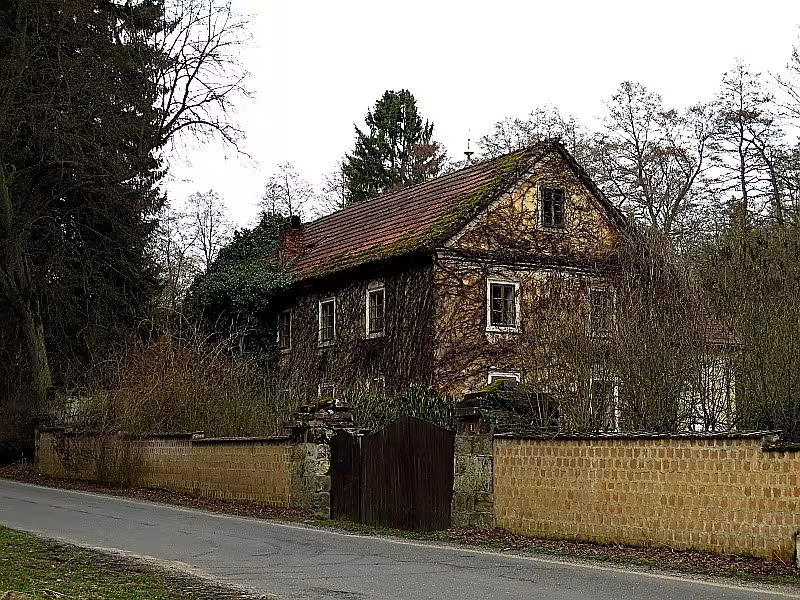
Vodní mlýn Mlčeň is a baroque building in the settlement of Silčín in Kokorovské Dole (district Mělík), located in the valley of the river Pšovka. As a real cultural monument of the Czech Republic, it has an important history dating back to the 16th century.
There is little information left about his oldest history. However, it is assumed that the mill served local agriculture in the 16th century. At that time, the reformation took place in the Czech countries and the use of water-powered machinery developed, which supported the expansion of mills as key economic units.
The architecture of the complex includes a storey, walled residential house with a mill, which has a simple decorative facade and a saddle roof. The Baroque core of the building was rebuilt in the second half of the 19th century. There is also a ground-floor brick exchange with stables, barn and pillar gate.
The name Silčen refers to the period after the 30-year war, when the mill did not grind for some time, i.e. "silent." In 1888 the auction of the building took place at an estimated price of 17481 gold and its original descriptive number was 1.
During the 20th century the mill became a multi-functional operation thanks to modern technologies. At the beginning of the century, Banki's turbine was deployed, which produced electricity for the needs of the building in addition to grinding. In 1930 there was a water wheel on top water (flow 0,158 m ³ / s, flow 5,4 m, power 7,36 k) and also a Francis turbine (flow 0,2 m ³ / s, flow 4,3 m, power 8,7 k).
The mill is located in the remote valley of Pšovka near Kokořín Mine, within reach of the natural sites of the Czech Paradise including rock cliffs and forest trails. This monument is a valuable example of the historical use of water power and represents an interesting goal for lovers of history and technology.
Historical milestones
- 1888
- auction mill in estimated price 17 481 gold
Architectural development
The original storey walled two-wing building was built in the 16th century, later in the second half of the 19th century it underwent Baroque reconstruction of the core. Around the mill there are attached wall objects of exchange, barn and barn, all under the saddle roof. In the 20th century, a water wheel, Francis' turbine and Bánki's turbine were added, making the mill a multi-functional operation.
Historical events
1888 - auction mill for 17 481 gold; 1930 - installation of water wheel on the upper water and Francis turbine; the beginning of the 20th century - the deployment of Bánki's electricity turbine
Points of interest
- The history of the mill dates back to the 16th century. - The name Silent refers to the period after the 30-year war, when the mill did not grind for some time. - In 1888 the auction of the building took place at an estimated price of 17481 gold. - At the beginning of the 20th century, Banki's turbine was deployed, which, apart from grinding, produced electricity. - In 1930, there was a water wheel on top of the water and a Francis turbine.
Guide
Show guide text
This text was created by artificial intelligence and has not been editorially reviewed. It may contain inaccuracies.
Welcome to the heart of Kokořín Dole, where time seems to be stopped and where nature with history forms one inseparable whole. You're standing in front of the water mill. Stop for a moment, take a breath through the fresh air of this remote valley and feel the atmosphere surrounding you. In front of you is a building that is a silent witness to centuries of human work, technical progress and a period of deep silence. Take a look at the mill building and imagine how for generations the rhythm of the water wheel and the noise of the Pšovka River has been heard, which continues to accompany this space with its cold water.
Let us now return together in time much further, to the sixteenth century. It is from this time that the first mention of this place comes. At that time, the mill was not just a building element of the landscape, but a crucial centre for the entire community. Imagine the agricultural landscape at that time, where the local farmers brought their grain to leave it on the ground. Mlýn Silín served primarily local agriculture and was a fundamental pillar of the survival of people living in this valley. It was an area of meeting, trading and hard physical work that was perfectly consistent with the cycle of nature and the flow of the river.
But if we move to the nineteenth century, we will see that the mill has undergone a significant transformation. Now pay attention to the overall appearance of the object. It was during this period that a large reconstruction took place, thanks to which the mill acquired its baroque core. Note the characteristic features of this time that still persist in the building. The Baroque brought a kind of clarity and harmony to architecture, which gave the mill the look we know today. At the same time, not only aesthetics, but also functionality, were being modified in the nineteenth century. The mill was equipped with modern water facilities to increase the efficiency of grinding and to make better use of the strength of the Oshka. Look at the facade and see how the practical purpose in this building combines with the period aesthetic feeling.
The history of this place is not only about stones and wood, but also about fate and money. Let's stop at one particular year, which is eighteen hundred eighty-eight. This year the mill became the subject of an auction. Imagine the tension at the time when they were applying for ownership of this işleta. The estimated price of the mill was set at a remarkable amount of seventeen thousand four hundred eighty-one gold. At that time, there was considerable capital, which reflected not only the value of the buildings themselves, but above all the potential of water law and the ability of the mill to generate profits. Today, this sum tells us how important and valuable the water mill was in the landscape.
Now I want to take you to one of the most interesting parts of the story of this place, which is already in its own name. Notice what the mill is called. Silence. You may think it's a common name, but there's a deeper and somewhat sad story behind it. The name refers to the period after the end of the devastating 30-year war. At that time, the landscape was devastated, humanity exhausted, and many places abandoned. The mill Silent in this period stopped talking. The bike stopped, the mill wheel went quiet, and there was silence in the valley. It was this long period of silence, when the mill did not fulfil its function and just stood in a remote valley, that it wrote down a name that it bears until today. It's a fascinating reminder of how powerful historical events can affect even one small object in a forgotten corner of the earth.
But the history of the mill Silent is not just about silence and stopping. In the early 20th century, it was time for a new technological leap. In the first half of this century, the mill was equipped with Banki's turbine. Try to imagine what it meant to people at the time. The turbine did not only deal with the grinding of the grain, but brought something completely new to this remote valley. The mill became a small power plant that supplied the entire building with energy. It was the transition from old craft to modern technology. The water force, which only turned the mill stone over centuries, has now lit the bulbs and changed the way of life in this place.
Today, when you stand in front of the mill Silent, you see a combination of several epoch. From the sixteenth century, to the baroque adaptations of the nineteenth century, to the technical advances of the twentieth century. It is a place where silence is encountered after war with turbine noise and where agricultural tradition has encountered modern energy. All this is hidden in this quiet valley of the River Pšovka, where nature slowly returns to what was from the beginning.
Now I encourage you to look around in peace. Take a look around the building, see the current of the river, and think about how many people have stood before you, how many grains of grain have passed through the mill stones and how many stories have happened here that no one knows about today. The mill Silent is a reminder of stability and change, silence and thunder of water.
Thank you for accompanying me on this short journey through time. I hope you've found a moment to think about it and that the atmosphere of this place has caught your eye. You are now being left to explore Kokořín Dole. Let yourself be guided by paths, listen to the noise of the forest and look for other traces of history that this landscape hides within you. I wish you a pleasant continued journey and beautiful experiences in this magical corner of our country. Goodbye.
Tips for visitors
Best time to visit the water mill Silence is autumn or spring when there are fewer people and nature offers unforgettable experiences. There are also beautiful leaf colours or flowering shrubs in these periods.
The mill can also be visited by public transport; we recommend checking the current connection before travelling.
When visiting, bring clothes suitable for walking on hilly terrain, shoes for dry feet and breakfast or drinking. Don't forget the protective coat or jacket, because the climate in the valley can be colder.
The best place for photography is at the mill itself, where beautiful light effects may appear at sunset. Use natural enlightenment to capture the atmosphere and historical details.
In the surroundings you can visit the rock cliffs of the Czech Paradise, which offer beautiful views. Forestry trails are also suitable for families with children, where children can play and discover nature.
Frequently asked questions
Can the monument be visited?
This is a technical monument. Some are open as exhibitions, others are out of use or on private land. We have not verified whether this one is accessible.
What are the opening hours and admission?
We have not verified the opening hours or admission. Current information is published by the operator.
Where is the monument?
Location: Kokořínský Důl, Středočeský kraj. The map on this page shows the exact spot.
Why is the monument protected?
It is listed in the Central List of Cultural Monuments of the Czech Republic as a cultural monument (register no. 1000131569).
Businesses nearby
Do you run a restaurant, accommodation, shop, museum, rental, wellness or other visitor service near this monument? Show yourself directly to the people heading to it — this is how they will see you in the app and on the web:
Nearby
The mill is located in the valley of the river Pšovka, near the village Kokořínský Důl and within reach of several natural sites of the Czech Paradise, including rock cliffs and forest trails.
Accommodation nearby
Themed route
Thematic cruise route: Vodní mlýn Mlčeň and surroundings
1. Vodní mlýn Mlčeň (main objective) - Type: Historical landmark - Why it is worth a visit: Vodní mlýn Mlčeň is a unique architectural monument, which represents typical water mills of the Czech Paradise. Its history dates back to the 19th century when it was built for the processing of grain using the River Pšovka. The mill is not only a technical monument but also a witness to the life of villagers in the past.
2. Rock cliffs of Cokořín Dola - Type: Natural location - Why is it worth a visit: Rock cliffs near the village Kokořínský Důl are an impressive natural theatre that offers beautiful views and is ideal for fast walks or picnics. The cliffs create a unique landscape area and are an important part of the natural environment of the Czech Paradise.
3. Forest trails by the river Pšovka - Type: Walk - Why is it worth a visit: Forest trails along the river Pšovka are an ideal place to relax and explore the natural environment. These paths offer a quiet experience in the valley where you can relax and look at the wild flora and fauna of the area.
4. - Type: Cultural location - Why is it worth a visit: The village is famous for its historical architecture and authenticity. Walk on the streets of Kokořín Dola takes you to the past where you can appreciate the ancient character of houses and the atmosphere of a small rural settlement.
5. Ústí River Pšovka - Type: Natural experience - Why is it worth a visit: The mouth of the river Pšovka is a place where you can watch its flow and pleasantly disconnect in peace. This place offers beautiful views of the surrounding countryside and is ideal for a short stop during your trip.
This route offers a combination of historical, cultural and natural experiences that are typical of the Czech Paradise region.
Seasonal recommendations
Spring in Kokorovsky mine brings awakening nature and fresh green leaf color. Thanks to melting snow, there is a stronger stream of water in the mill, which creates a lively atmosphere. The light is fine and scattered in this period. We recommend taking layered clothes because the morning cold may still be in the valley. The roads can be muddy because of the rain, which is why quality shoes are useful. The best thing to do is to arrive early in the morning before thick morning fog rises from the landscape.
Summer offers rich vegetation and a pleasant shade under the trees that protects against heat. The water mill in the summer sun is very fresh and the air is filled with the scent of the forest. In the main summer season there are more visitors, so it is reasonable to come earlier to enjoy a quieter moment. Dress lightly and don't forget the repellent and enough drinking water for a comfortable walk.
Autumn in the valley creates a color spectrum thanks to the golden and red shades of leaves. The atmosphere is quiet, slightly melancholic and often accompanied by morning fog above water. It is advisable to have a waterproof jacket and shoes that can handle wet soil. The ideal time to visit is in the afternoon when the sun shines at a lower angle and creates beautiful shadows.
Winter turns the mill into a silent, freeze-covered monument, where the white color of snow is replaced with dark bark of trees. There is a deep silence in the valley and the air is sharp and clean. Because of the short days and the low sun, it's best to schedule a visit around noon. The necessity is very warm clothes and shoes with good grip in case of ice on the road.
Visualizations and artistic views


The visualisations are generated by artificial intelligence and serve as inspiration.
Photos from the area
Real photos taken near the monument


Zdroj a licence jsou uvedeny u každého snímku.
Tips from visitors
No tips yet. Be the first!
Log in and add your tip.
Sources and literature
Photos: Sovicka169 / CC BY-SA 4.0 — Wikimedia Commons. The author and licence also appear when you hover over the image.
Faktickým podkladem tohoto textu byl článek na Wikipedii, jehož autory jsou přispěvatelé Wikipedie. Článek je dostupný pod licencí CC BY-SA 4.0.
Location on the map





Příběhy a pověsti
Legendy, pověsti a příběhy spjaté s touto památkou

Fotografie návštěvníků
Zatím žádné fotografie. Buďte první, kdo přidá fotografii z návštěvy!
Log in a přidejte svou fotografii nebo hodnoťte.
Za ověřenou návštěvu v aplikaci získáte víc bodů — poznáme podle GPS, že jste na místě.
Reviews and comments