



Vodní mlýn (Ředice) Water mill
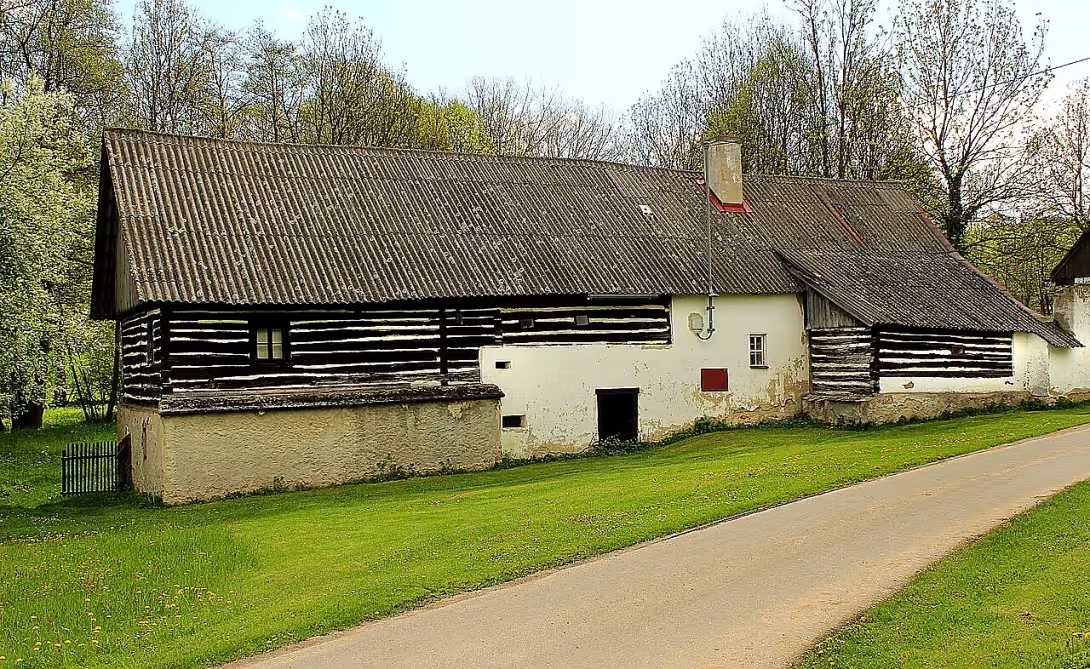
Novak's water mill is a cultural monument from the beginning of the 19th century, located near the Slabá creek between the municipalities of Ředice and Ředice in the district of Příbram. The area consists of a set of grafted and stone structures in which the original milling plant is preserved.
The oldest news about the mill dates back to the 16th century. The building is mentioned in the purchase contract already in 1527 and the first written mention is dated to 1545. The current appearance of the complex dates back to the beginning of the 19th century.
The main building is a storey residential building with a mill that is grafted and has a ground plan of the rectangle. The beams are connected in the fish corners. The ground floor area contains two skylights and the entrance is located from the eastern canopy facade. On the stone suspect is built a storey mill with a steeple on two thirds of the side facade, carried by transverse ceiling beams from the ground floor. There are two chambers upstairs. The forward shields are lined with vertically laid plates and a rectangular opening is located in the northern shield. The roof is saddled, covered with eternity, and the ceilings are beams. The original milling plant was preserved in the mill.
The entrance to the premises consists of a walled gate with a semicircular closure and a counter roof. The hoarder is a grafted two-chamber building on a suspicion of stone and bricks, with connected national beams for fish. It is connected to a walled open shed with a significantly expanded wall facing the road. The facade of the hoarder has two square holes and a niche with the statue of the Virgin Mary is located in the north facade. The hoarder has a saddle roof. The west side is closed by a stone barn with rectangular ground plan, plastered walls and longitudinal ventilation vents. There are two-wing doors in the north wall, and the barn is connected with a stone wall.
From 1881 to 1939 the mill belonged to the Novak family, which is documented in the Water Books. The technical operation was provided by a drive that delivered water from a stone-eater about 300 metres away through the floodgates and two storage tanks. In 1925, two water wheels were installed on the top water, but only one remained in operation since 1930. According to the 1930 figures, the gradient was 4.5 metres, the gradient was 0.116 m ³ / s and the output was 4.52 HP.
In 2003 the whole area was declared a cultural monument to the Czech Republic. The object is a valuable testimony about water management and traditional grafted architecture. Visiting this place allows you to see the history of the mill and see preserved technical elements.
Historical milestones
- 1527
- A reference in the sales contract.
- 1545
- First written mention of the mill.
- 1881
- The Novak family is listed in the Water Books as owners.
- 1939
- The last year of ownership of the Novak family.
- 2003
- Declaration of the mill for cultural monument of the Czech Republic.
Architectural development
The contemporary complex dates back to the beginning of the 19th century and consists of grafted structures on stone foundations. The residential building has a saddle roof covered with eternity and the ceilings are beams. There is also a walled gate with a counter roof and a stone barn.
Historical events
In 1527 the mill is mentioned in the purchase contract. The first written mention of the mill dates back to 1545. In 2003 the complex was declared a cultural monument to the Czech Republic.
Owners
Rod Novák owned the mill from 1881 to 1939.
Points of interest
- The oldest mention of the mill dates back to the 16th century, namely 1527 and the first written mention dates back to 1545. - The area consists of a set of grafted and stone structures and the original milling plant is preserved in the mill. - The technical operation provided a drive with a water run approximately 300 m away and two storage tanks; In 1925, two water wheels were installed, only one since 1930, with a drop of 4.5 m, an abundance of 0.116 m ³ / s and a power of 4.52 horsepower. - From 1881 to 1939 the mill belonged to the Novak family, which is documented in the Water Books. - In 2003 the whole area was declared a cultural monument to the Czech Republic.
Guide
Show guide text
This text was created by artificial intelligence and has not been editorially reviewed. It may contain inaccuracies.
Welcome to this extraordinary place where time has stopped and where every wooden plank and every stone tells stories from centuries ago. You're standing in front of Novak's water mill. Before we go into deeper exploration, let us just stop for a moment, soak up the atmosphere of this place and perceive the calm that rules here. You are located in a picturesque environment between the municipalities of Rivers and Rivers, in close proximity to the weak stream. It is this water, which once tirelessly flowed and powered this whole space, that is the soul of this place.
Look at what's right in front of you. You see a set of structures that form one complex and harmonious whole. The first one likely to reach out to you is the walled-up gate that separates this historic area from the rest of the world as a silent guardian. Behind it lies space, which was once full of life, work and constant movement. Notice the different structures you see here. There's a hoarder, a shed and a barn, and each of them had their essential role to play in the everyday life of the mill. But the main focus of everything is the impressive, storey grafted structure. Note how beautifully contrasts its wooden design with a solid stone suspect on which the whole building stands. This stone base is not only an aesthetic element, but above all a solid support that allowed the mill to survive centuries.
Now I want to take you on a journey deep into the past. To understand the importance of this place, we need to go back far beyond human memory. The history of this mill is not just a few years old, it has roots in the deep sixteenth century. If we look at the oldest records, we will find that this place is already written about in the year fifteen hundred twenty-seven, under one purchase contract. This is an incredible time when the world was shaped differently. A few years later, namely in the year fifteen hundred forty-five, the first direct written mention of the mill itself appeared. Imagine the continuity of existence, the constant work that has been going on here over hundreds of years. This mill was not just a building, it was a living organism that supplied the surrounding villages and was part of the economic heart of the entire region.
Now let's focus on the details that you can observe right now. Pay attention to the architecture of the complex. It is fascinating how various materials and methods of construction are mixed here. We have grafted structures that are cosy and human, and at the same time stone elements that provide total weight and stability. The whole complex consists of a combination of these structures, which creates a picture of a rich and rich rural estate. If you had the opportunity to enter the inner areas of the mill, you would encounter the rarest. That's where the original mill was preserved. These machines, which once crushed the grain on flour in the rhythm of the water, are now silent witnesses to the then technical level and human art. It's a rare find that allows us to understand exactly how work was done in these areas.
Speaking of the mill, we can't forget the people who lived here, worked here, and who shaped this place. One of the most important families that are closely associated with this place is the Novak family. Their name goes to this mill. In the year one thousand eight hundred eighty-one, these people are already listed as owners of this place in official water books. Imagine a long time when the Novak family controlled this space, how machines were being taken care of here, how they planned their work according to the flow of water and how their family's life was going. Their time at this mill lasted long, until the year one thousand nine hundred thirty-nine, when their ownership era ended. These years represent a period when the mill moved within a more modern history, but still remained true to its old traditions.
You may now wonder how it was possible to keep this whole dog in such good condition and how it was even guaranteed to operate. Here comes one of the most interesting things you should realize. The entire technical operation of the mill was not dependent solely on the creek itself, which you see nearby. In order for the grinding wheels to have sufficient power, the water supply had to be secured over the drive. This system was connected to a water course located about 300 meters away. Imagine the complex network of channels and waterways that had to be kept in perfect condition so that water could flow exactly where it needed to go. This ability to use the power of nature was the key to the success and survival of this place for centuries.
It is thanks to the incredible preservation of this complex in order to remind us of its story today, in the year two thousand and three it was declared a cultural monument of the Czech Republic. It's not just a formal label, it's a recognition of its high historical and technical value. It is a promise that this place, its grafted walls, stone foundations and grinding equipment, will remain preserved for future generations so that even those may stand here where you are right now, and feel the breath of history.
Now we'll let you continue your search. We recommend you to walk around all the buildings that form the premises. Feel every texture of wood, every inequality of stone on the gate and suspect. Explore the boatshed, shed and barn and try in your mind to imagine what this place looked like hundreds of years ago when everything was fully operational. Let yourself drift through the atmosphere of this place and enjoy every moment you spend near this precious heritage. Thank you for choosing to visit this story and become part of it. We wish you a pleasant further journey in the footsteps of history.
Tips for visitors
For the best experience we recommend a visit in the morning or late afternoon light, when the grafted architecture of the mill excels in warm tones. With us we recommend taking comfortable shoes suitable for the field, especially if you plan to walk along the Slábá stream. When shooting, focus on the walled gate and floor gearing, which form the dominant area. For families with children, it is ideal to walk between the villages of River and River, where children can discover old economic buildings such as a hoarder or barn.
Frequently asked questions
Can the monument be visited?
This is a technical monument. Some are open as exhibitions, others are out of use or on private land. We have not verified whether this one is accessible.
What are the opening hours and admission?
We have not verified the opening hours or admission. Current information is published by the operator.
Where is the monument?
Location: Středočeský kraj. The map on this page shows the exact spot.
Why is the monument protected?
It is listed in the Central List of Cultural Monuments of the Czech Republic as a cultural monument (register no. 1151471618).
Businesses nearby
Do you run a restaurant, accommodation, shop, museum, rental, wellness or other visitor service near this monument? Show yourself directly to the people heading to it — this is how they will see you in the app and on the web:
Nearby
Potok Slabá a obce Ředice a Ředičky.
Accommodation nearby
Themed route
1. River, village: The beginning of the route in this village, which serves as the starting point for walking. 2. Weak stream, water flow: The path leads along this stream of water, which offers a pleasant environment. 3. Water Mill, Mill: The main destination of the trip, where you can observe the historical use of water power. 4. Rivers, village: The conclusion of the route in this nearby settlement.
Seasonal recommendations
Spring: In spring the surrounding water mill The river turns into a living garden where different kinds of flowers bloom and trees start to sprout. The sunny days bring warm light, which joins the mill in the most beautiful colors of spring. Visitors can expect a mild crowd load because people often use this time for short walks and holidays in nature. It is advisable to dress in comfortable shoes and clothes with shorter sleeves so that you can enjoy the warm sunlight.
Summer: During the summer season the River Water Mill is a popular destination for visitors seeking relief from urban life. Sunshine days and warm night climate bring long hours of light, making it easier to explore at different times of the day. This season it is recommended to visit the memory early in the morning or late in the evening to avoid large crowds and experience has been fully experienced. It is advisable to wear light clothes, sunglasses and UV protection cream when visiting.
Autumn: In autumn the surrounding water mill The river turns into a coloured carpet with leaves in various shades of yellow, orange and red. Sunny days provide ideal conditions for shooting and sightseeing in a quieter atmosphere, as visitors often concentrate on preparing for winter. This period is also suitable due to mild temperatures and relative lack of crowds. It is recommended to wear a warm shirt or sweater because the evening can be colder.
Winter: During winter offers water mill A unique atmosphere with snow and calm. The sunny days are shorter, which may affect the time of the sightseeing tour. In this season it is important to dress warm, including hat and gloves, to enjoy a tour without the inconvenience caused by the cold. Visiting a memory in a quiet time can be a special experience due to a quiet and quiet environment.
Visualizations and artistic views


The visualisations are generated by artificial intelligence and serve as inspiration.
Photos from the area
Real photos taken near the monument


Zdroj a licence jsou uvedeny u každého snímku.
Tips from visitors
No tips yet. Be the first!
Log in and add your tip.
Sources and literature
Photos: This file is available under Creative Commons BY-SA license. Basically: You can use this picture for any purpose, provid / CC BY-SA 3.0 — Wikimedia Commons. The author and licence also appear when you hover over the image.
Faktickým podkladem tohoto textu byl článek na Wikipedii, jehož autory jsou přispěvatelé Wikipedie. Článek je dostupný pod licencí CC BY-SA 4.0.
Location on the map





Příběhy a pověsti
Legendy, pověsti a příběhy spjaté s touto památkou
Fotografie návštěvníků
Zatím žádné fotografie. Buďte první, kdo přidá fotografii z návštěvy!
Log in a přidejte svou fotografii nebo hodnoťte.
Za ověřenou návštěvu v aplikaci získáte víc bodů — poznáme podle GPS, že jste na místě.
Reviews and comments