



Vodní mlýn (Sazená) Water mill
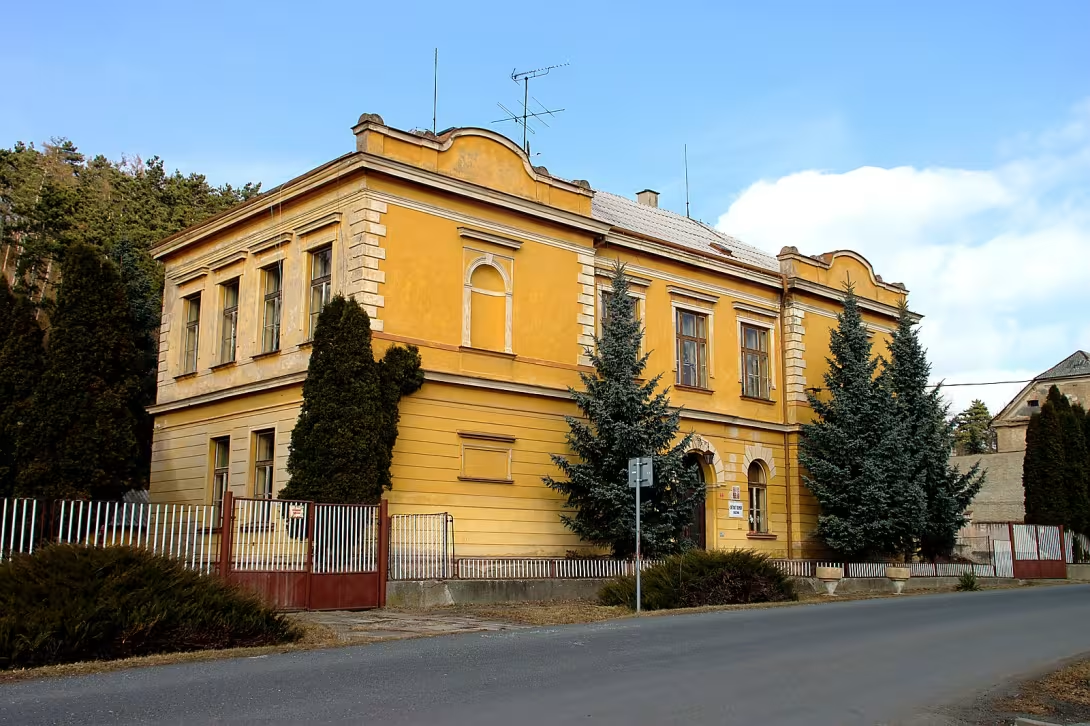
The Sazenské mill in the village Sazená, the district of Kladno, is a protected cultural monument built on the Bakovska stream. This water mill became famous for its long history dating back to the 16th century and a unique element in the form of a built-in fortress from 1938.
The first written mention of the mill dates back to 1544 when Urban mlynář from Sazen bought it. In 1569 and 1577 he was the owner of Gryspek z Gryspachu, who at that time had a dispute with David Boryn of Lhota for repeated damage to the drive. During this period the mill was walled, it had two floors and was covered by a canopy roof.
The current building has a rectangular floor plan and is covered by a Mansard roof with richly divided facades. The area is bounded by a wall with an entrance gate on the east corner. The eastern corner of the building occupies a barn with a shield to the road to which they connect along the wall of the ground-floor pigsty. The south and western parts of the area form a garden.
In 1757 the mill and the village purchased a monastery of premonstratek in Doksany, whose abbot Josef Václav Winkelburg remodeled the building in a costly way. After the abrogation of the monastery in 1782 as part of the reform of emperor Josef II. the large estate with mill in 1785 became property of the Kinský family, who then rented it. In the 19th century the mill faced a flood and damaged drive, which led to an auction of the rental in 1830, which took place only in 1869. In 1921 the mill went into the property of the tenant Šediý thanks to the land reform. After stopping grinding in 1943 the object was nationalized in 1950.
An important figure was miller Václav Hájek, mentioned in 1784, who became famous as a weather expert and collaborated with meteorologist Antonín Strnade. Technically, the mill originally operated by three water wheels on top water and used hail altitudes. After 1879 the new tenant JUDr. Žáček from Prague modernized machinery. The water wheels were replaced by a vertical Francis turbine brand Kohout and a milling line with French stones from Hübner and Opitz from Pardubice. In 1930, the paddle turbine was 9.9 horses.
The unique supplement is the reinforced strength No. 25a of type Z2, which was built directly into the mill interior in 1938 as part of the Prague line of construction section A-1 Velvary.
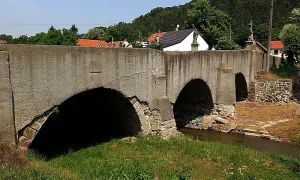
The Sazen Mill is a rare combination of traditional water and military architecture of the 20th century. Together with the surrounding stone bridge with statues, it is an important witness to the economic and strategic development of the region. Visiting this place offers a view of the history of miller and Czechoslovak fortifications.
Historical milestones
- 1544
- First mention of the mill and miller Urban
- 1757
- The purchase of a mill by a monastery of premonstratas in Doksan
- 1785
- Transfer of the mill to the Kinski family
- 1879
- Modernization of machinery and turbine installation
- 1921
- Acquisition of the mill into the ownership of the miller Šedivý
- 1938
- Installation of the Z2-type fortress into the interior
- 1950
- National mill
Architectural development
In the 16th century the mill was walled with two floors and a thatched roof. In the 18th century, a costly reconstruction of the monastery from Doksan took place. After 1879, the water wheels were replaced by a Francis turbine.
Historical events
1544 first mention of the mill, 1757 purchase of the mill by the doksan monastery, 1938 installation of the building of czechoslovak fortification, 1950 nationalization of the mill
Owners
1544 Urban mlynář, 1569 Gryspek z Gryspachu, 1757 Monastery of Premonstratas in Doksan, 1785 rod Kinských, 1921 Šedivý, 1950 State
Points of interest
- The mill has a unique element in the form of a built-in fortress from 1938. This strength of type Z2 was part of the Prague line. - The first written mention of the mill dates back to 1544 when Urban mlynář from Sazen bought it. - Miller Václav Hájek was a weather expert and collaborated with meteorologist Antonín Strnade. - The original three water wheels were replaced by a vertical turbine of the brand Kohout and a milling line with French stones. - In the 16th century, the mill was walled, it had two floors, and it was covered with a canopy roof.
Guide
Show guide text
This text was created by artificial intelligence and has not been editorially reviewed. It may contain inaccuracies.
Welcome to the water mill in the village Sazená. You are standing in a place where the relentless power of flowing water and the deep history that has evolved here for centuries is united. In front of your eyes is an impressive building, whose rectangular plan gives the whole place a sense of stability, calm and unwavering. Look up at her roof now. It is the so-called Mansard roof, which gives the whole house a very special, almost noble look in its specific form and style. Feel the atmosphere of this place, where the Bakovsky stream is constantly rumbling in the background and where every facade, richly divided and full of tiny details, is trying to tell a story about the people who lived here, worked and built their lives.
In order to fully understand the importance of this place, we must go along with you on the journey of time. The history of this mill goes deep into the past, up to 15 hundred and forty-four. This is the moment when the first record of writing shows the name of the miller Urban. Imagine how many generations of miller have been here, how many years the grain has been grinding here and how many human fates have been linked to this flow of water. Over the centuries, the fate of the mill has changed, along with the fate of the whole country and changing political and social conditions. In seventy-five seventy, the mill became part of the property of the premonstratry monastery of Doksan, which probably gave it some degree of stability and care. Later, in seventy-eighty-five, the mill passed into the hands of a significant noble line of Kinski, which at that time gave him another layer of prestige. The subsequent centuries also brought great modernization. In the 1800s, the mill began to become modern operation. However, the real break occurred in the nineteenth century, when a modern turbine was put into operation and the entire machinery was brand new. This step was a huge leap forward in work efficiency. In twenty-one, the mill became the property of the miller Grey, who probably continued here the tradition they had been building before him for centuries.
Now pay attention to the architecture that you are looking at right in front of you. Notice how the building is designed. Its rectangular shape is not random, but it serves the maximum use of space near water. The facades you see are simply not smooth walls, but they are richly fragmented, which suggests a high level of the craft at the time and that the mill was not just an ordinary job but an important part of the local economy. But the mill is not just this one main building. The whole area is much wider and richer. Look around you and feel the space. You see a wall with a gate that creates a clear line between the outside world and this private working space. Part of the complex is also a barn and various other ground buildings, which previously formed the heart of this economic unit and served for various needs of the mill family. All these elements together form a harmonious and coherent whole that now surrounds you.
However, any such historical structure is much more than just stones, wood and bricks. It's a place defined by humans. We can talk about the miller Urban, who worked here in the 16th century. We need to remember rod Kinských, who had interests here. But there is also a character that may interest you with his expertise and knowledge. The miller Václav Hájek was not just an ordinary worker by the water. He was a man with a deep interest in natural phenomena and the outside world. He collaborated with meteorologists, weather experts, and his knowledge was very valuable at the time. The understanding of the weather was absolutely crucial to miller activity because the weather determined the rhythm of the work and the very course of life in this place. Other names such as Gryspek z Gryspachu, David Boryně ze Lhoty, Josef Václav Winkelburg or Antonín Strnad appear in the history of this place. Even though you may not know their names today, their lives were inseparably linked to this place by the creek and every stone you see here.
And now I'm going to introduce you to something that is absolutely extraordinary and that may surprise you when you look at this calm water mill. When you look at this place, you might not expect something inside of it to be military. But right here, something unusual and fascinating is happening. In the year one thousand nine hundred thirty-eight the mill was built directly into the interior of the mill. It's not any construction, it's a specific type of Z-2. This fortress was part of a huge national military system known as the Prague Line. Imagine the incredible opposites - the place that served to grind the grain, to feed the families and to live with the water, became part of a huge fortification. This combination of civilian, economic life and military readiness is absolutely unique in this region. It's a secret that's hidden right inside these historic walls and that gives this mill a whole new, unexpected dimension.
Now that you have a much wider idea of this place and know its stories, we cordially invite you to further explore. Walk around, see the facade details, look at the wall and let the atmosphere of this place drift. Imagine what the life of the miller looked like hundreds of years ago, how it worked here and how the world around them changed. Thank you for spending time with this monument in Sazenách. We wish you a nice walk around and many other interesting experiences while exploring history.
Tips for visitors
The best time to visit the Sazen Mill is in the spring or autumn season, when nature is in full bloom and light is soft. These months offer beautiful experiences for photography with natural colour contrasts.
The place can also be visited by public transport; the best connection can be checked in the previous route planning.
When visiting take with you suitable footwear goods because the terrain around the mill can be untouched. Also remember the umbrella and protective clothing in case of unpredictable weather conditions.
The best place for photography is at the mill itself, where you can look forward to a beautiful perspective with water flow and roof. The best light offers morning or evening when the light is softer.
In the vicinity of the mill there is a historic stone bridge with statues that can be visited. For families with children it is interesting to explore the Bakovský stream and its natural environment.
Frequently asked questions
Can the monument be visited?
This is a technical monument. Some are open as exhibitions, others are out of use or on private land. We have not verified whether this one is accessible.
What are the opening hours and admission?
We have not verified the opening hours or admission. Current information is published by the operator. Official website: http://www.mlynsazena.cz/
Where is the monument?
Location: Sazená, Středočeský kraj. The map on this page shows the exact spot.
Why is the monument protected?
It is listed in the Central List of Cultural Monuments of the Czech Republic as a cultural monument (register no. 1000126963).
Businesses nearby
Do you run a restaurant, accommodation, shop, museum, rental, wellness or other visitor service near this monument? Show yourself directly to the people heading to it — this is how they will see you in the app and on the web:
Events nearby
Zdroj akcí: otevřená data měst a obcí ČR (Národní katalog otevřených dat) a kalendář akcí Národního památkového ústavu.
Nearby
Bakovský potok, kamenný most se sochami, silnice na Ledčice.
Accommodation nearby
Trips and activities nearby
Guided tours, tickets and activities nearby from GetYourGuide
Affiliate link: if you buy from the partner, we may receive a commission. The price for you does not change.
Search tours and activities →Themed route
Thematic cruise route: Water mill and surroundings Sazena
1. Vodní mlýn (Sazená) - Mill The main objective of our route is the water mill located in the village Sazená. This historical object attracts visitors with its architecture and technology from past times. It is a great example of the traditional mill plant, which was important for the local economy.
2. Bakovský porok - Natural water flow After visiting the mill we will look at the Bakovský stream, which is not only a source of energy for the mill, but also a natural element of the surrounding area. The stream offers beautiful landscapes and is an ideal place for relaxing and walking in nature.
3. Stone bridge with sochami - Bridge The following destination of our route is a stone bridge with statues, which is located near the Bajov creek. This architectural element is interesting with its history and decoration in the form of statues. It's a beautiful place to take pictures and explore local culture.
4. Roads on Ledchice - Roads To conclude the route, we will look at the road leading to Ledčice, which is an important transport connection in the area. This path will allow us to understand the historical and current communication routes of the region.
This route offers a view of the cultural and natural beauty surrounding Sazena, which is ideal for people in love with history and nature.
Seasonal recommendations
In spring, the mill wakes up with nature. The first flowers begin to grow around the water and the trees get a fresh green color. The light is soft and pleasant to observe the details of wooden structures. I recommend you take several layers of clothing because the wounds can still be cold while the afternoon is already warm. There are fewer visitors in this period, so you will enjoy the peace.
In the summer months there is most life. The sun clearly illuminates the water wheel and surrounding dense vegetation. The atmosphere is vibrant and hot, which perfectly complements the sound of running water. For more people, I suggest you come first thing in the morning to avoid the biggest crowds. Don't forget light summer clothes, headgear and plenty of fluids to freshen up.
Autumn brings golden and brown shades to the landscape around the mill. Leaves falling into the water create a beautiful picture and the morning mist above the surface adds mystery to the place. It's the perfect time for a peaceful observation of nature. Prepare a waterproof jacket and a warmer sweater because the humidity may be elevated. The best is to visit the mill in the afternoon when the light is the most golden.
Winter time turns the mill into a quiet and freezing world. If the frost comes, on the wooden parts and around the water will create a beautiful icing. The day is short and light is weak, which creates a melancholy atmosphere. It is necessary to dress thoroughly in very warm layers and to ensure wind protection. Due to a shorter day, I recommend planning a visit around noon.
Visualizations and artistic views


The visualisations are generated by artificial intelligence and serve as inspiration.
Photos from the area
Real photos taken near the monument


Zdroj a licence jsou uvedeny u každého snímku.
Tips from visitors
No tips yet. Be the first!
Log in and add your tip.
Sources and literature
Photos: Sovicka169 / CC BY-SA 4.0 — Wikimedia Commons. The author and licence also appear when you hover over the image.
Faktickým podkladem tohoto textu byl článek na Wikipedii, jehož autory jsou přispěvatelé Wikipedie. Článek je dostupný pod licencí CC BY-SA 4.0.
Location on the map





Příběhy a pověsti
Legendy, pověsti a příběhy spjaté s touto památkou

Fotografie návštěvníků
Zatím žádné fotografie. Buďte první, kdo přidá fotografii z návštěvy!
Log in a přidejte svou fotografii nebo hodnoťte.
Za ověřenou návštěvu v aplikaci získáte víc bodů — poznáme podle GPS, že jste na místě.
Reviews and comments