






Vodní mlýn v Dolní Sytové Water mill
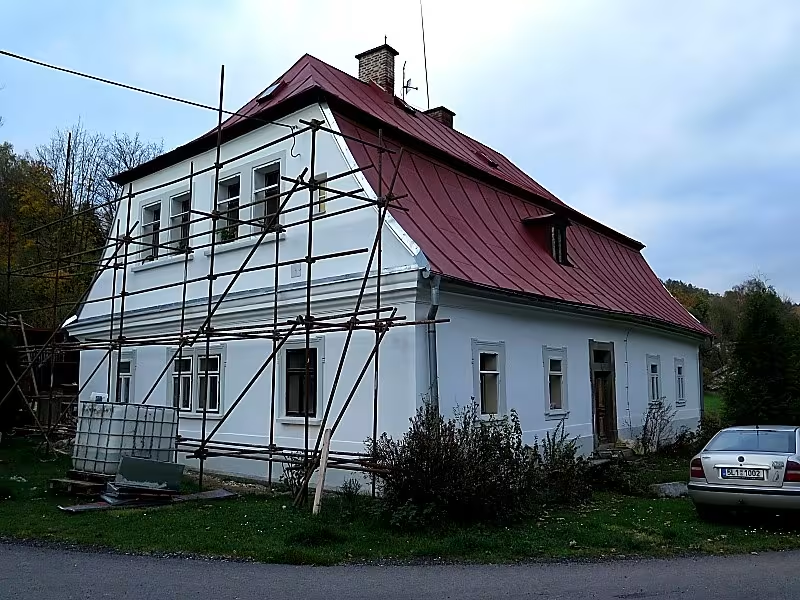
Vodní mlýn v Dolní Sytové, a local part of the village Háje nad Jizerou in Semily district, is a baroque mill built in 1791. It stands about 800 metres northeast of the Loukov Church on the Jizera River and since 2000 it has been protected as a real cultural monument of the Czech Republic. This object represents a valuable example of rural architecture associated with the history of milling along the watercourses.
The mill was built in 1791, which is confirmed by the year and by the epigraphic decoration for the translation of the entrance portal. The historical context of creation falls within the period of enduring enlightened absolutism under the rule of the Habsburg monarchy in the last decade of the eighteenth century, when the Czech countryside retained the traditional economic character associated with the development of crafts.
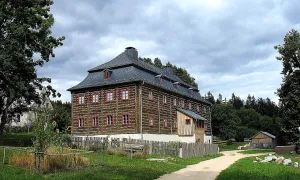
From a building point of view, the monument is characterized by a late baroque spirit. It was preserved mainly by a mansard roof with halves and valuable stoneware elements including an epigradically decorated entrance portal. The water was used to operate by a respectable, eight hundred meters long drive from the Jizera River.
Over time the area has undergone significant changes. The adjacent grafted building was demolished and some economic buildings with land were sold out. The preserved historical sources also indicate that the owner took the turbine to scrap.
The year 2000 became the key milestone in modern history, when the building was officially declared a cultural monument of the Czech Republic.
Today this building resembles the craft history of the region through preserved elements such as the Mansard roof and stone portal. Visiting this place on the Jizera River offers a view of the late Baroque building connected with the development of the mill industry in the village Háje nad Jizerou.
Historical milestones
- around 1750
- The emergence of a tradition of water milling in the region.
- 1791
- Built by a late Baroque water mill with a portal.
- 2000
- The building declared a cultural monument.
Architectural development
The mill was built in 1791 in the late Baroque spirit. It has been preserved mainly by stone elements and a Mansard roof with halves. Part of the original area was a grafted building and water drive eight hundred metres long.
Historical events
1791: The position of the mill as evidenced by the inscription on the translation of the portal entrance. 2000: Registration of the building between the real cultural monuments of the Czech Republic.
Points of interest
- Vodní mlýn v Dolní Sytové is a Baroque building built in 1791, which confirms the year and decoration for the translation of the input portal. - The mill was served by water delivered eight hundred meters long drive from the Jizera River. - From the original area preserved the Mansard roof with halves and valuable stoneware elements including decorated entrance portal. - The adjacent grafted building was demolished, some of the economic buildings with the land were sold off and the owner took the turbine to scrap. - Since 2000 this building has been protected as a real-estate cultural monument of the Czech Republic.
Guide
Show guide text
This text was created by artificial intelligence and has not been editorially reviewed. It may contain inaccuracies.
Welcome to Lower Sytova, in the picturesque corner of the village Háje nad Jizerou. Right now, you're standing in front of a building that carries echoes of ancient times when the rhythm of life in this area was determined by the noise of water and the regular rotation of the mill wheel. There is a water mill before you, a building that is today protected as a real-estate cultural monument of the Czech Republic. Feel this moment of peace and try to disconnect for a while from the hustle and bustle of today's world. Look at the whole structure and feel its atmosphere. It is a place where the human need to work with nature has joined together and where the technique of its time has met with aesthetic care for the appearance of the building.
To understand why this mill is so important, we have to go back a few centuries in time. In this region, in the vicinity of the Jizera River, the tradition of water miller has begun to develop strongly since around the year around seven hundred and fifty. At that time, water was the main source of energy, like electricity today. The mills were not only places where grain milling on flour, but centres of social activity and key points of the local economy became. It is from this tradition that the building you are now standing with has come. This particular late Baroque mill was built in the year of the seven hundred ninety-one. So imagine how many generations of people have gone through, how many bags of grain have been brought in and how many stories have been told here during long winter evenings.
Now I want to ask you to pay attention to the architecture itself, because it is in the details that the beauty of this place lies. Please look up on the roof. Notice its specific shape. It is a so-called Mansard roof with halves. This type of roof was very popular at the time of construction because it made it possible to use the space in the attic more efficiently and at the same time supplied the building with an elegant, yet noble look. It is one of the most preserved elements that today tell us about the original intention of builders.
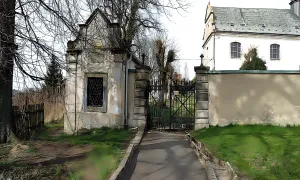
Now please move your view below, towards the entrance. Notice the entrance portal. It's the real jewel of this building. The portal is decorated with epigraphically, which means it contains inscriptions and years engraved directly into the stone. It is here that you can find confirmation of the year of production of the mill, that is to say, the year of the year, seven hundred ninety-one. These stone elements are very valuable because they allow us to date the construction with absolute certainty and to see the craftsmanship of the people who built it. Try to imagine the hands that worked on this stone and the pride with which the mill owner had his year of creation recorded for future generations.
When you look at the building, you might wonder how the mill actually powered. Here we come to one of the most interesting technical parts of this place. The mill may stand near the Jizera River, but the water was not brought to the propulsion of the water wheel by a simple current. Operation of the mill provided so-called drive. It was an artificially dug channel through which the water flowed from the river to the mill wheel. Now imagine this incredible performance: this drive was eight hundred meters long. So imagine how the water traveled almost a kilometer through the countryside to eventually spin the wheel with enough force and move the mill machines. It's a fascinating testimony about how powerful people were to influence the landscape to use nature's power to their advantage.
Today, when you observe the site, you see the main stone building. However, it is important to know that in the past this space looked different. A grafted building was adjacent to the main mill, which was unfortunately torn down over time. Even if we don't see her today, her absence reminds us of how fragile history is and how important it is to protect what's left of her. That is why this building was officially declared a cultural monument of the Czech Republic in the year two thousand. By doing so, the state acknowledged that the water mill in Lower Sytova is not just an old building, but an important piece of our common history that deserves care and respect.
Although we do not know the names of the particular architects who designed this project or the names of the miller who spent their days here, their trail is still present. There's a trail in a rock, a trail in the shape of a roof, and a trail in the very landscape that was shaped by the long drive. Perhaps this ignorance is part of the secret of this place. Who was the first to lay the foundation stone in the year seven hundred ninety-one? What was the miller thinking when he watched the Jizera level and hoped there would be enough water for his operation?
This mill is a silent witness to the changing times. He saw the arrival of the industrial revolution, the change in agriculture, and the gradual retreat of traditional miller industry, which was replaced by modern technologies. Yet he is still standing, upright and proud, with his Mansard roof and carved portal. It is a place that teaches us patience and reminds us that true quality and craftsmanship persist for centuries.
Now I'll leave you to explore the space around the mill at your own pace. I recommend you to re-examine the details of the stoneware decoration at the entrance and try to draw the water path in that eight hundred meters long canal. Feel the silence that is here today, and contradict it with the noise that must have been here in the days of full operation, when the floors were shaking in the building and the air was flying fine dust from ground grain.
If you like photography, I recommend you capture the contrast between the massive walls and the lightness of the halves roof. It's the perfect moment to make your own record of this beautiful place.
Thank you for accompanying me on this short journey through the history of the water mill in Lower Sytova. I hope this visit inspired you and that you felt a connection with the people who lived and worked here hundreds of years ago. Now you can continue to discover the beauty of the Háje nad Jizerou surroundings. I wish you a pleasant walk and many other fascinating experiences while you are traveling through our sights. Goodbye.
Tips for visitors
The best time to visit the water mill in Dolní The system is spring and autumn, when the weather is mild, the sunlight is soft and tourism is smaller. At these times, you can easily walk through the surrounding forests and soak up the atmosphere of the historic place.
Parking is possible directly at the mill in the reserved parking lot, or in the parking lot at the meadow church, from where a short path leads to the water mill. You can reach Hájí nad Jizerou by car and public transport; Check the current connection in the search engine and then proceed on foot to the mill.
Take with you comfortable shoes suitable for uneven terrain, waterproof jacket or blanket in case of rain, as well as a water bottle. A camera or a mobile phone with a good camera will help you capture unique scenery, and a map or GPS for orientation around you.
For photography are the best places in front of the mill on the stone bridge, where you can capture the reflection of the water wheel in the water, and also from the left bank of the river at sunset, when light falls on historic stones. Use the golden hour morning and evening for the most beautiful colors.
The surrounding area is worth visiting a meadow church, which is about 800 metres northeast of the mill, and a natural trail along the Jizera River, where you can take a short walk or cycling. The historic cottage in Hájí is also within reach and the view of the river is ideal for relaxation and picnic.
Businesses nearby
Do you run a restaurant, accommodation, shop, museum, rental, wellness or other visitor service near this monument? Show yourself directly to the people heading to it — this is how they will see you in the app and on the web:
Nearby
Mlýn stojí přibližně osm set metrů severovýchodně od loukovského kostela na řece Jizeře v obci Háje nad Jizerou.
Accommodation nearby
Themed route
I propose a thematic cruise route focused on the main destination and its immediate surroundings in the village Háje nad Jizerou.
1.Vodní mlýn v Dolní Sytové Type: Historical technical monument Why is it worth a visit: This water mill represents a valuable example of folk architecture and technical construction associated with the history of grain milling on the river.
2. Church at Loukov Type: Sacral construction Why is it worth a visit: The historical sanctuary is located not far from the river stream and forms a significant dominant feature of the entire area in the village Háje nad Jizerou.
3. Jizera River Type: Natural flow Why is it worth a visit: Water flow flowing through the village Háje nad Jizerou creates a picturesque environment for walks around the mill and adjacent church.
Seasonal recommendations
Spring awakens nature around the Jizera River in fresh green and awakening flower gives old mill buildings a romantic character. The sun's rays penetrate the still slightly squeaky trees and create interesting shadow games on the stone facade, while the humming water in the drive gives the whole place fresh spring energy. You will not meet many visitors here during this period, so you will enjoy complete peace, but due to the melting snow in the mountains the terrain around the river is soggy. Therefore, take firm and waterproof shoes, a warmer windbreaker and the best time to visit is in the morning, when the morning fog is slowly receding to the sun.
Summer brings lush vegetation, which partly hides the construction in the green, and the trees provide a welcome shade during hot sunny days. Intense afternoon light beautifully highlights the structure of historical masonry and adjacent water works, while the surrounding landscape attracts longer walks along the stream. Since this is the main period of holidays and holidays, you will meet the most tourists and cyclists who pass through here. We recommend to arrive early in the morning or in the evening, when the biggest heat and crowds of people fall off, put on light breathtaking clothes and don't forget the headgear and the supply of drinking water.
Autumn offers an unrepeatable spectacle where the surrounding mixed forests turn into warm shades of yellow, orange and red, creating a wonderful contrast with dark wood and stone mill. The low sun creates soft, scattered light ideal for photography and cooler air complements the quiet melancholic atmosphere of falling nature. Weekends can attract lovers of autumn wanderings, but working days are very quiet. For this season you can use layered clothes, a non-inflatable jacket and solid shoes due to fallen and occasionally slippery leaves, while the ideal time for a tour is around noon when it is the hottest outside.
Winter covers the Jizera Valley in silence and often also into a snow blanket that turns the surrounding area into a fairy tale landscape where ice crystals glistening on a frozen drive. The early dimming and grey skies give the memory a mysterious feel, while the cold air sharpens the sounds of flowing water, which is still looking for a way under the ice. Tourists come here at this time really minimum, which guarantees maximum privacy when exploring history. It is necessary to choose warm winter clothes, high snowballs or hippos with anti-slip soles and plan your trip for around noon, when daylight lasts only briefly and temperatures fall lowest.
Visualizations and artistic views


The visualisations are generated by artificial intelligence and serve as inspiration.
Photos from the area
Real photos taken near the monument


Zdroj a licence jsou uvedeny u každého snímku.
Tips from visitors
No tips yet. Be the first!
Log in and add your tip.
Sources and literature
Photos: Sovicka169 / CC BY-SA 4.0 — Wikimedia Commons. The author and licence also appear when you hover over the image.
Faktickým podkladem tohoto textu byl článek na Wikipedii, jehož autory jsou přispěvatelé Wikipedie. Článek je dostupný pod licencí CC BY-SA 4.0.
Location on the map
Příběhy a pověsti
Legendy, pověsti a příběhy spjaté s touto památkou

Fotografie návštěvníků
Zatím žádné fotografie. Buďte první, kdo přidá fotografii z návštěvy!
Log in a přidejte svou fotografii nebo hodnoťte.
Za ověřenou návštěvu v aplikaci získáte víc bodů — poznáme podle GPS, že jste na místě.
Reviews and comments