



Vodní tvrz Fortress
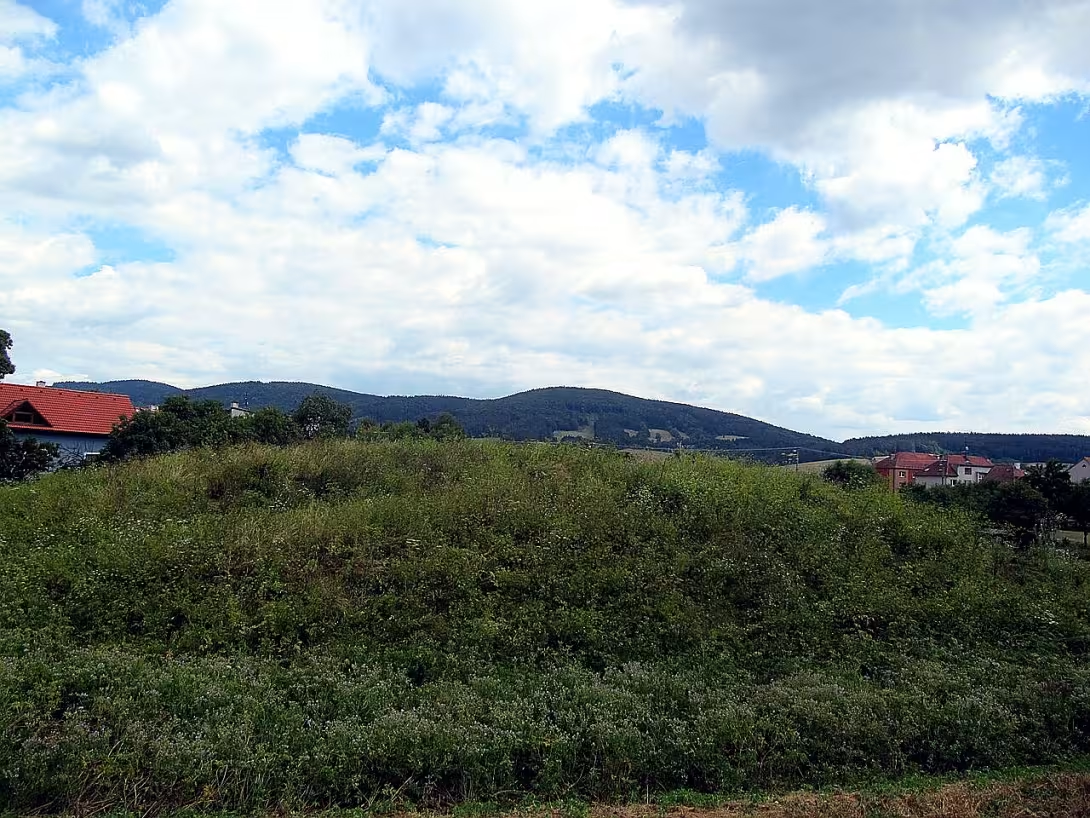
Vodní tvrz Vlachovice, also known as Chestnut, presents archaeological traces of the medieval residence from the second half of the 15th century. The monument lies on the southwest edge of the village of Vlachovice in the district of Zlín. Its importance lies in the preserved terrain plan of the original fortification.
The headquarters was built around 1460 vladykové Vlachovští from Vlachovice, who owned the property on the site since 1343. The fortress was created in the late Middle Ages as a representative and defence space for the family.
The original building was designed as a water fortress with a circumferential wall and a circular moat, powered by water from the nearby river Vrára. The entire fortress has approximately rectangular shape with dimensions of 80 x 65 meters. The core of the seat was a raised hill about 32 x 25 meters, which was raised above the surrounding landscape to a height of 3.5 to 5 metres.
In 1544, they sold the Vlakhov fort to Podstati of Prusinovic to pay their debts. In 1574, the estate was divided between the Hungarian family of Yakušice and the Aranyi. After the marriage of Dorota Jakoušic and Ference Serényiho in 1593, half of the estate went into the hands of the Serenyi family. Both parts of the estate were united by Countess Ester Forgáčová of Gymesh, who connected Vlachovice to Broum Manor around 1662.
From 1703 to 1709, an uninhabited fortress served as a support for Austrian dragoons who resisted the Kururans during the anti-Habsburg uprising of František Rakóczi. Since the beginning of the 18th century, the building gradually turned into a ruin because the locals used masonry as cheap building material.
Today the monument is only visible as a fortress without any sign of masonry. The dominant is a grass-covered hill at the site of the former core, surrounded by a partially preserved valley and a well-seen moat. The building is located approximately 50 metres from the right bank of the river Vláry, near the road leading to Vrbětice.
Visiting this place allows you to see the trail of a lost noble residence and understand the changes of the landscape over the centuries. It is a suitable stop for anyone interested in medieval fortified architecture in the Zlín region.
Historical milestones
- 1460
- construction of a new headquarters of the Vlashovský
- 1544
- sale of fortress Podstati from Prusinovic
- 1703
- use of the fort by austrian dragoon during the anti-habsburg uprising
Architectural development
Originally inhabited water fort with a circumferential wall and a circular moat powered by the river Vlára. It is currently a grass-covered hill without visible remnants of masonry.
Historical events
1460: construction of the headquarters of the Vlashovský flag; 1544: sale of the Podstati fortress from Prusinovic; 1703-1709: use of an uninhabited fortress by Austrian dragoon.
Owners
Vladyková Vlashovský (since 1343), Podstatský z Prusinovic (since 1544), the House of Jakošice and the House of Aranyi (since 1574), the House of Serényi (since 1593), Ester Forgáčová (around 1662).
Points of interest
- The fortress represents archaeological traces of a medieval mansion from the second half of the 15th century. - The original building had a perimeter wall and a moat powered by water from the river Vrára. - The entire fortress is approximately rectangular with dimensions of 80 x 65 meters. - Between 1703 and 1709, an uninhabited fortress served as a support for Austrian dragoons. - Today, the monument is only visible as a fortress without a hint of masonry.
Guide
Show guide text
This text was created by artificial intelligence and has not been editorially reviewed. It may contain inaccuracies.
Welcome to one of the most fascinating, albeit inconspicuous sights in the area. Stop for a moment, take a breath and look around you. You are standing right where the water fort of Vlachovice once stood, which the local people also keep in mind under the name "Chestnut." Perhaps at first glance you might wonder where the fort is. If you're looking for tall walls, towers or monumental gates, you might be disappointed. But that's the secret of this place. There are no walls of stone in front of you, but traces in the landscape. You are on the southwest edge of the village, close to the river Vrára, and it was this river that was the key to the existence of the entire mansion. What you see today are archaeological clues, silent testimonies of the past, inviting us to reconstruct the image of the time when the nobles ruled here.
Let us now return in time more than 500 years ago. Imagine the second half of the fifth century, namely the year one thousand four hundred sixty. It is at this time that vladykové Vlachovští has built their new headquarters. At the time, the fort was not only home, but, above all, a safe haven. The Vladyks were a lower nobility that needed a place to express their status, but at the same time provided protection. The choice of this particular location by the river Vrára was not random. Water was the best defense ally at the time. The fort was designed to be basically an island that separated the inner space from the outside world.
Now pay attention to what this mansion looked like in terms of its construction. Even though we're only seeing leftovers today, we can imagine an overall plan. The entire fortress had approximately rectangular shape, its dimensions were about 80 meters in length and sixty-five meters in width. Try to encircle this rectangle around you. Notice the terrain. The original building was surrounded by a circumferential wall, which was a ground syllable, which served as the first line of defense. And right behind him was a trench. This ditch wasn't empty, but it was powered by water just from the nearby river of Vlura. So imagine a deep belt of water that surrounded the entire home of the flags. Whoever wanted in had to cross the water and then cross the wall. That made the fort a very safe place for then's circumstances.
Maybe you're wondering why we don't see the beautiful walls we talked about today. The answer is in human need and practice. Over the centuries, as times changed and the fortress lost its strategic significance, it gradually began to lose its weight. The locals, who lived and built their own houses, saw a valuable source of material in the ruins. The stone and bricks that once formed walls and chambers were gradually dismantled and transferred to the surrounding buildings. The fortress was so slowly, almost unnoticeably, transformed into a ruin, until in the end only these archaeological traces remained in the country we are studying today.
But this space was not just a pile of rocks, it was a ticket to the world of the then society. Vladyková Vlashovský established their roots here, but the owners changed over time. In a thousand and five hundred forty four, the fort was sold to the Podstatsky family of Prusinovic. With every new owner there were new stories. The history of this place is linked to a number of personalities whose names now sound like echoes from the past. These included Dorota Jakušičová, Ference Serényi, Ester Forgáčová or František Rákóczi. Each of them saw this place differently. For some, it could have been a luxury mansion, for others, just an administrative point within a wider estate. Imagine them going through the same paths that you go through, discussing politics, family matters, or management in the surrounding fields.
Now I want to take you to one of the most interesting and possibly exciting parts of the history of this place. Let us move on to the beginning of the eighteenth century, namely the year one thousand seven hundred and three. At that time, blood was boiling in the countries of the Czech crown and in the surrounding areas. There was an anti-Habsburg uprising. The fortress of Vlachovice was no longer inhabited at the time, it was basically an empty box, but that is why it was strategically useful. Austrian dragoons, who were riders equipped with weapons, used this abandoned fortress as their support. Imagine that in the year 1,000 seven hundred and three armed soldiers suddenly appeared on horseback. The silence of the forgotten manor was replaced by the rustling of horses, the shouting of commanders and the sound of metal weapons. The fort served as a military point until the year one thousand seven hundred and nine. It is fascinating to think that the place that was built for the peaceful life of the flags has become part of bloody military conflicts for several years.
If you look around today, you may see only grass and mild terrain inequalities, but that's the secret of archeology. What is invisible is often the most exciting. This fort is like a book whose pages have been torn apart, but we're still trying to read the rest of the story. It is a reminder of how fleeting human glory is and how powerful nature and time are. The water from the river Vlura, which once protected the flags from the enemy, has now flowed further through the silent current and carried centuries of history with it.
Now imagine the last painting. Close your eyes for a moment and try to hear the noise of the river, the sound of the hooves of the dragoon and the quiet conversations of the flags of Vlačovstí. Do you feel the calm this place radiates today? It is a quiet place that has done its duty and is now resting in the arms of the countryside.
Now I invite you to slowly walk around the perimeter of this invisible rectangle. Try to feel the terrain under your feet and think about where the moat might have been and where the wall was standing. Explore the surroundings, perceive the atmosphere of this quiet corner and let yourself be drifted by your ideas of the Middle Ages. I hope this short trip to the past helped you see more than empty space. Thank you for coming through the history of Vlachovice Water Fortress. I wish you a pleasant further journey and many other discoveries in our beautiful region. Goodbye.
Tips for visitors
Best time to visit the water fort Chestnut is during spring or autumn, when the weather is pleasant and vegetation on the surrounding slopes offers beautiful green. This period also avoids visitors in summer.
We recommend checking the current connection using a search engine or local sources.
When visiting, bring protective clothing and shoes suitable for walking on uneven paths. A complement is the umbrella that protects from the sun in clear weather.
Photography here is great especially in the early morning or in the evening when light is soft and shady. The best views of the fort can be captured from the surrounding slopes above the river Vladou.
In the vicinity of the water fort Chestnut is located the village of Vrbětice, which offers visitors the opportunity to explore local culture and history. For families with children it is advisable to visit the surrounding natural areas where children can enjoy leisure time.
Frequently asked questions
Can the monument be visited?
This is a ruin. Such sites are often freely accessible, but some can only be visited with a guide or are closed for safety reasons. We have not verified the current situation – take care and respect any restrictions.
Where is the monument?
Location: Zlínský kraj. The map on this page shows the exact spot.
Why is the monument protected?
It is listed in the Central List of Cultural Monuments of the Czech Republic as a cultural monument (register no. 1000130480).
Businesses nearby
Do you run a restaurant, accommodation, shop, museum, rental, wellness or other visitor service near this monument? Show yourself directly to the people heading to it — this is how they will see you in the app and on the web:
Events nearby
Zdroj akcí: otevřená data měst a obcí ČR (Národní katalog otevřených dat) a kalendář akcí Národního památkového ústavu.
Nearby
řeka Vlára, obec Vrbětice
Accommodation nearby
Themed route
1. village Vrbětice Type: Villages Why to visit: This village is the perfect place to start your trip.
2. River Vlura Type: Water flow Why to visit: Walk along the water offers a pleasant environment and peace.
3.Vodní tvrz Type: Historical construction Why to visit: The main destination of your route, which will lead you to explore ancient architecture.
Seasonal recommendations
Spring: In spring, life awakens around the water ruins and the surrounding plants begin to grow rapidly. The light is fine in this period and the colours are fresh, which gives the old remains a new look. We recommend coming at a time when nature is the most green, but count on the soil to be still wet. Dress well to easily adjust to changing temperatures between cold morning and warmer day.
Summer: In the summer months there is the greatest excitement and the sun strongly illuminates every crack in the stone. The water level around the fort can be calm and reflect clear skies, which creates a wonderful connection with the old walls. Due to the largest number of visitors, it is best to arrive immediately after opening to enjoy your peace. Don't forget enough water and sun protection because it can be hot in the open.
Autumn: Autumn season brings fog to the surroundings and the colour of leaves are beautifully reflected in the water surface. The mood becomes quiet and a little sad, which perfectly matches the falling monument. It is important to have fixed shoes because wet leaves and damp can cause slippery paths. Prepare a warmer garment because the sun is getting less bright and the afternoon is getting cold.
Winter: Winter makes this ruin very raw and lonely, especially when everything is covered with frost or snow. The ice layer on the water and the white find on the rocks creates an unusual, quiet view. There will be no crowds at this time, which will allow you to see the past in complete peace. The necessity is very warm clothes and high-quality shoes to move in difficult terrain, and also count on the day being very short.
Visualizations and artistic views


The visualisations are generated by artificial intelligence and serve as inspiration.
Photos from the area
Real photos taken near the monument


Zdroj a licence jsou uvedeny u každého snímku.
Tips from visitors
No tips yet. Be the first!
Log in and add your tip.
Sources and literature
Photos: Palickap / CC BY-SA 3.0 — Wikimedia Commons. The author and licence also appear when you hover over the image.
Faktickým podkladem tohoto textu byl článek na Wikipedii, jehož autory jsou přispěvatelé Wikipedie. Článek je dostupný pod licencí CC BY-SA 4.0.
Location on the map
More monuments – Zlínský kraj
Show all in the region

Příběhy a pověsti
Legendy, pověsti a příběhy spjaté s touto památkou
Fotografie návštěvníků
Zatím žádné fotografie. Buďte první, kdo přidá fotografii z návštěvy!
Log in a přidejte svou fotografii nebo hodnoťte.
Za ověřenou návštěvu v aplikaci získáte víc bodů — poznáme podle GPS, že jste na místě.
Reviews and comments